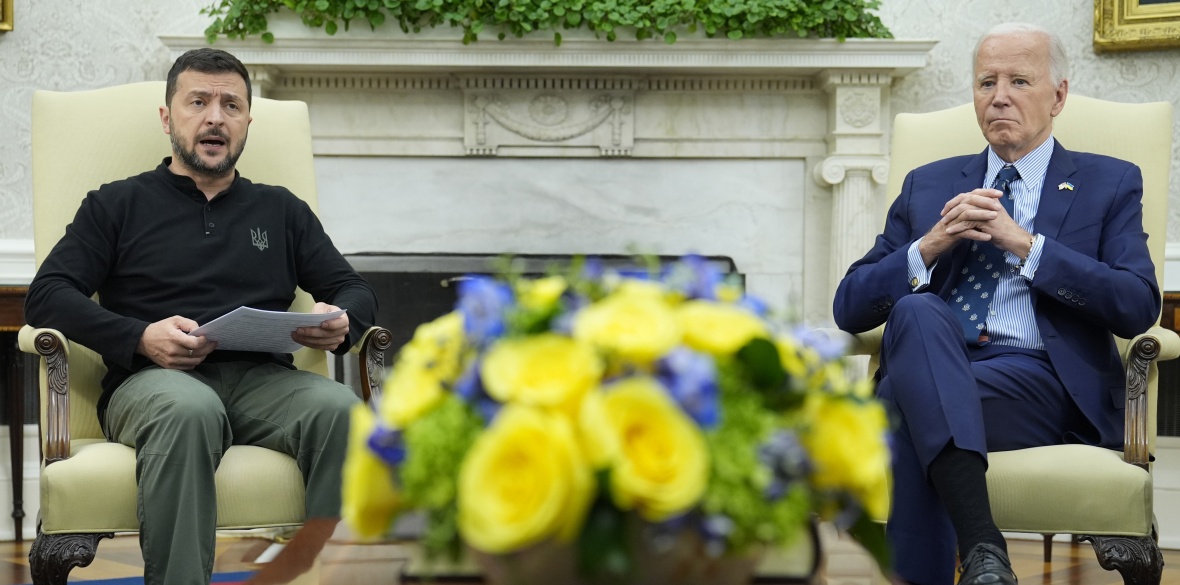
President Joe Biden (right) listens as Ukraine’s President Volodymyr Zelenskyy (left) speaks during their meeting in the Oval Office of the White House in Washington, September 26, 2024
IT SCARCELY gets more dangerous than this. The semi-senile President of the United States has determined to use his remaining months in office to dramatically ratchet up the war in Ukraine.
Joe Biden’s decision to allow Ukraine to fire US-supplied missiles deep into Russia, permission it has hitherto withheld, is a major step towards extending the conflict into an actual face-off between the world’s two major nuclear-armed powers.
Since the missiles concerned cannot easily be operated without full US logistical, intelligence and targeting support, this takes the prolonged proxy war much closer to a direct clash.
Biden’s move looks likely to be echoed, as ever, by Keir Starmer, who has been prevented by Washington from allowing Ukraine to use British Storm Shadow missiles to hit targets inside Russia. Those restrictions may now be cast aside.
Starmer is talking of “doubling down” on the war at the precise moment when hopes for an end to a bloody and unnecessary conflict should be rising.
…
The people must press for peace in Ukraine as a matter of urgency, on the basis of stable security for all. That is already the demand of most of the world’s nations, and it must be imposed on Labour’s warlords.
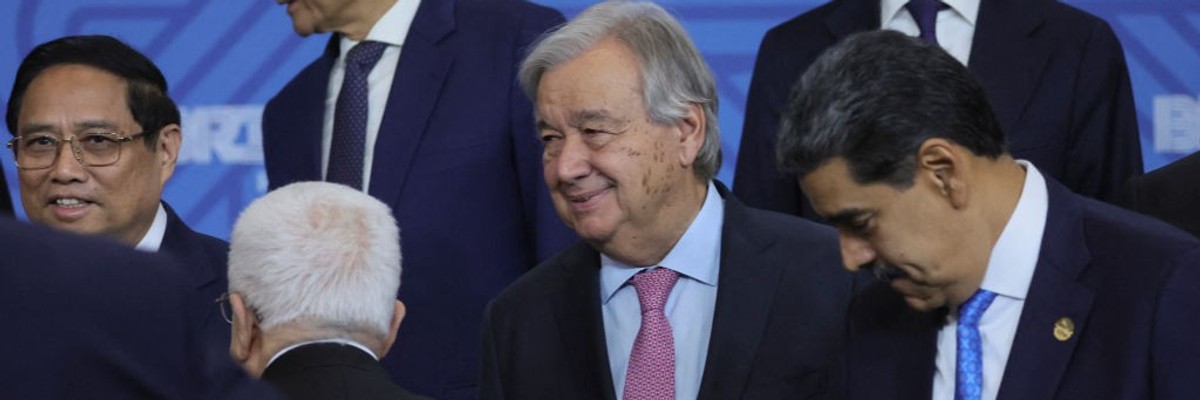
United Nations Secretary-General Antonio Guterres, center, stands with other dignitaries at the BRICS Plus conference in Kazan, Russia, on October 24. 2024. (Photo: Maxim Shipenkov/POOL/AFP via Getty Images)
“We need peace in Ukraine,” U.N. Secretary General Antonio Guterres said, speaking before Russian President Vladimir Putin.
United Nations Secretary-General Antonio Guterres, speaking in Russia on Thursday, called for peace in Ukraine and “across the board” as wars also rage in Gaza, Lebanon, and Sudan.
Guterres spoke before Russian President Vladimir Putin and other leaders from “BRICS Plus” countries gathering in Kazan, a city roughly 500 miles east of Moscow.
“Across the board, we need peace,” Guterres said.
“We need peace in Ukraine,” he added. “A just peace in line with the U.N. Charter, international law, and U.N. General Assembly resolutions.”
After the speech, Guterres renewed his call for a cease-fire in Lebanon and Gaza.
“We need a cease-fire in Lebanon—as we need a cease-fire in Gaza and the immediate release of all hostages,” he wrote on social media. “Escalation after escalation is leading to the unimaginable for the people of the region.”
We need a ceasefire in Lebanon – as we need a ceasefire in Gaza and the immediate release of all hostages.
Escalation after escalation is leading to the unimaginable for the people of the region. pic.twitter.com/YhwLkSbXzV
Putin presided over the closing ceremonies of the BRICS conference on Thursday, saying the group provided a counterbalance to the “perverse methods” of the West. Brazil, Russia, India, and China formed the group in the 2000s, with South Africa joining in 2010; BRICS recently expanded to include a number of other developing countries.
The conference drew the largest gathering of international diplomats into Russia since Putin’s forces invaded Ukraine in February 2022, escalating a conflict that had begun in 2014.
Ukraine’s foreign ministry criticized Guterres for attending the conference and noted that he did not attend Ukraine’s global peace summit in Switzerland in June.
“This is a wrong choice that does not advance the cause of peace,” according to the ministry’s social media account. “It only damages the U.N.’s reputation.”
Guterres has repeatedly called for a cease-fire in Gaza in the last year. The Israeli government declared him persona non grata earlier this month, barring him from entering the country on the grounds that he had not strongly condemned an Iranian barrage of missiles into Israel—an accusation Guterres denied, saying he did forcefully condemn the Iranian attack.
For U.N. Day, celebrated annually on October 24, Guterres issued a video statement calling for the world’s nations to keep the “beacon of hope” that is the U.N. “shining.”
The U.N. has had only limited success in stopping or slowing the wars in Ukraine, Gaza, Lebanon, and Sudan, which are among many dozens of conflicts across the world and have brought mass death and destruction.
The total number of Ukrainians and Russians who’ve died since February 2022 has reached roughly one million, The Wall Street Journalreported last month.
In Gaza, more than 42,000 people have been killed by Israeli forces in roughly the last year, following the Hamas-led October 7 attack that killed about 1,200 Israelis. More than 2,500 people have been killed by Israeli forces in Lebanon over the same period, including 1,900 in the escalation that’s occurred in the last five weeks, according to Lebanon’s health ministry. Dozens of Israelis have also died in that conflict.
A U.N. official said last month that the death toll in Sudan, which has been ravaged by civil war since April 2023, is at least 20,000 and could be much higher. The country is facing the prospect of a large-scale famine, with Save the Children on Tuesday raising the alarm that conditions there are worsening.
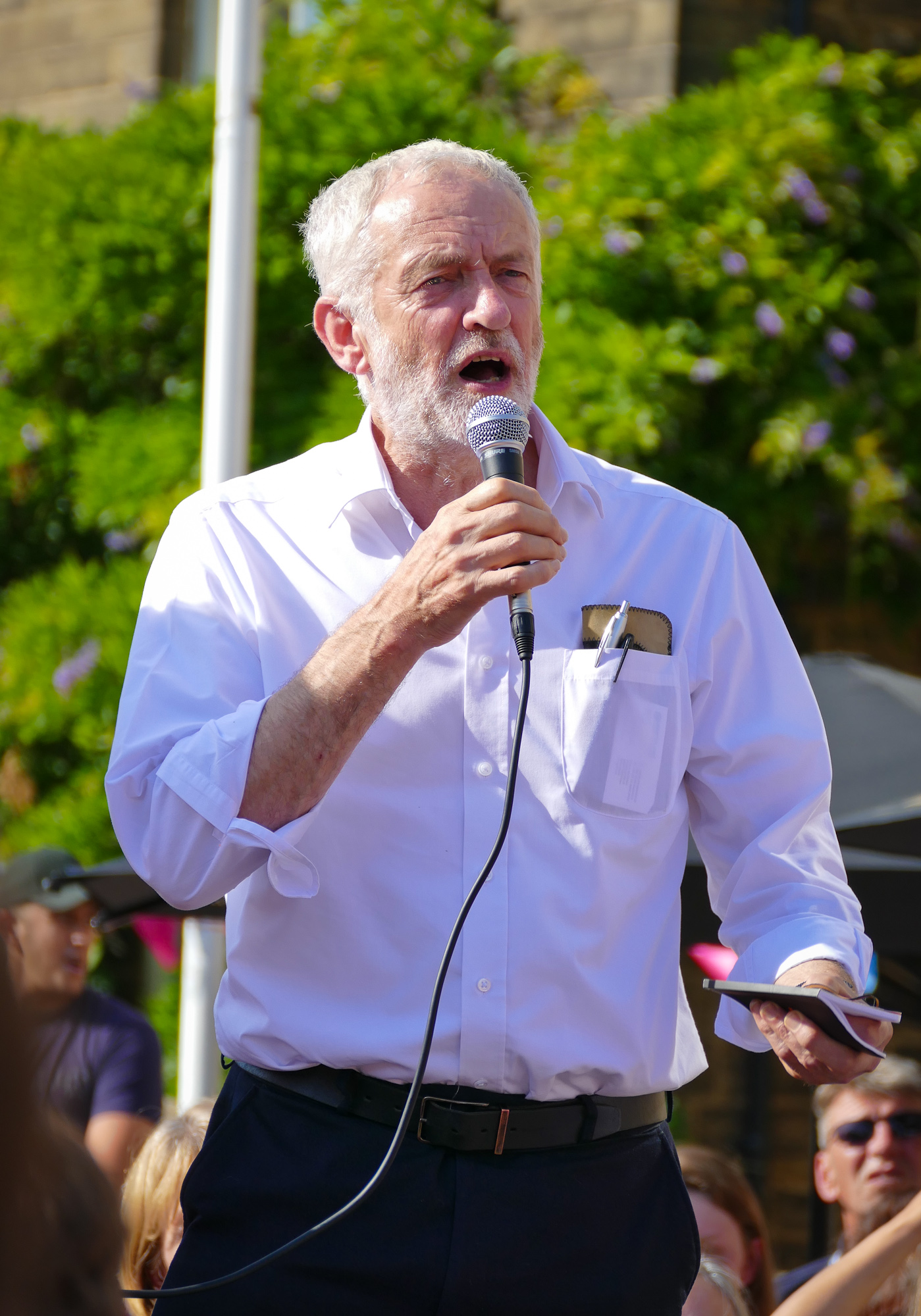
PEACE: Former Labour Party leader and now independent MP Jeremy Corbyn speaks at a London rally for Palestine, September 11 2024
Speaking at the Podemos congress over the weekend, JEREMY CORBYN MP outlines three crucial areas for building a powerful leftist movement across Europe: opposing austerity, promoting peace and combating the far right
AS we look to build a united left across Europe, there are three key issues that can form the basis of a strong, powerful movement: anti-austerity, peace and opposition to the far right.
Europe is heading toward a renewed era of austerity. We have witnessed attacks on wages and conditions all over Europe. Working-class living standards have fallen. Wages have stagnated. Meanwhile, there are more billionaires than ever before.
Inequality is not inevitable. It is the result of decisions that governments take to take money from the many and give it to the few. Last week, the British government celebrated its 100-day anniversary.
In that time, it has made two supposedly “tough” choices. One is to keep children in poverty by retaining the two-child benefits cap, refusing to lift 250,000 children out of poverty. The second decision was to cut the winter fuel allowance for 10 million pensioners.
We are told that these have been “tough choices.” Every day, my constituents make tough choices. Tough choices like deciding whether to heat their homes or put food on the table. Tough choices like taking out a loan to pay for this month’s rent. Tough choices like selling their home to pay for their family’s social care.
The government knows that there is a range of choices available to them. They could introduce wealth taxes to raise upwards of £10 billion. They could stop wasting public money on private contracts. They could launch a fundamental redistribution of power by bringing water and energy into full public ownership.
Instead, they have opted to take resources away from people who were promised things would change. There is plenty of money, it’s just in the wrong hands — and we will not be fooled by ministers’ attempts to feign regret over cruel decisions they know they don’t have to take.
Austerity is not a tough choice. It is the wrong choice. The British government tells us there is no money. At the very same time, they are committing to raising defence expenditure to 2.5 per cent of GDP.
Jeremy Corbyn MP, former leader of the Labour Party
Group calls for more MPs to join and vows to campaign on issues such as austerity and two-child benefit cap
Jeremy Corbyn is to form an official parliamentary alliance with four independent MPs who were elected on pro-Gaza platforms – issuing a call for more MPs to join.
The group will have the same number of MPs as Reform UK and the Democratic Unionist party, who each have five MPs, and more than the Green party and Plaid Cymru on four.
Promising to fight austerity and campaign on issues including the winter fuel allowance, the two-child benefit limit and arms sales to Israel, the group also explicitly invited MPs to join them, a reference to seven rebel Labour MPs suspended by the party for voting to axe the two-child benefit cap.
Corbyn, a former Labour leader, was elected as an independent MP for Islington North after being barred from standing as a Labour candidate at the last election. The group will also include the MPs Shockat Adam, Ayoub Khan, Adnan Hussain and Iqbal Mohamed.
The MPs said: “We were elected by our constituents to provide hope in a parliament of despair. Already, this government has scrapped the winter fuel allowance for around 10 million pensioners, voted to keep the two-child benefits cap, and ignored calls to end arms sales to Israel.
“Millions of people are crying out for a real alternative to austerity, inequality and war – and their voices deserve to be heard. As individuals we were voted by our constituents to represent their concerns in parliament on these matters, and more, and we believe that as a collective group we can carry on doing this with greater effect.
“The more MPs who are prepared to stand up for these principles, the better. Our door is always open to other MPs who believe in a more equal and peaceful world.”
Jeremy Corbyn MP, former leader of the Labour Party
JEREMY CORBYN and four other pro-Palestine independent MPs could form a new parliamentary group.
The former Labour leader, Shockat Adam, Ayoub Khan, Adnan Hussain and Iqbal Mohamed have been exploring options on how they can affect policy more effectively.
Mr Adam, who unseated Labour’s Jonathan Ashworth to become MP for Leicester South, told the BBC that the group was “looking at options that would give us more access to the levers of power.”
The potential grouping of five independents would equal the number of Reform UK MPs and outnumber the Greens.
Last month they vowed to work with seven Labour MPs who had their party whip suspended for voting to scrap the two-child benefit cap to offer a “real alternative.”
…
It is thought there has so far been no formal co-ordination between independent MPs and suspended Labour MPs.
Becoming an official group in Parliament would increase the independents’ chances of taking part in debates and committees, which are usually decided proportional to party size.