Why are people still flying to climate conferences by private jet?
Spread the love
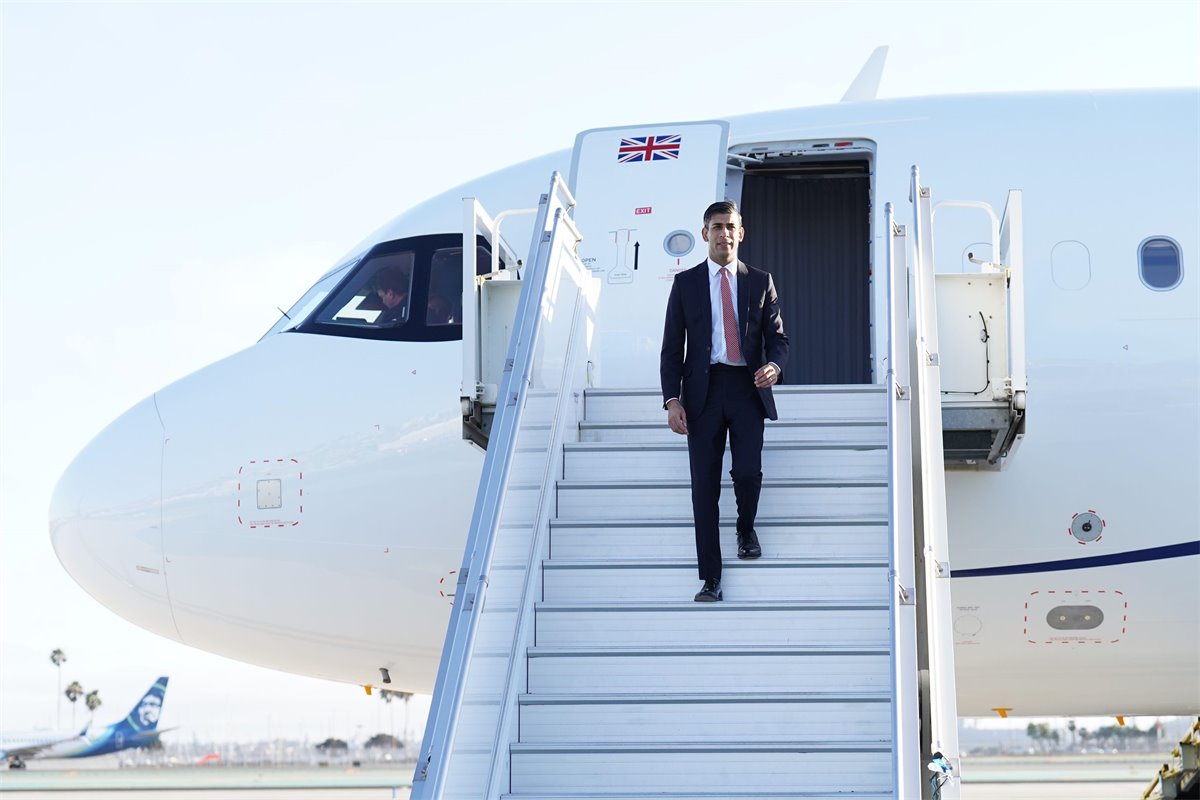
One of the many occasions climate change denier and UK Prime Minister Rishi Sunak uses a private jet.
Climate change denier and UK Prime Minister Rishi Sunak flew to COP28 at Dubai by private jet.

Carole Roberts, UCL; Mark Maslin, UCL, and Prof Priti Parikh, UCL

Rishi Sunak, David Cameron and King Charles are just three of the more than 70,000 delegates from nearly 200 countries at the latest UN climate summit in Dubai, COP28. But they are among hundreds who will have travelled there by private jet. In fact, the UK prime minister, foreign secretary and king even travelled in three separate planes.

At COP27 in Egypt last year, around 315 private jet journeys took place. This is an extraordinary statistic, especially as fewer world leaders attended that COP, as many were busy at a G20 summit in Bali.

That’s why we set up a team of academic experts to estimate the carbon footprint of travel to this year’s meeting, COP28 in Dubai, for different modes of transport including private jets. We ultimately want to empower attendees to make informed climate-conscious travel choices.

We also compared the carbon footprints for the past three COPs to help see where the conferences could be located in order to dissuade attendees from using private jets, unless absolutely essential for security. The use of private jets last year – and presumably this year too, though we don’t yet have full data – suggests this is becoming the new norm and has moved beyond just essential world leaders.

Carbon footprint of transport modes

Flying is already one of the most carbon-intensive forms of travel both due to emissions from burning jet fuel and because vapour trails help create high altitude clouds which trap more heat in the atmosphere. It’s also particularly hard to decarbonise – there aren’t electric planes we could simply use instead.
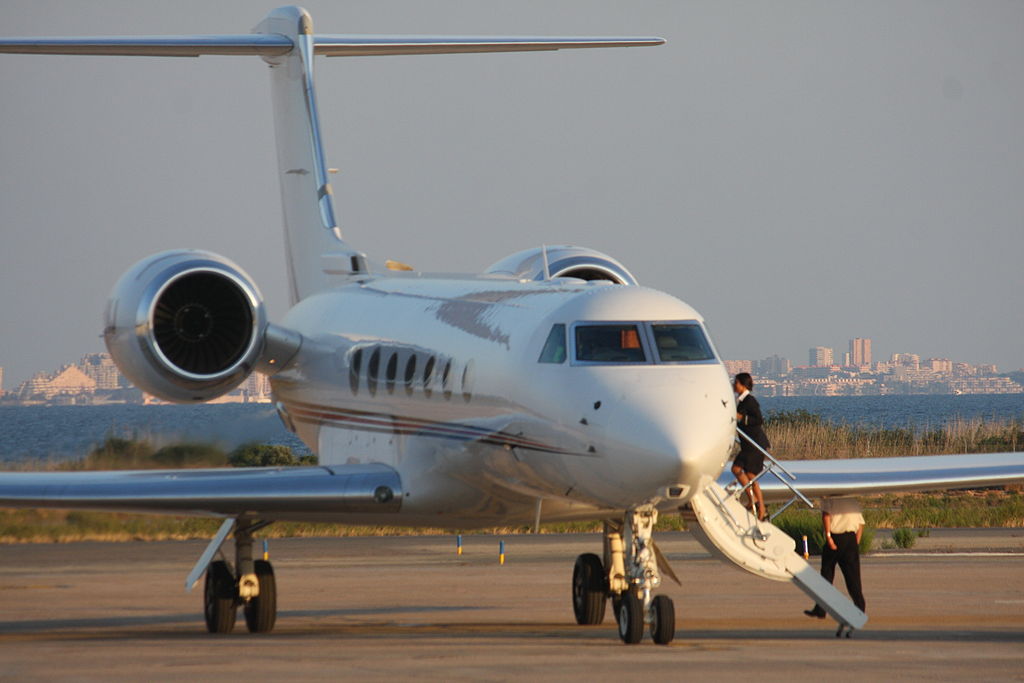
Image of a private jet by Andrew Thomas from Shrewsbury, UK.
Licensed under the Creative Commons Attribution-Share Alike 2.0 Generic license.
For emissions, private jets are the worst of the worst. Andrew Thomas via wikimedia, Creative Commons Attribution-Share Alike 2.0 Generic license

Private jet travel is the most polluting mode of all, consuming lots of fuel yet carrying few passengers. French economist Thomas Piketty argues they are an example of class inequality and must be tackled if we are to deal with climate change.

Their use by high-profile people clearly undermines the goal of a climate conference and symbolises a disconnect between environmental concerns and individual actions and a lack of commitment to sustainable practices. This in turn risks shaping and influencing public opinion. Previous research suggests members of the public take climate action less seriously if they feel that their leaders are not doing their bit.

We started by looking at the use of private jets for COP27 in Egypt (our results are available as a preprint ahead of formal peer-review). Most private flights were short-haul, often just an hour between the capital Cairo and the conference venue in Sharm El-Sheikh. Over shorter distances, planes are even less efficient as take off and landing burns more fuel compared to cruising.

So avoiding short flights and private jets is a must. With this in mind, we explored a range of travel options to get to COP28 in Dubai for participants from the UK, where we’re based.

For a journey from London to Dubai, private jet travel is 11 times more polluting than a commercial aircraft, 35 times more than train and 52 times more than coach travel (even after factoring in a flight from Istanbul, since you can’t go all the way to Dubai by train or coach). For those flying from the UK, the longer flight to Dubai compared to Egypt means emissions will be higher this year.

Carbon intensity (grams of CO₂equivalent) of transport from London to COP28:
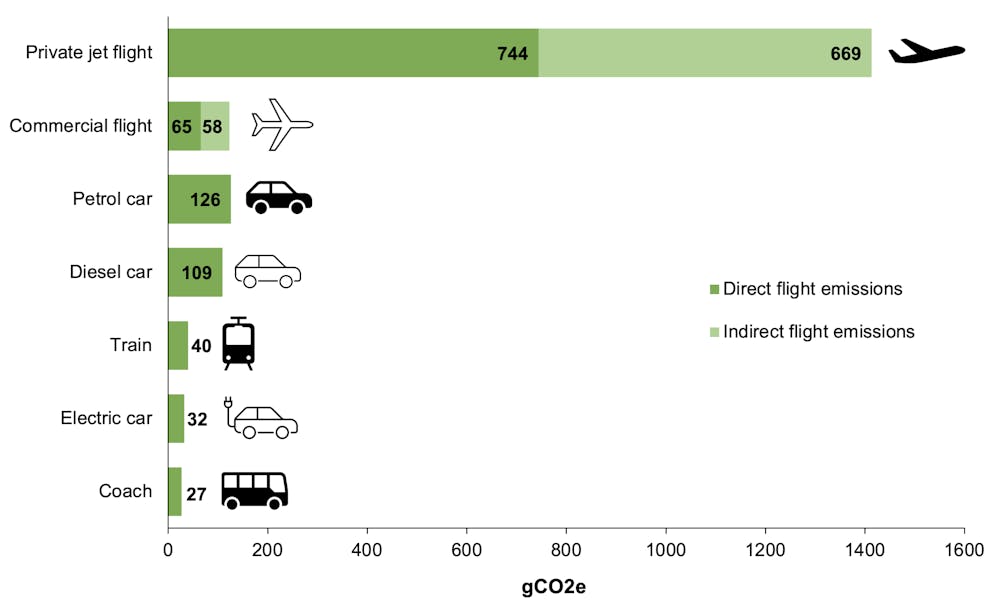
Bar chart
Flight emissions are based on journeys from London to Dubai. Car, train and coach emissions are based on journeys from London to Istanbul and then a flight. Private jet emissions are based on a Cessna 680 Citation Sovereign (most common in COP27 data), commercial flight emissions are based on an Airbus A380-300 and car journeys are calculated for a Vauxhall Corsa.
Roberts et al (2023), CC BY-SA

Location of COP

Some of the blame for flight emissions must lie with the UN body which decides where COP meetings will be held, the UNFCCC. Dubai is surrounded by conflict zones, which block land routes from Europe, Asia and Africa and makes flying there essential.

While most delegates will want to travel sustainability, their actions will depend on the accessibility of alternative forms of travel such as safe land routes and for those coming from further away at least the option of direct flights to minimise their carbon emissions.

In this respect Dubai is a good choice as it is a major airline hub and so there are many direct flights and less need for second or internal flights.

Our analysis highlights the need to consider very carefully the carbon footprint implications of travel to COP meetings. Ultimately policymakers will need to identify host locations for climate change meetings which can help to minimise the carbon footprint of the participants.

Private jets are still not advisable, however. Their carbon footprint is substantially higher than other forms of transport, they exacerbates existing inequities at climate negotiations and send the wrong message to the world.The Conversation

Carole Roberts, Researcher, Carbon Footprint of Transport, UCL; Mark Maslin, Professor of Natural Sciences, UCL, and Prof Priti Parikh, Professor of Infrastructure Engineering and International Development, UCL

This article is republished from The Conversation under a Creative Commons license. Read the original article.

How world leaders’ high-carbon travel choices could delay climate action

Space tourism: rockets emit 100 times more CO₂ per passenger than flights – imagine a whole industry
Continue ReadingWhy are people still flying to climate conferences by private jet?

UK to loosen post-Brexit chemical regulations further

Spread the love

https://www.theguardian.com/environment/2023/nov/14/uk-to-loosen-post-brexit-chemical-regulations-further

Experts warn UK’s regulations now lag behind those of the EU and that Britons will be exposed to more toxic chemicals as a result

The government is to loosen EU-derived laws on chemicals in a move experts say will increase the likelihood of toxic substances entering the environment.

Under new plans the government will reduce the “hazard” information that chemical companies must provide to register substances in the UK. The safety information provided about chemicals will be reduced to an “irreducible minimum”, which campaigners say will leave the UK “lagging far behind the EU”.

The UK’s scheme, called UK Reach, is falling behind the EU’s as it is. The UK has not been part of the bloc’s chemicals regulations scheme, EU Reach, since 2021. Eight rules restricting the use of hazardous chemicals have been adopted by the EU since Brexit, and 16 more are in the pipeline. The UK has not banned any substances in that time and is considering just two restrictions, on lead ammunition and harmful substances in tattoo ink.

Campaigners have called for the government to follow EU chemicals regulations as standard, diverging only if and when there is a good reason to do so. This would free up time and money for regulators and mean dangerous chemicals banned by the EU do not enter the environment before there is time to ban them.

https://www.theguardian.com/environment/2023/nov/14/uk-to-loosen-post-brexit-chemical-regulations-further

Continue ReadingUK to loosen post-Brexit chemical regulations further

Post-Brexit UK water quality standards set to be much lower than EU standards

Spread the love

‘The UK’s decision to diverge from EU water quality standards is yet another blow in a string of post-Brexit setbacks.’

Image of a burst water main.


https://leftfootforward.org/2023/11/post-brexit-uk-water-quality-standards-set-to-be-much-lower-than-eu-standards/

The UK government is to diverge from the EU’s standards for monitoring the quality of water in England.

An exclusive report by the Guardian this week revealed that instead of being covered by the EU’s water framework directive (WFD), as it was when the UK was in the European Union, the government will use its own, as yet undisclosed, methodology to assess the quality of England’s waterways. Under the WFD, a national chemical and ecology survey was carried out every year. But from 2016, the government made the decision that water quality under WFD would only be tested every three years, instead of annually.

The last time a full water assessment of England’s rivers took place was in 2019, when just 14 percent were found to be in good ecological health. None however, met good chemical health standards. 

According to the report, government officials told stakeholders about the change at a meeting. A source from an NGO who had attended the meeting said: “When asked how this would affect assessments against the target set out in the government’s environment improvement plan, officials commented that this data would no longer be used for that purpose, and that Defra were looking to use the Natural Capital and Ecosystem Assessment (NCEA) process to assessment performance. I question how developed the work on the NCEA is and whether this is suitable.”

Campaigners have warned that diverging from EU environmental standards will lead to England’s rivers and waterways becoming even more polluted if the new measuring methods are less rigorous. They also warn that it may make it more difficult for the state of England’s rivers to be compared with those in the EU, meaning the public will be left in the dark about water pollution and sewage.

https://leftfootforward.org/2023/11/post-brexit-uk-water-quality-standards-set-to-be-much-lower-than-eu-standards/

Continue ReadingPost-Brexit UK water quality standards set to be much lower than EU standards

Water firms illegally spilled sewage on dry days – data suggests

Spread the love
Image of a burst water main.

https://www.bbc.co.uk/news/science-environment-66670132

Three major water companies illegally discharged sewage hundreds of times last year on days when it was not raining, a BBC investigation suggests.

The practice, known as “dry spilling”, is banned because it can lead to higher concentrations of sewage in waterways.

Thames, Wessex and Southern Water appear to have collectively released sewage in dry spills for 3,500 hours in 2022 – in breach of their permits.

Water UK, the industry body, said the spills “should be investigated”.

Collectively throughout 2022, Thames, Southern and Wessex illegally started releasing sewage on dry days 388 times – research by the BBC’s climate and data teams suggests – including during last summer when these regions were in drought.

There even appears to have been spills by all three companies on 19 July 2022, the hottest day on record, when temperatures topped 40C in some places and many people tried to cool off in rivers.

https://www.bbc.co.uk/news/science-environment-66670132

Continue ReadingWater firms illegally spilled sewage on dry days – data suggests

RSPB chief apologises after charity calls ministers ‘liars’ over green policy

Spread the love
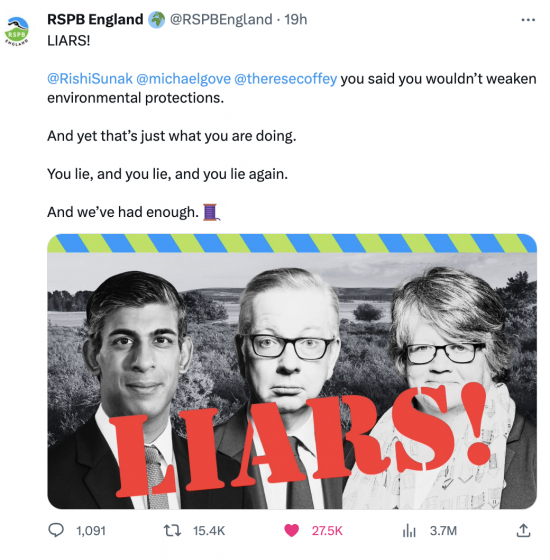
Screenshot of RSPB screenshot accusing ministers of lying over protecting water quality protections when they were reduced by UK government.
Screenshot of RSPB X (previously Twitter) posting accusing ministers of lying over protecting water quality protections when they were reduced by UK government.

https://www.theguardian.com/environment/2023/aug/31/rspb-chief-apologises-ministers-liars-green-policy-environment

Beccy Speight says frustration at ‘weaker protections’ prompted criticism of Sunak, Gove and Coffey

The head of the RSPB has apologised after the wildlife charity called Rishi Sunak and other ministers “liars” in a social media post.

“The reason that we issued our apology is that we do believe that the nature of public discourse does matter and that we have a role to play in that, and that we campaign on policy, not on people.

“So, the framing of that tweet, where we called out individual people, we felt was incorrect and inappropriate, and we apologise for that.”

*Royal Society for the Protection of Birds

https://www.theguardian.com/environment/2023/aug/31/rspb-chief-apologises-ministers-liars-green-policy-environment

Continue ReadingRSPB chief apologises after charity calls ministers ‘liars’ over green policy