Activists from Just Stop Oil hanging a banner above the M25
ENVIRONMENTAL groups Friends of the Earth (FoE) and Greenpeace UK will intervene in appeals challenging sentences given to climate protesters who blocked the M25.
Roger Hallam, Daniel Shaw, Louise Lancaster, Lucia Whittaker De Abreu and Cressida Gethin were jailed in July.
Mr Hallam, co-founder of Just Stop Oil, was sentenced to five years while the other four protesters received four-year sentences for disrupting traffic by climbing motorway gantries in November 2022.
The appeal will be heard on January 29-30, 2025, alongside cases involving 16 other Just Stop Oil activists.
FoE argues the sentences breach human rights laws and is calling for “proportionate” penalties for protesters.
The group’s senior lawyer, Katie de Kauwe, said the sentences “show the chilling effect of the previous government’s anti-protest laws in stifling our democracy and allowing the government of the day to curb dissent.”
She said: “In what functioning democracy can it be right for those peacefully raising the alarm about the climate crisis to receive longer jail sentences than people who participated in racially motivated violence this summer, and deliberately targeted migrants, refugees and Muslim communities?
“Peaceful protesters shouldn’t be locked up, period.”
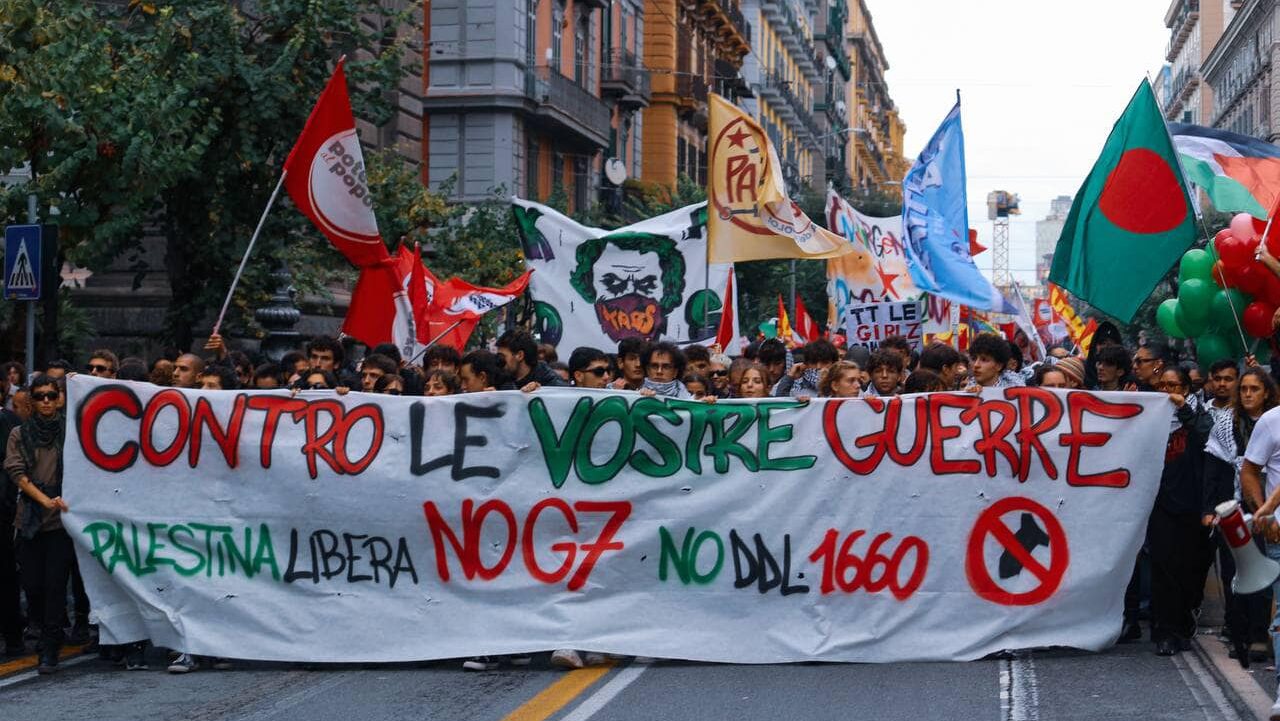
Over 2,000 people took to the streets of Naples against soaring military spending in Europe and increased repression of dissent as G7 defense ministers convened for high-level talks
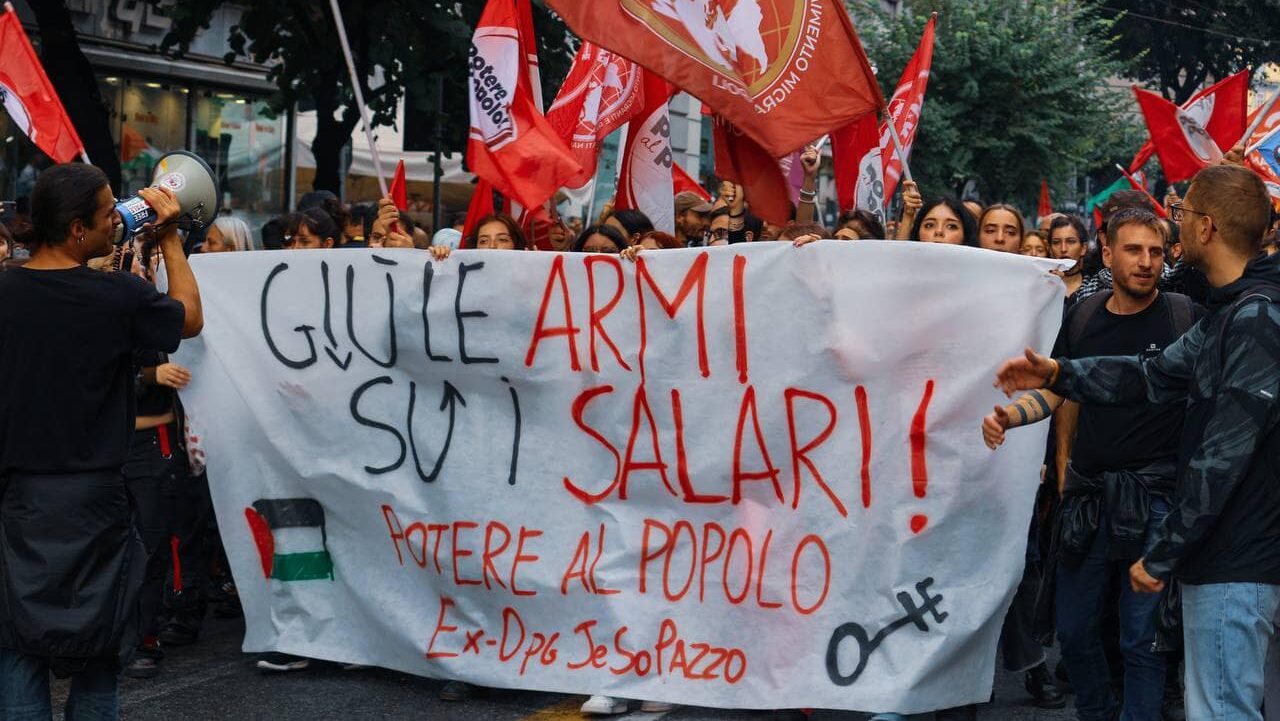
Thousands of people took to the streets of Naples on October 19, demonstrating against the G7 military agenda and Italy’s proposed reforms that would limit the freedom to dissent. Protesters, representing a host of organizations including student associations, trade unions, and community centers, rallied against Prime Minister Giorgia Meloni’s government’s policies, demanding a shift in priorities toward social needs instead of military spending. Side by side with the protest in Naples, demonstrations were held in dozens of cities across Italy, as reported by the left political party, Power to the People (Potere al Popolo).
Protesters carrying a banner reading “Cut the weapons, raise the wages!”. Source: Ex OPG occupato – Je so’ pazzo/Facebook
The protest was organized to counter a G7 defense ministers’ meeting that took place in Naples from October 18 to 20, with a focus on global military goals. The meeting was seen by protesters as yet another example of Western countries deepening their involvement in wars, including the ongoing genocide in Gaza and the war in Ukraine, instead of pursuing agendas of social justice and peace. In the lead-up to the meeting, local activists voiced their opposition, stating that “lords of war” were not welcome in their city.
“Never has so much been spent on war, and as a result, war is rampant everywhere,” the associations organizing the march asserted during the preparations. “We refuse to host a meeting in our city that supports the war economy our government has chosen to follow.”
Two central issues dominated the protest in Naples: the West’s support for Israel as it continues to exterminate the people of Gaza and the increasing repression of dissent at home, embodied in Meloni’s proposed security bill. Many protesters pointed out the link between military aggression abroad and domestic policies that seek to criminalize dissent. European countries continue to actively repress solidarity with Palestine and others, like Italy, are doing so while attempting to silence voices against their policies.
The new security bill seeks to impose severe restrictions on protests, including strikes and environmental activism. Progressive associations argue that this is a blatant attempt to stifle opposition and consolidate power, and some of them saw Saturday’s protest as a test run for the government’s strategy of suppressing future mobilizations. Days before the protest, authorities tried to restrict the march route, forcing organizers to end the demonstration a kilometer away from the G7 meeting site.
Despite these attempts, protesters refused to be stopped. They briefly broke through the set course of the rally, marching in areas originally declared off-limits by the authorities. In response, police deployed tear gas and used other forms of violence against them. Naples’ historic center has systematically been blocked off to popular protests, and things are set to get worse if the new bill is passed, protesters said. Because of that, community groups including Ex OPG – Je so’ pazzo called upon people to continue resisting.
“We believe this repressive project must be stopped, and more importantly, we see it as a reflection of the Meloni government’s fear of what might still be burning beneath the surface of the seeming calm in the country,” they said.
Saturday’s protest marked an important moment of resistance against the shrinking of democratic space in Italy, as well as to the strengthening of the armament agenda in Europe. Demonstrators announced they were ready to continue fighting against the security bill and expressed determination to challenge Meloni’s government over announced cuts to social support.
“Today, this square is sending a loud message: if the government thinks it can ignore social needs, public healthcare, workers’ rights, and housing in favor of pouring billions into military spending, it’s headed in the wrong direction,” said Chiara Capretti from Power to the People.
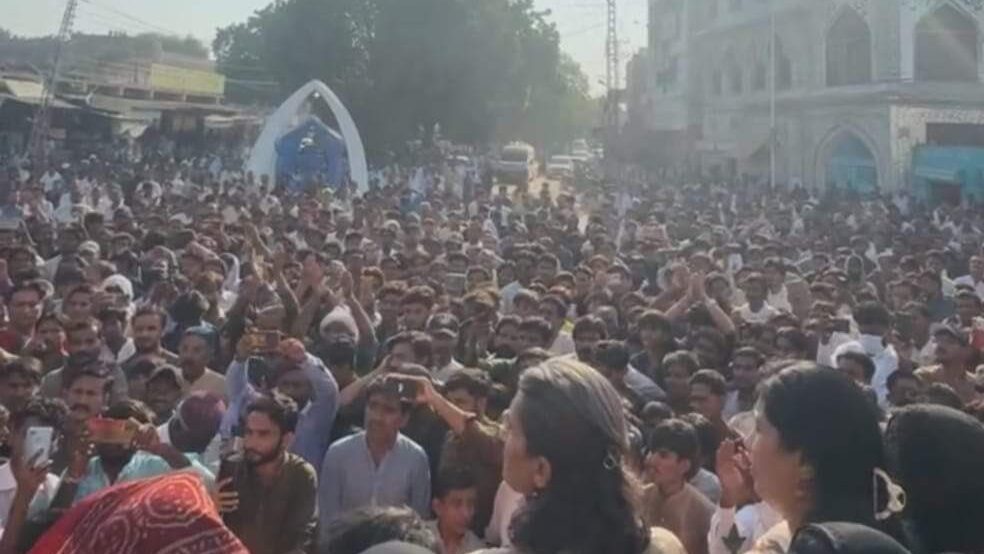
Protesters during a rally against extrajudicial killings on September 25, Sindh. Source: Atif Tauqeer/X
Progressive and left movements in Pakistan are voicing alarm over the increasing collaboration between the state and extremist forces, which they say is undermining citizens’ rights to life and religious freedom
Hundreds of people gathered in Umerkot on Wednesday, September 25, to protest the rising instances of extrajudicial killings in Pakistan’s Sindh province. Protesters voiced concern over the growing collaboration between the state and religious extremist forces and demanded justice for the victims.
The protest was organized by a Joint Action Committee made up of civil society groups and left organizations in Sindh, following the extrajudicial killing of Dr. Shahnawaz Kunbhar, a medical doctor, by the provincial police in what was allegedly a staged encounter last week.
Dr. Kunbhar’s daughter also attended the protest, where demonstrators accused the Pakistan People’s Party (PPP)-led provincial government of protecting extremist forces and the policemen involved. Protesters questioned the PPP leadership’s secular credentials, according to Dawn.
On September 18, the physician had been arrested under Pakistan’s controversial blasphemy law which prohibits insulting Islam or Islamic figures and can result in the death penalty. His home was raided by Sindh police and just a few hours later he was killed, with the police reporting it as in the context of a shoot out. When the police attempted to return his body to the family for cremation, a mob reportedly snatched the body and later burned it, motivated by the blasphemy accusations.
In response, protesters have demanded an immediate ban on extremist religious preachers and the arrest of individuals who incited the violence through social media posts. They also called for immediate action against the police officers responsible for Dr. Kunbhar’s killing.
Commending the protesters in Umerkot, Haqooq-e-Khalq party leader Ammar Ali Jan said in a post on X that while the state surrenders to extremists, people are showing “unparalleled bravery to defend humanity.”
Lynchings on the rise
Pakistan has seen a rise in mob lynchings related to blasphemy accusations. On September 12, a policeman shot dead a person accused of blasphemy while in custody in Quetta, Balochistan province. Afterwards, state officials reportedly pressured the family of the victim to “pardon” the accused policeman.
According to reports in Pakistani media, at least four people have been killed in mob violence related to blasphemy since May, including members of minority communities. In all cases, the role of police and local authorities has come under scrutiny.
Dr. Kunbhar’s extrajudicial killing has drawn strong condemnation from the Human Rights Commission of Pakistan (HRCP). In a statement on X, the HRCP called this pattern of violence “an alarming trend,” especially given the alleged involvement of law enforcement.
The HRCP called upon the state to react to the rise in religious extremism, claiming that it has “historically sponsored” such hate. The commission urged Pakistani authorities to act swiftly to “counter the rising radicalization that triggers such incidents.”
Several civil society movements and human rights groups echoed these concerns, demanding immediate action to curb religious extremism in Pakistan and protect citizens’ rights to life and religious freedom. Amnesty International stated: “The horrific spate of extrajudicial killings of people accused of blasphemy highlights the government’s ongoing failure to uphold their obligation to respect and protect human rights, including the right to life, freedom of religion or belief, and prohibition of discrimination.”
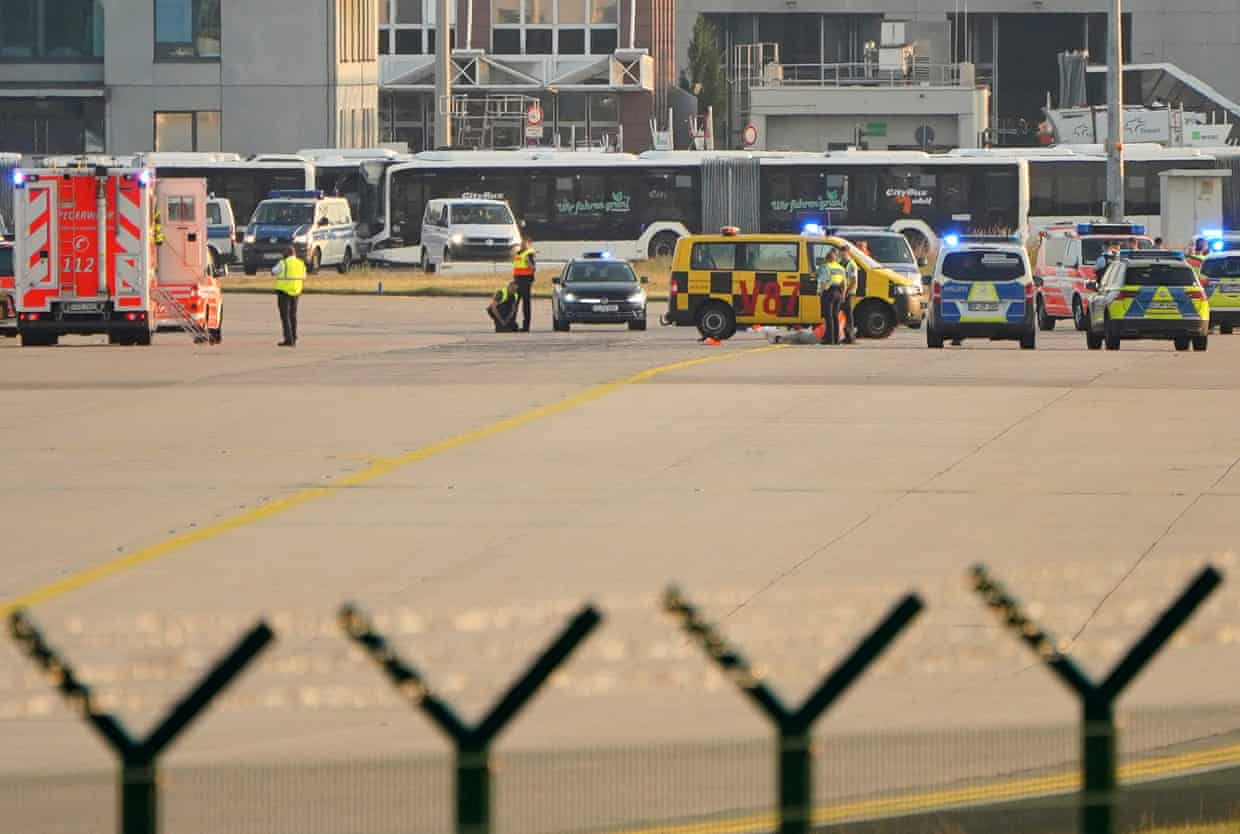
Police, security and medical staff parked their vehicles after Letzte Generation (Last Generation) activists staged a demonstration at Frankfurt airport. Photograph: Timm Reichert/Reuters
Flights at Germany’s busiest airport ‘gradually resuming’ on second day of coordinated ‘oil kills’ protests
Climate activists have disrupted flights at Frankfurt and Oslo airports on the second day of coordinated “oil kills” protests across Europe and North America.
Demanding an end to fossil fuels by 2030, supporters of Letzte Generation (Last Generation) briefly suspended flights at Frankfurt airport on Thursday morning. The activists said they had cut a wire fence, entered on bicycles and skateboards and glued themselves to the tarmac.
In Oslo, protesters from Folk Mot Fossilmakta and Scientist Rebellion Norway caused large queues by blocking a check-in lane with a banner that read: “Fast track to phase out.”
“I would rather not be here today, but I can no longer stand and watch as our elected officials do too little, too slowly,” said Ina Nagler, a climate researcher who took part in the Oslo protest. “The science is clear: We must drastically reduce the use of fossil fuels during this decade.”
The protests, which seek to pressure governments to speed the shift to a clean economy, have hit airports during the start of the busy summer season. On Wednesday morning, activists disrupted travel plans at airports from Helsinki to Barcelona. Further airport protests are expected in the US and Canada on Thursday.
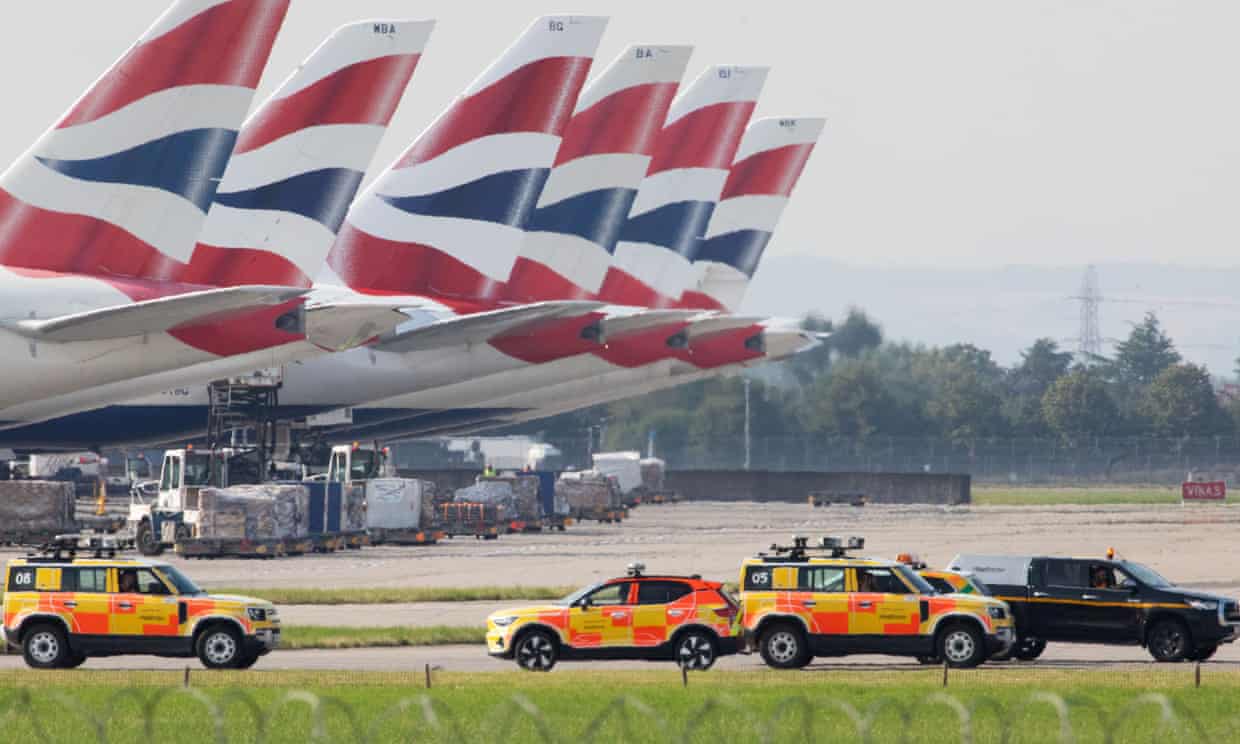
Police and Heathrow airport security were on high alert after Just Stop Oil protesters were arrested at the airport’s perimeter fence. Photograph: Kristian Buus/In Pictures/Getty Images
Ten activists arrested at Heathrow, over 30 flights cancelled at Cologne-Bonn, and planes delayed or diverted
Climate activists acting under the banner “oil kills” have glued themselves to the tarmac and grounded flights across Europe as holidaymakers attempt to make summer getaways.
In a wave of protests at airports from Oslo to Barcelona, activists disrupted flights and demanded that rich and polluting countries phase out fossil fuels by 2030. The protests, which the activists said had led to several arrests, came a day after climate scientists logged the world’s hottest day on record.
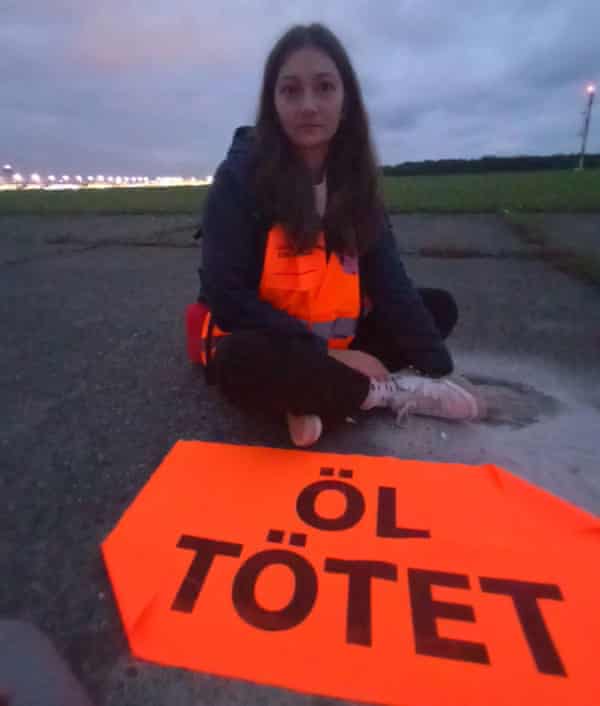
An activist taking part in the protest at Cologne-Bonn airport holds her hand glued to the runway. Photograph: Letzte Generation Handout/EPA
“Ordinary people are taking matters into their own hands today to do what our criminal governments have failed to do,” the campaign said in a statement. “We are putting our bodies on the wheels of the machine of the global fossil economy and saying ‘oil kills’.”
In Germany, protesters from the climate group Letzte Generation (Last Generation) briefly stopped flights on Wednesday morning after they cut a chain-linked fence and glued themselves to the tarmac at Cologne-Bonn airport. The airport said that 31 flights had been cancelled and six diverted.
In Austria, activists delayed a flight by refusing to sit down before takeoff while others spilled orange paint in the terminal at Vienna airport. In Switzerland, they blocked roads leading to Zürich and Geneva airports.