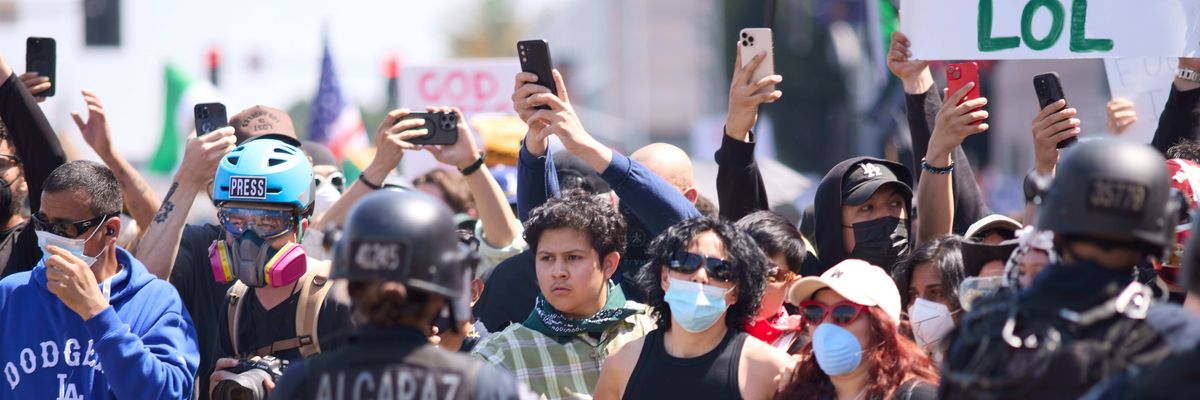
Police take security measures during demonstration as the Trump administration continues its immigration raids in Los Angeles, California, United States on June 8, 2025. Hundreds of protesters are seen demanding an immediate halt to U.S. Immigration and Customs Enforcement raids at workplaces in America’s second largest city. (Photo: Taurat Hossain/Anadolu via Getty Images)
“These protests are a matter of huge public interest and the public has a right to know exactly what’s going on,” said the executive director of RSF USA.
The press freedom group Reporters Without Borders, also known as RSF, on Monday condemned recorded attacks carried out largely by law enforcement, but also by protestors, against journalists reporting on protests that took place in Los Angeles this past weekend.
Protests began on Friday to oppose federal immigration raids on workplaces.
In a statement, RSF said that it has verified at least 27 recorded incidents of violence against journalists since June 6 with the help of its local partner, the Los Angeles Press Club. Twenty four of those incidents were carried out by law enforcement, and three were carried out by individual protestors, according to the statement.
“The wave of violence against journalists on the streets of Los Angeles this weekend is unacceptable. These protests are a matter of huge public interest and the public has a right to know exactly what’s going on. The only way that can happen is if journalists are allowed to do their jobs freely,” said Clayton Weimers, the executive director of RSF USA.
“This is inherently dangerous work, but it’s made more dangerous by authorities who are unable or unwilling to distinguish press from protestors, and by private actors who attack members of the media,” Weimers continued. “Authorities in LA must do more to ensure press freedom is respected during these protests.”
In one incident caught on camera, police hit reporter Lauren Tomasi, a U.S. correspondent for CNN-affiliate Nine News in Australia, with a rubber bullet while she was reporting live on on air.
Several media workers reported being hit with “less-than-lethal munitions,” such as pepper balls, rubber bullets, and tear gas canisters, by police, according to RSF.
According to the group, U.S. President Donald Trump’s decision to call in National Guard troops in response to protests “contributed to the violence against journalists already being perpetrated by law enforcement.” On Saturday, Trump ordered that 2,000 National Guard members be called up to help quell the anti-U.S. Immigration and Customs Enforcement protests, over the objections of Democratic California Gov. Gavin Newsom. As of Sunday, some 300 federal troops were on the ground in Los Angeles, according to The Associated Press.
Alleged incidents of violence carried out by protestors against media workers include an episode, caught on video, of a KTTV Fox 11 TV crew being heckled and forced to leave a protest.
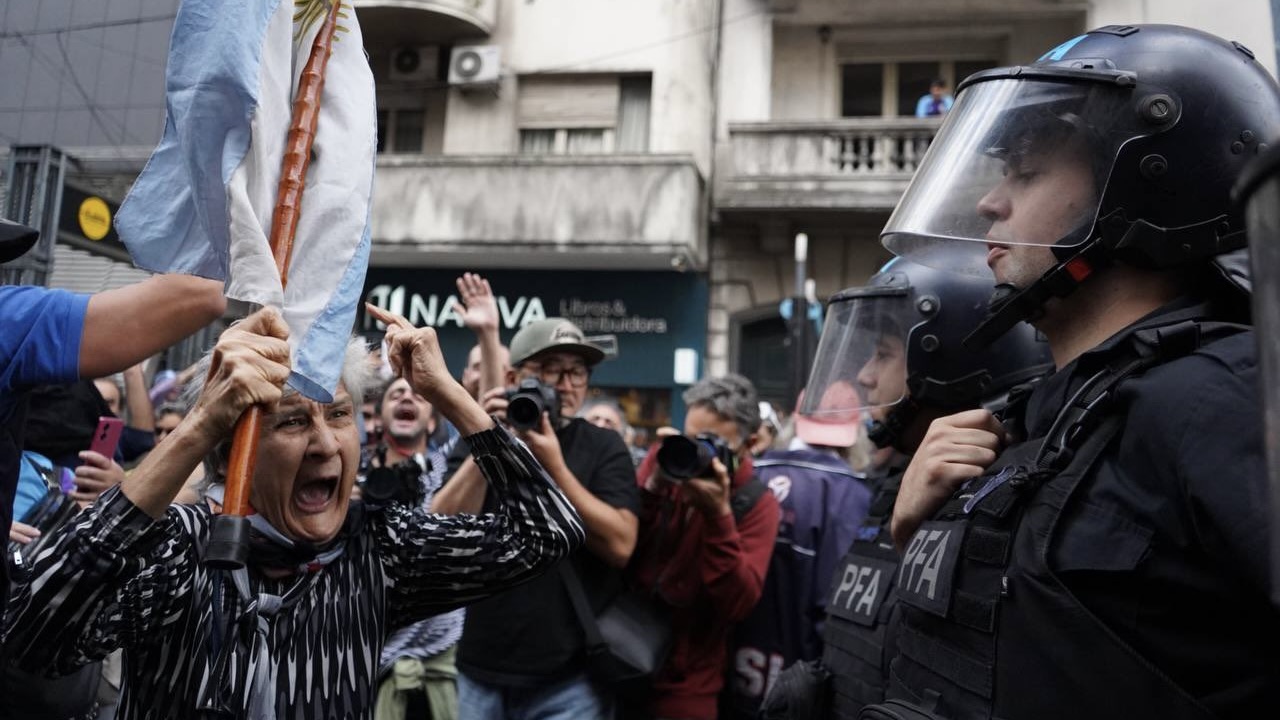
Interaction between a pensioner and a cop in Buenos Aires on March 12. Photo: Argentina Humana / X
More than a hundred people were arrested and dozens were injured in the police repression. Movements and press organizations have called for the resignation of the Secretary of Security, Patricia Bullrich.
On March 12, Javier Milei’s right-wing government brutally repressed a demonstration of retirees and their supporters, including fan clubs of football teams, demanding better living conditions. The Buenos Aires Police reported that at least 124 people were arrested in the protests outside Congress. For its part, the Emergency Medical Attention System (SAME) reported that, at the end of the day of protests, 46 people were injured.
Early on March 13, a judge in Buenos Aires, Karina Andrade, ruled to free 114 of the detainees arguing that the constitutional rights to protest, to manifest in democracy, and free speech, had been put at risk. She added that elderly people are “one of the most vulnerable sectors of our country” and they are protected.
Retirees demand to live with dignity
For the past several months, retirees have been protesting every Wednesday to demand an improvement in their living conditions. Thanks to Milei’s neoliberal adjustments, their quality of life has drastically declined.
According to data from the Ombudsman’s Office for the Elderly, a pensioner needs at least 1,200,523 pesos (USD 1,066) per month to cover their basic expenses. However, the minimum pension in February was 343,086 pesos (USD 321), including a bonus of 70,000 pesos (USD 65). The glaring gap between the cost of living and the income of pensioners has been the key motivating factor driving adults of 70-90 years old to take to the streets every week and risk brutal repression from Milei’s right-wing government.
According to Florencia Abreju, an Argentine journalist, “The cuts to medicines, the reduction of medical assistance, and the excessive increase of basic services have aggravated the situation even more. Why always with the retirees? The answer is clear: Milei’s government destroys the rights of all, starting with the weakest.”
Repression was ordered by Milei’s government
This Wednesday was not the first time that the Minister of Security Patricia Bullrich had ordered repression, but the level of force used by the police was certainly more extreme. Tear gas, rubber bullets, water cannons, pepper spray, blows with batons, etc., were some of the means of repression used by the Argentine police to confront the demonstrators, who were mostly retirees.
Pensioner dousing his face with milk after being tear gassed. Photo: Argentina Humana / X
One of the victims is photographer Pablo Grillo, who suffered a serious head injury while taking pictures of the protest and the repression. As seen in a video, the police fired a tear gas bomb at him which directly impacted his head, causing a severe wound that kept him on the verge of death at the Ramos Mejía hospital in Buenos Aires.
The Executive justified the widespread repression of the protests by citing the participation of several fan organizations of various Argentine soccer clubs, such as Chacaritas, Boca Juniors, River Plate, and Rosario Central, among others. According to Bullrich, the members of the so-called “barras bravas” are dangerous groups and this justified the forceful response of the National Police, even though several of the injured and detained do not belong to such groups. On her X account, the Security Secretary wrote “Our forces are deployed to enforce the protocol: traffic is not cut and the barras bravas, on the sidewalk.”
However, for Florencia Abreju, this type of rhetoric seeks to discredit the legitimate claims of the protesters. “The most alarming thing is that the government, through Bullrich and her officials, justified the repression and stigmatized the protesters… This discourse seeks to criminalize social protest and delegitimize the demands of people who take to the streets to defend their rights. The stigmatization of militancy and fierce repression are tools typical of an authoritarian government that is willing to do anything to stay in power.”
Several journalists demand Bullrich’s resignation
In response to the repression ordered by the Secretary of Security and in solidarity with the injured journalist, several journalists have begun calling for Patricia Bullrich’s resignation. The Association of Graphic Reporters of Argentina expressed in a communiqué “Institutional violence and impunity for crimes committed by the security forces have increased…Today [we demand] that the President [Milei] immediately remove [Patricia Bullrich] and place her and her subordinates at the disposal of the justice system. Otherwise, we make him morally, politically, and criminally complicit in the crimes committed by his [Security] Secretary.”
“They shot a colleague in the Congress…Tomorrow all the journalists in Argentina must be asking for the resignation of whoever ordered the shooting of the colleague,” said a journalist on the Crónica TV Show as images of the repression flashed on the screen.
For now, Milei shows no signs of backing down from his internal security policy of openly and forcefully repressing demonstrators opposing his neoliberal agenda. In this regard, Abreju points out “Repression, stigmatization, and authoritarian discourse are signs of a government that is in decline but does not hesitate to resort to excessive force to impose its agenda through terror. It is time to be alert and united in the face of this subjugation of rights. What is at stake is not only the future of retirees but democracy and the future of the nation. Today, as never before, it is necessary to defend what has been conquered and repudiate the systematic violence that seeks to install fear in the people with an already known recipe.”