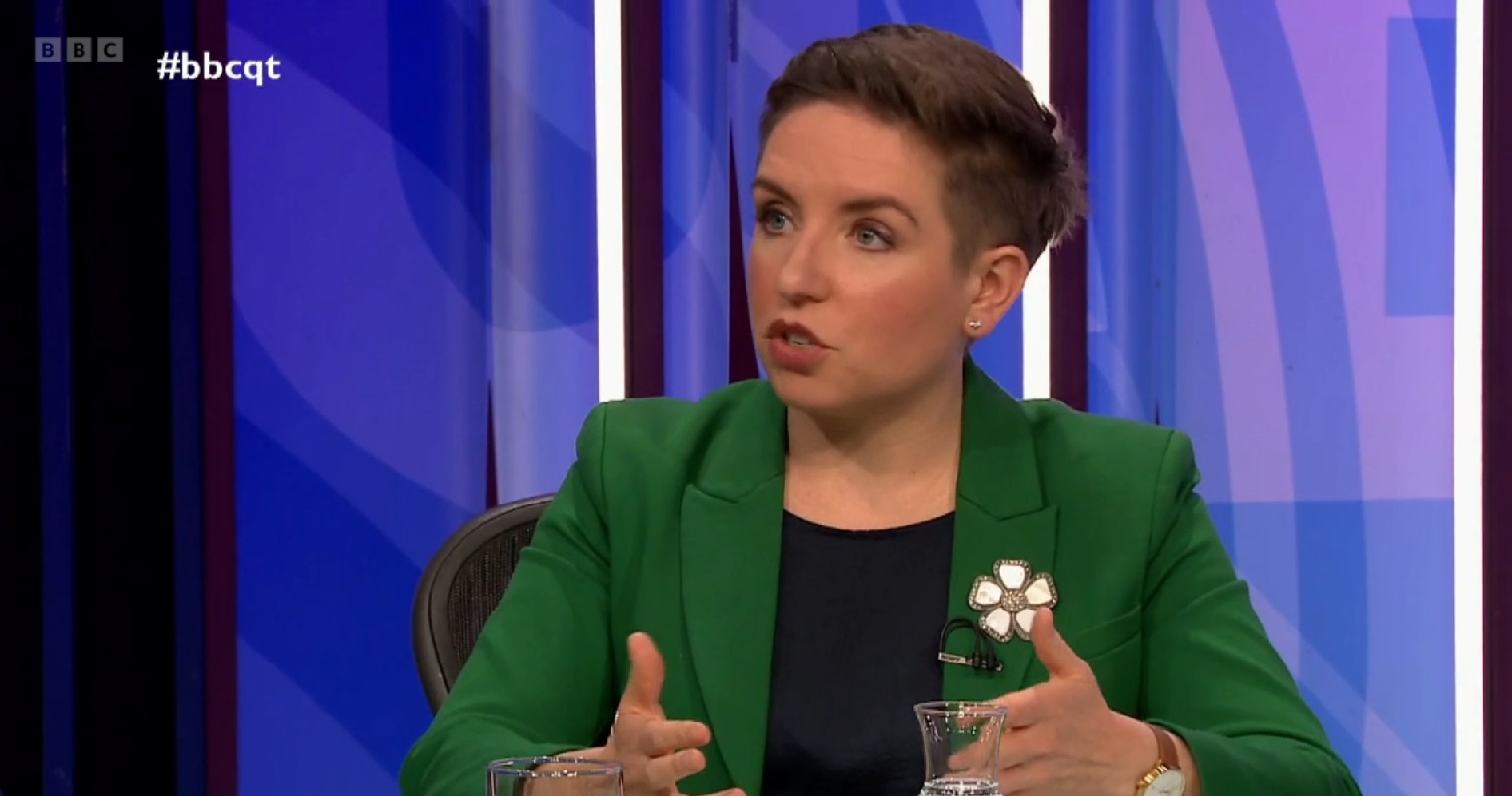
Image of the Green Party’s Carla Denyer on BBC Question Time.
Green Party Co-Leader, Carla Denyer said, “The reports over the weekend that no food has entered Northern Gaza since the 1st of October, of Israel’s attack on al-Aqsa Hospital, of chemical weapons being used to attack UNIFIL peacekeepers, of mass civilian casualties in Gaza’s Jabalia Refugee Camp and of increased rocket fire into Israel from Hezbollah are extremely disturbing. The huge numbers of civilian deaths and the prospect of widespread starvation in Northern Gaza are intolerable.
The Labour government must recognise that violence in the Middle East is escalating rapidly and that their current approach is failing. The Government needs to consider far more direct measures to incentivise a ceasefire including an end to arms sales, the introduction of divestments, boycotts and sanctions, prosecutions for all those who have committed war crimes and a plan for a viable Palestinian state.”
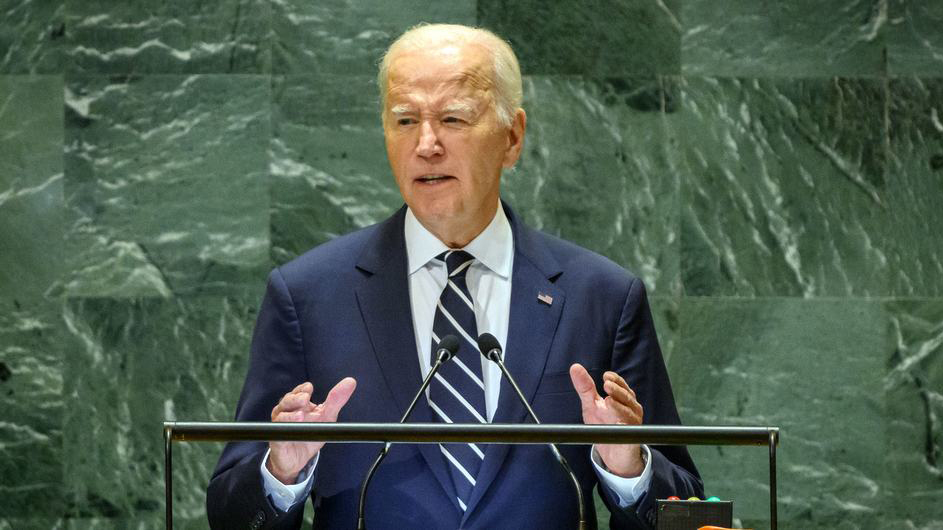
Biden addresses the general debate of the General Assembly’s 79th session (Photo: UN Photo/Loey Felipe)
Biden’s final address to the United Nations as president was riddled with falsehoods and hypocrisies typical of US foreign policy
When US President Biden ended his final address to the UN General Assembly with “my fellow leaders, there is nothing that’s beyond our capacity if we work together,” it can be easy to forget that the United States is the number one obstacle to mutual cooperation around the world.
Biden’s mention of the various conflicts and aggressions around the world—from Ukraine to Sudan to Gaza—of course made no mention of the US’s complicity in each of these conflicts.
Biden calls for “a ceasefire and hostage deal” for Gaza in order to “bring the hostages home, secure security for Israel, and Gaza free of Hamas’ grip, ease the suffering in Gaza, and end this war.”
But while Biden calls for an end to the war, the US continues to send weapons and other forms of aid to Israel as it carries out genocide in Gaza, aggression in the West Bank, and extends the war to Lebanon. Biden’s administration has ignored the popular demand for an arms embargo against Israel, supported by major labor unions which represent almost half of all unionized workers in the US as well as 61% of the US population. Instead, the US has only expanded its military support for Israel, approving a USD 20 billion dollar arms package to the Zionist state in August.
The US has maintained its unconditional support of Israel, even as Israel floats a possible ground invasion of Lebanon. Yet ironically Biden said of the war in Sudan, “the world needs to stop arming the generals.” According to the Palestinian Youth Movement, an international Palestinian diaspora organization, “the Biden-Harris administration is responsible for the current massacres in Lebanon.”
The US’s support for Israeli genocide has received additional scrutiny after it was revealed that USAID and the State Department knew that Israel had deliberately blocked humanitarian aid to Gaza. US law requires the government to cut off weapons shipments to countries which block deliveries of US-backed aid, and so US Secretary of State Antony Blinken seems to have deliberately told Congress that Israel did not block aid so that weapons shipments to Israel would remain unaffected.
Yet in his speech to the UNGA, Biden entreated Sudanese generals to “stop blocking aid to the Sudanese people.”
“We do not currently assess that the Israeli government is prohibiting or otherwise restricting the transport or delivery of US humanitarian assistance,” Blinken told Congress on May 10, despite being told the opposite by USAID and the State Department in April.
In Ukraine, not only were the US and NATO’s violations of Russian security red lines the chief cause of that war, but the West continues to be an obstacle to a peaceful settlement of the conflict. There has been no negotiation between Ukraine and Russia ever since the West allegedly forced Ukraine to withdraw from talks in April 2022, and the US in its usual fashion continues to supply billions of dollars in weapons to Ukraine to continue the war.
And while Biden urged other UNGA member nations to “stand up” for the Ukrainian people, US military officials openly thirst for Ukrainian blood—complaining in a New York Timesarticle from last year that the Ukrainian military has become too “casualty averse,” causing it to “race through precious [US-provided] ammunition supplies” as opposed to human lives.
Biden spent time lamenting the humanitarian situation in Sudan, and claiming that “the United States has led the world in providing humanitarian aid” to the war-torn country. But like many global conflicts, the war in Sudan has its roots in the savagery of US imperialism. According to Stephanie Weatherbee Brito of the International Peoples Assembly, “Through both military interventions and economic sanctions, the United States has shown its willingness to coerce any nation deviating from its interests. This has fostered a global environment where nations vie for power and influence. The US’s propensity to invade and punish perceived adversaries has spurred countries to bolster their military and geopolitical capabilities to safeguard their sovereignty in a world marked by violence and conflict, saturated with weaponry and lacking effective mechanisms to ensure peace.”
“This is essentially what is happening in Sudan today, where the conflict has resulted in more than ten million displaced persons. The conflict between the Sudanese Armed Forces and the Rapid Support Forces serves to thwart the democratic process the people have been struggling for since 2018, as rival military groups struggle to control the country and its resources,” Brito articulated.
US hybrid wars remains chief obstacle to global cooperation
“Our task, our test, is to make sure that the forces holding us together are stronger than those that are pulling us apart,” Biden claimed in his address to the UN, despite his administration’s wielding of sanctions that cause economic devastation throughout the world.
For decades, the international community has been calling on the United States to lift deadly sanctions on Cuba that are part of an over 60-year-long blockade against the socialist nation. Most recently, a group of nearly 600 parliamentarians from 73 different countries penned a joint letter condemning the continued inclusion of Cuba on the list. And 35 former heads of state from across the globe penned a separate letter to Biden, urging him to remove Cuba from the US’s “State Sponsors of Terrorism” list.
But when it comes to US sanctions and other violations of the sovereignty of other countries, Cuba is but one facet. Comprehensive US sanctions target and put a stranglehold on the economies of countries such as Iran, North Korea, Russia, Venezuela, and Syria. Other nations, such as China, are under constant attack on many fronts, whether through media fear mongering or military exercises near their territories.
And yet in his speech to the UNGA, Biden seems to deny that his administration has deliberately stoked conflict with China. “We also need to uphold our principles as we seek to responsibly manage the competition with China so it does not veer into conflict,” Biden pontificated. “We stand ready to cooperate on urgent challenges for the good of our people and the people everywhere.”
According to Amanda Yee, journalist, anti-imperialist activist, and host of The China Report on BreakThrough News, Biden’s China strategy has nothing to do with managed competition. “In reality, it’s a belligerent policy which will only escalate toward war,” Yee told Peoples Dispatch.
“What he calls ‘strengthening our network of alliances and partnerships across the Indo-Pacific’ really means the continuation of arming Taiwan, building more military bases on allies’ soil and in the South China Sea, sending cruise missiles to Japan, conducting war games exercises in South Korea—all to further build up the military encirclement of China.”
The future of US democracy
“I’ve made the preservation of democracy the central cause of my presidency,” Biden claimed during his address. And yet those in the US who have protested against their governments’ domestic and foreign policies have faced police violence, mass arrests, and even deportation.
As US presidential elections fast approach, whether the winner is Biden’s successor Kamala Harris or the ultra-conservative former president Donald Trump, anti-imperialist activists can expect more of the same repression.
The U.N. General Assembly approves a resolution calling for an end to Israel’s occupation of Palestinian territories on September 18, 2024. (Photo by Selcuk Acar/Anadolu via Getty Images)
“The vast majority of countries have made it clear: Israel’s occupation of Palestine must end, and all countries have a definite duty not to aid or assist its continuation.”
The United Nations General Assembly on Wednesday passed a resolution demanding that the Israeli government end its occupation of Palestinian territories within 12 months, affirming a recent International Court of Justice opinion that deemed the decadeslong occupation unlawful.
The Palestine-led resolution, co-sponsored by dozens of nations, calls on Israel to swiftly withdraw “all its military forces” from Gaza and the West Bank, including East Jerusalem. The final vote tally was 124 member states in favor and 14 against, with 43 nations abstaining.
Unsurprisingly, Israel and the United States—Israel’s top ally and arms supplier—were among the 14 countries that opposed the resolution, which is not legally binding. The United Kingdom, which recently suspended some arms export licenses for Israel, abstained from Wednesday’s vote, a decision that the advocacy group Global Justice Now (GJN) said shows “complete disregard for the ongoing suffering of Palestinians forced to live under military-enforced racial discrimination.”
“The vast majority of countries have made it clear: Israel’s occupation of Palestine must end, and all countries have a definite duty not to aid or assist its continuation,” said GJN’s Tim Bierley. “To stay on the right side of international law, the U.K.’s dealings with Israel must drastically change, including closing all loopholes in its partial arms ban and revoking any trade or investment relations that might assist the occupation.”
The Palestinian-led Boycott, Divestment, and Sanctions (BDS) Movement welcomed passage of the resolution, noting that the U.N. General Assembly voted “for the first time in 42 years” in favor of “imposing sanctions on Israel.”
The resolution specifically calls on all U.N. member states to “implement sanctions, including travel bans and asset freezes, against natural and legal persons engaged in the maintenance of Israel’s unlawful presence in the occupied Palestinian territory, including in relation to settler violence.”
NEWS: UN General Assembly adopts resolution demanding that Israel brings to an end its unlawful presence in the Occupied Palestinian Territory without delay and within the next 12 months.https://t.co/Vj0Ve1lLBipic.twitter.com/2rKKvDNDqd
The resolution’s passage came nearly two months after the International Court of Justice (ICJ), the U.N.’s highest legal body, handed down an advisory opinion concluding that Israel’s occupation of Palestinian territories is illegal and must end “as rapidly as possible.”
The newly approved resolution states that “respect for the International Court of Justice and its functions… is essential to international law and justice and to an international order based on the rule of law.”
The Biden administration, which is heavily arming the Israeli military as it assails Gaza and the West Bank, criticized the ICJ’s opinion as overly broad.
Nihad Awad, national executive director of the Council on American-Islamic Relations (CAIR), said in a statement Wednesday that “the Biden administration should join the overwhelming majority of nations around the world in condemning these crimes against the Palestinian people, demanding an end to the occupation, and exerting serious pressure on the Israeli government to comply.”
“We welcome this U.N. resolution demanding an end to one of the worst and ongoing crimes against humanity of the past century,” said Awad.
Ahead of Wednesday’s vote, a group of U.N. experts said in a statement that many countries “appear unwilling or unable to take the necessary steps to meet their obligations” in the wake of the ICJ’s opinion.
“Devastating attacks on Palestinians across the occupied Palestinian territory show that by continuing to turn a blind eye to the horrific plight of the Palestinian people, the international community is furthering genocidal violence,” the experts said. “States must act now. They must listen to voices calling on them to take action to stop Israel’s attacks against the Palestinians and end its unlawful occupation. All states have a legal obligation to comply with the ICJ’s ruling and must promote adherence to norms that protect civilians.”
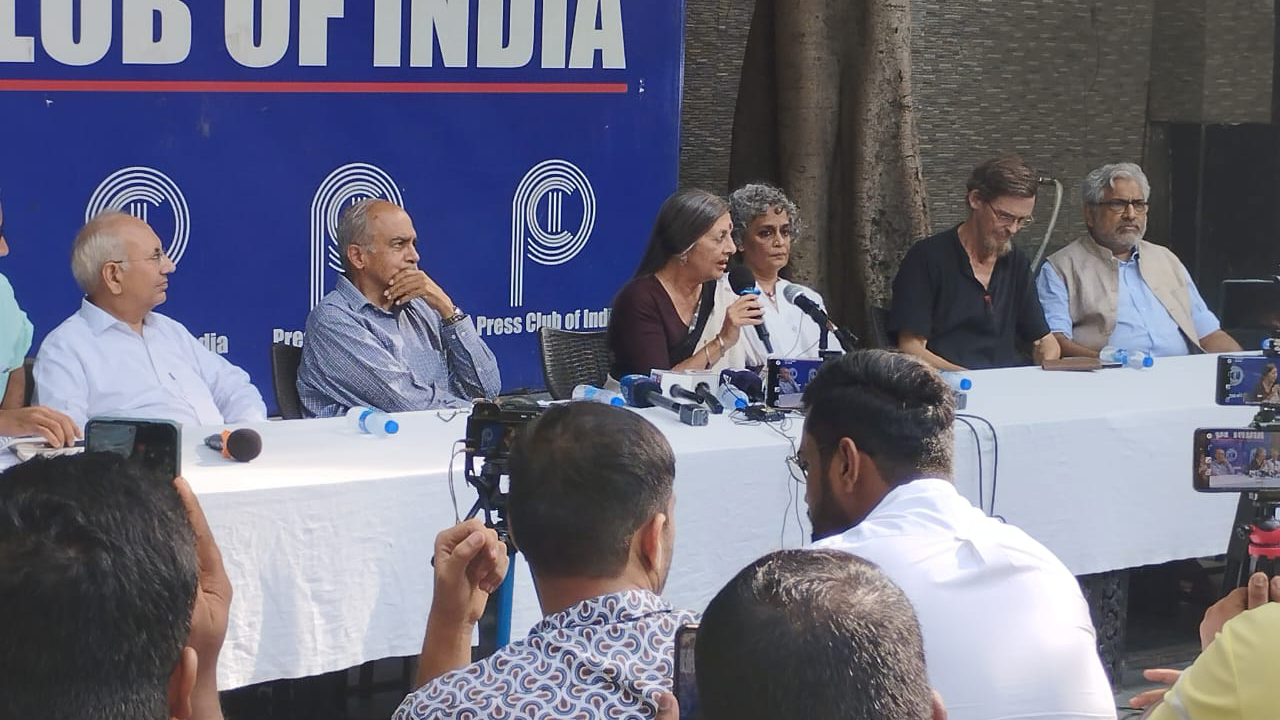
Brinda Karat, CPI (M) polit bureau member speaking in the press conference in New Delhi on Thursday, August 1
Left parties will observe a day of solidarity with Palestine on August 3 to pressure the Indian government to stop sending weapons to Israel and to end the genocide
Five left parties in India issued a joint call, asking the Indian government to stop supplying weapons to Israel, and demanding immediate comprehensive international sanctions over its continued violations of international law and the genocide of Palestinians in Gaza. Similar calls were made by civil society groups as well.
The parties include the Communist Party of India (Marxist), the Communist Party of India (CPI), the Revolutionary Socialist Party (RSP), Forward Bloc, and the Communist Party of India (Marxist-Leninist) Liberation, issued a joint call for a nationwide protest mobilization on August 3, in solidarity with the Palestinian people.
Apart from calling for an immediate ceasefire in Gaza and creation of a Palestinian state on pre-1967 borders, the left parties demanded Israel be declared an apartheid state, and denounced Israel’s continued defiance of UN resolutions, existing international laws and the rulings of the International Court of Justice (ICJ).
“In the light of brazen violations of UN resolutions, the ICJ rulings against the genocide by Israel in Gaza and the escalation of such genocide against the people of Palestine,” the left parties call upon “Indian people to express their solidarity with the Palestinian people and against the genocide and atrocities being carried out by Israel backed by the United State of America” the text of the joint call reads.
The left parties also demanded that the government of India “cancel all export licenses and permissions to various Indian companies for the supply of military arms and ammunition to Israel, and halt all arms imports from Israel” and “end all forms of complicity with Israel’s illegal military occupation and genocide [which is] based on the principles of colonial apartheid.”
Speaking in a press conference organized by civil society groups on Thursday in New Delhi, Brinda Karat, a CPI (M) polit bureau member said that, “our deep and abiding solidarity for Palestinian freedom requires us to hold our own government accountable for actions which help the perpetrators of the continuing barbaric horrors against the children, the people of Palestine.”
Speaking in the press conference, economist and right to food activist Jean Dreze accused the Indian government of complicity in genocide and starvation of Palestinians, by refusing to stop cooperation with the Zionist state and by refusing to press Israel to stop its war in Gaza.
Almost 40,000 Palestinians have been killed and over 90,000 injured so far in the Israeli genocide on Gazam which began on October 7 of last year.
Stop aiding Israeli genocide in Gaza!
Several prominent figures, including former judges of the Supreme Court of India, scholars and activists wrote a joint letter to India’s defense minister Rajnath Singh on Wednesday, asking the country to immediately halt all supplies of weapons to Israel, claiming it violates India’s obligations to international laws and its own constitutional provisions.
Quoting media reports about Spain not allowing the docking of at least two ships allegedly carrying military equipment from India to Israel in recent months, as well as labels of “made in India” found on some of the missiles dropped by Israel in Gaza, the civil society members claimed in a press conference on Thursday that the Narendra Modi-led government of India has forgotten its own commitments to the Genocide Convention and other international laws, and even failed to implement its historical positions on the Palestinian issue.
The joint letter to India’s defense minister provides evidence of how at least three Indian companies are manufacturing missile parts and Hermes drones, which are used by Israel to launch attacks inside civilian areas in Gaza.
“Any supply of military material to Israel would amount to a violation of India’s obligations under international humanitarian law and the mandate of Article 21 read with Article 51 (c) of the Indian constitution. We urge you, therefore, to cancel the concerned export licenses and halt the granting of any new licenses to companies supplying military equipment to Israel,” the joint letter reads.
India’s billions of dollars of arms trade with Israel contradicts its own stated positions of “peaceful resolution in Palestine” and its voting patterns on successive UN resolutions most of which support an immediate ceasefire and the creation of a Palestinian state on the occupied territories, various speakers said in the press conference on Thursday.
Speakers, including Karat, demanded that the Indian government should stop trying to be a beneficiary of the Israeli occupation and stop indulging in opportunistic practices, such as sending its workforce to replace Palestinians in Israel.
Last year, the Indian government agreed to send workers to replace thousands of Palestinians whose work permits were canceled by Israel after the beginning of the war on October 7.
Siddharth Varadarajan, editor of the Wire, said that India’s policy on supporting Israel during the war goes against the Modi government’s stated position of preserving Indian interests, as Israeli acts such as the assassination of Ismail Haniyeh in Iran earlier this week could result in the eruption of regional warm which can force around 5 million Indians working in the Gulf countries to return home.
Lawyer Prashant Bhusan, and prominent writer Arundhati Roy, also underlined that any clandestine deal between India and Israel violates India’s democratic principles and its historic commitments to anti-colonial struggles around the world.
Closing campaign rally of Nicolás Maduro in Caracas. Photo: Zoe Alexandra
Numerous international media outlets have stepped up attacks against Nicolás Maduro in a seemingly scripted manner with key messages that they seek to establish as the truth
On Sunday, the people of Venezuela will head to the polls to elect their next president. The 21 million eligible voters in Venezuela have the opportunity to pick between 10 candidates from a broad range of political parties and currents. The two projected front runners however, are from completely opposite ends of the spectrum: incumbent President Nicolás Maduro and candidate for the right-wing Unitary Democratic Platform, Edmundo González.
As election day comes closer, and international mainstream media pays more attention to what is happening in the Caribbean country, several dominant patterns have emerged in the discourse and messages of these outlets.
First of all, several media outlets have carried profiles of the leading candidates, and presented a very stark dichotomy. Maduro is authoritarian, González is democratic. Maduro is oppressive, González is free. In these profiles, when talking about Maduro, they will talk about the alleged amount of money and properties that he owns, but when profiling González, no such questions are asked.
When speaking of González, another type of framing is used, namely, that of the chosen one who was able to bring about the unity of an opposition that has historically had enormous difficulties in reaching minimum agreements. In this way, they want to present a worn out, questioned and “possibly” corrupt candidate (Maduro), while on the other hand, they want to show a peaceful, conciliatory, and ethically pristine candidate (Gónzález). This framing also erases the other eight opposition candidates who are running in these elections who also represent important political sectors. This has a very clear political intention, although not explicitly stated.
It goes without saying that there is almost no mention of the ferocious hybrid war which Venezuela has been subjected to for the last decade and how the Maduro government has endured coup attempts, assassination attempts, a near complete blockade on the country’s economy and oil production, and attempted invasions by paramilitary groups. In this situation of an almost constant political and economic siege, Maduro and his party United Socialist Party of Venezuela (PSUV) have not only been able to initiate remarkable economic recovery, but also have forged unity amongst the diverse political progressive tendencies which are under the broad umbrella of Chavismo. During the last several months, the socialist candidate has traveled to dozens of cities and towns across the country to meet with the people, listen to them, and hear their demands of the government and the Bolivarian process. These multitudinous rallies and meetings have received almost no media attention.
Qué impresionante fue ver a mi gente de Valencia y La Victoria en la calles, donde cantamos, bailamos y entregamos obras para el Pueblo. El 28 de julio vamos a triunfar y colocaremos la canción profunda: Viva #Venezuela, mi Patria Querida. ¡Viva la #patria! ¡Viva Carabobo y… pic.twitter.com/6NicWbDrah
Another type of premise that hegemonic media outlets have tried to establish is that of an almost certain electoral fraud if the candidate of the PSUV wins. At the same time they state that if the opposition wins, Maduro will not recognize the results (even though the government has repeatedly publicly stated that it will respect the results, whatever they may be).
That is to say, the media perspective acquires the structure of an informal fallacy called “false dilemma”, in which, according to the hegemonic narrative, either the opposition wins and Maduro ignores the results, or Maduro wins but only through electoral fraud.
For almost a month, these media outlets have also sought to express that the so-called opinion polls (carried out by corporate, right-wing pollsters) give such a wide advantage to González that Maduro will be unable to subtract such difference, implicitly stating that, for almost a month, the election has already been decided. This fatalism also relies on the false premise that election results are absolute and defined several weeks before voting day – completely undermining the people’s will and sovereignty to decide their future.
Furthermore, it is intentionally not said that other polls have put Maduro ahead in terms of voting intentions, thus reinforcing their message that either González wins overwhelmingly or that Maduro carries out electoral fraud. Hence, it is justified, in a somewhat bizarre way, when far-right opposition leaders like María Corina Machado that are backing the candidacy of González, say that the only result they will accept is the victory of their candidate. These figures continue to denounce that Chavismo would only accept a victory of its own. Ironically, only the PSUV has affirmed that it would accept the result, whatever it may be.
This type of Manichean media attitude provokes an evident polarization and increases the tension in a country that already suffered right-wing political violence and tensions after electoral processes.
With all eyes on Venezuela this Sunday, these predetermined media narratives are important to identify and debunk. It will not be the mainstream media outlets like the New York Times, CNN, InfoBae, Voz de América and others that will determine Venezuela’s future, it will be the Venezuelan people.