THE government came under pressure to let tenants withhold rent over disrepair today, after complaints from social housing residents jumped by over 40 per cent.
A report by the Housing Ombudsman revealed it had to intervene 26,901 times between April 2024 and March 2025 in disputes about landlords’ failings.
Property condition was the most common complaint category, with complaints about repairs soaring by 43 per cent.
Over 40 per cent of the £5.4 million compensation ordered was for failures in handling leaks, damp and mould.
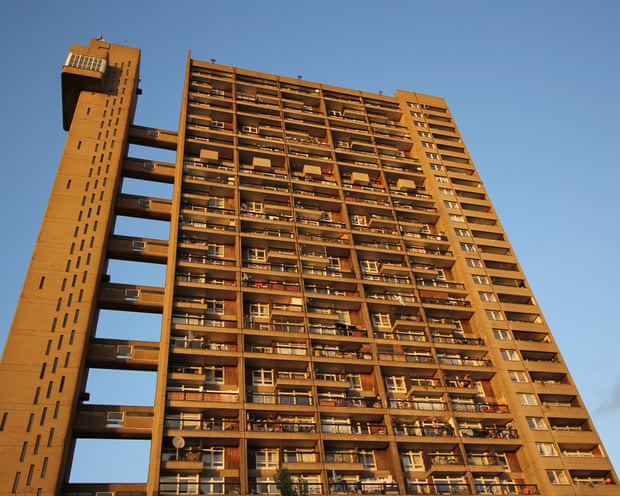
London’s Trellick Tower. The Common Wealth report urged the state to buy back and restore homes sold off under right to buy. Photograph: Chris Morphet/Getty
Depletion of social housing stock spurs calls for councils to have first refusal to buy ex-council homes entering market
England will sell off more than eight times as many council homes in 2025-26 as were constructed the previous year, research has found.
Right to buy is depleting council housing stock more quickly than public housing can be replaced, forcing people to spend more money on private market rents and obtain less secure tenancies, a report from the thinktank Common Wealth finds.
Its analysis of government data in England found that 38,170 social homes and 2,850 council homes were constructed by the government in 2023-24. In 2024-25, 2,260 council homes were built. There were 13,966 sell-offs of council houses through right to buy in 2023-24 and 8,656 in 2024-25. An analysis in the i Paper estimated that 18,500 council homes will be sold off in 2025-26 – more than eight times more than the number built in 2024-25.
The report concludes that if the government wants to increase the supply of social rental housing quickly, it must invest in buying back and restoring homes sold off under right to buy, alongside more council housebuilding.
Adam Peggs, the report’s author, said: “We need to pull every effective lever we can find to expand public housing. Council housing gave people secure, low-cost homes in the past. With the right framework, it can give people high-quality, genuinely affordable homes, with real democratic voice in the future too. But we need to build the political will to make it happen.
Richard Blakeway called the quality of social housing in England ‘completely inadequate in the 21st century’. Photograph: Michael Kemp/Alamy
Richard Blakeway says 474% increase in complaints to his office in last five years points to risk of ‘social disquiet’
The housing ombudsman has warned “simmering anger at poor housing conditions” could boil over into social tension as his office recorded a 474% increase in complaints about substandard living conditions since 2019/20.
Richard Blakeway, the housing ombudsman for England, said repairs were now the single biggest driver of complaints his office deals with, accounting for 45% of its workload.
“Without change we effectively risk the managed decline of one of the largest provisions of social housing in Europe,” he said. “To replace these homes would take more than 60 years at recent building rates.”
He said it was “neither fanciful nor alarmist” to suggest the growing anger at housing conditions could become “social disquiet”, saying the “shock of Grenfell Tower and Awaab Ishak’s death resonate still”.
“I travel across the country to different public meetings and there is a sense of people feeling invisible, of voices not being heard, their issues not being taken seriously, a lack of respect and dignity in the way in which residents have been treated. It is leading to a really serious fracturing of trust, which in some cases is irreparable,” he said.
This manifesto is our manifesto – it belongs to every single person who has written to me over the last 41 years, met me at a community event or simply stopped me in the street. Meeting people, talking to people and working together to bring about a fairer society – that is what being an MP is all about.
The issues facing people in Islington are part of a much wider set of crises. There are more people living in desperate poverty than I have ever known. More rough sleepers struggling to survive. More refugees fleeing the horrors of war and climate catastrophe. We will not solve these crises unless we build a new kind of politics. Our people-powered campaign will demand a redistribution of wealth, ownership and power. For rent controls. For an end to the two-child benefits cap. For a Green New Deal. For safe routes for asylum seekers. For a fully funded, fully public NHS.
This future is no pipedream – our community is proof that a kinder world is possible. I visit community centres which are welcoming, creative places, where people can meet each other, learn, eat together, receive support when they need it, and give it when they are able to. I meet carers doing all they can to support relatives or friends, often in the most difficult circumstances. I meet members of mutual aid groups who are building a new economy, one act of solidarity at a time. If we applied these basic principles across the board, we would create a society that cares for each other and cares for all.
When I vote in Parliament, I do not vote alone. I vote with my community – and this campaign is bringing together people of all ages, faiths and backgrounds in pursuit of a better world. We are offering people something very precious: hope.
Join us at www.votecorbyn.com to prove that when we come together to fight for a better society for everyone, we can win.
CONTENTS
ACTION ON THE COST OF LIVING End the energy and water rip-off Fair pay for Islington workers Abolish the two-child benefit cap Universal basic income Wealth tax
HOUSING IS A HUMAN RIGHT Security for renters Build social housing Housing insulation Leasehold reform Cladding justice
DEFEND OUR NHS End privatisation Support our doctors and nurses Mental health A National Care Service Reproductive health
A GREENER ISLINGTON A Green New Deal Protect our parks Save our buses Walking and cycling Animal welfare
EDUCATION FOR ALL Save our schools Education is not a commodity Lifelong learning Update our curriculum
A SAFER ISLINGTON A public health approach Tackling hate crime and extremism A fairer criminal justice system
HUMAN RIGHTS ARE UNIVERSAL Peace Reparations Refugees are welcome here Migrant justice
OUR DEMOCRACY The right to protest The right to strike Decentralisation Local public ownership Media and sport
Flats originally built for social housing | Photo by Matt Cardy/Getty Images
More social rent homes were sold or demolished than built last year, new government figures show
The number of social rent homes in England continues to plummet with almost 10,000 lost last year, according to new government statistics.
The country’s housing crisis continues to deepen amid a lack of supply and soaring rents, with evictions and homelessness surging.
According to figures released yesterday by the Department of Levelling Up, Housing, and Communities (DLUHC), a net 9,379 homes for social rent were lost in 2022/23.
Social rent homes – historically known as council houses, though they are no longer solely provided through councils – are already massively oversubscribed. There are 1.2 million people on housing waiting lists across the country and people can languish on these for decades before being offered a home. Last year openDemocracy revealed that in 2022 2,300 people had died while on the waiting list.
Labour MP Nadia Whittome, who sits on parliament’s housing select committee, told openDemocracy: “I see the devastating impact of the lack of social housing in my inbox and my advice surgeries every week. Without social homes, too many people simply have nowhere else to go – they cannot afford to rent privately.
“At a time when we desperately need to increase the number of social homes, it’s outrageous that government policy means we’re losing them instead. The homelessness crisis is being fuelled by Right to Buy and the failure to build social housing.”
The latest figures show 18,799 social homes in the “low-cost rental” category were sold last year, while another 3,224 were demolished – totalling 22,023. According to the government, 86% (about 18,940) of these losses were social rent homes, with the remainder classed as so-called “affordable” rent, “intermediate” rent or “London affordable” rent.
With just 9,561 social rent homes completed in the same year, that brings the total losses to 9,379.
Social housing used to be the second most common type of home in the UK after home ownership. But following Margaret Thatcher’s Right to Buy policy introduced in 1980, the country has seen a huge sell-off of homes into private ownership. Councils sold 10,896 through Right to Buy last year.
These statistics come as the supposed landmark private renters bill, the Renters Reform Bill, has been delayed again, with no update on when one of its key tenets, banning ‘no-fault’ section 21 evictions, will come in. News of the delay coincided with the publication of damning statistics that show the number of these evictions has rocketed by a third in 12 months.
Section 21 evictions are the number one cause of homelessness in the UK and figures released by the Ministry of Justice show 30,230 landlords began section 21 court proceedings in 2023 – a 28% rise on 2022. There was also a surge in the number of these evictions where bailiffs were involved.
Housing minister Lee Rowley was recently criticised for a misleading boast about a “significant increase” in all types of social housing under the Conservative government, while being questioned about a policy that only affected social rented homes.
Rowley is yet to correct his statements.
Separate statistics from the government’s own Regulator of Social Housing shows there has been a decrease of 225,102 genuine social rented homes since 2012, though this is offset by the addition of 361,560 so-called “affordable” rent homes.
“Affordable” rent homes are rented for up to 80% of market rates and remain out of reach for many of the people on housing wait lists. Poverty campaigners, the Chartered Institute of Housing, and even a Conservative MP have criticised the government’s use of “affordable” homes figures to massage the dire state of social rented stock.
Conservative MP Bob Blackman told openDemocracy that building more social homes at social rents was essential.
“I feel disappointed,” he told openDemocracy. “I’m not worried about the number of homes sold, or the numbers demolished. What I’m concerned about is that we’re not replacing them. That’s the problem.”
Blackman insisted the Conservative government had not failed on social housing, but added: “I agree that we haven’t built enough whatsoever.”
A spokesperson fro DLUHC told openDemocracy: “Our £11.5 billion Affordable Homes Programme is delivering thousands more affordable homes to rent and buy right across the country.
“Last year also saw the highest levels of completions of social rent since 2013. The total stock of [all types of affordable housing] has grown by 151,000 since 2010, whereas in the previous 13 years it fell by 420,000. Despite the economic climate we remain on track to build one million homes this parliament and our long-term plan for housing will allow us to go even further to deliver the homes we need.”