OpenDemocracy Exclusive: How Palantir harvested millions in UK tax breaks

Spread the love

Article by Aman Sethi and Jade-Ruyu Yan republished from OpenDemocracy under a Creative Commons Attribution-NonCommercial 4.0 International licence

Alex Karp, CEO of Palantir Technologies and PLTR stock price | Photo by Kevin Dietsch/Getty Images / composition by James Battershill

In 2024, Palantir’s effective tax rate was just 8%, far less than the usual 25%, despite £25.3m of pre-tax profits

By Aman Sethi and Jade-Ruyu Yan

Palantir is benefiting from millions of pounds of tax deductions that allow it to pay very little corporate tax in the United Kingdom despite soaring profits, an investigation by openDemocracy reveals.

The controversial tech firm has won at least £670m in UK public contracts in recent years, which have helped to make the country its second-largest market by revenue after the United States, where it is headquartered. Yet despite accounting for 10% of the company’s global revenue last year, its tax payments in the UK amounted to less than 5% of its total global cash tax spend, according to US filings.

The filings suggest Palantir’s UK subsidiary paid less than $1.08m (£820,000) in cash tax in the UK in 2025 – less than it paid in Korea, Japan, France and Germany – after accumulating tax deductions due to stock prices. Palantir’s stock has surged since the company went public in 2020, peaking in 2025 before paring back gains this year.

In 2024, Palantir’s UK subsidiary reported pre-tax profits of £25.3m, but assessed its local corporate tax requirement as only around £2m, according to the latest accounts filed with Companies House. This puts its annual corporate tax rate at roughly 8% – far lower than the 25% usually paid by businesses with profits over £250,000 in the UK. 

In 2023, the company’s tax rate was lower still, at 4.7% on pre-tax profits of approximately £19.1m, and in 2022 it was 4.2% on pre-tax profits of around £19.9m. Its UK accounts are not yet available for 2025 onwards. Taken together, that’s just £3.7m of tax on £63.4m in cumulative pre-tax profits over three years.

openDemocracy analysed hundreds of pages of Palantir’s filings in the US and the UK from 2020 to 2025, a period when the company recorded extraordinary growth in revenue and profits. We found the company’s low tax exposure was down to two factors: A structured arrangement that limits the profits recognised in the UK, and a provision in the UK tax code that rewards companies with significant tax breaks in return for compensating their employees with stock rather than in cash. 

This strategy, experts say, is legal and very effective. In 2020, the company had already accumulated £32m in tax breaks in the UK, according to Companies House, of which about £26m were due to what the company called “employee share acquisition relief”. Two years later, the total size of the UK tax break had ballooned sevenfold to $303.4m (approximately £230m) in net operating losses in the UK, which its parent company said “can be carried forward indefinitely” in its 2022 annual filings in the US. 

The nature of annual filings makes it hard to assess the current size of Palantir’s accumulated tax deductions, but it is clear that the company’s tax deductions in the UK have grown much faster than its profits. The most recent Companies House accounts suggest the company gained about £92m in tax deductions in 2024 alone, of which it used a small portion to reduce its tax assessment for the year from £6.3m at the standard rate of 25% to only about £2m on pre-tax profits of £25.3m. 

“When profitable companies are paying very little tax, especially when much of their revenues derive from taxpayers’ money itself, then it’s important to ask why,” said Mike Lewis, the director of TaxWatch. “Is it because tax incentives and tax breaks are poorly targeted? Or is it because companies are shifting profits in ways that our tax system is supposed to counteract?”

In Palantir’s case, the company’s surging stock price created deductions at a scale that would lower its tax burden even if the company recognised more profits in the UK. 

The company is far from the only tech firm to have reduced its UK tax burden in this way. Fair-tax proponents have called for the UK to do a better job of taxing tech companies since Meta (then known as Facebook) provoked outrage for paying only £4,327 in corporate taxes in 2014, after paying more than £35m to staff in a share bonus scheme. 

“It’s a consistent pattern,” said Nathan Goldman, professor of accounting at North Carolina State University, whose work focuses on corporate taxation. “All of these companies are following the same pattern. They’re not doing anything illegal.”

Goldman said that while there are “lots of knobs you can turn” to get deductions, share-based compensation for employees is the one that can yield significant gains in cases where stock prices rise sharply in a short period of time.

Yet, Palantir’s critics say its case stands out because much of its revenue derives from public sector contracts, including the cash-strapped National Health Service. As openDemocracy revealed back in 2020, Palantir’s work with the NHS went from a £1 contract to £1m. The company’s current NHS contract is worth at least £330M.

“If these findings are accurate, they expose the staggering extent to which Palantir is taking from our country while giving back as little as possible,” said Green Party Deputy Leader Mothin Ali. 

“It has pocketed hundreds of millions of pounds in public contracts, yet appears to have paid an effective tax rate that is a fraction of that paid by the doctors, nurses and other public sector workers who keep our services going. Greens have said before that Palantir should pack its bags and get the hell out of our NHS. What will it take for this Labour government to finally show them the door?”

“At a time we are asking for more scrutiny into the Federated Data Platform contract, it is mindboggling that Palantir are siphoning millions of pounds out of the UK,” said Liberal Democrat MP Martin Wrigley, who has been a vocal opponent of the UK government’s work with Palantir. “Our NHS needs to be working with trusted suppliers, and Palantir seem to be consistently undermining that trust. It’s time the government gets serious and builds the offramp.”

“Multinationals like Palantir are able to exploit the defects in current international tax rules to pay lower effective tax rates overall,” said Sol Picciotto, an emeritus professor at Lancaster University and senior adviser with the Tax Justice Network. “This is particularly problematic for those providing services which can be delivered globally, giving them great freedom to decide where and how to declare taxable profits.” 

🔎

We are continuing to investigate Palantir. If you have any information you feel might be relevant, please send it to jaderuyu.08 on Signal or jade-ruyu.yan@opendemocracy.net. We protect our sources.

“Palantir is paying little or no corporate income tax in both the US and the UK, despite its bread and butter being government contracts,” said Paul Monaghan, chief executive of the Fair Tax Foundation. He called the strategy “textbook Silicon Valley profit-shifting” and added that the “generous corporate tax treatment” of these types of share-based payments is “in play on both sides of the Atlantic”. 

“Whilst Palantir’s share price grows, these are likely to continue to depress the company’s effective tax rate.”

“It is therefore re-assuring to see an indication in the US parent’s financial statements that they are the subject of a live inquiry by HMRC that encompasses the last two years,” he said, referring to a note in the company’s US annual filing for 2025, which reads that the “Company is subject to potential examination by tax authorities” in “the UK for tax years 2024 through 2025.”

“We do not comment on the tax affairs of individual taxpayers,” said a spokesperson for HMRC, the government department responsible for the collection of taxes. “These are long‑standing rules set by Parliament, and we enforce them rigorously to make sure every company pays the tax that is due under UK law.”

openDemocracy has reached out to Palantir for comment, but had not heard back at time of publication. This story will be updated if the company responds.

Behind the shield

Business leaders insist that the UK’s corporate tax regime stifles investment and cripples economic growth. In 2021, when then-chancellor Rishi Sunak announced that corporate taxes would rise from 19% to 25%, The Times carried an article headlined “Companies ‘will quit UK’ over Sunak’s corporation tax rise”.

Yet an examination of Palantir’s accounts reveals that the UK’s corporate tax regime allows fast-growing technology companies to harvest millions of pounds in tax breaks by richly remunerating their employees with stock options.

Compensating employees in this manner, said Goldman the accounting professor, creates “incentive alignment”, where employees have a stake in the success of the company – improving employee retention rates – as well as allowing companies to preserve cash (as offering stock options doesn’t impact cash flows), and generating future tax deductions if, and only if, the company succeeds.

But if a company succeeds like Palantir, he added, the tax deductions generated in this manner are very large.

The key to this mechanism lies in Part 12 of the Corporation Tax Act 2009, which allows a company to claim a tax deduction relief equivalent to the difference between the market price of the stock at the point at which they are acquired by the employee and the original strike price paid by the employee. 

“UK tax policy allows qualifying companies these kinds of deductions,” said Dr Federica Casano, lecturer in business and tax law at the University of Leeds. “The relief under Part 12 of CTA 2009 is broadly neutral as to the type of instrument – restricted or unrestricted shares, options or RSUs [Restricted Stock Units].”

In Palantir’s case, the stock has soared by over 1,000% since the company went public in September 2020, thereby creating hundreds of millions of pounds of tax deductions in the UK as the company’s employees have cashed in.

In 2024, the company’s stock price closed the year at about $77. That year, the accounts reveal, the company generated about £92m in tax deductions. The following year, the stock peaked at $207.52 in November 2025, before paring back its gains, suggesting the company would have harvested a fresh round of multi-million-pound tax deductions for that year. At the time of publishing, the stock is priced at about $107.

“The corporation tax deduction available in the UK is among the more generous. Stock-based compensation is supposed to reduce payroll pressure on cash flow, especially for start-ups,” said Lewis from Tax Watch. 

“The fact that it is also available to established, profit-making companies means that it can effectively wipe out very profitable companies’ tax bills for years if share values significantly increase. In an era of almost historically unprecedented tech stock valuations, it may be time to look at restricting the deduction.”

Wittgenstein’s tax rules

Around the world, governments have long struggled to get corporations to pay more tax in their respective countries. Raise taxes in one jurisdiction, the argument goes, and companies will simply restructure to recognise profits elsewhere. 

In 2021, the Organisation for Economic Cooperation and Development (OECD) sought to prevent a race to the bottom by establishing a global minimum tax rate of 15%, often referred to as a ‘top-up’ tax. In January 2025, as these rules were being rolled out across the world, the Trump administration not only withdrew from the agreement, but announced it would sanction countries that sought to tax US companies under the framework. Since then, the G7 has struck an uneasy carve-out for the US, the implications of which are still unclear.

Even so, the UK remains an outlier, both in how it taxes multinational Big Tech companies and also in its willingness to contract out vital public services to these companies. 

“The case of Palantir clearly shows the defects of these rules, and also highlights the failure to resolve them over the past 13 years through the OECD,” said Lancaster professor Picciotto. “That’s why developing countries launched negotiations for a global tax treaty through the UN. The UK should strongly support this initiative to ensure that multinationals can be taxed where they have real activities, including revenues.”

“It’s notable that the UK government has just agreed, at the behest of the Trump administration, to exempt US-headquartered companies from one key defence against such profit-shifting: the global minimum ‘top-up’ tax,” Lewis said, adding that the Office of Budget Responsibility estimates that this will cost the UK at least £700m in tax revenues every year. 

Palantir’s UK subsidiary had to pay this ‘top-up’ tax last year on low-taxed profits within the group, in the most recent year, Lewis noted. “It may not have to in the future. That’s an example of how the UK’s acquiescence to the White House puts UK firms at a disadvantage compared to their US competitors, and costs us much-needed tax revenues.”

Governments in several of Palantir’s other key overseas markets – none of which is as large as the UK – are already distancing themselves from the company. France and Germany have announced they are moving away from Palantir’s products, while the company’s work in Korea remains largely commercial as part of an alliance with the Hyundai group.

Meanwhile, in the UK, Palantir continues to work with government bodies, causing public outcry. And the company’s leadership remains bullish on its  prospects and profitability. In a letter to investors in May this year, CEO Alex Karp noted the company had generated $871m in profits on $1.6bn in revenue in the first three months of 2026 alone. 

“Our quarterly profit – the largest in our company’s twenty-three-year history – has more than quadrupled in only twelve months,” Karp wrote. “What business in the world, at this scale, has ever accomplished anything of the sort?”

Karp began his letter to shareholders with an enigmatic quote from Austrian philosopher Ludwig Wittgenstein’s Philosophische Untersuchungen: “And to think one is obeying a rule is not to obey a rule.”

– Ethan Shone contributed to this report

Article by Aman Sethi and Jade-Ruyu Yan republished from OpenDemocracy under a Creative Commons Attribution-NonCommercial 4.0 International licence

Continue ReadingOpenDemocracy Exclusive: How Palantir harvested millions in UK tax breaks

With Help From Trump-GOP Law, At Least 88 Big US Corporations Paid $0 in Federal Income Tax Last Year

Spread the love

Original article by Stephen Prager republished from Common Dreams under Creative Commons (CC BY-NC-ND 3.0). 

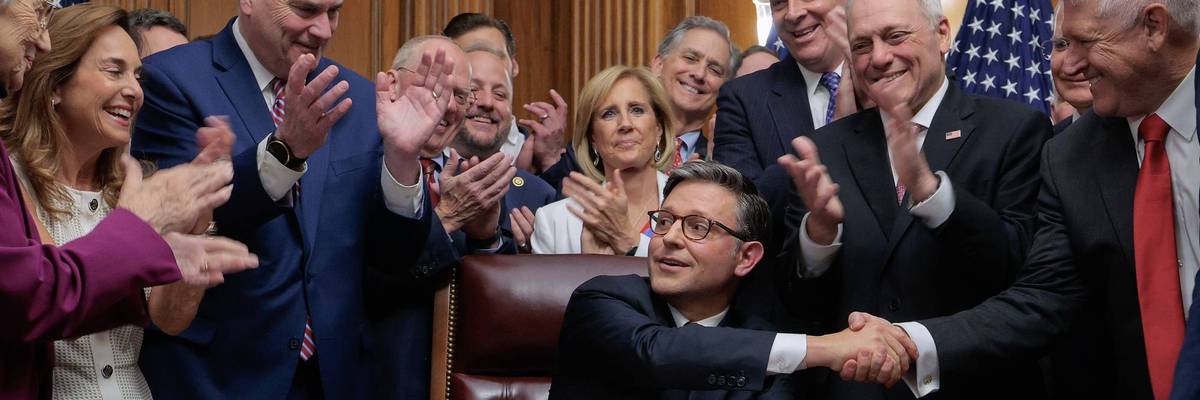
Speaker of the House Mike Johnson (R-La.) is congratulated by his fellow Republicans after signing the One Big Beautiful Bill Act during an enrollment ceremony in the Rayburn Room at the US Capitol on July 3, 2025, in Washington, DC. (Photo by Chip Somodevilla/Getty Images)

Dozens of America’s most profitable corporations avoided paying any federal income taxes in 2025, according to an analysis out on Tuesday from the Institute on Taxation and Economic Policy.

The 88 companies—which include Tesla, Southwest Airlines, Live Nation, Palantir, Citigroup, and many others listed in the S&P 500—brought in a collective $105 billion in pretax income last year.

RECOMMENDED…

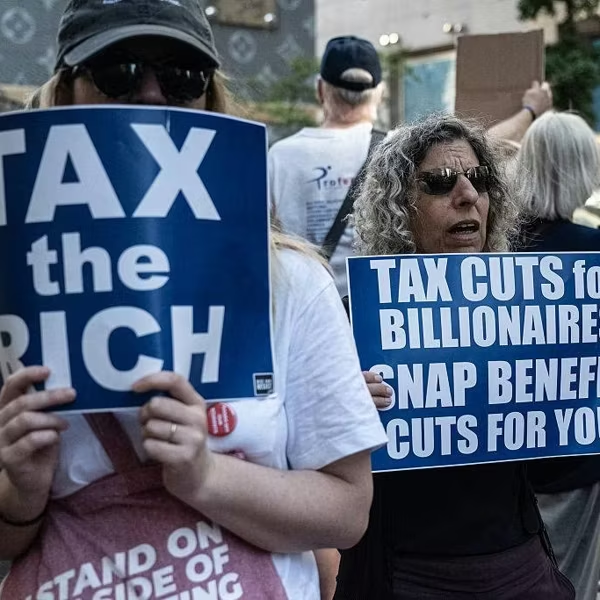
Protesters demonstrate in front of Trump Tower on July 4, 2025 in New York City.

Top 1% to Get $117 Billion in Trump Tax Cuts This Year as Bottom 95% Pay More

U.S. Vice President JD Vance Leads U.S. Delegation In Peace Talks With Iran In Pakistan

Iran’s Top Diplomat Says Trump Team Sabotaged Talks With Deal ‘Inches Away’

ITEP found that 2025 saw a spike in corporate tax avoidance, enabled in part by new loopholes created by the One Big Beautiful Bill Act signed by President Donald Trump and by his 2017 Tax Cuts and Jobs Act, which reduced the corporate tax rate to 21% from its previous 35%.

The One Big Beautiful Bill Act is expected to hand the wealthiest 1% of Americans $117 billion in tax cuts this year, while those in the bottom 95% are set to pay more in taxes while facing across-the-board cuts to social safety net programs like Medicaid and the Supplemental Nutrition Assistance Program.

It also allowed multimillion- and billion-dollar corporations to find new ways to avoid paying taxes. More than half of the tax-avoiders listed in the report used a provision in the new tax law allowing companies to immediately write off capital investments, reducing their collective taxes by $11.4 billion.

Pharmaceutical and tech companies, meanwhile, were able to take advantage of tax write-offs for research and development, exempting them from approximately another $4.4 billion.

In total, the corporate tax avoidance documented in 2025 by the researchers helped to rob the public coffers of yet another $26.7 billion, enough to give every public school student a free lunch for a year, according to a University of Missouri analysis of the National School Lunch Program.

The researchers said that the full scale of corporate tax avoidance remains unclear, since corporate tax returns are not publicly available. Some companies were also excluded because they are not part of the S&P 500 or have not yet reported their 2025 taxes.

“These findings are not isolated cases—they reflect systemic deficiencies in the corporate tax code,” said Amy Hanauer, the executive director for ITEP. “Without meaningful reform, profitable corporations will continue to pay less than their fair share.”

Original article by Stephen Prager republished from Common Dreams under Creative Commons (CC BY-NC-ND 3.0). 

Orcas discuss how Trump was re-elected and him being an obviously insane, xenophobic Fascist.

Continue ReadingWith Help From Trump-GOP Law, At Least 88 Big US Corporations Paid $0 in Federal Income Tax Last Year

HMRC won’t admit how much tax is lost offshore

Spread the love

Original article by Simon Lock and Ed Siddons republished from TBIJ under a Creative Commons Attribution-NonCommercial-NoDerivs 3.0 Unported License.

Sign outside HMRC in Whitehall, London SW1

The taxman has the numbers needed to estimate how much cash is lost to overseas havens – but it isn’t sharing the details

An MP has demanded HMRC release its official estimate of how much tax is being lost to offshore havens – information we discovered is currently being withheld by the authority.

A Freedom of Information request by TaxWatch, shared with TBIJ, revealed that in apparent contrast to its previous claims, HMRC holds data needed to estimate the offshore tax gap. But it would not hand the information over.

“We urgently need HMRC to clarify the situation – otherwise we will never crack down on tax dodging,” said Lloyd Hatton MP, who sits on the Public Accounts Committee.

The offshore tax gap is the difference between the amount of tax the UK should collect from offshore sources, and what it actually receives. It puts a number on the cost to the public when people and companies move their money offshore to avoid, evade or fail to declare tax.

HMRC has previously claimed that it holds no estimate for the overall offshore tax gap. But in response to a recent FOI request, the tax authority revealed that it does in fact hold a figure for “offshore tax at risk”.

This number is the amount of tax HMRC thinks could be lost because of avoidance, evasion and non-compliance. HMRC has said itself that this could be used to work out the offshore tax gap. All HMRC would need to do is subtract from it another number called the “compliance yield” – the amount HMRC did manage to claw back through enforcement activities.

HMRC has even published its figures on the compliance yield for offshore-related tax, meaning it already has data needed to calculate the offshore tax gap figure.

But in response to our FOI request, HMRC refused to disclose the “tax at risk” figure on the basis it could “prejudice the effective conduct of public affairs”.

The correspondence calls into question direct statements made earlier this year by the head of HMRC to the Public Accounts Committee (PAC), whose role is to scrutinise government departments.

In February, the authority’s CEO Jim Harra wrote to the PAC’s chair to say his organisation did not hold figures on the total offshore tax gap. Instead, he referred to a number published by the agency in 2024.

Back then, this partial number – gathered from self-assessment tax returns – was referred to as “experimental statistics” and it estimated that tax from offshore sources was underpaid to the tune of only £0.3bn.

We urgently need HMRC to clarify the situation – otherwise we will never crack down on tax dodging

Lloyd Hatton, MP

This figure has been called into question as too low by the Public Accounts Committee. By comparison, the UK’s entire tax gap is estimated by HMRC to be nearly £50bn.

Commenting on the new FOI correspondence, Hatton said: “The Public Accounts Committee report [in July] showed that HMRC is incapable of identifying those super-wealthy individuals who choose to squirrel away their wealth – often using offshore accounts in tax havens.

“Without this, it cannot effectively pursue those who deliberately avoid or evade paying their fair share of tax.

“The Committee has pressed for greater transparency concerning tax lost offshore, without this information we cannot properly assess whether HMRC’s compliance efforts are effective or adequately resourced. And – even more crucially – we cannot go after egregious tax dodging.”

A spokesperson for TaxWatch said: “We understand that HMRC has a responsibility to ensure that it’s publishing accurate information. But there seems undue secrecy around this figure, which is routinely published for other types of tax and taxpayer.”

It marks yet another turn in the hunt for clarity on just how much tax is avoided or evaded offshore. In 2022, then Treasury Minister Lucy Frazer vowed that HMRC would publish the much-desired offshore tax gap figure, but in the run-up to the general election, HMRC demurred.

A spokesperson for HMRC said: “We are working to assess the feasibility of broadening the scope of the published estimate of the offshore tax gap, as stated to the Public Accounts Committee, and will report back to them.”

Original article by Simon Lock and Ed Siddons republished from TBIJ under a Creative Commons Attribution-NonCommercial-NoDerivs 3.0 Unported License.

Continue ReadingHMRC won’t admit how much tax is lost offshore

38 Former World Leaders Have a Message: Tax Fossil Giants to Fight Climate Crisis

Spread the love

Original article by Jon Queally republished from Common Dreams under Creative Commons (CC BY-NC-ND 3.0).

A Greenpeace sign projected on a building says, “Stop Drilling-Start Paying”—a message directed at the world’s fossil fuel companies. (Photo: Greenpeace)

“Pressure is mounting on today’s politicians to hold those most responsible for the climate crisis to account,” said one Greenpeace campaigner.

Thirty-eight former world leaders on Wednesday used the occasion of the United Nations General Assembly this week in New York—as well as other global summits on the horizon—to demand a new global framework for steeper taxes on the world’s wealthiest and most powerful fossil fuel giants to pay for an urgent transition away from dirty energy sources toward a healthier planet and more equitable economy.

Under the auspices of the nonpartisan Club de Madrid, the world’s largest forum of former democratically-elected presidents and prime ministers, an open letter—signed by Carlos Alvarado, former President of Costa Rica; Mari Kiviniemi, former Prime Minister of Finland; Chandrika Kumaratunga, former President of Sri Lanka; former UN Secretary General Ban-Ki Moon; and dozens of others—calls the climate crisis “a defining challenge of our time” and urges current leaders to “place the question of fair taxation of fossil fuel company profits firmly on national and international agendas” before it is too late.

RECOMMENDED…

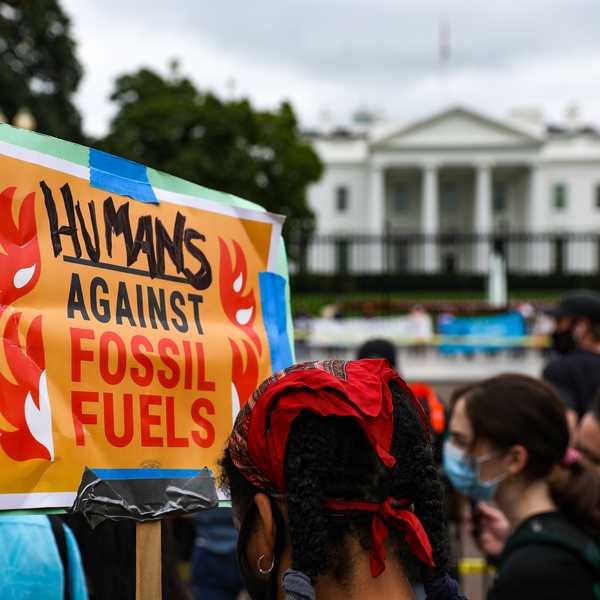
Week-long fossil fuel demonstrations continue in Washington

‘Reckless’ Countries to Extract More Than Double the Fossil Fuels Consistent With 1.5°C

US President Donald Trump

Climate Defenders Blast Trump’s ‘Reckless’ UN Speech

“With wealthier countries leading by example,” say the leaders, increased taxation of the world’s coal, oil, and gas giants coupled with a redirection of taxpayer subsidies away from the fossil fuel sector and toward a just renewable energy transition “could be transformative, enabling a faster and fairer global transition and strengthening public trust that climate action can deliver tangible benefits for all.”

“Taxing fossil fuel profits is not only fair—it is also essential to ease the economic burden of the climate crisis, felt by ordinary people through higher food prices, lost working days, pressure on energy bills and higher home insurance premiums.”

Citing the need for global cooperation and ambition to address the warming planet and ongoing climate breakdown, the open letter states:

It is time to consider innovative solutions that can simultaneously establish a clear incentive for companies to shift investment to renewable energy as quickly as possible, while mobilising significant funds to address climate damages and advance both equality and equity. Today, we call on you to consider permanent polluter profit taxes applied to high-emitting industries, designed to ensure contributions come from those with the greatest capacity to pay rather than from ordinary consumers of fossil fuels. With wealthier countries leading by example, these taxes should place the primary responsibility on those with the greatest capacity, not on middle- and low-income communities.

The former world leaders acknowledge the strain governments feel about generating the necessary revenue, estimated at approximately $6.5 trillion per year by 2030, to fund the rapid transition scientists and experts say is necessary to avoid the worst future impacts of an increasingly hotter planet. However, they argue that the polluting companies that have profited most from the fossil fuel era are best positioned to foot the bill, and that the cost of action is far less than the cost of fixing the damage that future climate change will cause if left unaddressed.

“During the oil and gas price crisis in 2022, many governments implemented windfall taxes. We must consider making such approaches permanent,” the letter argues. “A polluter profits tax modestly applied to normal returns and significantly higher on windfall gains could, if applied just to oil, coal, and gas companies, generate up to $400 billion in its first year.”

Rebecca Newsom, Greenpeace International’s global political lead for its “Stop Drilling Start Paying” campaign, said the letter represents what real leadership looks like and that forcing fossil fuel giants to pay higher taxes to help solve the planetary crisis their insatiable greed has spurred has never been more popular with the people worldwide.

“This is a powerful call from former world leaders to make oil and gas corporations pay their fair share for the destruction they have caused,” said Newsom.

Noting recent survey data, Newsom said 8 out of 10 people around the world now “support taxing these polluters for climate damages—the backing of former political leaders adds more weight to this urgent demand.”

“Pressure is mounting on today’s politicians to hold those most responsible for the climate crisis to account,” she said. “Taxing fossil fuel profits is not only fair—it is also essential to ease the economic burden of the climate crisis, felt by ordinary people through higher food prices, lost working days, pressure on energy bills and higher home insurance premiums.”

With the upcoming G20 summit in South Africa and the UN Global Tax Convention in Kenya, both scheduled for November, the former world leaders say the moment is right for global leaders to finally show urgency on the issue.

“The world has the tools, the knowledge, and the resources to act,” their letter concludes. “What is needed now is the political courage to ensure that those with the greatest capacity contribute their fair share. This will not only advance climate justice but also strengthen the foundations of a more stable, resilient, and prosperous global economy.”

Greenpeace’s Newsom said the message is clear. “Governments must find the courage to decisively tax oil and gas corporations and redirect those funds towards a just transition away from fossil fuels and a safe future in the face of a climate crisis.”

Original article by Jon Queally republished from Common Dreams under Creative Commons (CC BY-NC-ND 3.0).

Continue Reading38 Former World Leaders Have a Message: Tax Fossil Giants to Fight Climate Crisis

The rich are a threat to our economy and our democracy

Spread the love

https://morningstaronline.co.uk/article/rich-are-threat-our-economy-and-our-democracy

 Waspi (Women Against State Pension Inequality) campaigners stage a protest on College Green in Westminster, London, as Chancellor of the Exchequer Rachel Reeves delivers her Budget in the Houses of Parliament, October 30, 2024

HMRC’S ignorance about how much tax British billionaires pay exposes the missing factor in government announcements on public spending.

Tight finances are used as excuses to attack pensioners and deny justice to the wronged, like the Waspi women.

Even when — thanks to a welcome revolt against Rachel Reeves’s renewed austerity by Labour MPs — cuts to disability payments are reduced in scope, ministers suggest the pain will be shunted sideways: it will make it harder to lift the two-child benefit cap, or force a regressive freeze on income tax thresholds (so they don’t rise with inflation, distributing the tax burden downwards).

The public accounts committee’s Lloyd Hatton says its report is “not concerned with political debate around the redistribution of wealth,” and is intended solely to address shortcomings in HMRC’s ability to collect the tax owed.

But the doubt it casts on HMRC’s own estimates of the “tax gap” (the difference between tax owed in theory and tax collected) has significant implications for public spending choices.

Besides, the failure to introduce land and wealth taxes is one reason the very wealthy are able to hide their assets, and indeed real incomes, so effectively.

The concentration of extreme wealth among an ever smaller number of people is accelerating. It is pronounced enough — with just 50 families owning as much as the poorer 50 per cent of the British population — to distort the entire economy.

Keir Starmer confirms that he's proud to be a red Tory continuing austerity and targeting poor and disabled scum.
Keir Starmer confirms that he’s proud to be a red Tory continuing austerity and targeting poor and disabled scum.
Continue ReadingThe rich are a threat to our economy and our democracy