In 41 US States, Richest 1% Pay Lower Tax Rates Than Everyone Else

Spread the love

Original article by JAKE JOHNSON republished from Common Dreams under Creative Commons (CC BY-NC-ND 3.0). 
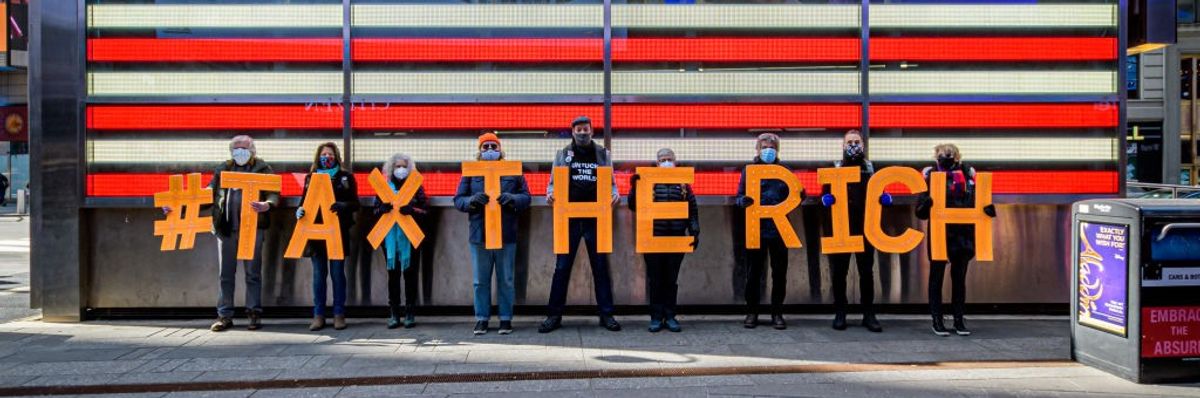
Protesters are pictured spelling out #TaxTheRich at Times Square on March 4, 2021. (Photo: Erik McGregor/LightRocket via Getty Images)

“Almost nobody says we should have the richest pay the least. And yet when we look around the country, the vast majority of states have tax systems that do just that.”

Nearly every state and local tax system in the U.S. is fueling the nation’s inequality crisis by forcing lower- and middle-class families to contribute a larger share of their incomes than their rich counterparts, according to a new study published Tuesday.

Titled Who Pays?, the analysis by the Institute on Taxation and Economic Policy (ITEP) examines in detail the tax systems of all 50 U.S. states, including the rates paid by different income segments.

In 41 states, ITEP found, the richest 1% are taxed at a lower rate than any other income group. Forty-six states tax the top 1% at a lower rate than middle-income families.

“When you ask people what they think a fair tax code looks like, almost nobody says we should have the richest pay the least,” said ITEP research director Carl Davis. “And yet when we look around the country, the vast majority of states have tax systems that do just that.”

“There’s an alarming gap here between what the public wants and what state lawmakers have delivered,” Davis added.

In recent years, dozens of states across the U.S. have launched what the Center on Budget and Policy Priorities recently called a “tax-cutting spree,” permanently slashing tax rates for corporations and the wealthy during a pandemic that saw billionaire wealth skyrocket and company profits soar.

A report released last week, as Common Dreamsreported, showed ultra-rich Americans are currently sitting on $8.5 trillion in untaxed assets.

According to ITEP’s new study, tax systems in just six states—California, Maine, Minnesota, New Jersey, New York, and Vermont—and the District of Columbia are progressive, helping to reduce the chasm between rich taxpayers and other residents.

Massachusetts, which has one of the more equitable tax systems in the nation, collected $1.5 billion in revenue last year thanks to its recently enacted millionaires tax, a measure that improved the state’s ranking by 10 spots in ITEP’s Tax Inequality Index. Minnesota has also ramped up its taxes on the rich over the past several years while expanding benefits for lower-income families, ITEP’s study observes.

“The regressive state tax laws we see today are a policy choice, and it’s clear there are better choices available to lawmakers.”

But the full picture of U.S. state and local systems is grim. In 44 states, tax laws “worsen income inequality by making incomes more unequal after collecting state and local taxes,” ITEP found.

Florida has the most regressive tax code in the U.S., with the richest 1% paying a mere 2.7% tax rate while the poorest 20% pay 13.2%.

Florida is among the U.S. states that don’t have personal income taxes, which forces them to rely on consumption and property taxes that are “nearly always regressive,” ITEP notes in the new analysis.

“Eight of the 10 most regressive tax systems—Florida, Washington, Tennessee, Nevada, South Dakota, Texas, Arkansas, and Louisiana—rely heavily on regressive sales and excise taxes,” the study says. “As a group, these eight states derive 52% of their tax revenue from these taxes, compared to the national average of 34%.”

Aidan Davis, ITEP’s state policy director, said that “we’ve seen a lot of states shift their tax systems to become even more regressive in recent years by enacting deep tax cuts for the wealthiest.”

The report points to Kentucky’s adoption of a flat tax and repeated corporate tax cuts, which “delivered the largest windfall to families in the upper part of the income scale and have been paid for in part through new or higher sales and excise taxes on a long list of items such as car repairs, parking, moving services, bowling, gym memberships, tobacco, vaping, pet care, and ride-share rides.”

Davis said that “we know it doesn’t have to be like this,” arguing there is a “clear path forward for flipping upside-down tax systems and we’ve seen a handful of states come pretty close to pulling it off.”

“The regressive state tax laws we see today are a policy choice,” said Davis, “and it’s clear there are better choices available to lawmakers.”

Original article by JAKE JOHNSON republished from Common Dreams under Creative Commons (CC BY-NC-ND 3.0). 

New Massachusetts ‘Tax the Rich’ Law Raises $1.5 Billion for Free School Lunch and More

1.4 Million Wealthy Americans Are Evading Nearly $66 Billion in Federal Taxes

With Funds Opposed by GOP, IRS to Target Ultrawealthy Tax Delinquents

The Lost Art (and Joy) of Taxing the Rich

300+ Economists, Millionaires, and Elected Officials to G20: ‘Tax Extreme Wealth’
Continue ReadingIn 41 US States, Richest 1% Pay Lower Tax Rates Than Everyone Else

Keeping 1.5 alive, phasing out fossil fuels and tackling climate inequality must be priorities for COP28 climate talks

Spread the love

As the COP28 climate talks begin today in Dubai, the Green Party has set out three key demands. They are to ‘keep 1.5 alive’; an agreement on the fair and managed phase-out of all fossil fuels; and measures to address ‘climate inequality.’ Greens are challenging the UK government to lead by example and put into practice policies that will help meet these demands. 

Image of the Green Party's Carla Denyer on BBC Question Time.
Image of the Green Party’s Carla Denyer on BBC Question Time.

Co-leader of the Green Party, Carla Denyer, said:  

“We need to hear a clear unambiguous commitment from the UK government to the 1.5C Paris Agreement target which was signed up to by 196 countries eight years ago at COP21. The government must agree to whatever it takes to get this target back on track. It’s going to require a hugely ambitious strategy, but the massive scaling up of climate action that is now necessary is because of dither and delay by countries like the UK in taking the bold action needed. 

“Another vital outcome of COP28 must be the fair and managed phase-out of all fossil fuels. As one of the rich countries most responsible for the climate crisis, the UK must stand on the side of future generations and those on the front line of climate breakdown and agree to urgently move away from fossil fuels. The UK government must resist pressure from the petrostates and others at COP who wish to continue with business as usual and keep the world hooked on fossil fuels. At home this means leading by example with an immediate end to all new oil and gas licences and a rapid acceleration towards renewable energy. 

“Thirdly, these climate talks must recognise that it is a super-rich elite who are super-heating the planet. The UK government must be willing to challenge the grotesque inequality driving climate breakdown and reform our tax system to make the polluter pay. This means taxing the wealth of the super-rich and introducing a carbon tax on the most polluting corporations and individuals. Such taxes, introduced globally, could generate the funds needed for a generous new Loss and Damage Fund to finance climate action in the poorest countries – those suffering the most from the impacts of climate breakdown but contributing the least to the crisis.” 

Continue ReadingKeeping 1.5 alive, phasing out fossil fuels and tackling climate inequality must be priorities for COP28 climate talks

‘Modest’ wealth tax on richest 0.3% could raise more than £10bn for public services, says TUC

Spread the love

Abba: Money, Money, Money (“It’s a rich man’s world”.)

https://leftfootforward.org/2023/08/modest-wealth-tax-on-richest-0-3-could-raise-more-than-10bn-for-public-services-says-tuc/

The trade union body has set out options for taxing the small number of individuals with wealth over £3 million, £5 million and £10 million

A modest wealth tax on the richest 140,000 individuals in the country could raise more than £10bn to help pay for public services, according to the Trades Union Congress (TUC).

With the country’s public services in a dire state and with the Tories repeatedly using excuses about not having enough money to invest in them, the TUC has set out a clear plan for how further money could be raised, by taxing the wealthiest 0.3% of the UK population, as it called for a “national conversation about taxing wealth”.

The trade union body has set out options for taxing the small number of individuals with wealth over £3 million, £5 million and £10 million, excluding pensions. It says that the options are illustrative examples of what a wealth tax could look like, using Spain’s existing policy as a potential model.

It proposes the following:

  • A wealth threshold of £3 million with a marginal tax rate of 1.7% would yield £2.7 billion (with the tax payable on wealth above £3 million by 142,000 individuals or 0.27% of adults in the UK)
  • A further wealth threshold of £5 million with a marginal tax rate of 2.1% would yield an additional £3.2 billion (with the tax payable on wealth above £5 million by 48,000 individuals or 0.09% of adults in the UK) 
  • A further wealth threshold of £10 million with a marginal tax rate of 3.5 % would yield an additional £4.6 billion (with the tax payable on wealth above £10 million by 17,000 individuals or 0.02% of adults in the UK).

https://leftfootforward.org/2023/08/modest-wealth-tax-on-richest-0-3-could-raise-more-than-10bn-for-public-services-says-tuc/

Continue Reading‘Modest’ wealth tax on richest 0.3% could raise more than £10bn for public services, says TUC

Campaigners demand stronger tax on private jets as luxury travel in UK soars

Spread the love
Image of a dirty jet passenger aircraft

https://leftfootforward.org/2023/07/campaigners-demand-stronger-tax-on-private-jets-as-luxury-travel-in-uk-soars/

While government refuses to reveal details of Prime Minister’s private jet use at taxpayer expense

Campaigners have announced that private jets ‘are even worse than we thought’ after new research presents their high carbon footprint and low rate of taxation in the UK as post-pandemic luxury travel grows.

One in ten flights from UK airports are now from private jets, research by the climate action campaign group Possible found. Pre-pandemic, 7.5% of flights were private, which peaked at 20% during the pandemic and now sits at 10%.

Emissions from private jets are 30 times higher than normal flights, yet activists have stressed that the taxation is not proportionate. Half of private jet passengers pay the same rate of tax as passengers on standard flights, whilst one in five private jets pay no tax at all.

Possible are calling for a ban on private jets by 2030, with a proper tax system in place until then. The group’s report ‘jetting away with it’ found that, the more polluting an individual’s flight is, the lower the effective rate of tax per tonne of emissions.

https://leftfootforward.org/2023/07/campaigners-demand-stronger-tax-on-private-jets-as-luxury-travel-in-uk-soars/

Continue ReadingCampaigners demand stronger tax on private jets as luxury travel in UK soars

How much tax do oil companies usually pay?

Spread the love
Image of loads of money

Part of a wider article by BBC discussing the UK’s Windfall tax on big oil and gas companies.

Shell initially said it did not expect to pay any windfall tax for 2022, as its North Sea investments meant was not considered to have made any UK profits.

But on 2 February it announced that it would pay $134m (£108m) for 2022, and expected to pay more than $500m (£400m) for 2023.

BP said it would pay $700m (£583m) in windfall tax for 2022.

BP and Shell both received more money back from the UK government than they paid every year from 2015 to 2020 (except 2017, when Shell paid more than it received).

Shell also paid a negative amount of tax in 2021, taking its 2015 to 2021 total to -£685m of tax in the UK.

BP paid more money in tax than it received back in 2021, taking its total between 2015 and 2021 to -£107m.

Continue ReadingHow much tax do oil companies usually pay?