Instead of Holocaust Museum, Detour Signs Direct Israel’s Herzog to The Hague

Spread the love

Original article by COMMON DREAMS STAFF republished from Common Dreams under Creative Commons (CC BY-NC-ND 3.0). 
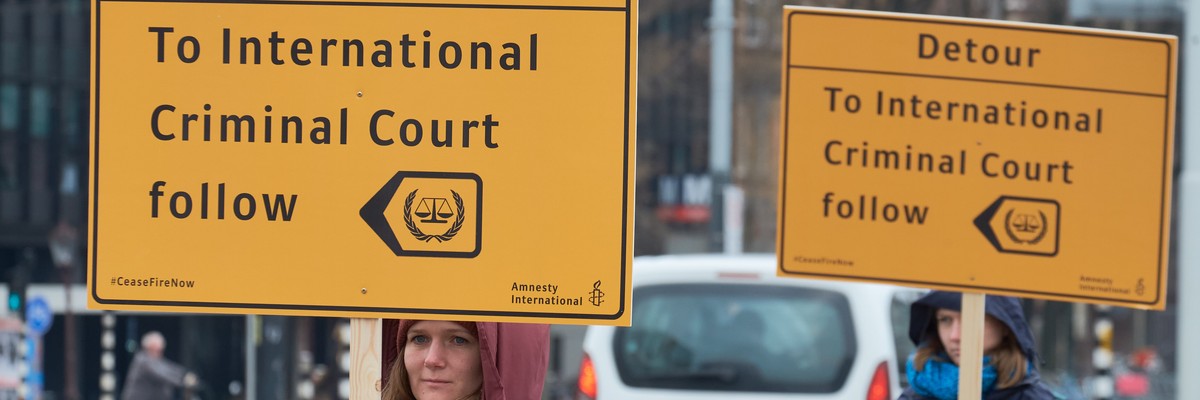
Human rights activists of Amnesty International hold traffic boards showing the way to the International Criminal Court for the President of Israel, Isaac Herzog on March 10, 2024 in Amsterdam, Netherlands. Over 30,000 Palestinians have been killed in Israeli attacks on Gaza since October 7. The President of Israel is in Amsterdam to open the Holocaust Museum. (Photo by Pierre Crom/Getty Images)

“How is it possible that such a sacred space is being used to normalize genocide today?” asked one Dutch Jewish organizer behind the protest.

Human rights activists in The Netherlands greeted Israeli President Isaac Herzog on Sunday with large protests and directed him towards the International Criminal Court at The Hague over his nation’s alleged war crimes against the Palestinian people in the Occupied West Bank and Gaza.

Herzog was in Amsterdam to attend the opening of the new National Holocaust Museum, but demonstrators said Herzog’s presence needed to be challenged given the large scale death and destruction that Israel’s military has unleashed in Gaza over the last five months.

As Al-Jazeera reports:

Dutch Jewish anti-Zionist organization Erev Rave, which organized the demonstrations at the musuem’s opening with the Dutch Palestinian community and Socialist International, said that while it is important to honor the memory of Holocaust victims, it cannot stand by while the war in Gaza continues.

“For us Jews, these museums are part of our history, of our past,” said Joana Cavaco, an activist with Erev Rav, addressing the crowd before the museum’s opening ceremony. “How is it possible that such a sacred space is being used to normalize genocide today?”

A pro-Palestinian Dutch organization, The Rights Forum, called Herzog’s presence “slap in the face of the Palestinians who can only helplessly watch how Israel murders their loved ones and destroys their land.”

Along Herzog’s route through the city, members of Amnesty International—which has accused Israel of apartheid and backed the findings of the International Court of Justice (ICJ) which said policies in Gaza may amount to genocide—carried fake detour signs pointing the motorcade towards the nearby ICC.

As the president of Israel, Amnesty International Netherlands said Herzog “is the political symbol of the humanitarian disaster in Gaza. It is unfortunate that Herzog was invited after his controversial statements. That is why we are taking action.”

Amnesty and other rights groups have documented numerous incidents in Gaza and the West Bank that they say may amount to “war crimes,” including the indiscriminate bombing of civilians areas, the use of prohibited weapons like white phosphorous, attacks on hospitals and emergency medical personnel, the blocking of life-saving food, water, and other supplies, and other acts of “callous disregard for Palestinian lives.”

At a square nearby the museum where Herzog gave his speech, reportsReuters, demonstrators crowded the streets and chanted slogans like “Cease-fire Now!” and “Stop Bombing Children!” as they held signs that read “Jews Against Genocide” and “The Grandchild of a Holocaust Survivor Says: Stop Gaza Holocaust.”

Ahead of Sunday’s opening, the Jewish Cultural Quarter that operates the new museum, said in a statement that it was “profoundly concerned by the war and the consequences this conflict has had, first and foremost for the citizens of Israel, Gaza and the West Bank.”

The statement said the museum stands “for a just and resolution for all those directly involved” and the impact the ongoing violence and hatred is having beyond the Middle East:

The reduction to black-and-white opposites and apparently incompatible arguments – oppressed against oppressor, good against bad, truth against lie. This polarization has spread hatred toward Jews and Islamophobia. It takes courage to speak out against injustice. It takes courage to recognize that the real world is complex and contradictory, and that our empathy need not be confined to one side.

At the heart of the National Holocaust Museum’s mission is the desire to build a just society in the Netherlands by signalling the danger of dehumanizing and excluding those who live among us. That is the message in our presentation, our educational program and our events.

The group said Herzog had been invited to attend the opening prior to the Hamas-led attack on October 7 of last year, but that the fighting since has only further revealed the importance of remembering and learning from the past.

That “the war continues to rage,” the statement concluded, “makes our mission all the more urgent.”

Original article by COMMON DREAMS STAFF republished from Common Dreams under Creative Commons (CC BY-NC-ND 3.0). 

Israeli President Herzog Opens Holocaust Museum In Amsterdam … ›

With Genocide in Gaza, the Word ‘Never’ Has Been Stripped From ‘Never Again’

Continue ReadingInstead of Holocaust Museum, Detour Signs Direct Israel’s Herzog to The Hague

South Africa to file legal action with ICJ against UK, US, for war crime complicity

Spread the love

Article republished from the Skwawkbox

South Africa’s legal team at the ICJ last month

Nation whose case put Israel formally on trial for genocide joins Nicaragua in turning its sights on accomplices in genocide

A team of almost fifty South African lawyers is preparing a legal case to bring to the International Court of Justice (ICJ), the United Nations’ top court, against the US and UK, for their complicity in Israel’s array of war crimes in Gaza and the occupied West Bank.

South Africa’s successful ICJ case against Israel last month led to Israel being put formally on trial for genocide and resulted in a string of binding orders on Israel to stop its slaughter of Gazans and even to protect Palestinians from harm, as well as to ensure adequate aid reaches the strip’s 2.5 million people, many of whom are now starving and homeless.

Israel has flouted the rulings, continuing and even intensifying the mass murder and blockade, and is being supported in its flagrant disregard for international law by the UK and US, who are providing both material and financial aid, and giving political cover by refusing to condemn Israel’s actions or to call its crimes what they are, instead casting doubt on the mass deaths and brutality and denigrating the Court’s ruling.

South Africa joins Nicaragua in taking action against the UK and US. The Central American nation has also filed a case against Germany, Canada and the Netherlands.

The team of lawyers, which already numbers around fifty, is likely to grow further as more lawyers are set to join from other nations. Wikus van Rensburg, who is leading the action, said that it was time for the US and other complicit nations to “be held responsible for [their] crimes”.

Article republished from the Skwawkbox

Continue ReadingSouth Africa to file legal action with ICJ against UK, US, for war crime complicity

Dutch Court Hears Case Accusing Government of Complicity in Israeli War Crimes

Spread the love

Original article by JULIA CONLEY republished from Common Dreams under Creative Commons (CC BY-NC-ND 3.0).

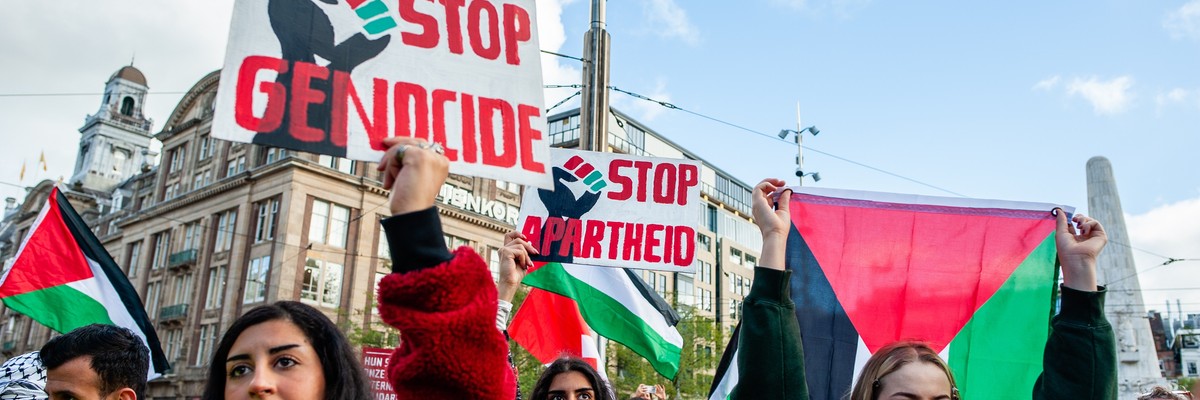
Protesters hold signs denouncing genocide during a demonstration in solidarity with Palestine in Amsterdam on October 15, 2023. (Photo: Ana Fernandez/SOPA Images/LightRocket via Getty Images)

“When military goods can contribute to human rights violations or international humanitarian law, that export is strictly prohibited,” said one campaigner. “It is incomprehensible that, despite clear warnings, the government has knowingly deviated from this.”

A Dutch court on Monday heard opening arguments in a case brought by four human rights organizations that have accused the government of the Netherlands of being complicit in Israeli war crimes due to its export of military supplies as Israel kills thousands of civilians in Gaza.

Supplying the Israel Defense Forces (IDF) with parts for F-35 fighter jets, which are stored in a warehouse in the Netherlands, puts the Dutch government at risk for “becoming complicit in violations of international humanitarian law,” the director of the Dutch branch of Amnesty International , one of the plaintiffs, said when the lawsuit was announced last month.

Amnesty is joined by Oxfam Novib—the Dutch chapter of Oxfam International—The Rights Forum, and PAX in the case, which is expected to result in a judgement around December 15.

The groups filed the lawsuit after government documents showed the Netherlands had allowed at least one shipment of reserve parts for F-35s since October 7, Al Jazeera reported .

The Dutch Defense Ministry wrote in a letter to Parliament that “it cannot be established that the F-35s are involved in grave violations of the humanitarian laws of war,” but with nearly 16,000 people killed in Gaza in less than two months—including more than 6,600 children —the human rights groups aim to test that claim in court.

“The state must immediately stop its deliveries of F-35 parts to Israel,” lawyer Liesbeth Zegveld said Monday at the Hague District Court. “That is its obligation under… Article 1 of the Geneva Conventions, it is its obligation under the Genocide Treaty to prevent genocide, and it is its obligation under export law.”

Martje van Nes, PAX’s director of organization, pointed out last month that “the Netherlands has a very concrete assessment framework for arms exports.”

“When military goods can contribute to human rights violations or international humanitarian law, that export is strictly prohibited,” said van Nes. “It is incomprehensible that, despite clear warnings, the government has knowingly deviated from this. This makes them responsible for the deployment of the equipment.”

PAX noted on Monday that the call for the Netherlands to end shipments of any supplies that Israel could use to continue its massacre of Palestinian civilians—in retaliation for an attack by Hamas in October that killed 1,200 Israelis—”is all the more urgent” considering the end of a temporary cease-fire on Friday. More than 800 people have been killed since the pause in fighting ended last week, and Israel was stepping up its ground attacks on Monday.

“As far as we are concerned, the government must take action now to protect citizens,” said PAX on social media. The group has demanded a permanent humanitarian cease-fire.

Dagmar Oudshoorn, director of Amnesty International in the Netherlands, said that as the host country “of both the International Court of Justice and the International Criminal Court,” the Dutch government “likes to present itself as a champion of international law.”

“Our government is losing all credibility right now,” she said. “Evident violations such as food, water, and fuel blockade, the forced displacement of the population, and the bombing of schools and hospitals, are not mentioned. And by supplying armies, the Netherlands runs the risk of becoming complicit in violations of international humanitarian law.”

The Netherlands has maintained since October 7 that Israel “has the right to defend itself” and has called for Prime Minister Benjamin Netanyahu’s government to adhere to international law, but the groups said the IDF is clearly not doing so and should lose the support of the country.

“This complicity must stop now,” said Gerard Jonkman, director of The Rights Forum.

Original article by JULIA CONLEY republished from Common Dreams under Creative Commons (CC BY-NC-ND 3.0).

Continue ReadingDutch Court Hears Case Accusing Government of Complicity in Israeli War Crimes

How much do people around the world care about climate change? We surveyed 80,000 people in 40 countries to find out

Spread the love

This article is republished from The Conversation under a Creative Commons license. Read the original article.


ra2 studio / shutterstock

Simge Andı, University of Oxford and James Painter, University of Oxford

New survey results from 40 countries shows that climate change matters to most people. In the vast majority of countries, fewer than 3% said climate change was not serious at all.

We carried out this research as part of the University of Oxford’s Reuters Institute annual Digital News Reports. More than 80,000 people were surveyed online in January and February of this year.

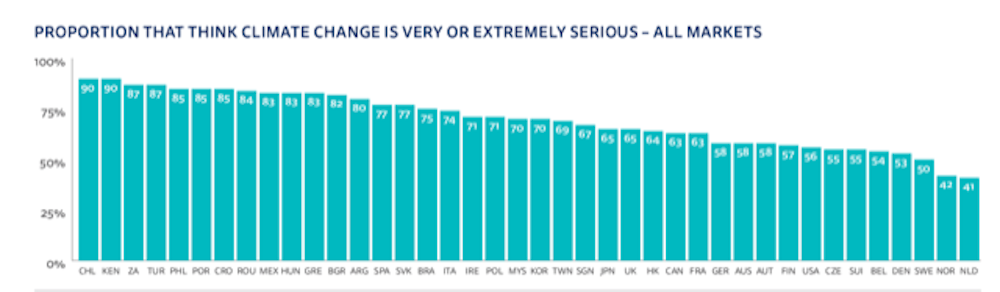
Almost seven in ten think climate change is “a very, or extremely serious, problem”, but the results show notable country differences. Lack of concern is far higher in the US (12%) as well as in Sweden (9%), Greta Thunberg’s home country. Despite disastrous bush fires at the time of our fieldwork, 8% of respondents in Australia report that climate change is not serious at all. These groups with low levels of concern tend to be right wing and older.

Four of the five countries showing the highest levels of concern (85-90%) were from the global south, namely Chile, Kenya, South Africa and the Philippines. However, in countries with lower levels of internet penetration, our online survey samples over-represent people who are more affluent and educated.


Almost everyone in Chile and Kenya thinks climate change is serious. But that’s not the case in Scandinavia and the Low Countries.
Reuters Institute Digital News Report, Author provided

Perhaps surprisingly, the five countries with the lowest levels of concern are all in Western Europe. In Belgium, Denmark, Sweden, Norway and the Netherlands, only around half (or less) think that climate change is a serious problem.

It is the first time that results from survey questions on climate change have been included in the Reuters Institute’s reports, so it is difficult to draw out historical trends. However, results in 2015 from the Pew Center based on surveys in 40 countries (with different questions and countries to those in our survey) found that 54% of those surveyed thought that climate change was “a very serious” problem.

So it looks like concern for climate change may be rising globally. There is certainly strong evidence that it is increasing in some countries. In the US, in November 2019 two in three Americans (66%) said they were at least “somewhat worried” about global warming, an increase of 10 percentage points over the past five years.

In the UK, data from the CAST centre at Cardiff University showed that in 2019 levels of “worry” about climate change were at their highest recorded point. Extreme weather events, media reporting and wider publicity were mentioned by respondents as reasons for their increase in concern.

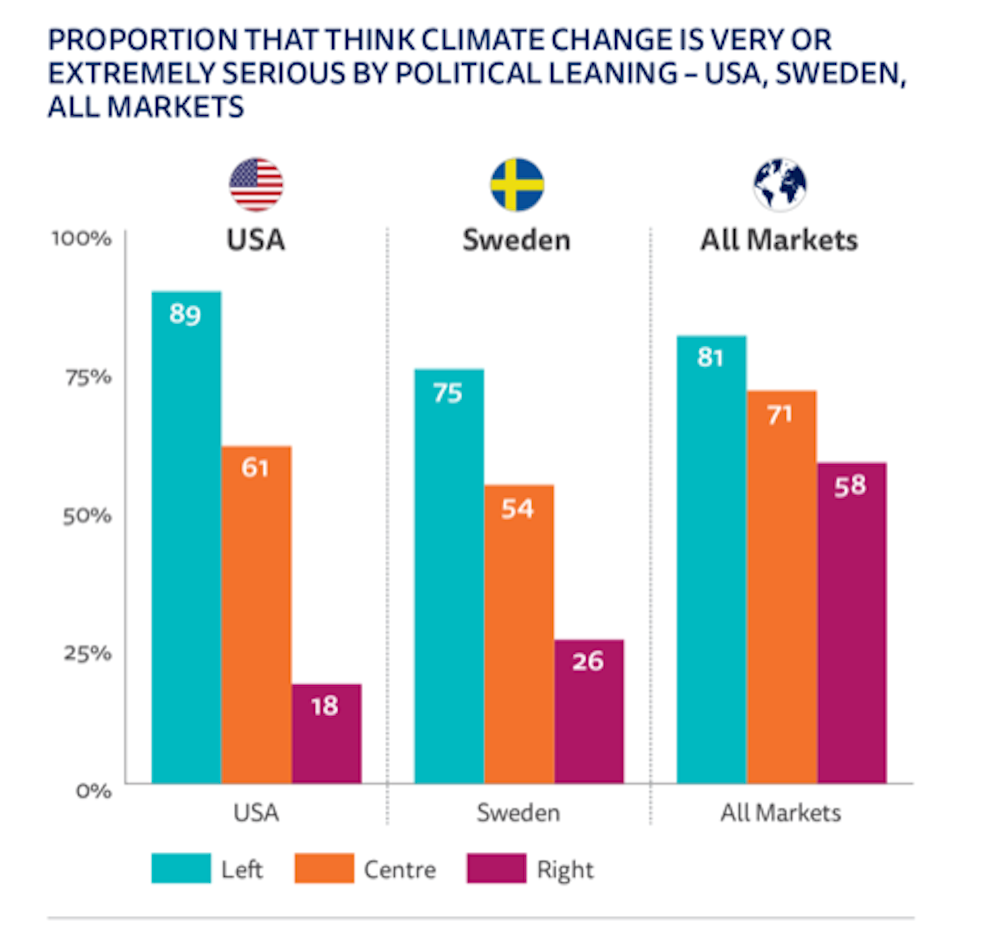
In our survey, across countries and markets, individuals who identify as left-wing tend to report higher levels of concern. This finding is even more visible in more polarised societies such as the US where 89% of those who self-identify on the left note that climate change is serious, compared to only 18% of those who self-identify on the right.


Right-wingers tend to take climate change less seriously – especially in the US and Sweden.
Reuters Institute Digital News Report, Author provided

We also find a similar divide in Sweden. As Sweden is widely considered one of the world’s most progressive nations, these results surprised us and we asked Martin Hultman, a researcher in climate denialism at Chalmers University in Gothenburg, what to make of them.

“These figures do not surprise me”, he told us in an email. “Since 2010, the leadership of the far-right political party Sweden Democrats has been against all types of policies to tackle climate change, including the Paris Agreement.”

“And we know that the spread of climate change denial ideas and rhetoric is widespread in Sweden – not least when digitally-born far-right media sites spread conspiracy theories about Greta Thunberg.”

TV news still dominates

Across all countries, people say they pay most attention to climate news on television (35%). Online news sites of major news organisations are the second most popular news source (15%), followed by specialised outlets covering climate issues (13%), then alternative sources such as social media and blogs (9%).

Figures from the UK, US and Australia are broadly in line with these preferences. Printed newspapers and radio are way down, with only around 5% saying each was the source they paid most attention to. In Chile, where the concern is high, specialised outlets covering climate issues (24%) as well as alternative sources such as social media (17%) are nearly as popular as television (26%).

The differences in climate news consumption are also visible among different age groups. Younger generations, more specifically the so-called Generation Z (aged 18-24), are more likely to report paying attention to alternative sources on climate change (17%) as well as TV (23%) and online news sites from major news organisations (16%). Older people, however, rely more heavily on TV (42%) and use less of the online news sites (12%) or alternative sources such as social media (5%).

Respondents from both sides of the political spectrum criticise the media for either being too doom-laden, or not bold enough, in their coverage of climate change. That said, our survey shows that almost half of our respondents (47%) think that news media generally do a good job of informing them about climate change, and 19% think that they do a bad job.

However, those who have low levels of concern are much more inclined to say that the news media are doing a bad job (46%). This might indicate a lack of trust in climate change coverage or a more general loss of confidence in the news media.The Conversation

Simge Andı, Postdoctoral Research Fellow, Reuters Institute for the Study of Journalism, University of Oxford and James Painter, Research Associate, Reuters Institute, University of Oxford

This article is republished from The Conversation under a Creative Commons license. Read the original article.

Continue ReadingHow much do people around the world care about climate change? We surveyed 80,000 people in 40 countries to find out