Australian lawmakers call for Julian Assange’s release ahead of extradition appeal
Original article by Tanupriya Singh republished from peoples dispatch under a Creative Commons Attribution-ShareAlike 4.0 (CC BY-SA) license.
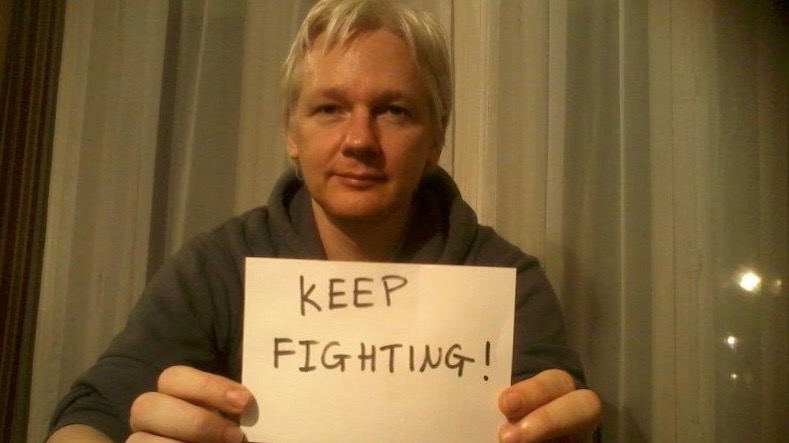
The motion in parliament, which was supported by Prime Minister Anthony Albanese, has called for the return of imprisoned WikiLeaks founder Julian Assange to his family in Australia. Assange is days away from a final court hearing in the UK against his extradition to the US.
On February 14, lawmakers in Australia’s parliament voted 86-42 in support of a motion calling on the UK and the US to return arbitrarily imprisoned WikiLeaks founder and journalist, Julian Assange, to his home and family in Australia.
The move, which was also supported by Prime Minister Anthony Albanese, came just days before the High Court of Justice in London will decide if Assange can continue to contest his extradition to the US through the UK’s legal system.
The US has indicted Assange on 18 charges, 17 of which are under the notorious Espionage Act, in relation to the publication of confidential documents on WikiLeaks that exposed the war crimes and atrocities committed by US forces during the invasions of Iraq and Afghanistan. If convicted, Assange would face up to 175 years in a maximum security prison.
The 52-year-old journalist has already been held at the UK’s high security Belmarsh prison for nearly five years, without charge or conviction, amid serious concerns over his mental and physical health.
“Mr. Assange has been deliberately exposed, for a period of several years, to progressively severe forms of cruel, inhuman or degrading treatment or punishment, the cumulative effects of which can only be described as psychological torture.” Nils Melzer, the former UN Special Rapporteur on torture, had said of the journalist’s condition back in 2019.
Addressing a press conference on February 15, Assange’s partner, Stella, stated that his “life is at risk every single day he stays in prison– and if he is extradited he will die”, warning that Assange could be “on a plane within days”.
The public hearings on February 20 and 21 will mark the culmination of a protracted legal battle for Assange. A two-judge bench of the High Court will review a June 6, 2023 decision by Justice Jonathan Swift, in which he had rejected all eight grounds of appeal filed by Assange’s legal team.
If approved, the appeal will challenge the extradition order approved by the UK Home Office in June 2022.
Read more: Assange completes four years in UK jail, struggle against US extradition continues
On Wednesday, independent lawmaker Andrew Wilkie introduced a motion in the Australian parliament, calling on the US and the UK to bring “the matter to a close so that Mr. Assange can return home to his family in Australia”.
“This will be the time for all of us to take a stand, to stand up and to take a stand, and to stand with Julian Assange, stand for the principles of justice, stand for the principles of media freedom and the rights of journalists to do their job…This has gone on too long, that it must be brought to an end.”
Commenting directly on the matter in Parliament on February 15, PM Albanese stated that there was a “common view” that “enough is enough”. “People will have a range of views about Mr. Assange’s conduct… but regardless of where people stand, this thing cannot just go on and on indefinitely.”
He went on to state, “I hope it can be resolved amicably. It’s not up to Australia to interfere in the legal processes of other countries, but it is appropriate for us to put our very strong view that those countries need to take into account the need for this to be concluded.”
The Prime Minister’s ambiguous statements throughout the legal proceedings, including a refusal to outrightly call for a withdrawal of the extradition order, has been criticized by progressive, anti-imperialist forces, with the late renowned journalist John Pilger having called it a “betrayal” in March 2023.
Read more: The betrayers of Julian Assange
Addressing reporters outside Parliament House on Thursday, Assange’s brother, Gabriel Shipton, warned that his extradition would mean that “all the ties to his family, his lifeline that are keeping him alive inside that prison will be cut off and he’ll be lost into a horrific prison system in the United States”.
He added that the vote in parliament had given the Australian government a “real mandate to advocate very, very strongly for a political solution” to bring Assange home.
“It’s not just about being extradited. Julian should never have been put in prison in the first place,” Stella Assange implored on Thursday, as journalists and activists across the world have warned of the impact Assange’s case could have on the press.
“We are seeing a critical attack on press freedom worldwide. It is like a disease, an anti-press pandemic, creeping up on us that has been incrementally taking shape over the years”, said WikiLeaks editor-in-chief Kristinn Hrafnsson, adding that Assange had been the “canary in the gold mine”.
Read more: Julian Assange case: 4 things that the media doesn’t tell you
Assurances about conditions in US prison are “dubious”, say advocates
This was reiterated by over 35 law professors in the US in a letter sent to the Department of Justice on February 14, stating that Assange’s prosecution posed an “existential threat” to the freedom of speech and press enshrined under the First Amendment.
These “constitutional implications” could “extend beyond the Espionage Act and beyond national security journalism [to] enable prosecution of routine newsgathering under any number of ambiguous laws and untested legal theories.”
Assange’s extradition to the US was approved on the basis of supposed “assurances” given by the US regarding his safety, including the avoidance of what are called “special administrative measures” (SAMs) — a horrific punitive measure that combines “the brutality and isolation of maximum-security units with additional restrictions that deny individuals almost any connection to the human world”.
However, human rights organizations and observers had immediately warned that these “assurances” were unreliable and could be arbitrarily revoked.
“The US assurances cannot be trusted. Dubious assurances that he will be treated well in a US prison ring hollow considering that Assange potentially faces dozens of years of incarceration in a system well known for its abuses, including prolonged solitary confinement and poor health services for inmates,” stated Julia Hall, the international expert on counter-terrorism and criminal justice in Europe at Amnesty International.
If the High Court of Justice in London does not rule in favor of Julian Assange next week, Stella Assange has stated that he will then approach the European Court of Human Rights (ECHR), seeking urgent measures to halt his extradition under Rule 39— granted when there is an “imminent risk of irreparable harm” — pending a full consideration of his case.
The present UN Special Rapporteur Dr. Alice Edwards, has also pointed out that outside of the legal process, the ultimate decision to actually proceed with the extradition will lie with the US Secretary of State. Antony Blinken, for his part, had rebuffed calls by the Australian government last year to drop the prosecution.
“The UK is a party to the UN convention against torture as well as the European convention on human rights, both of them have Article 3 which prohibits states from sending people to where they may face this type of treatment [torture],” Edwards said.
Original article by Tanupriya Singh republished from peoples dispatch under a Creative Commons Attribution-ShareAlike 4.0 (CC BY-SA) license.