Starmer under pressure over cruel plan to slash welfare budget
… KEIR STARMER came under pressure from MPs across the Commons over his cruel plan to cut benefits today.
Labour announced on Tuesday that it will slash £5 billion from the welfare budget by the end of the decade.
In the Commons, Labour’s Diane Abbott told Sir Keir to stop pretending his cuts were moral.
“There is nothing moral about cutting benefits for what may be up to a million people,” she said.
“This is not about morality, this is about the Treasury’s wish to balance the country’s books on the back of the most vulnerable and poor people in this society.”
Colum Eastwood from the SDLP told the prime minister of a constituent “who needed help, she had a disability. It meant that her children have to cut up her food, they have to help her wash between the waist, they have to supervise her when she goes to the toilet.
“Under the Tory welfare system we were able to get that lady on PIP. Under the Prime Minister’s new proposed system she will get zero, nothing.
“And after 14 years of the Tory government — and many of us wanted to see the back of them — can the Prime Minister answer one question – what was the point if Labour are going to do this?”
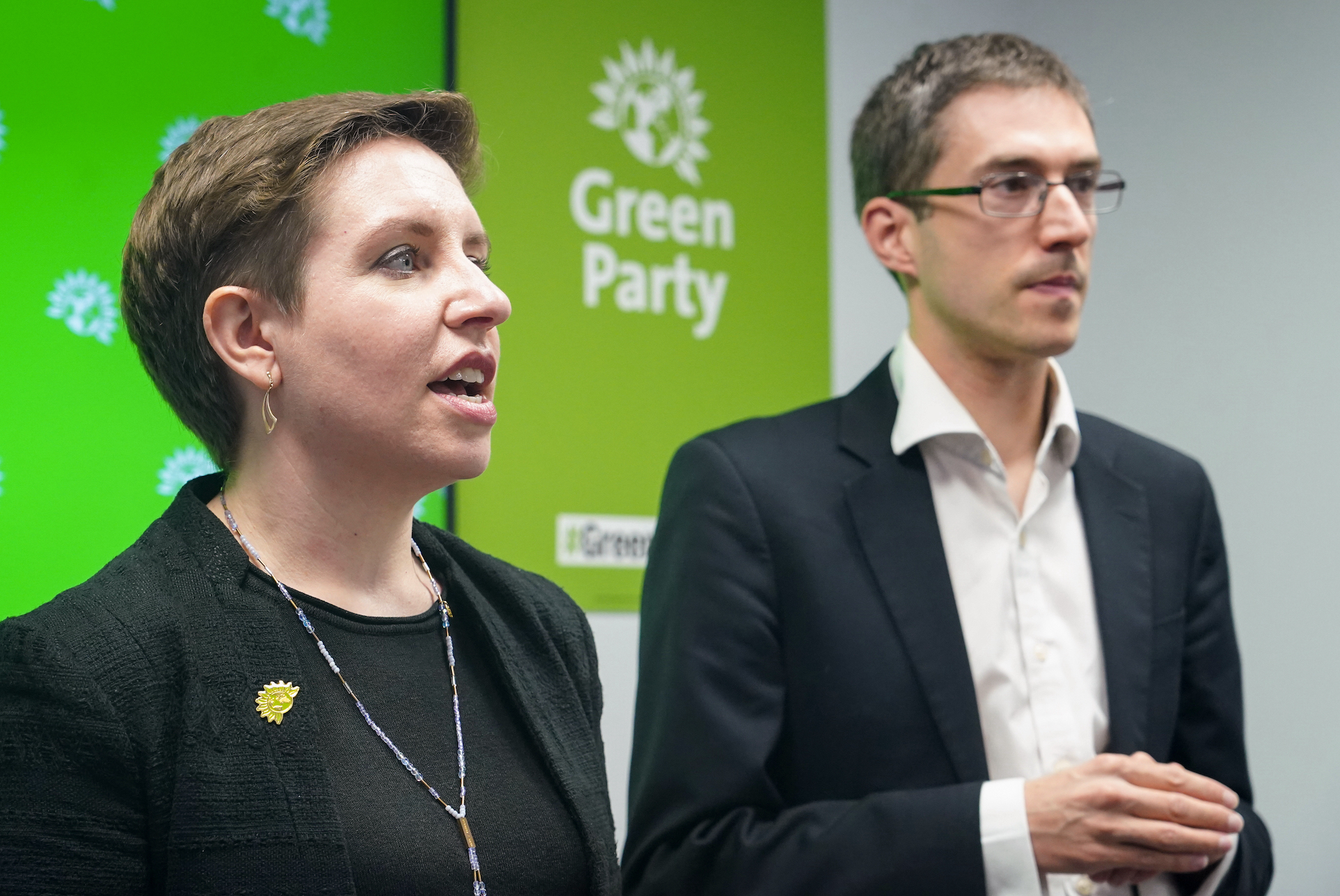
Green co-leader Carla Denyer urged a wealth tax instead of cuts, a policy quietly supported by many Labour MPs.
“We have a deeply unfair, unequal economic system where vast numbers of people are struggling yet billionaires are getting richer and richer,” she told Sir Keir.
“Does the Prime Minister really think that the way to tackle this is to put the onus onto older people, children and now sick and disabled people rather than on the shoulders of the super-rich with a wealth tax, those people who could most easily afford to pay?”
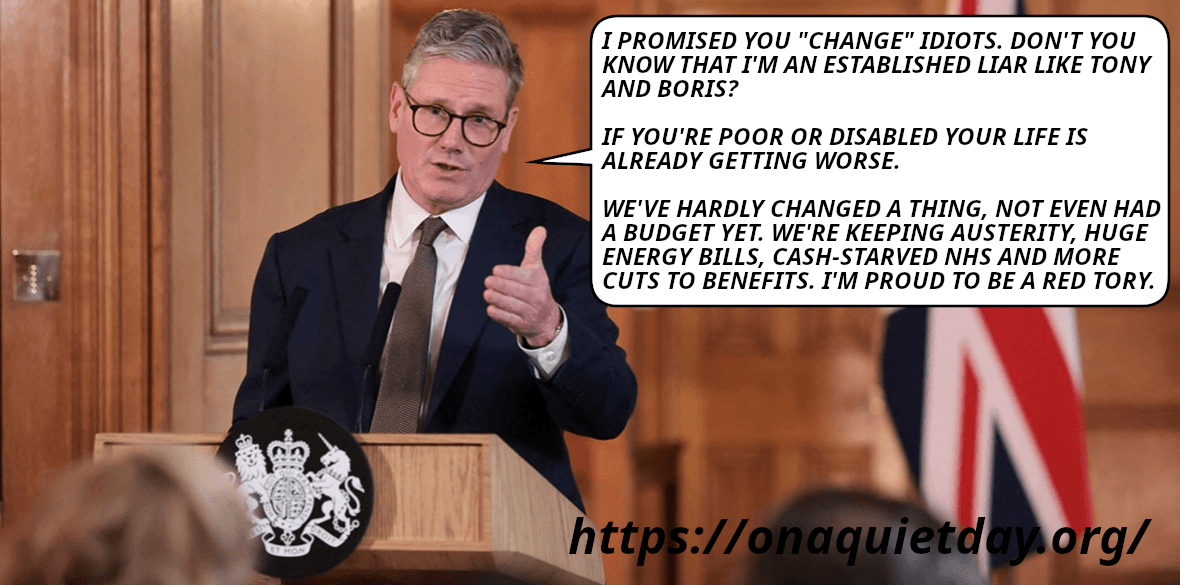
Keir Starmer confirms that he’s proud to be a red Tory continuing austerity and targeting poor and disabled scum.Keir Starmer says pensioners can freeze to death and poor children can starve and be condemned to failure and misery all their lives.
Introducing a wealth tax would indicate this is a progressive government. But that seems unlikely
Taking as his theme the need to “fix the foundations” after “14 years of rot” under Tory rule, new Labour prime minister Keir Starmer this week delivered a message that should bring discomfort to everyone in the months and perhaps years to come.
Those “14 years of rot” are of no surprise to voters; indeed, they helped ensure a landslide Labour victory in the election in July. But Starmer’s plans to resolve them appear likely to be far harsher than many voters expected.
The chancellor of the Exchequer, Rachel Reeve, has made numerous hints that hard times are ahead. Her October budget will be uncompromising in its commitment to raising revenue to help fill a fiscal hole reckoned to be around £20bn – but much of this money seems likely to be taken from the poorer sections of society, not the rich.
Labour will retain unpopular policies introduced by the Conservatives – the ‘bedroom tax’ and limiting child benefit allowances to the first two children, for example – while introducing its own cost-cutting measures, such as reducing the winter fuel allowances for many pensioners.
These actions contribute to a growing sense that the Starmer government will prove to be decidedly right-of-centre in a country beset with deep divisions of wealth and poverty. Some areas may see an improvement, such as labour rights, but even there, it is a matter of the devil in the detail.
One area where the government does apparently have cash to spash, though, is military spending, which is set to be substantially increased despite the manifest failures in Afghanistan, Iraq and Libya, and the deeply unpopular Israeli wars on Gaza and the West Bank.
Labour’s attitude to Israel is certainly unlikely to change, with the Department for Business and Trade reporting on efforts to strike a new trade deal with the country, saying: “Our teams will be entering negotiating rooms as soon as possible, laser-focused on creating new opportunities for UK firms.” An official from the British Embassy in Israel also recently wrote of the “tremendous opportunity for collaboration between Israeli and British companies”.
A full-scale Strategic Defence Review is also underway, and there are few if any indications that it will start by addressing the grievous failures of the past two decades. If previous experience is anything to go by, it will likely also omit the main challenge to international security: climate breakdown. Without that, the review will not be worth the paper it is written on. Net zero secretary Ed Miliband may be doing his best to maintain the idea of a green transition but the issue would be sidelined by any major increase in government spending.
On the domestic front, less than two months into the new Labour government the contrast between Food Bank Britain and the ludicrous levels of runaway wealth is apparent. It was coincidentally yet powerfully illustrated just four days before Starmer’s pre-budget speech, by a full-page property advertisement from Sotheby’s in the Financial Times.
Of the seven properties on sale, one was a relatively modest three-bedroom apartment in Chelsea, on sale for a mere £5m, while the others included a six-bedroom house in Belgravia offered at £18m and a nine-bedroom/five-bathroom place near Regent’s Park for £20m. Another Regent’s Park number was on sale for £25m million, which at least had 7 bathrooms for the 6 bedrooms. Trumping all was a triplex number in Knightsbridge – £50m with exclusive access to Hans Place Gardens.
While we have to wait for the October budget announcements, we can be reasonably sure that there will be some attempts to raise modest amounts from the wealthier sectors of society, possibly involving changes in capital gains and inheritance taxes. But the best indicator of a changed government would be one willing to bring in wealth taxes, especially those directed at the super-rich.
Onee of Britain’s largest trade unions, Unite, recently proposed a 1% per annum tax on those with net assets of over £4m, which would include property, shares and bank holdings but not mortgaged property. That is estimated to yield £25bn a year but would be bitterly opposed, with the Daily Mail informing us that: “Millionaires are looking to flee the UK in their droves to escape Labour’s tax raids – with a record number of wealthy Britons tipped to leave the country this year.”
As things stand, the budget is expected to include substantial cuts in public spending that could be at least partly avoided by such a wealth tax, and it is worth noting that some European countries such as Switzerland and Spain have already introduced them. At least Britain’s wealthy won’t be fleeing “in their droves” to those countries.
If adopted in October, in even a modest form, a wealth tax would be a reasonable marker for a progressive government. If not, then an opportunity will be missed for placing Labour in a more progressive place in the political spectrum than currently seems at all likely.
Keir Starmer confirms that he is continuing Tory policies and that he’s proud to be a red Tory.Keir Starmer says pensioners can freeze to death and poor children can starve and be condemned to failure and misery all their lives.
Chancellor of the Exchequer Rachel Reeves during a press conference following her statement to the House of Commons on the findings of the Treasury audit into the state of the public finances, July 29, 2024
Unite general secretary Sharon Graham calls for wealth tax
MORE austerity is on the agenda as Chancellor Rachel Reeves prepares a new clampdown on public spending in her autumn Budget.
In a move that risks sparking new divisions and struggle within the labour movement, Ms Reeves is set to prioritise reassuring global money markets over repairing the damage done by the Tories.
She is reported to have been spooked by figures showing public sector borrowing at £3.1 billion in July, £1.8bn more than a year previously and above most expectations.
However, borrowing has fallen over a longer time-frame, but Ms Reeves will pay more attention to the short-term figures and use them as a reason to impose more austerity.
…
Unite general secretary Sharon Graham has called for a shift in priorities, saying: “We are the sixth-richest economy in the world, where the 50 richest families are worth £500bn.
“It is clear, irrespective of ‘black holes,’ that we need to consider a wealth tax.”
“The idea that rich and poor are equal before government in democratic societies is ludicrous,” writes Polychroniou. “As disparities in wealth and income grow, so do the disparities in political influence.” (Photo: flickr/Creative Commons)
Wealth taxation may sound like a good idea, but can it really address, let alone solve, the problem of inequality?
Economic inequality is the scourge of the 21st century. The rich are getting richer and faster than any other time since the onset of neoliberalism, which calls for “free-market” capitalism, regressive taxation, fiscal austerity and the rejection of the social state. They get richer not only when the economy is on an upswing but even amid crises. Billionaires more than doubled their net worth during the pandemic, according to Bloomberg Billionaires Index.
The latest analysis shows that the richest 1 percent gained $42 trillion in new wealth over the past decade, which amounts to “nearly 34 times more than the entire bottom 50 percent of the world’s population.” In the meantime, the very poor and low-income people across the globe, including the U.S., are actually getting poorer. So much for trickle-down economics which was popularized during the 1980s by the Reagan administration’s vast capital gains and income tax cuts and continues to persist to this day in spite of its major flaws. Cutting taxes on the rich not only increases economic inequality but has no effect on economic growth and unemployment.
There must be something very rotten with an economic system that allows individuals to generate obscene amounts of wealth to the point they can hijack the political system and undermine democracy.
However, inequality should not be examined purely from an economic perspective. Over the years, numerous studies have shown that economic inequality influences public attitudes toward democracy by generating political disillusion and low trust in government and other institutions, like Congress. Inequality also undermines social mobility, contributes to political polarization and fuels authoritarianism.
Finally, inequality contributes to climate change. The richest 1 percent is responsible for more carbon emissions than the poorest 66 percent, according to a 2023 report by Oxfam. Of course, while the world’s wealthiest people make a huge contribution to climate change, they are also able to insulate themselves from the worst impacts of global warming.
In sum, the super-rich can be blamed for many of the most serious ills confronting societies in the twentieth-first century. The only consequential question here is this: what can be done about it then?
One of the most frequent responses to the problem of rising inequality is a call for the implementation of a wealth tax. Wealth taxation may sound like a good idea, but can it really address, let alone solve, the problem of inequality? The answer is an unqualified “no.” At least for the world’s advanced economies. Indeed, even if it’s possible to discover all the wealth that the very rich people own (much of which is hidden in companies or put in trusts) and then proceed with an accurate asset valuation, this will have very little impact, if any, on the daily lives of people who try to survive on minimum wages. Wealth taxation alone will have no impact on workers without social protection and no bargaining power at companies. It won’t protect workers at the “gig economy” and part-time workers.
To effectively address economic inequality, we must identify the root cause of the problem, and one simple way to do this is by asking a rather simple question: How does one become superrich? Where does this immense wealth come from? Because as the renowned progressive economist James K. Boyce recently put it “nobody ‘earns’ a billion dollars.
There must be something very rotten with an economic system that allows individuals to generate obscene amounts of wealth to the point they can hijack the political system and undermine democracy. Democracy cannot exist when we have wealth concentrated in the hands of a few. The idea that rich and poor are equal before government in democratic societies is ludicrous. As disparities in wealth and income grow, so do the disparities in political influence.
Take corporations, for example, which exert enormous influence, thanks primarily to campaign donations and lobbying Their actions, which range from opposing labor laws and policies that benefit workers to restricting unionization, exacerbate inequalities at all levels of society and across the globe. Moreover, the surge in billionaire wealth and the surge in “corporate power and monopoly power” form a powerful connection. The very rich are not simply beneficiaries of the existing economic order. They are in control of the working arrangements of the global economic system. Yet despite the enormous power that corporations have on people’s lives and the communities in which they operate, there are very few policies and mechanisms at national or international level to curtail that power.
Of course, we know that billionaires and big corporations pay very little in taxes, but we need much more than wealth and corporate taxation. We need ways to curb the power of big corporations and their drive to maximize shareholder value at the expense of everything else. We should also set a cap on extreme wealth. There is no social value for having billionaires. We should abolish the superrich, perhaps an easier task, politically speaking, than finding ways to tax them. Democratic societies could hold a referendum on whether we should abolish extreme wealth.
In addition, we could create economic arrangements that provide a minimum income to ensure that everyone’s basic needs are met. This can be done either through universal basic income or guaranteed income programs.
Last, but not least, we can challenge the rule of capital by advancing democratic forms of economic governance and economic planning. Participatory economics is one such alternative that would change the economy as we know it since it entails social ownership of production and self-managed workplaces. Worker cooperatives are established is various parts of Europe, particularly in Italy and Spain. The Mondragon Corporation in the Basque region of Spain is owned by its workers and represents the biggest and most successful case of worker cooperatives. Of course, for economic transformation to occur, breaking down hierarchical structures and putting workers in charge of business activities is not enough. What needs to happen is that the values of worker cooperatives spread across the economy and that power is wrested away from the capitalist class.In today’s world, we can tackle economic inequality only by shifting the conversation to its root causes and then coming up with blends of policies that work together to put an end to the driving forces behind inequality. Spending all political capital on something like a wealth tax will only help to prolong the life of an immensely cruel and dangerous economic system. An easier and far more effective way to end plutocracy is through the power of democracy via a binding referendum that calls on citizens to decide whether or not we should abolish altogether extreme wealth.
The Green Party has unveiled its election manifesto, sold as a plan to “mend broken Britain”.
Addressing the Greens’ launch event in Brighton and Hove, co-leader Carla Denyer said the manifesto contained measures to “offer real hope and real change”.
“Our manifesto is based on investing to mend broken Britain and offer real hope and real change”, she said, adding: “We can’t go on with an economy where most people are working harder and yet getting poorer while inequality keeps growing.”
The Greens’ policies include introducing a new wealth tax of 1 per cent annually on assets above £10 million and 2 per cent on those above £2 billion, banning domestic flights for journeys which would take less than three hours by train, and moving to a four-day working week.
The party would also bring water companies, railways, and big five retail energy companies into public ownership; end immigration detention for all migrants unless they pose a danger to public safety; invest £50 billion in health and social care “to defend and restore the NHS”; scrap university tuition fees and increase the schools budget; and stop all new fossil fuel projects and cancel those recently licensed, like Rosebank in Scotland.