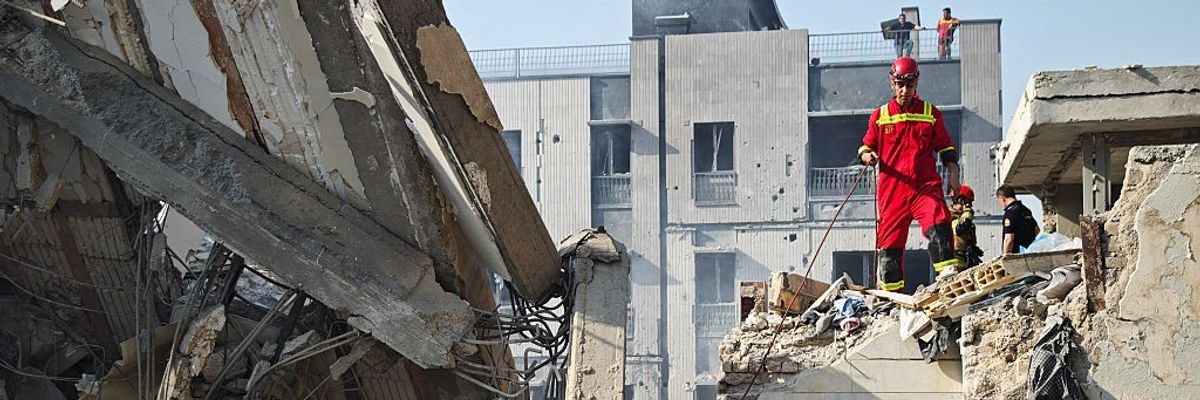
Life Support: doctors in Gaza bear witness to genocide

Spread the love

This work by Middle East Monitor is licensed under a Creative Commons Attribution-NonCommercial-ShareAlike 4.0 International License.

Life Support by Daniele Rugo

by Nasim Ahmed  Nasimbythedocks

Daniele Rugo’s documentary turns the testimony of British and international medics who worked in Gaza into a searing record of what is described in the film as Israel’s “genocidal frenzy”.

Hospitals represent life. The killing of people inside them, the doctors in Life Support say, is a line that should never have been crossed. Daniele Rugo’s 93-minute documentary opens with British doctors talking about Gaza, their connection to it, the resilience of the people there and a love of life that even decades of siege has not extinguished, before showing what happened when that line was crossed, again and again, over two years.

The film had its world premiere at Sheffield DocFest on 13 June 2026, where it was nominated for the festival’s Tim Hetherington Award, followed by a Q&A with Rugo and contributors Dr Ana Jeelani and Prof Nick Maynard. A public premiere follows at Curzon Mayfair on 9 July. Most of what is on screen was shot by the doctors themselves, on their phones, in the middle of treating patients. MEMO was given an early preview of Life Support ahead of its public premiere at Curzon.

Rugo’s starting point, as he puts it, was simple: surgeons, physicians and nurses went to Gaza to support their Palestinian colleagues and ended up as “the sole international observers” of a genocide. Foreign media have been barred from entering Gaza throughout the war. The doctors who passed through Medical Aid for Palestinians (MAP), Healthcare Workers 4 Palestine and similar routes were, for long stretches, among the only outsiders able to see what was happening inside the enclave.

The names will be familiar to anyone who has followed British medics’ accounts since October 2023: Dr Victoria Rose, the London-based reconstructive surgeon who has worked in Gaza since 2016 and has been on four missions since the war began; Prof Nick Maynard, the Oxford gastrointestinal surgeon who helped set up Gaza’s cancer services; and Dr Tanya Haj Hassan, the paediatric intensive care doctor and one of the few international witnesses to reach the north of the Strip. Dr James Smith, Dr Deborah Harrington, Dr Khaled Dawas and Dr Ana Jeelani also appear.

Their testimonies, painfully delivered, are as heart-wrenching as they are inspirational.  Rose recalls using her own initiative to take essential medical kit into Gaza in 23 suitcases. Jeelani describes operating without electricity or proper instruments, on wounded children who often needed repeated surgery. Maynard, who has worked in other war zones, says the scale of destruction in Gaza was on a different level.

Outside the hospitals hours of unseen footages filmed a dystopian landscape of buildings razed as far as the eye can see, alongside the daily life that somehow continues around it. This footage is vital because the film is not only about the wounded, the starving and the dead, but about the destruction of the institutions that make human life possible: hospitals, schools, religious buildings and the civic centres that sustain a people, a culture and a civilisation.

What the doctors describe is not only the bombing of buildings, but the destruction of the conditions that allow human existence to continue. This gives the film its wider charge: it is not only a record of war, but of what the doctors repeatedly understand as genocide.

“This is a war on civilians,” Haj Hassan says, describing wards filled with children and elderly women. The cases the doctors treat reflect Gaza’s population under siege: children, women, the elderly and the displaced. They speak of Palestinian medics operating after being told their own relatives had been killed, and of health workers fainting from hunger and exhaustion mid-shift. The footage from inside Al-Shifa hospital after Israel’s withdrawal, including the mass graves hospital staff were left to exhume themselves, is among the hardest material in the film to sit through.

The film also addresses one of the central justifications used by Israel for its attacks on Gaza’s hospitals: the claim that they were being used by Hamas. The doctors answer this directly. Despite hearing the allegation repeated by Israeli officials and echoed by Western governments, they say they saw no evidence to support it. For them, the destruction of Gaza’s hospitals cannot be explained away as a military necessity. It is part of a wider assault on everything that sustains life.

READ: Israeli Supreme Court rejects appeal against Palestinian doctor’s detention, lawyer says

That is where the film’s argument about genocide becomes unavoidable. Maynard says he did not use the word lightly and initially resisted it. But after what he witnessed in Gaza, he reached a different conclusion. The film follows that moral and intellectual shift carefully, showing how doctors who entered Gaza to provide medical care came out asking how such devastation had been allowed to continue.

The documentary then widens the lens, turning to genocide scholars to explain the role of dehumanisation. They describe it as a common feature of genocides, from Rwanda onwards: a process by which a people are stripped of their humanity before violence against them is normalised. In Gaza, the film suggests, that process has been visible not only in language, but in the targeting of the very environment needed for human life to continue. As one contributor puts it, Palestinians have been dehumanised “in a way that we’ve not seen anywhere else in modern times.”

The doctors do not leave Gaza as they entered it. They arrive to treat the wounded and support Palestinian colleagues, but what they see makes it impossible for them simply to return home and move on. “You cannot witness what is happening in Gaza and not emerge enraged and determined to stop it,” one doctor says. That sense of responsibility runs through the film: having seen what they have seen, the doctors know that silence is no longer possible.

The film also shows how Israel’s policy of starvation became another weapon deployed against Palestinians. We see what that meant for Gaza’s children, and for the parents and doctors trying desperately to keep them alive with almost nothing. The documentary links this suffering to the Gaza Humanitarian Foundation, whose aid distribution system turned the search for food into a life-and-death situation for Palestinians.

Yet Life Support is not only a film about suffering. It also shows how Palestinians continue to hold on to their humanity, dignity and will to live amid conditions designed to break them. The doctors help carry Gaza’s story to the outside world, but they are not the centre of it. At the centre are the Palestinian doctors, nurses and medical teams who keep treating patients with almost nothing, relying on courage, skill and sheer determination to keep people alive.

Rugo brings the same concern with memory and violence that shaped his previous film, The Soil and The Sea, which documented mass graves from Lebanon’s civil war. In Life Support, he works with editor Masahiro Hirakubo to hold together material that is often extremely painful to watch without losing sight of the people at the heart of the film: the doctors, the patients and the Palestinian medical workers trying to keep Gaza alive.

The film’s sound is equally important. Palestinian composer Habib Shehada Hanna is joined by Robert Del Naja and Euan Dickinson of Massive Attack, giving the documentary a soundtrack that deepens its emotional force. The film’s executive producers include Hollywood star Susan Sarandon, Melissa Barrera, Farah Nabulsi and Asif Kapadia. Ken Loach has called the film “compulsory viewing.”

He is right. Life Support does not try to make its subject easier to watch, and it should not. What it leaves you with is a record of who kept Gaza’s hospitals running, what it cost them, and how much of it the world chose not to see.

READ: Gaza doctors were building a health system – then came the war

This work by Middle East Monitor is licensed under a Creative Commons Attribution-NonCommercial-ShareAlike 4.0 International License.

Keir Starmer explains that UK is actively supporting Israel's genocidal expansion and repeats his previous quotation that he supports Zionism "without qualification". Keir Starmer said “I said it loud and clear – and meant it – that I support Zionism without qualification.” here: https://www.jewishnews.co.uk/keir-starmer-interview-i-will-work-to-eradicate-antisemitism-from-day-one/
Keir Starmer explains that UK is actively supporting Israel’s genocidal expansion and repeats his previous quotation that he supports Zionism “without qualification”. Keir Starmer said “I said it loud and clear – and meant it – that I support Zionism without qualification.” here: https://www.jewishnews.co.uk/keir-starmer-interview-i-will-work-to-eradicate-antisemitism-from-day-one/
Keir Starmer objects to criticism of the IDF. He asks how could anyone object to them starving people to death, forced marches like the Nazis did, bombing Gaza's hospitals and universities, mass-murdering journalists, healthworkers and starving people queuing for food, killing and raping prisoners and murdering children. He calls for people to stop obstructing his genocide for Israel.
Keir Starmer objects to criticism of the IDF. He asks how could anyone object to them starving people to death, forced marches like the Nazis did, bombing Gaza’s hospitals and universities, mass-murdering journalists, healthworkers and starving people queuing for food, killing and raping prisoners and murdering children. He calls for people to stop obstructing his genocide for Israel.
Orcas discuss Donald Trump and the killer apes' concept of democracy. Front Orca warns that Trump is crashing his country's economy and that everything he does he does for the fantastically wealthy.
Orcas discuss Donald Trump and the killer apes’ concept of democracy. Front Orca warns that Trump is crashing his country’s economy and that everything he does he does for the fantastically wealthy.

Continue ReadingLife Support: doctors in Gaza bear witness to genocide

Seeds, land, sovereignty: lessons from the Sahel for the International Day of Peasant Struggle

Spread the love

This article by Jonis Ghedi-Alasow republished from peoples dispatch under under a Creative Commons Attribution-ShareAlike 4.0 (CC BY-SA) license.

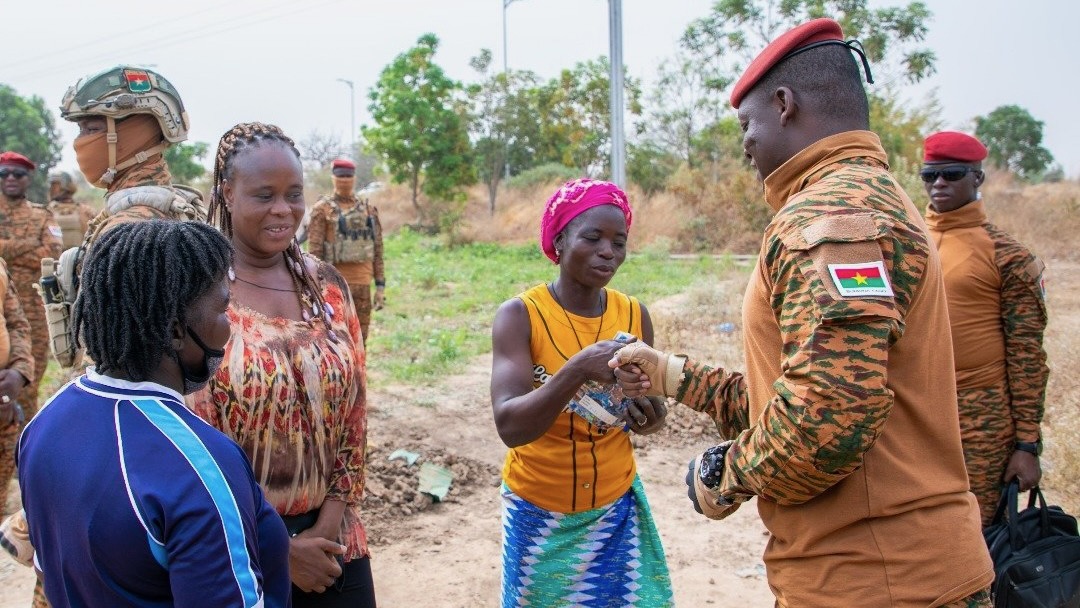
Ibrahim Traore visits women in agricultural production on International Women’s Day. Photo: Burkina Faso Presidency

April 17 is a day that reminds us that the Burkinabé, African, and international peasantry must be the heartbeat of livelihoods in our communities and must therefore be at the center of the claims being made to sovereignty.

On April 17, 1996, military police in Eldorado dos Carajás, Brazil, killed 21 landless workers who were blocking a road to demand agrarian reform. They were members of the Landless Rural Workers’ Movement (MST). Since then, La Via Campesina has designated April 17 as the International Day of Peasant Struggle – a global day to honor those fighting for land, seeds, water, and food sovereignty, and to hold accountable those who profit from their dispossession.

As we observe the 30th anniversary of this day in Africa, we are compelled to pay closer attention to important developments in the Sahel region of our continent, where, when the terrorists arrived, the women of Burkina Faso hid seeds in their hair.

This is not a metaphor. It is also not improvisation. Before colonial borders were drawn across the Sahel, before cash crops displaced subsistence farming, and before structural adjustment dismantled public seed banks, the women of West Africa had long carried seeds on their bodies. Seeds were inherited – the record of generations of cultivated knowledge about which variety survived the dry season and which grew on degraded soil. Seed-keeping was a form of social reproduction as fundamental as any other, and women overwhelmingly carried it. That practice faded under colonial tax regimes, agribusiness inputs, and varieties designed not to be saved. Communities grew dependent on inputs they did not control.

Crisis brought it back. As armed groups (whose proliferation followed directly from NATO’s 2011 intervention in Libya) swept through farming communities across the Sahel – burning fields, killing, and forcing hundreds of thousands from their land – Burkinabé women returned to what their grandmothers knew: concealing seeds beneath their hair. When the terrorists had gone, they brought the seeds out again. They planted once more. The act was both practical and political: what was preserved was not only food but also the cultivated knowledge that makes food sovereignty possible.

Land as weapon, seeds as resistance

Every year, 360,000 hectares of agricultural land are lost in Burkina Faso due to terrorism-driven displacement, climate change, and the cascading effects of a decade of instability. Peasants displaced from their villages either move to cities without support or try to rebuild their lives and livelihoods on unfamiliar, unsuitable, or equally threatened land.

Terrorism serves to weaken and fragment agricultural production. The displacement of Burkinabé peasants benefits those who seek to keep Africa reliant on food imports, international aid, and the “goodwill” of imperialism.

In response, peasant organizations, united under the Coalition for Surveillance of Biotechnological Activities (CVAB), have created an agroecological alternative to dependence on corporate inputs. Their opposition to GMOs and corporate biotechnology is based on structural issues, not sentiment: patented seed systems transfer control of Africa’s food supply to external actors (reflecting the logic of structural adjustment, but applied to agriculture). 

The state behind the seed

These issues are not new. They have been raised by the peasants and the organizations they have built for decades across the African continent. What, then, has changed under Ibrahim Traoré’s government? It is the scope of political possibilities. For the first time since Sankara, the agenda of peasant organizations – including food sovereignty, opposition to GMOs, and prioritizing locally produced food – has gained state support. The Agricultural Offensive launched in 2023 has redistributed tractors and inputs to farmers, redeployed agricultural engineers to rural regions, and achieved grain surpluses for two consecutive years. In his New Year’s address on December 31, 2025, Traoré declared that Burkina Faso had reached food self-sufficiency. In February 2026, the government established and nationalized five major agro-industrial complexes.

Importantly, the Alliance of Sahel States has established APSA-Sahel – the Alliance of Agricultural Seed Producers of the Sahel. Its clear mandate is to develop and distribute locally adapted, climate-resilient seeds; to build an indigenous regional seed market; and to end reliance on foreign seed imports that have left Sahelian farmers vulnerable for decades. The knowledge of locally adapted seed that the women of Burkina Faso have kept in their hair – which is irreplaceable – is now being formalized across three countries. The informal sector is becoming institutionalized.

April 17 and the African peasant

La Via Campesina’s call on April 17, 2025, highlighted that land, water, and territories are not commodities, and the act of conserving and exchanging traditional seeds should not be perpetually criminalized worldwide. The UN Declaration on the Rights of Peasants (UNDROP), adopted in 2018, affirms the collective rights of peasant communities over their seeds, land, and communal ways of life.

Food sovereignty, seed sovereignty, and environmental sovereignty are therefore strategic questions for the Africa Liberation struggle, commemorated on May 25 annually – not secondary concerns. In the Alliance of Sahel States, the fight over seeds is closely connected to the struggle for land, resources, and the right to influence development. It also puts the question of who the beneficiaries of these initiatives should be squarely on the table. In the spirit of April 17, the answer is clear: the Burkinabé, African and international peasantry must be the heartbeat of livelihoods in our communities and must therefore be at the center of the claims being made to sovereignty.

As Africa continues to fight for sovereignty and peasants strive for prosperity, there may be valuable lessons in the Burkinabé practice of preserving seed in women’s hair as a dignified symbol of the land (and continent) of the upright people.

Jonis Ghedi-Alasow is the Coordinator of the Pan Africanism Today Secretariat.

This article by Jonis Ghedi-Alasow republished from peoples dispatch under under a Creative Commons Attribution-ShareAlike 4.0 (CC BY-SA) license.

Continue ReadingSeeds, land, sovereignty: lessons from the Sahel for the International Day of Peasant Struggle

Florida Republicans Ripped for Advancing Show-Me-Your-Papers Voter ID Bill

Spread the love

Original article by Jessica Corbett republished from Common Dreams under Creative Commons (CC BY-NC-ND 3.0). 

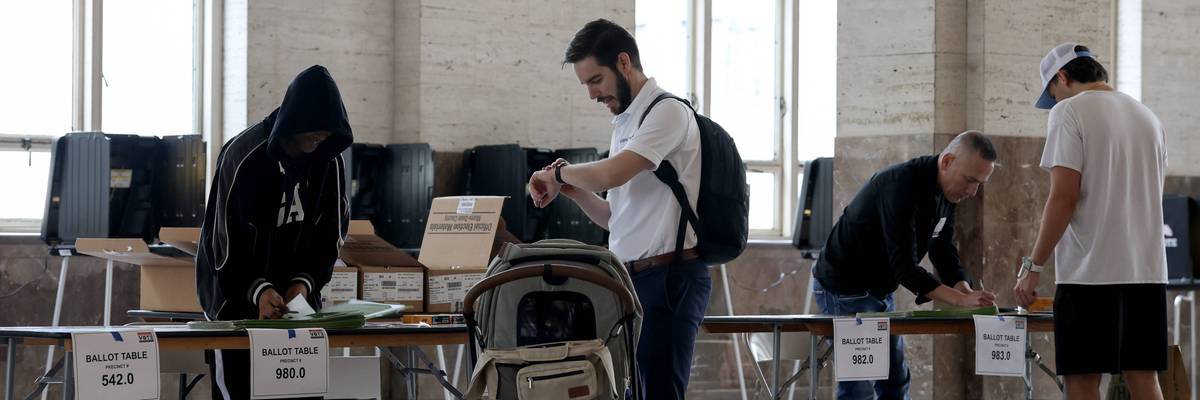
Poll workers help voters as they prepare to cast their ballots on December 09, 2025 in Miami, Florida. (Photo by Joe Raedle/Getty Images)

“This wave of anti-voter legislation is advancing amid ongoing abuses of power that pose unprecedented threats to American democracy,” said the ACLU of Florida’s executive director.

With 251 days until the US general election, Florida Republicans on Wednesday passed a show-me-your-papers bill that opponents warn could prevent thousands of eligible state voters from registering if they don’t have a valid birth certificate or passport, or their documents don’t reflect a name change.

Midterm elections are coming later this year—and they’re a crucial test of our democracy,” ACLU of Florida executive director Bacardi Jackson said in a Wednesday statement. “Moments like this bring new voters into the process and give communities the power to hold leaders accountable—exactly what a healthy democracy demands. But right now, some lawmakers are pushing an anti-voter bill that could shut thousands of eligible people out of our elections and discourage the enrollment of new eligible voters.”

RECOMMENDED…

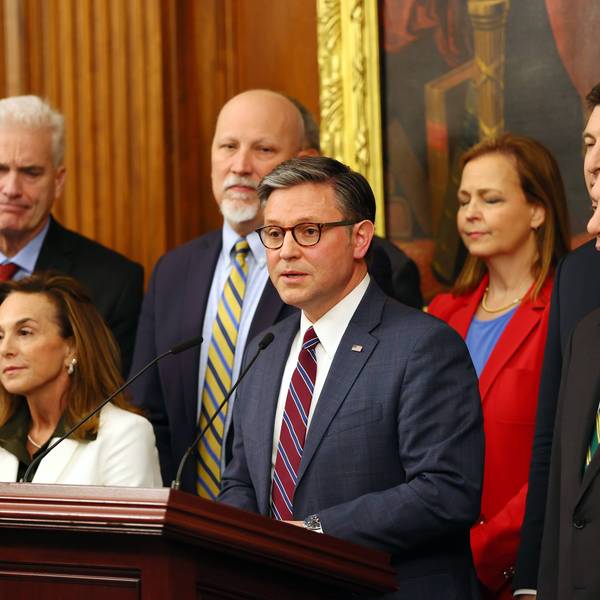
Speaker Johnson Holds Press Conference On House Passage Of SAVE America Act

Republicans Approve ‘Dystopian’ Voter Suppression Bill That Would Force States to Give Info to DHS

GENIUS Act Presser

‘Most Dangerous Attack on Voting Rights Ever’? New GOP Election Bill Sparks Dire Warnings

The Florida House of Representatives on Wednesday voted 83-31 on HB 991, sponsored by Rep. Jenna Persons-Mulicka (R-78).

“The Florida House version of the bill would only go into effect in January 2027. But under a similar bill set for consideration in the Florida Senate, the new rules would take effect this July, before the November midterm elections,” Democracy Docket detailed. “A House committee already gave preliminary approval to the bill earlier this month.”

Jackson highlighted that “many eligible voters don’t have ready access to an unexpired passport or an original or certified copy of their birth certificate because of logistical and financial barriers. More than 8 million Floridians do not have a valid passport, and because many women legally change their name upon marriage, more than 4.7 million women in Florida do not have a birth certificate reflecting their current legal name—documents this bill would require.”

“At the same time, this proposal would eliminate current, valid forms of ID proving eligibility at the polls, including student IDs, retirement center IDs, and public assistance IDs,” she warned. “Taken together, these changes are not neutral or harmless—they would fall hardest on low-income voters, students, seniors, women, and Black and brown Floridians.”

The ACLU leader also argued that “context matters. This wave of anti-voter legislation is advancing amid ongoing abuses of power that pose unprecedented threats to American democracy.” She specifically pointed to the Safeguard American Voter Eligibility (SAVE) America Act that the GOP-controlled US House of Representatives passed earlier this month.

“We’re seeing parallel efforts nationally to make it harder for eligible voters to cast their ballots—including the SAVE Act being debated in Congress right now—and Florida is leading the way down this authoritarian path,” she said. The federal bill is less likely to get through the US Senate, whose filibuster rule requires the GOP to get some Democratic support to advance most legislation.

“What makes this even more galling is that lawmakers don’t have to do any of this at all—they are choosing to,” said Jackson. “They could enact reforms making it easier for eligible Floridians to vote and have their voices be heard, like the Harry T. and Harriette V. Moore Florida Voting Rights Act, HB 1419/SB 1598. Instead, they are fast-tracking legislation that would make voting harder for eligible Floridians and silence communities that deserve to be heard.”

“We will not stand by while politicians in power seek to entrench their power at the expense of the people’s rights,” she vowed. “We will keep organizing and fighting to reclaim and defend our democracy—because every eligible Floridian deserves to vote.”

Meanwhile, at the federal level, Senate Majority Leader John Thune (R-SD) plans to hold a vote on the SAVE America Act this week. President Donald Trump used his State of the Union address on Tuesday night to increase pressure on Congress to send the bill to his desk.

“I’m asking you to approve the SAVE America Act to stop illegal aliens and others who are unpermitted persons from voting in our sacred American elections—that cheating is rampant in our elections,” Trump said. “It’s very simple: All voters must show voter ID. All voters must show proof of citizenship in order to vote. And no more crooked mail-in ballots except for illness, disability, military, or travel. None.”

Experts have long countered such GOP claims by emphasizing that, as the Brennan Center for Justice put it in a pair of blog posts, “noncitizen voting is already illegal” and “extensive research reveals that fraud is very rare.”

Michelle Kanter Cohen, policy director and senior counsel for the national voting rights group Fair Elections Center, told Democracy Docket on Wednesday that Florida’s voter suppression bill “would do a lot of the same things,” as the SAVE America Act, “in terms of preventing American citizens from voting who don’t have access to documentary proof of citizenship documents.”

“The last thing someone who is on a path to citizenship would want to do is to jeopardize their naturalization by voting illegally,” Kanter Cohen said. “And so people don’t do that. That’s not something that’s happening because it has such dire consequences.”

Original article by Jessica Corbett republished from Common Dreams under Creative Commons (CC BY-NC-ND 3.0). 

Donald Fuhrump says that Amerikkka doesn't bother with crimes or charges anymore, not being 100% Amerikkkan and opposing his real estate intentions is enough.
Donald Fuhrump says that Amerikkka doesn’t bother with crimes or charges anymore, not being 100% Amerikkkan and opposing his real estate intentions is enough.
Orcas discuss Donald Trump and the killer apes' concept of democracy. Front Orca warns that Trump is crashing his country's economy and that everything he does he does for the fantastically wealthy.
Orcas discuss Donald Trump and the killer apes’ concept of democracy. Front Orca warns that Trump is crashing his country’s economy and that everything he does he does for the fantastically wealthy.
Elon Musk urges you to be a Fascist like him, says that you can ignore facts and reality then.
Continue ReadingFlorida Republicans Ripped for Advancing Show-Me-Your-Papers Voter ID Bill

250 million Indian workers and farmers on the streets in a national strike

Spread the love

Original article by Abdul Rahman republished form peoples dispatch under a Creative Commons Attribution-ShareAlike 4.0 (CC BY-SA) license.

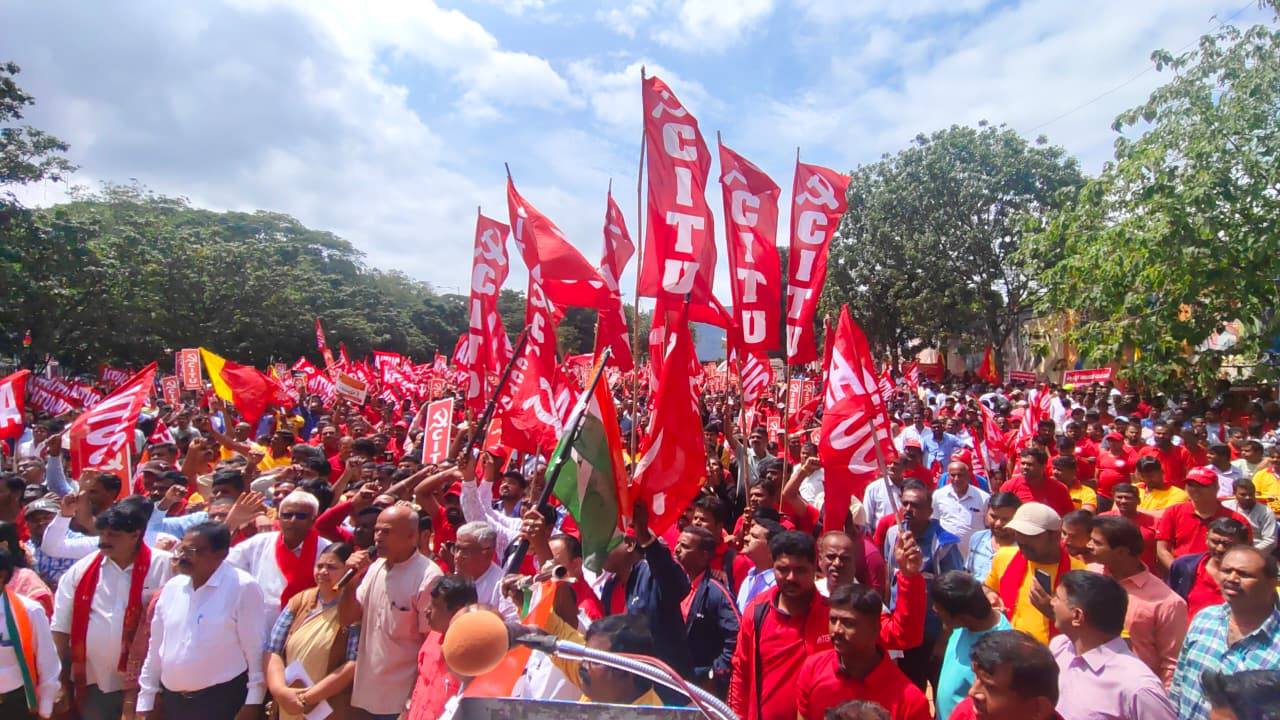
The strike was called by the trade unions and farmers groups against anti-workers labor codes and failures of the government to enact a legal support price for farm products.July 09, 2025 by Abdul Rahman

250 million Indian workers and farmers on the streets in a national strike

National strike against the “anti-worker” labor codes of the Modi government on July 9. Photo: CPI(M)

Millions took to the streets all over India on Wednesday, July 9, to observe a national strike call made by Central Trade Unions (CTU). They are striking against the anti-worker policies adopted by the ultra-right-wing government in the country. 

CTU is a platform of all the major trade union federations in the country, spanning the ideological and political spectrum. It includes the Center for Indian Trade Unions (CITU), the All India Trade Union Congress (AITUC), the Indian National Trade Union Congress (INTUC) and several others. 

The strike was also supported by all the major groups of farmers, students, women, and various professional unions such as teachers, journalists, and IT employees in the country. 

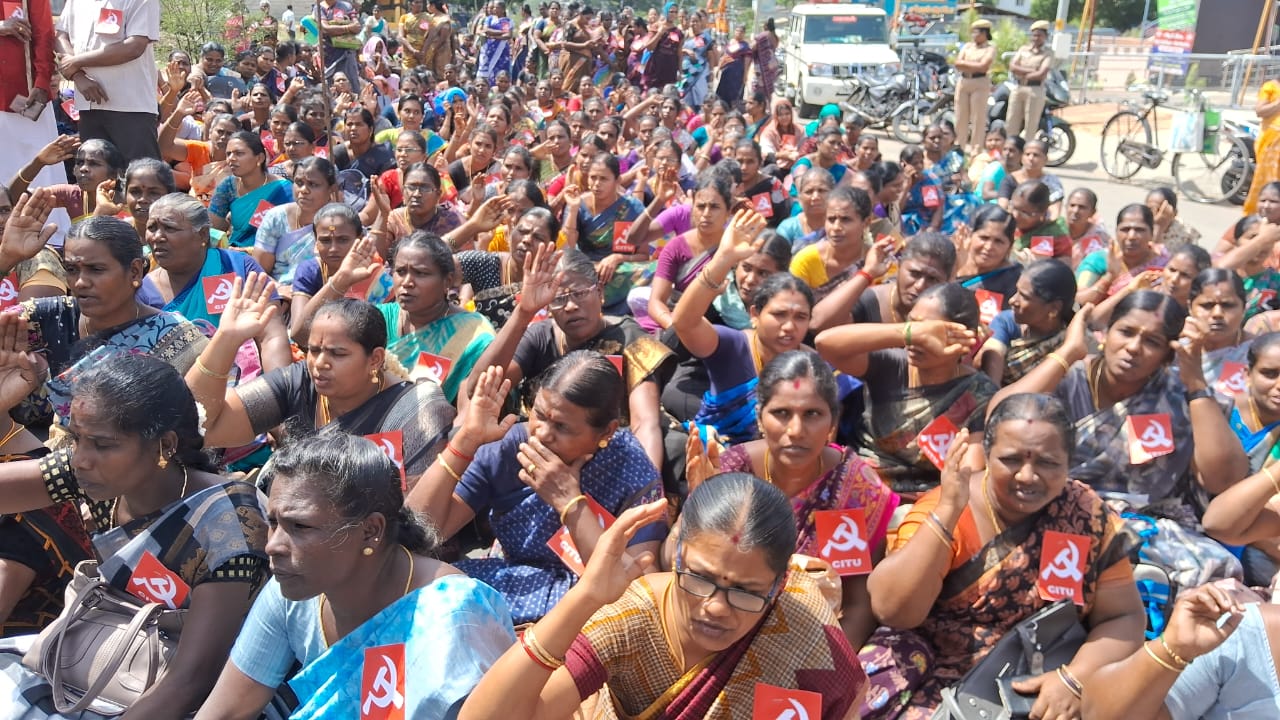
According to various estimates, more than 250 million workers and farmers – both in organized and unorganized sectors – directly participated in the strike and protests across the country. 

Workers in other organized sectors such as ports, airports, and banking also participated alongside those in various public sectors.

The strike affected most of the industrial activities in the country, particularly industries related to mining.

#Strike #GeneralStrike बी टी आर वाडको एम्पलाइज यूनियन के साथी अपनी कंपनी एस एफ सी सॉल्यूशन साहिबाबाद के गेट पर हड़ताल को कामयाब बनाते हुए। pic.twitter.com/311IoxICHS

— CPIM DELHI (@CPIMSTATEDELHI) July 9, 2025

In several places, workers blocked the movement of trains, blocked highways, and picketed factory gates to mobilize greater support. In some cases, such as the Kochi refinery in the southern state of Kerala, workers defied court orders and observed the strike.

Picket lines stand strong and militant in front of the factory gate.#9thJulyGeneralStrike pic.twitter.com/V2a33uoQT9

— CITU CENTRE (@cituhq) July 9, 2025

A total shut down of all major business was observed in various states in the country such as Kerala, Tripura, Bihar, Jharkhand, and others.

Anti-worker labor codes must be withdrawn

The workers were demanding immediate withdrawal of the new labor codes enacted by the ultra-right-wing government led by Narendra Modi at the center in 2020. CTU claims the four new labor codes are anti-worker, depriving them of their basic rights, including the right to collective bargaining, which was won through a historic and painful worker’s struggle.

The other major demands include: 

  • The end of the privatization and contractualization of jobs
  • A national minimum wage of Rs. 26,000 (USD 303)
  • Improvements in working conditions across all sectors for all kinds of workers

Trade union workers take out a march in West Bengal. #GeneralStrike #StrikeHard pic.twitter.com/hxrTd0AoYY

— CPI (M) (@cpimspeak) July 9, 2025

The strike also supported the demands raised by the country’s major farmers groups, led by the Samyukta Kisan Morcha (SKM), for a legal minimum support price for all farm produce, the waiving of loans for farmers, an end to all forced land acquisition, and better employment opportunities.

The strike was originally scheduled for May 19. It had to be postponed following the war-like situation in the region created after India attacked several locations inside neighboring Pakistan, accusing it of supporting armed groups who carried out attacks on tourists in Pahalgam.

Popular action defeats government lies

A central protest rally was held in the national capital Delhi. The protest was attended by all the constituents of CTU and SKM, the farmers collective which has extended support to the strike.

Millions of workers, farmers strike in India to protect their basic rights, livelihoods
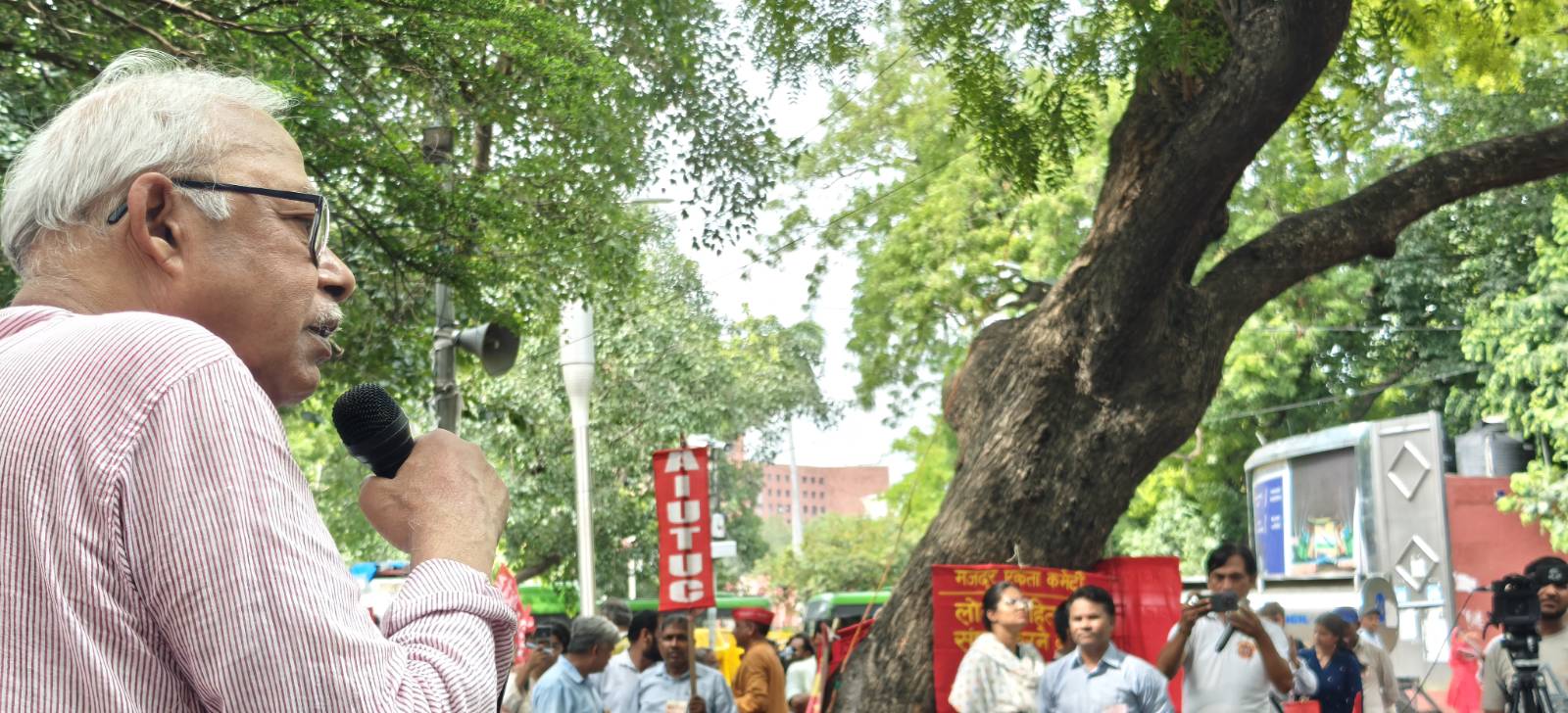
CPI(M) Politburo Member and CITU General Secretary Tapan Sen addresses a strike demonstration in Jantar Mantar, New Delhi. Photo: CPI (M)

Addressing the rally, Tapan Sen, general secretary of CITU and a member of the Communist Party of India (Marxist) polit bureau, claimed that the success of the strike demolishes the myths created by the Modi government about the so-called economic prosperity his government’s policies have created.

Millions strike in India
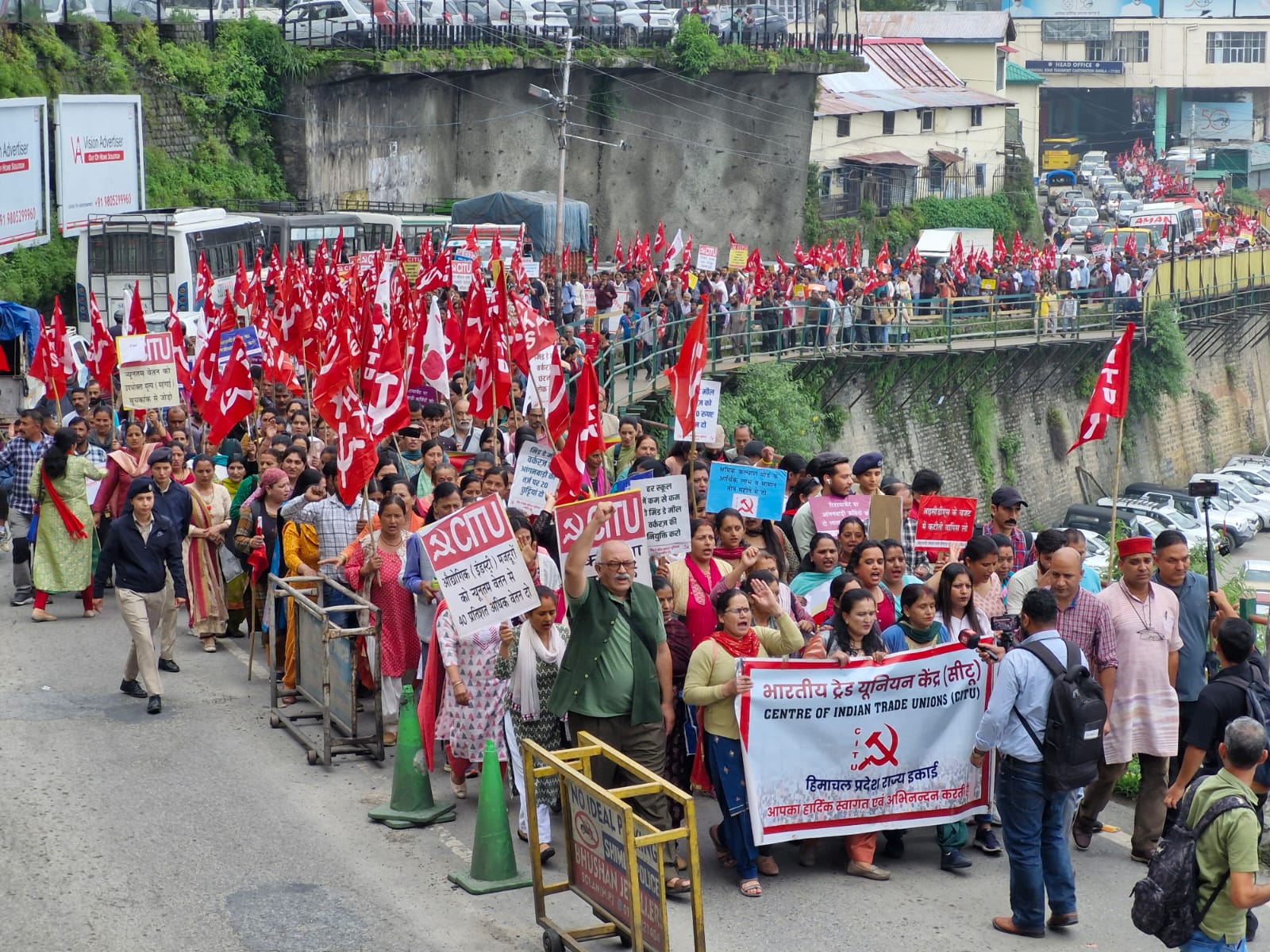
Strike demonstration in Shimla, Himachal Pradesh. Photo: CPI (M)

Most Indians today are struggling to find a decent source of livelihood and those who have one are struggling to protect it from the effects of the various wrongful and pro-corporate policies of the Bharatiya Janata Party (BJP)-led government, Sen underlined.

The lies about India being the third or fourth largest economy in the world, propagated by the present government in the country and magnified by the complicit media, have been exposed by the sheer number of people who participated in today’s strike. It establishes the fact that under Modi’s decade-long rule the condition of the working classes in India has gone from bad to worse, Sen told the protesters gathered at the rally.

Millions strike in India workers and farmers
Photo: CPI(M)

Sen also warned the government against going ahead with the proposed trade deal with the US, claiming that would further compromise the interest of workers and farmers in India.

Amarjeet Kaur, general secretary of the AITUC, claimed that the BJP used pro-government unions to divide the working classes in the country and falsely called the strike “illegal”.

“The attempts to divide the working class, so that the interest of its corporate bosses are protected, was defeated by the successful strike” Kaur declared. She noted that this was the fourth such strike since 2020 and more such strikes will happen in the future, with more intensity, if the government fails to correct its ways and take back the four draconian labor codes, and enact laws which really benefit the working classes of this country.

Original article by Abdul Rahman republished form peoples dispatch under a Creative Commons Attribution-ShareAlike 4.0 (CC BY-SA) license.

Continue Reading250 million Indian workers and farmers on the streets in a national strike

US Progressives Say Stop Supporting ‘Rogue Genocidal Regime’ as Israel Wages Illegal War on Iran

Spread the love

Original article by Brett Wilkins republished from Common Dreams under Creative Commons (CC BY-NC-ND 3.0). 

Rescue workers comb through the ruins of a residential building bombed by Israel on June 13, 2025 in Tehran, Iran. (Photo: Majid Saeedi/Getty Images)

“Trump must act immediately to suspend all military support to Israel and stop allowing U.S. arms to fuel war crimes, mass civilian death, and regional collapse,” said one critic.

Progressive U.S. lawmakers and human rights defenders demanded an end to unconditional American armed and diplomatic support for Israel after it launched a series of attacks on Iran early Friday, reportedly killing senior military officials and civilians including nuclear scientists, women, and children in a dramatic escalation that Iranian leaders vowed to avenge.

Israeli forces carried out at least five waves of airstrikes targeting not only Iran’s nuclear facilities but also its military leadership and capabilities, Al Jazeera reported. In addition to airstrikes, Israeli and international media reported that operatives from Mossad, Israel’s foreign spy agency, also conducted assassination and sabotage attacks in Iran.

The Israel Defense Forces (IDF) claimed that Islamic Revolutionary Guard Corps (IRGC) Commander-in-Chief Major Gen. Hossein Salami and Iranian Armed Forces Chief of Staff Major Gen. Mohammad Bagheri were assassinated, as were numerous Iranian nuclear scientists.

IDF attacks targeted cities including the capital Tehran, Natanz, Isfahan, Arak, Tabriz, and Kermanshah. Iranian television reports showed bombed-out apartment towers and said that an unknown number of civilians including women and children were killed in the strikes.

The attack on Natanz—home to Iran’s primary nuclear enrichment facility—sparked fears of radiological contamination.

Israeli Prime Minister Benjamin Netanyahu called the attack—dubbed Operation Rising Lion—a “preemptive strike,” a dubious form of warfare previously waged by forces including imperial Japan during the bombing of Pearl Harbor and the George W. Bush administration in Iraq.

Israeli President Isaac Herzog said the attacks were meant to “neutralize an immediate and existential threat to our people,” an apparent reference to Iran’s nuclear program. Successive U.S. administrations including President Donald Trump’s have concluded for decades that Iran is not trying to develop nuclear weapons.

During his first term, Trump unilaterally abrogated the Joint Comprehensive Plan of Action, also known as the Iran nuclear deal.

Last year, Israel and Iran carried out limited tit-for-tat attacks following the former’s assassination of Hassan Nasrallah, who led the Lebanon-based resistance group Hezbollah, and Hamas leader Ismail Haniyeh.

This time, Iranian leaders vowed “severe punishment,” with fears that the U.S. could be targeted due to its staunch support for Israel as it wages what the international community increasingly views as a genocidal war on Gaza. While U.S. Secretary of State Marco Rubio claimed that his country was not involved in the attacks, Israeli officials insisted there was close coordination with the Trump administration.

Iranian Supreme Leader Ayatollah Seyyed Ali Khamenei said Friday that “in the early hours of today, the Zionist regime extended its filthy and bloodstained hand to commit a crime in our beloved country, exposing its vile nature more than ever by targeting residential areas.”

“With this crime, the Zionist regime has prepared a bitter and painful fate for itself—and it will undoubtedly face it,” Khamenei added.

As the world braced for Iran’s response to the attacks, U.S. progressives called for a diplomatic solution and an end to American support for Israel.

“The Israeli government bombing Iran is a dangerous escalation that could lead to regional war,” Congresswoman Rashida Tlaib (D-Mich.) said on social media.

Tlaib asserted that Netanyahu, who is wanted by the International Criminal Court for alleged war crimes and crimes against humanity in Gaza and is facing a domestic criminal corruption trial, “will do anything to maintain his grip on power.”

“We cannot let him drag our country into a war with Iran,” she added. “Our government must stop funding and supporting this rogue genocidal regime.”

Referring to negotiations on a new Iran nuclear deal, Congresswoman Ilhan Omar (D-Minn.) said: “Just as talks with Iran were set to resume, Netanyahu launches a strike and declares a state of emergency. He is provoking a war Americans don’t want.”

“We should not allow ourselves to be dragged into yet another conflict, against our will, by a foreign leader pursuing his own agenda of death and destruction,” Omar added.

The U.S.-based peace group CodePink—some of whose members held an emergency protest outside the White House in Washington, D.C.—said that it “strongly condemn[s] Israel’s unprovoked and reckless attack on Iran, which risks igniting a catastrophic regional war.”

“This dangerous escalation threatens millions of lives across the entire Middle East,” the group added. “The U.S. must not continue to support and enable this illegal act of aggression.”

CodePink co-founder Medea Benjamin said: “It’s horrific that Israel is bombing yet another country. And Trump calls himself a peace president? He knew this was coming and stood by. This is entirely out of step with the will of the American people.”

“The whole world is desperate for peace in the Middle East, and instead, Israel decides to move the region closer to World War III,” Benjamin added.

Noting that nuclear talks with Iran were set to resume this weekend, the National Iranian American Council (NIAC) said that “this is an attack on peace and diplomacy.”

“Israeli political officials have demonstrated that U.S. diplomacy and a peaceful resolution with Iran is what they consider to be the true threats,” NIAC asserted.

“This much is clear: This is a war of choice, and an illegal and unprovoked attack,” NIAC added. “Trump must weigh in to stop this conflict before it spirals out of control, and to preserve the chance of maintaining diplomatic offramps.”

Michael Schaeffer Omer-Man, Israel-Palestine director at the advocacy group Democracy for the Arab World Now (DAWN), contended that “Israel deciding to launch a war against Iran at the very same time it faces unprecedented international isolation and pressure over its genocide in Gaza is a nightmarish outcome of impunity.”

DAWN executive director Sarah Leah Whitson said that “Israel has committed an unlawful, unprovoked attack on Iran to undermine the growing global efforts to sanction it for its illegal occupation and to disrupt Trump’s efforts to independently pursue America’s interests via diplomacy.”

Nihad Awad, national executive director at the Council on American Islamic Relations, issued the following statement:

We condemn Israel’s offensive strike on Iran and the broader pattern of aggression it represents. Netanyahu is using American weapons and taxpayer dollars to launch illegal and destabilizing wars across the region. President Trump must act immediately to suspend all military support to Israel and stop allowing U.S. arms to fuel war crimes, mass civilian death, and regional collapse. Secretary Rubio’s statement confirms what we already knew—Israel is acting recklessly, and the U.S. is letting it happen.

CodePink noted that “in the past month and a half alone, Israel has bombed Palestine, Lebanon, Syria, Yemen, and Iran.”

“There is no other choice,” the group added, “ARMS EMBARGO NOW!”

Original article by Brett Wilkins republished from Common Dreams under Creative Commons (CC BY-NC-ND 3.0). 

Continue ReadingUS Progressives Say Stop Supporting ‘Rogue Genocidal Regime’ as Israel Wages Illegal War on Iran