‘This Is Climate Change’: Devastating Flooding Kills More Than 70 in Spain

Spread the love

Original article by Olivia Rosane republished from Common Dreams under Creative Commons (CC BY-NC-ND 3.0).
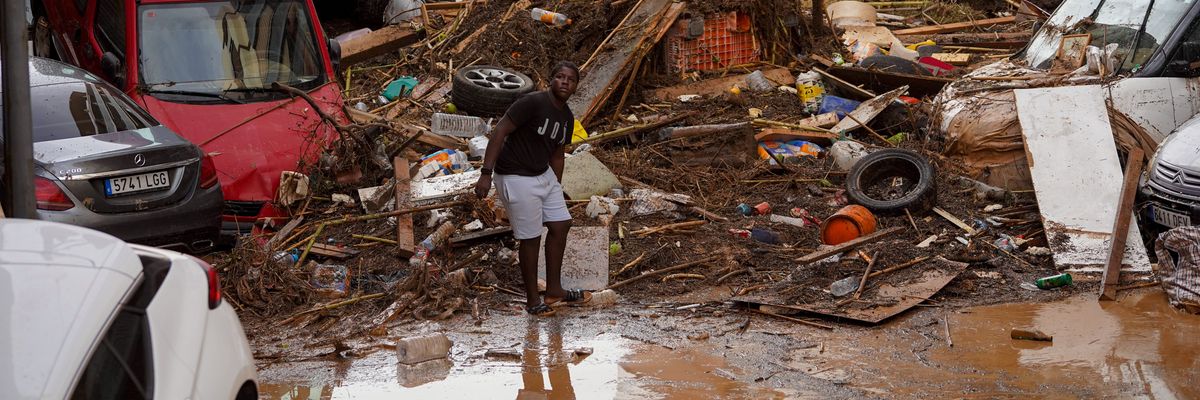
A view of the damaged area after a deluge brought up to 200 liters of rain per square meter (50 gallons per square yard) in hours in towns across the region of Valencia, Spain on October 30, 2024. (Photo: Alex Juarez/Anadolu via Getty Images)

“These disasters are only getting worse, and stopping the industries and systems driving climate collapse is the only rational response,” one climate group said.

Spain’s deadliest flooding in 30 years killed at least 72 people as torrential rain slammed the eastern region of Valencia on Tuesday, with some towns recording a year’s worth of rain in a single day.

The flooding sent churning muddy water down narrow streets, tossing cars, downing trees, bulldozing bridges and buildings, and trapping people in rising flood waters.

“The neighborhood is destroyed, all the cars are on top of each other, it’s literally smashed up,” Christian Viena, who owns a bar in Valencia’s Barrio de la Torre, told The Associated Press. “Everything is a total wreck, everything is ready to be thrown away. The mud is almost 30 centimeters (11 inches) deep.”

https://x.com/MatthewCappucci/status/1851377469942562964?ref_src=twsrc%5Etfw%7Ctwcamp%5Etweetembed%7Ctwterm%5E1851377469942562964%7Ctwgr%5Ecee4dacd5fa098e03f39569643b409cc286a36a7%7Ctwcon%5Es1_c10&ref_url=https%3A%2F%2Fwww.commondreams.org%2Fnews%2Fclimate-deadly-flooding-spain

Sorry, this content could not be embedded.

X

As of Wednesday morning, officials reported 70 deaths in Valencia and two in the bordering region of Castilla La Mancha. However, the death toll could rise as search and rescue operations continue amid difficult conditions, such as power outages and blocked roadways. Many people remain missing with their fates uncertain.

This includes residents of Utiel in Valencia, whose mayor, Ricardo Gabaldón, told Spanish broadcaster RTVE that Tuesday was the “worst day of my life.”

“We were trapped like rats,” Gabaldón said. “Cars and trash containers were flowing down the streets. The water was rising to 3 meters (9.8 feet).”

One person who was rescued was Denis Hlavaty, who spent the night perched on the edge of the roof of a gas station where he works.

“It’s a river that came through,” Hlavaty told Reuters, adding, “The doors were torn away and I spent the night there, surrounded by water that was 2 metres (6.5-feet) deep.”

“The fossil fuel industry increases the climate emergency, destroys the balance of critical ecosystems, and puts people’s lives in danger.”

The storm also canceled high-speed rail travel between Valencia and Madrid and Barcelona, and derailed one high-speed train near Malaga, though no one was injured.

While the rains had tapered off in Valencia by Wednesday morning, the rest of the country is not out of danger, as the storm is projected to move northeast.

“We mustn’t let our guard down because the weather front is still wreaking havoc and we can’t say that this devastating episode is over,” Spanish Prime Minister Pedro Sánchez told the nation on television Wednesday.

Even if the death toll does not rise, Tuesday’s floods are already the deadliest in Spain since 1996, when a flood near the Pyrenees killed 87. They are also the deadliest in Europe since floods in 2021 that killed at least 185.

In the immediate term, Tuesday’s deluge was caused by a phenomenon called a gota fría, or “cold drop,” a storm formed as cold air moves over the warm Mediterranean. In Spain, these kinds of storms are also commonly referred to with the acronym DANA—for Depresión Aislada en Niveles Altos, or isolated high-level depression.

However, scientists observe that the climate crisis is making rainstorms like this one more extreme, as warmer air can hold more moisture to dump when conditions are right. For Europe specifically, the warming of the Mediterranean causes more water to evaporate from its surface, super-charging rainstorms.

“Events of this type, which used to occur many decades apart, are now becoming more frequent and their destructive capacity is greater,” Ernesto Rodriguez Camino, senior state meteorologist and a member of the Spanish Meteorological Association, told Reuters.

https://twitter.com/DaveThroup/status/1851315836239110151?ref_src=twsrc%5Etfw%7Ctwcamp%5Etweetembed%7Ctwterm%5E1851315836239110151%7Ctwgr%5Ecee4dacd5fa098e03f39569643b409cc286a36a7%7Ctwcon%5Es1_c10&ref_url=https%3A%2F%2Fwww.commondreams.org%2Fnews%2Fclimate-deadly-flooding-spain

Sorry, this content could not be embedded.

X

The Spanish flooding comes a little more than a month after record rainfall swamped Central Europe and Eastern Europe, in an event that scientists concluded was made approximately twice as likely and 7% more severe by the climate crisis fueled primarily by the burning of fossil fuels.

“When we talk about climate change and climate emergency, it’s often perceived as an abstract concept far from our daily reality,” Eva Saldaña, the executive director of Greenpeace Spain, said in a statement. “Unfortunately, this is climate change: the intensification of extreme weather phenomenons like what happened tonight, with the level of destruction greater each time. Ignoring it causes deaths that we cannot allow.”

In a post on social media, Greenpeace Spain said that fossil fuel companies including the Spanish Repsol should pay for the damages.

“DANAS are more intense every time due to climate change,” the group wrote. “The fossil fuel industry increases the climate emergency, destroys the balance of critical ecosystems, and puts people’s lives in danger.”

Extinction Rebellion Global agreed. “These disasters are only getting worse, and stopping the industries and systems driving climate collapse is the only rational response,” the group wrote on social media.

The U.S.-based Climate Defiance, meanwhile, shared images of flood-ravaged streets with dismissals often leveled at climate activists.

https://x.com/ClimateDefiance/status/1851390346145788144?ref_src=twsrc%5Etfw%7Ctwcamp%5Etweetembed%7Ctwterm%5E1851390346145788144%7Ctwgr%5Ecee4dacd5fa098e03f39569643b409cc286a36a7%7Ctwcon%5Es1_c10&ref_url=https%3A%2F%2Fwww.commondreams.org%2Fnews%2Fclimate-deadly-flooding-spain

Sorry, this content could not be embedded.

X

https://twitter.com/ClimateDefiance/status/1851605825346764852?ref_src=twsrc%5Etfw%7Ctwcamp%5Etweetembed%7Ctwterm%5E1851605825346764852%7Ctwgr%5Ecee4dacd5fa098e03f39569643b409cc286a36a7%7Ctwcon%5Es1_c10&ref_url=https%3A%2F%2Fwww.commondreams.org%2Fnews%2Fclimate-deadly-flooding-spain

Sorry, this content could not be embedded.
X

Yellow Dot Studios, Don’t Look Up director Adam McKay’s climate-focused media studio, also shared an image of cars dropped in piles in the street by the flood waters to call out the double-standard in how direct-action climate protests and the corporate crimes of the fossil fuel industry are punished.

https://twitter.com/weareyellowdot/status/1851637056126308480?ref_src=twsrc%5Etfw%7Ctwcamp%5Etweetembed%7Ctwterm%5E1851637056126308480%7Ctwgr%5Ecee4dacd5fa098e03f39569643b409cc286a36a7%7Ctwcon%5Es1_c10&ref_url=https%3A%2F%2Fwww.commondreams.org%2Fnews%2Fclimate-deadly-flooding-spain

Sorry, this content could not be embedded.

X

Friends of the Earth Spain focused on the human impacts, arguing that urgent climate action meant “putting people’s lives, and not economic models, at the center.”

“Don’t prioritize sending people to work in extreme and dangerous conditions,” the group wrote. “It is a priority to take effective, ambitious, and urgent measures in response to the climate crisis we are living through.”

Original article by Olivia Rosane republished from Common Dreams under Creative Commons (CC BY-NC-ND 3.0).

dizzy: It’s almost as if Elon Musk’s X is censoring the climate crisis!

Continue Reading‘This Is Climate Change’: Devastating Flooding Kills More Than 70 in Spain

Vance Dossier Shows Not All Hacks Are Created Equal

Spread the love

Original article by Ari Paul republished from FAIR under https://creativecommons.org/licenses/by-nc-nd/3.0/

Ken Klippenstein, an independent reporter operating on Substack and an investigative alum of the Intercept, announced (Substack9/26/24) that he had been kicked off Twitter (now rebranded as X). His crime, he explained, stemmed from posting the 271-page official dossier of Republican vice presidential candidate’s J.D. Vance’s campaign vulnerabilities; the US government alleges that the information was leaked through Iranian hacking. In other words, the dossier is a part of the “foreign meddling campaign” of “enemy states.”

Klippenstein is not the first reporter to gain access to these papers (Popular Information9/9/24), but most of the reporting about this dossier has been on the intrigue revolving around Iranian hacking rather than the content itself (Daily Beast8/10/24Politico8/10/24Forbes8/11/24). Klippenstein decided it was time for the whole enchilada to see the light of day:

As far as I can tell, it hasn’t been altered, but even if it was, its contents are publicly verifiable. I’ll let it speak for itself.

“The terror regime in Iran loves the weakness and stupidity of Kamala Harris, and is terrified of the strength and resolve of President Donald J. Trump,” Steven Cheung, communications director for the Trump campaign, responded when I asked him about the hack.

If the document had been hacked by some “anonymous”-like hacker group, the news media would be all over it. I’m just not a believer of the news media as an arm of the government, doing its work combating foreign influence. Nor should it be a gatekeeper of what the public should know.

The US Office of the Director of National Intelligence said in a statement that alleged Iranian hacking (9/18/24) was “malicious cyber activity” and “the latest example of Iran’s multi-pronged approach…to stoke discord and undermine confidence in our electoral process.”

Where’s the beef?

Ken Klippenstein (Substack9/26/24) argued that the Vance dossier ” is clearly newsworthy, providing Republican Party and conservative doctrine insight into what the Trump campaign perceives to be Vance’s liabilities and weaknesses.”

The Vance report isn’t as salacious as Vance’s false and bizarre comments about Haitians eating pets (NPR9/15/24), but it does show that he has taken positions that have fractured the right, such as aid for Ukraine; the report calls him one of the “chief obstructionists” to providing assistance to the country against Russia. It dedicates several pages to Vance’s history of criticizing Trump and the MAGA movement, suggesting that his place on the ticket could divide Trump’s voting base.

On the other hand, it outlines many of his extreme right-wing stances that could alienate him with putative moderates. It says Vance “appears to have once called for slashing Social Security and Medicare,” and “is opposed to providing childcare assistance to low-income Americans.” He “supports placing restrictions on abortion access,” and states that “he does not support abortion exceptions in the case of rape.”

And for any voter who values 7-day-a-week service, Vance “appears to support laws requiring businesses to close on Sundays.” It quotes him saying: “Close the Damn Businesses on Sunday. Commercial Freedom Will Suffer. Moral Behavior Will Not, and Our Society Will Be Much the Better for It.” That might not go over well with small business owners, and any worker who depends on their Sunday shifts.

‘Took a deep breath’

The Washington Post (8/13/24) suggested that Vance dossier was different from Hillary Clinton’s hacked emails in 2016 because of “foreign state actors increasingly getting involved” in US elections.

Are the findings in the Vance dossier the story of the century? Probably not, but it’s not nothing that the Trump campaign is aware its vice presidential candidate is loaded with liabilities. There are at least a few people who find that useful information.

And the Washington Post (9/27/24) happily reported on private messages Vance sent to an anonymous individual who shared them with the newspaper that explained Vance’s flip-flopping from a Trump critic to a Trump lover. Are the private messages really more newsworthy than the dossier—or is the issue that the messages aren’t tainted by allegedly foreign fingerprints? Had that intercept of material involved an Iranian, would it have seen the light of day?

In fact, the paper (8/13/24) explained that news organizations, including the Post, were reflecting on the foreign nature of the leak when deciding how deep they should report on the content they received:

“This episode probably reflects that news organizations aren’t going to snap at any hack that comes in and is marked as ‘exclusive’ or ‘inside dope’ and publish it for the sake of publishing,” said Matt Murray, executive editor of the Post. Instead, “all of the news organizations in this case took a deep breath and paused, and thought about who was likely to be leaking the documents, what the motives of the hacker might have been, and whether this was truly newsworthy or not.”

Double standards for leaks

Politico (10/7/16) quoted a Clinton spokesperson: “Striking how quickly concern about Russia’s masterminding of illegal hacks gave way to digging through fruits of hack.” This was immediately followed by: “Indeed, here are eight more e-mail exchanges that shed light on the methods and mindset of Clinton’s allies in Brooklyn and Washington.”

There seems to be a disconnect, however, between ill-gotten information that impacts a Republican ticket and information that tarnishes a Democrat.

Think back to 2016. When “WikiLeaks released a trove of emails apparently hacked from Hillary Clinton’s campaign chairman email account, unleashing thousands of messages,” as Politico (10/7/16) reported, the outlet didn’t just merely report on the hack, it reported on the embarrassing substance of the documents. In 2024, by contrast, when Politico was given the Vance dossier, it wrote nothing about its contents, declaring that “questions surrounding the origins of the documents and how they came to our attention were more newsworthy than the material that was in those documents” (CNN8/13/24).

The New York Times and Washington Post similarly found the Clinton leaks—which were believed at the time to have been given to WikiLeaks by Russia—far more newsworthy than the Vance dossier. The Times “published at least 199 articles about the stolen DNC and Clinton campaign emails between the first leak in June 2016 and Election Day,” Popular Information (9/9/24) noted.

FAIR editor Jim Naureckas (11/24/09) has written about double standards in media, noting that information that comes to light through unethical or illegal means is played up if that information helps powerful politicians and corporations. Meanwhile, if such information obtained questionably is damaging, the media focus tends to be less on the substance, and more on whether the public should be hearing about such matters.

For example, when a private citizen accidentally overheard a cell phone conversation between House Speaker John Boehner, former Speaker Newt Gingrich and other Republican congressmembers, and made a tape that showed Gingrich violating the terms of a ethics sanction against him, news coverage focused on the illegality of taping the conversation, not on the ethics violation the tape revealed (Washington Post1/14/97New York Times1/15/97).

But when climate change deniers hacked climate scientists’ email, that produced a front-page story in the New York Times (11/20/09) scrutinizing the correspondence for any inconsistencies that could be used to bolster the deniers’ arguments.

When Cincinnati Enquirer reporter Michael Gallagher wrote a series of stories about the Chiquita fruit corporation, based in part on listening without authorization to company voicemails, the rest of the media were far more interested in Gallagher’s ethical and legal dilemmas (he was eventually sentenced to five years’ probation) rather than the bribery, fraud and worker abuse his reporting exposed.

Meet the new boss

Musk personally ordered the suspension of the account of antifascist activist Curt Loder, the Independent (1/29/23) revealed, noting that “numerous other accounts of left-leaning activists and commentators have been suspended without warning.”

There’s a certain degree of comedy in the hypocrisy of Klippenstein’s suspension. Since right-wing billionaire Elon Musk bought Twitter, he has claimed that his administration would end corporate censorship, but instead he’s implemented his own censorship agenda (Guardian1/15/24Al Jazeera8/14/24).

The Independent (1/29/23) reported that Musk “oversaw a campaign of suppression that targeted his critics upon his assumption of power at Twitter.” He

personally directed the suspension of a left-leaning activist, Chad Loder, who became known across the platform for his work helping to identify participants in the January 6 attack.

Al Jazeera (2/28/23) noted that “digital rights groups say social media giants,” including X, “have restricted [and] suspended the accounts of Palestinian journalists and activists.” Musk has likewise fulfilled censorship requests by the governments of Turkey (Ars Technica5/15/23) and India (Intercept1/24/233/28/23) officials, and is generally more open to official requests to suppress speech than Twitter‘s previous owners (El Pais5/24/23Washington Post9/25/24).

Meanwhile, Musk’s critics contend, he’s allowed the social network to be a force multiplier for the right. “Elon Musk has increasingly used the social media platform as a megaphone to amplify his political views and, lately, those of right-wing figures he’s aligned with,” AP (8/13/24) reported. (Musk is vocal about his support for former President Donald Trump’s candidacy—New York Times7/18/24.)

Twitter Antisemitism ‘Skyrocketed’ Since Elon Musk Takeover—Jewish Groups,” blasted a Newsweek headline (4/25/23). Earlier this year, Mother Jones (3/13/24) reported that Musk “has been retweeting prominent race scientist adherents…spreading misinformation about racial minorities’ intelligence and physiology to his audience of 176.3 million followers.”

‘Chilling effect on speech’

The message Ken Klippenstein got from X announcing he had been kicked off the platform.

Now Musk’s Twitter is keeping certain information out of the public view—information that just happens to damage the presidential ticket he supports. With Klippenstein having been silenced on the network, anyone claiming X is a bastion of free speech at this point is either mendacious or simply deluded.

Klippenstein (Substack9/26/24) explained that “X says that I’ve been suspended for ‘violating our rules against posting private information,’ citing a tweet linking to my story about the JD Vance dossier.” He added, though, that “I never published any private information on X.” Rather, “I linked to an article I wrote here, linking to a document of controversial provenance, one that I didn’t want to alter for that very reason.”

The journalist (Substack9/27/24) claims that his account suspension, which he reports to be permanent, is political because he did not violate the network’s code about disclosing personal information, and even if he did, he should have been given the opportunity to correct his post to become unsuspended. “So it’s not about a violation of X’s policies,” he said. “What else would you call this but politically motivated?”

Klippenstein is understandably concerned that he is now without a major social media promotional tool. “I no longer have access to the primary channel by which I disseminate primarily news (and shitposts of course) to the general public,” he said. “This chilling effect on speech is exactly why we published the Vance Dossier in its entirety.”

UPDATE: Klippenstein (Substack9/29/24) reports that his publication of the Vance dossier is being censored not only by X, but by Meta (Facebook and Instagram) and Google as well: “The platforms said that the alleged Iranian origin of the dossier — which no one is calling fake or altered — necessitated removing any links to the document.”

FAIR’s work is sustained by our generous contributors, who allow us to remain independent. Donate today to be a part of this important mission.

Original article by Ari Paul republished from FAIR under https://creativecommons.org/licenses/by-nc-nd/3.0/

Continue ReadingVance Dossier Shows Not All Hacks Are Created Equal

Big Tech’s complicity in genocide: The unforgivable silence of online platforms

Spread the love

Original article by Ziyad Motala republished from Middle East Monitor under a Creative Commons Attribution-NonCommercial-ShareAlike 4.0 International License.

A view of Google Headquarters in Mountain View, California, United States on March 23, 2024 [Tayfun Coşkun – Anadolu Agency]

A damning report, “Palestinian Digital Rights, Genocide, and Big Tech Accountability”, by 7amleh, a Palestinian-led non-profit organisation that is focused on protecting the human rights of Palestinians, has laid bare the disturbing and active role that major online platforms and big tech companies play in perpetuating human rights abuses against Palestinians. While the world watches the horrors unfold in Gaza, the role of these digital accomplices cannot be ignored. The report highlights that platforms like Meta, X, YouTube and tech giants Google and Amazon have enabled, facilitated and even profited from these atrocities, effectively shielding war crimes under a digital smokescreen.

The findings are a harrowing indictment of how big tech companies, under the guise of neutrality, have become active participants in censorship, disinformation and incitement to violence. They have provided crucial infrastructure that underpins Israel’s military actions, allowing their platforms to be weaponised, silencing Palestinian voices while amplifying hate speech and calls for genocide. The complicity of these platforms is not a mere oversight; it is an entrenched system of deliberate decision-making that prioritises profits over human rights.

Systematic censorship of Palestinian voices

At the heart of the report’s findings is a shocking pattern of systematic censorship targeting Palestinian voices. Between October 2023 and July 2024, over 1,350 instances of censorship were documented on major platforms, including Facebook, Instagram, X and TikTok. These platforms disproportionately targeted Palestinian journalists, activists and human rights defenders, with Meta’s platforms being among the worst offenders. The censorship took many forms: accounts were suspended, content takedowns became routine and distribution of pro-Palestinian narratives was heavily restricted.

READ: Israel accused of using Google ads to undermine UN body

Meta’s manipulative algorithm changes played a key role in this censorship. The report reveals that during the ongoing war in Gaza, Meta altered its content moderation policies to lower the threshold for flagging Palestinian content, reducing the accuracy of its filters and triggering unnecessary takedowns. For Palestinian content, Meta’s filters operated with a mere 25 per cent certainty of a violation, compared to the usual 80 per cent applied elsewhere. These so-called “temporary risk response measures” were never lifted, allowing for an outsized level of scrutiny on Palestinian content creators. This is not an isolated incident – it’s a calculated, discriminatory policy that silences marginalised voices and hinders the free flow of information at a time when it’s needed the most.

As 7amleh’s report highlights, Meta’s broken promises to safeguard free speech, coupled with its biased content moderation, exacerbated the situation for Palestinians. Human Rights Watch had already condemned Meta for its systemic censorship of Palestinian voices during the war, with over 1,050 instances of content removal on Facebook and Instagram. In nearly all cases, this censorship targeted peaceful, pro-Palestinian content while allowing violent, anti-Palestinian content to flourish unchecked. Comments like “Free Palestine”, “Stop the Genocide” and “Ceasefire Now” were removed under Meta’s spam guidelines, reflecting a dangerous double standard that stifles legitimate political discourse.

Platforms as instruments of genocide

The report makes clear that online platforms are not simply neutral forums but have become instruments of incitement to genocide. Between October 2023 and July 2024, over 3,300 instances of harmful content – including incitement to genocide – were documented, the majority on X and Facebook. These platforms allowed high-level Israeli officials and other users to openly call for the extermination of Palestinians, dehumanising them as “sub-humans”, “animals” and worse. This genocidal rhetoric wasn’t limited to obscure corners of the internet. It was promoted, amplified and left unchallenged by the very platforms that claim to be committed to community standards and human rights.

For instance, on X, a December 2023 post by the deputy mayor of Jerusalem described blindfolded Palestinian detainees as “ants” and called for burying them alive. Although this specific post was eventually removed, countless others like it remain, fuelling a climate of violence and dehumanisation against Palestinians. This failure to combat hate speech directly contravenes international law, particularly in light of the International Court of Justice’s January 2024 order, which directed Israel to prevent and punish incitement to genocide.

These platforms are not just failing in their duty to protect free speech; they are actively facilitating the spread of genocidal propaganda. In the case of Meta, the report details how over 9,500 takedown requests from the Israeli government were sent to Meta between October and November 2023, with a shocking 94 per cent compliance rate. This high level of cooperation with a state actively committing war crimes raises serious concerns about the ethical boundaries of these companies. Meta’s decision to comply with such requests without transparency or accountability reveals a deeper issue: these platforms are willing to become tools of state oppression when the price is right.

READ: Israel using Meta’s WhatsApp to kill Palestinians in Gaza through AI system

The role of Big Tech: Project Nimbus and the automation of killing

Beyond the sphere of social media, Google and Amazon’s collaboration with the Israeli military under Project Nimbus casts an even darker shadow over the tech industry’s role in this conflict. The $1.2 billion cloud computing contract, as the report highlights, provides critical infrastructure to power Israel’s AI-driven Lavender and Gospel targeting systems – systems that are directly linked to the mass civilian casualties in Gaza.

The Lavender system, in particular, functions as a tool for automated killings, identifying targets based on massive data inputs and feeding them into the Israeli military’s bombing campaigns. The report describes how Lavender alone identified over 37,000 potential targets, contributing to the deaths of thousands of civilians, including women and children. By providing cloud services to facilitate this mass-scale targeting, Google and Amazon are directly implicated in these violations of international law. Despite mounting global pressure, both companies continue to support Israel’s military operations under Project Nimbus, even as the civilian death toll in Gaza rises.

Hate speech and disinformation: A coordinated assault on truth

The report goes on to document a deluge of hate speech and disinformation campaigns, often spearheaded by Israeli officials and amplified by online platforms. These campaigns, which include the systematic dissemination of dehumanising content on Telegram, X and YouTube, have targeted Palestinians both inside Gaza and across the diaspora. The report cites three million instances of violent content in Hebrew aimed at Palestinians on X alone, much of it coordinated by Israeli state actors.

Perhaps most troubling is the Israeli government’s influence operation known as STOIC, which ran a disinformation campaign targeting US and Canadian lawmakers to undermine the work of The United Nations Relief and Works Agency for Palestine Refugees in the Near East (UNRWA). This campaign, orchestrated with the help of AI, spread false narratives that led to the defunding of UNRWA, cutting off critical humanitarian aid to Palestinians. This is not merely a failure of moderation but an example of how platforms can be weaponised for state-driven disinformation, with devastating consequences for innocent civilians.

Profiting from genocide: Advertising amidst war crimes

As if censorship and disinformation weren’t enough, the report also exposes how platforms like Facebook have profited from harmful advertisements promoting violence against Palestinians. The investigation found that Facebook ran ads calling for the assassination of pro-Palestinian activists and the forced expulsion of Palestinians from the West Bank. Meta profited from these campaigns, further entrenching its complicity in the human rights violations unfolding in Gaza.

READ: Google, Amazon workers protest billion-dollar contract with Israel

Meanwhile, YouTube ran ads from the Israeli government that used graphic imagery to sway public opinion in favour of its military actions in Gaza. Despite YouTube’s policies against violent content, these ads flooded social media with incendiary narratives, particularly in Europe and the US, contributing to the normalisation of war crimes under the guise of counter-terrorism.

Time for accountability

The findings of this report should compel the international community to act. It is no longer acceptable for tech companies to hide behind vague policies and empty commitments to free speech while facilitating the mass killing and silencing of a besieged population. The complicity of Meta, X, YouTube, Google and Amazon in these atrocities must be brought into the spotlight and held accountable for their role in enabling these crimes.

These platforms are not neutral arbiters of truth – they are corporations driven by profit, willing to accommodate genocidal regimes and turn a blind eye to the suffering of millions if it serves their bottom line. As the report makes clear, it is time for the world to demand that these companies stop profiting from the destruction of Palestinian lives. The silence and complicity of big tech are unforgivable, and they must not be allowed to escape responsibility any longer.

The views expressed in this article belong to the author and do not necessarily reflect the editorial policy of Middle East Monitor.

Original article by Ziyad Motala republished from Middle East Monitor under a Creative Commons Attribution-NonCommercial-ShareAlike 4.0 International License.

Continue ReadingBig Tech’s complicity in genocide: The unforgivable silence of online platforms

Murdoch to Musk: how global media power has shifted from the moguls to the big tech bros

Spread the love
The Conversation, Mary Altaffer/AAP, Frederic Legrand/Shutterstock

Matthew Ricketson, Deakin University and Andrew Dodd, The University of Melbourne

Until recently, Elon Musk was just a wildly successful electric car tycoon and space pioneer. Sure, he was erratic and outspoken, but his global influence was contained and seemingly under control.

But add the ownership of just one media platform, in the form of Twitter – now X – and the maverick has become a mogul, and the baton of the world’s biggest media bully has passed to a new player.

What we can gauge from watching Musk’s stewardship of X is that he’s unlike former media moguls, making him potentially even more dangerous. He operates under his own rules, often beyond the reach of regulators. He has demonstrated he has no regard for those who try to rein him in.

Under the old regime, press barons, from William Randolph Hearst to Rupert Murdoch, at least pretended they were committed to truth-telling journalism. Never mind that they were simultaneously deploying intimidation and bullying to achieve their commercial and political ends.

Musk has no need, or desire, for such pretence because he’s not required to cloak anything he says in even a wafer-thin veil of journalism. Instead, his driving rationale is free speech, which is often code for don’t dare get in my way.

This means we are in new territory, but it doesn’t mean what went before it is irrelevant.

A big bucket of the proverbial

If you want a comprehensive, up-to-date primer on the behaviour of media moguls over the past century-plus, Eric Beecher has just provided it in his book The Men Who Killed the News.

Alongside accounts of people like Hearst in the United States and Lord Northcliffe in the United Kingdom, Beecher quotes the notorious example of what happened to John Major, the UK prime minister between 1990 and 1997, who baulked at following Murdoch’s resistance to strengthening ties with the European Union.

In a conversation between Major and Kelvin MacKenzie, editor of Murdoch’s best-selling English tabloid newspaper, The Sun, the prime minister was bluntly told: “Well John, let me put it this way. I’ve got a large bucket of shit lying on my desk and tomorrow morning I’m going to pour it all over your head.”

MacKenzie might have thought he was speaking truth to power, but in reality he was doing Murdoch’s bidding, and actually using his master’s voice, as Beecher confirms by recounting an anecdote from early in Murdoch’s career in Australia.

In the 1960s, when Murdoch owned The Sunday Times in Perth, he met Lang Hancock (father of Gina Rinehart) to discuss potentially buying some mineral prospects together in Western Australia. The state government was opposed to the planned deal.

Beecher cites Hancock’s biographer, Robert Duffield, who claimed Murdoch asked the mining magnate, “If I can get a certain politician to negotiate, will you sell me a piece of the cake?” Hancock said yes. Later that night, Murdoch called again to say the deal had been done. How, asked an incredulous Hancock. Murdoch replied: “Simple […] I told him: look you can have a headline a day or a bucket of shit every day. What’s it to be?”

Between Murdoch in the 1960s and MacKenzie in the 1990s came Mario Puzo’s The Godfather with Don Corleone, aided by Luca Brasi holding a gun to a rival’s head, saying “either his brains or his signature would be on the contract”.

Former British Prime Minister John Major fell foul of Rupert Murdoch – and paid the price. Lynne Sladky/AP/AAP

Changing the rules of the game

Media moguls use metaphorical bullets. Those relatively few people who do resist them, like Major, get the proverbial poured over their government. Headlines in The Sun following the Conservatives’ win in the 1992 election included: “Pigmy PM”, “Not up to the job” and “1,001 reasons why you are such a plonker John”.

If media moguls since Hearst and Northcliffe have tap-danced between producing journalism and pursuing their commercial and political aims, they have at least done the former, and some of it has been very good.

The leaders of the social media behemoths, by contrast, don’t claim any fourth estate role. If anything, they seem to hold journalism with tongs as far from their face as possible.

They do possess enormous wealth though. Apple, Microsoft, Google and Meta, formerly known as Facebook, are in the top ten companies globally by market capitalisation. By comparison, News Corporation’s market capitalisation now ranks at 1,173 in the world.

Regulating the online environment may be difficult, as Australia discovered this year when it tried, and failed, to stop X hosting footage of the Wakeley Church stabbing attacks. But limiting transnational media platforms can be done, according to Robert Reich, a former Secretary of Labor in Bill Clinton’s government.

Despite some early wins through Australia’s News Media Bargaining Code, big tech companies habitually resist regulation. They have used their substantial influence to stymie it wherever and whenever nation-states have sought to introduce it.

Meta’s founder and chief executive, Mark Zuckerberg, has been known to go rogue, as he demonstrated in February 2021 when he protested against the bargaining code by unilaterally closing Facebook sites that carried news. Generally, though, his strategy has been to deploy standard public relations and lobbying methods.

But his rival Musk uses his social media platform, X, like a wrecking ball.

Musk is just about the first thing the average X user sees in their feed, whether they want to or not. He gives everyone the benefit of his thoughts, not to mention his thought bubbles. He proclaims himself a free-speech absolutist, but most of his pronouncements lean hard to the right, providing little space for alternative views.

Some of his tweets have been inflammatory, such as him linking to an article promoting a conspiracy theory about the savage attack on Paul Pelosi, husband of the former US Speaker, Nancy Pelosi, or his tweet that “Civil war is inevitable” following riots that erupted recently in the UK.

As the BBC reported, the riots occurred after the fatal stabbing of three girls in Southport. “The subsequent unrest in towns and cities across England and in parts of Northern Ireland has been fuelled by misinformation online, the far-right and anti-immigration sentiment.”

Nor does Musk bother with niceties when people disagree with him. Late last year, advertisers considered boycotting X because they believed some of Musk’s posts were anti-Semitic. He told them during a live interview to “Go fuck yourself”.

He has welcomed Donald Trump, the Republican Party’s presidential nominee, back onto X after Trump’s account was frozen over his comments surrounding the January 6 2021 attack on the capitol. Since then both men have floated the idea of governing together if Trump wins a second term.

Is the world better off with tech bros like Musk who demand unlimited freedom and assert their influence brazenly, or old-style media moguls who spin fine-sounding rhetoric about freedom of the press and exert influence under the cover of journalism?

That’s a question for our times that we should probably begin grappling with.

Matthew Ricketson, Professor of Communication, Deakin University and Andrew Dodd, Director of the Centre for Advancing Journalism, The University of Melbourne

This article is republished from The Conversation under a Creative Commons license. Read the original article.

Continue ReadingMurdoch to Musk: how global media power has shifted from the moguls to the big tech bros

Why Bernie Sanders Is Thanking Elon Musk

Spread the love

Original article by JAKE JOHNSON republished from Common Dreams under Creative Commons (CC BY-NC-ND 3.0).

Elon Musk speaks at an event on November 29, 2023 in New York City.  (Photo: Slaven Vlasic/Getty Images for The New York Times)

The Vermont senator said Musk has done “an exceptional job of demonstrating a point that we have made for years—and that is the fact we live in an oligarchic society.”

U.S. Sen. Bernie Sanders on Tuesday took the unusual step of applauding Elon Musk—but not for reasons that the Tesla CEO and world’s richest man would likely find flattering.

In the wake of reports indicating that Musk plans to inject $45 million per month into a new super PAC supporting former President Donald Trump’s bid for another four years in the White House, Sanders (I-Vt.) thanked Musk for doing “an exceptional job of demonstrating a point that we have made for years—and that is the fact we live in an oligarchic society in which billionaires dominate not only our economic life and the information we consume, but our politics as well.”

“And let me be clear. While the size of Musk’s financial contribution is particularly egregious, he is not alone in attempting to buy this election to further his own needs,” Sanders continued. “Other billionaires are also playing a significant role—in both political parties. Oh, I know… here goes Bernie Sanders again about Citizens United and the role of money in politics. I have no shortage of critics who accuse me of being boring and of hammering away at the same themes year after year after year.”

“They’re probably right. I am repetitious, but that’s because the problems we care about are only getting worse,” he added. “Let’s be clear. It has never made sense to me, then or now, that a tiny clique of people should have incredible wealth and power while most people have none.”

“While people like Elon Musk try to buy elections for Donald Trump, people who work for low wages, have no health insurance, can’t afford prescription drugs, and can’t find affordable housing are giving up on politics.”

Citing unnamed sources, The Wall Street Journal and Bloomberg reported earlier this week that Musk has pledged to donate $45 million per month to America PAC, whose founding donors include ultra-rich tech investors who are part of Musk’s social circle. The New York Timesseparately reported that “one leader of America PAC told a friend that the group expected to have a major donor who would make donations in four batches, adding up to as much as $160 million over the course of the campaign.”

The Journal and Bloomberg stories—which Musk denied with a meme that included the words “fake gnus”—followed reports that Musk had already given the super PAC a substantial sum of money despite his March declaration that he is “not donating money to either candidate for U.S. president.”

Musk formally endorsed Trump on X—the social media platform Musk owns—following an assassination attempt against the former president this past weekend in Pennsylvania. Conspiracy theories about the attempt on Trump’s life proliferated rapidly on X, with the help of Musk himself.

The Tesla CEO’s name did not appear on America PAC’s disclosure filings for June, which could mean that he donated to the PAC earlier this month.

Musk, who is worth over $250 billion, is one of more than a dozen billionaires supporting Trump and his newly chosen running mate, Sen. JD Vance (R-Ohio). Axios and the Times reported Tuesday that Musk personally lobbied Trump to make Vance his vice presidential pick.

Musk and other U.S. billionaires got $1 trillion richer during Trump’s first four years in office, gains fueled by massive tax cuts he signed into law in 2017.

Sanders wrote in his email Tuesday that Musk’s influence on the 2024 election could be particularly pronounced given his ownership of X, the social media platform formerly known as Twitter.

Musk, Sanders wrote, has used the platform “to amplify the voices of conspiracy theorists who deny the results of the last election and spread the dangerous idea that Democrats want to allow mass, undocumented migration to the country to replace, electorally, the votes of white people.”

“The reality is that while people like Elon Musk try to buy elections for Donald Trump, people who work for low wages, have no health insurance, can’t afford prescription drugs, and can’t find affordable housing are giving up on politics,” the senator continued. “They see the rich getting richer as they use their wealth to buy influence, and wonder whether anyone in Washington even knows what is going on in their lives.”

Sanders argued that to end the pernicious political influence of Musk and other billionaires, it is essential to elect candidates who support overturning Citizens United v. Federal Election Commission, the 2010 Supreme Court decision that spawned the super PACs now playing a massive role in the nation’s elections.

“It is an issue that should concern all Americans—regardless of their political point of view—who wish to live under a government that represents all of the people and not just a handful of powerful special interests,” Sanders wrote. “Taking action is not just good politics, it is also good policy. Because the truth is, campaign finance reform is the most important issue facing us today, because it impacts all the others.”

Original article by JAKE JOHNSON republished from Common Dreams under Creative Commons (CC BY-NC-ND 3.0).

World’s Richest Man, Other Billionaires Rally Around Trump After Assassination Attempt ›

Continue ReadingWhy Bernie Sanders Is Thanking Elon Musk