From left to right: La France Insoumise deputy leader Nathalie Oziol, Die Linke general secretary Janis Ehling, Workers’ Party of Belgium general secretary Peter Mertens, British-Palestinian activist Leanne Mohamad, Jeremy Corbyn and Zarah Sultana
Jeremy Corbyn and Zarah Sultana discuss the formation of a new leftwing party
THE Tories and Labour’s grip on power must come to an end, people attending The World Transformed Festival 2025 in Manchester heard today.
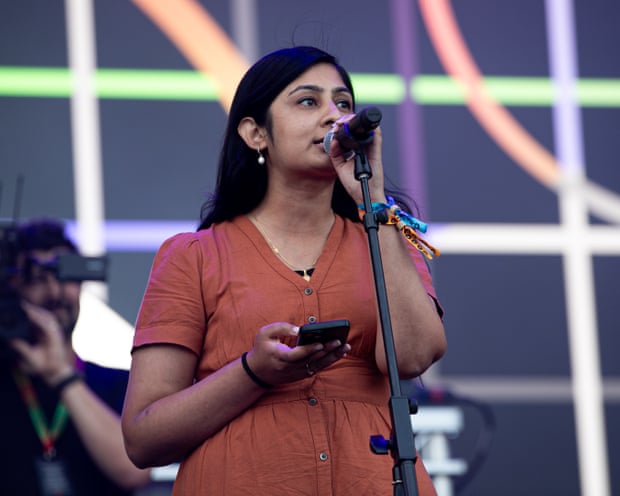
A massive queue wrapped around the Niamos Radical Arts Centre in Manchester’s Moss Side in the afternoon as people waited eagerly to join a panel discussion with former Labour Party leader Jeremy Corbyn and independent MP Zarah Sultana focused on the formation of their new political party.
“For too long, our politics has been trapped in a cycle: the same two parties, the same tired promises, the same broken failures; a nightmare that keeps us stuck divided and ignored,” began prominent British-Palestinian activist Leanne Mohamad.
“The truth is that the two-party system has failed us all,” she said. “Everything that these two parties touch is corrupted. And that is why we have to break this duopoly and we will.”
Ms Sultana began a passionate speech by first addressing the new party’s rocky start. “Obviously, you’ve all seen what’s happened over the past few weeks,” she said. “But I’m here to tell you, the show is back on the road.”
Keir Starmer says that the Labour Party under his leadership all feel a small part of Scunthorpe.Keir Starmer objects to criticism of the IDF. He asks how could anyone object to them starving people to death, forced marches like the Nazis did, bombing Gaza’s hospitals and universities, mass-murdering journalists, healthworkers and starving people queuing for food, killing and raping prisoners and murdering children. He calls for people to stop obstructing his genocide for Israel.UK Conservative Party leader Kemi ‘not a genocide’ Badenoch explains her reality that the Earth is flat, the Moon is made of cheese and that she was born from
Unicorn horn dust
People take part in a Stand Up to Racism protest in Epping, Essex, July 27, 2025
LEFT MPs Zarah Sultana and Diane Abbott and senior trade unionists will lead thousands of counterprotesters’s “far-right festival of hate” in London on Saturday.
A thousand people attended an online event to launch the Women Against the Far Right campaign on Thursday night, in the run-up to the march organised by Stand Up To Racism, with hundreds from the campaign set to join the march.
Ms Abbott, who is currently suspended from the Labour Party, said: “The far right are a menace to the whole of society.
“Their first targets, asylum-seekers and Muslims, are broadening to all migrants, black people and on to trade unionists, all religious minorities and anti-racists. They must be stopped.”
Ms Sultana said: “The far right are not welcome on our streets. We see through their lies.
“Their politics of hate and division make our communities weaker and women less safe.
“That’s why thousands of us are marching on Saturday — to show that fascists will be met with resistance wherever they spread their poison.”
Climate science denier Nigel Farage explains that it’s simple to blame asylum-seekers or Muslims for everything.Elon Musk urges you to be a Fascist like him, says that you can ignore facts and reality then.
Sultana said: ‘People are desperate for a leftwing alternative that is not beholden to the interests of the billionaires and the super rich.’ Photograph: Mike Lewis/Redferns
Co-leader of nascent leftwing party says more than 750,000 people have registered their interest
“Labour is dead” after failing to deliver for working people, Zarah Sultana said as she urged supporters of a new leftwing party she is creating to be patient and “watch this space”.
Sultana, the independent MP for Coventry South who quit Labour after losing the whip for backing a move to scrap the two-child benefit cap, is co-leader of a nascent party with Jeremy Corbyn.
She was speaking at the weekend in Newcastle at the conference of a separate but like-minded leftwing party founded by the former Labour North of Tyne mayor, Jamie Driscoll, who quit the party when he was blocked from standing as its candidate in the north-east mayoralty election.
It was a packed house of about 300 people in the Great Hall meeting room of Newcastle’s Discovery Museum. The gathering shines a light on how Labour has to look over its left shoulder, as much as its right, while it navigates the changing political landscape with confidence in established, mainstream parties on the decline.
Sultana said more than 750,000 people had registered their interest in the new party but acknowledged frustration at how long it was taking to get it formally launched. In lieu of an agreed name it is being called “Your party” and no date for a promised “mid-autumn” conference has been announced.
“Watch this space,” Sultana told the Guardian. “I am just as desperate to get this going but it will take time to make sure democracy is at the heart of it. It needs to be reflective of the movement, it can’t just be MP-led.”
Up and down the country, Jeremy Corbyn is drawing large crowds | Jeff J Mitchell/Getty Images
As Nigel Farage dominates headlines, Jeremy Corbyn is being overlooked by the media – just as he was in 2017
In May 2017, British Conservative prime minister Theresa May called a snap election three years early, despite having a comfortable majority in Parliament and having told the country she would not do so.
May was polling well and assumed it would be easy to push Jeremy Corbyn’s Labour opposition to a crushing defeat, winning an even bigger majority that would strengthen her hand in Brexit negotiations. Most pundits agreed this was the likely outcome.
But on polling day, May failed dismally. The Tories lost their majority. Corbyn, despite having faced bitter opposition from within his own party since being elected leader two years earlier, somehow managed to reach out over them to speak to a much wider public.
Something had happened to the body politic that had been missed by the media. Now, with the announcement of Corbyn and former Labour MP Zarah Sultana’s new party, a similar shift is underway – and is once again flying under the radar.
As I wrote for openDemocracy at the time, back in 2017, Corbyn was drawing large crowds across the country ahead of the election. When his rallies and meetings were held in public spaces, thousands turned up, often at short notice. If scheduled for indoor venues, these would be full to bursting, and he often had to repeat his speech to those waiting outside.
In one sense, there had already been signs of something going on below the political surface. When Corbyn first ran for the party leadership in 2015 – a contest in which he was the runaway winner – there were early indications that he was attracting considerable support from the grassroots.
A year later, strong opposition from within his own party led to a leadership challenge that he won, again achieving a hugely positive reaction at public meetings in spite of his internal critics.
History is repeating itself. Corbyn and Sultana’s new left-wing offering – not yet officially named but for now known as Your Party – may be a work in progress, but the enthusiasm with which it has been greeted is palpable.
Some 800,000 people have signed up to support the idea. If just a quarter follow through to become members when it is formally established, it may well become the UK’s largest political party by membership overnight, given the collapse in Labour membership.
The idea that a new decidedly left party could come to the fore and acquire serious political power may seem impossible, given Westminster’s First Past the Post voting system, but just look at what is happening across the UK political scene, especially in England.
It’s hard to say how many groups have sprung up across the country to form local concentrations of support for Your Party in the past four or so weeks, but it almost certainly runs into the many hundreds. In the West Yorkshire council where I live, two groups have already met, with two more due to do so in the next week, all with loose coordination yet covering the whole area of the metropolitan council.
In contrast, Labour’s practised and experienced membership bureaucracy is seeing support ebbing away. Accurate, up-to-date figures are not easy to come by, but the party reportedly had 309,000 members six months ago, down from a peak of 532,000 under Corbyn in 2019. Some constituency party treasurers are reporting recent membership losses of up to a third over the past year alone.
There are many factors involved in this decline, not least the Labour leadership maintaining a marked degree of austerity and failing to confront Nigel Farage and Reform UK head-on. But perhaps the key problem is the party’s even greater failure to confront Benjamin Netanyahu and his Israeli government over the appalling genocide they are inflicting in Gaza. This issue, probably more than any other, is leading Labour activists who would normally be at the forefront of projecting its policies to leave the party in droves.
Can Labour’s decline and Your Party’s rise, not to mention the current considerable strength of Farage and Reform UK, lead to a radical re-ordering of the political environment in England? Several things suggest it could be possible.
For a start, we’re likely three years away from a general election being called. That gives enough time for Reform’s weaknesses to show themselves.
The party is substantially trading on fear, principally of migrants, but which commonly extends to a more general ‘fear of the other’. Corbyn is particularly effective at countering this head-on with hope, which is thoroughly appealing and especially so to younger people, as can be seen in new polling showing that one in five 16 and 17-year-olds would vote for Corbyn and Sultana’s new party.
Reform is also vulnerable in its attempts to claim it is standing up for the ordinary person against a woke and distant elite. That simply doesn’t add up; given the considerable wealth floating around the Reform leadership and its funders, it is not difficult to present them as the true elite.
Finally, a serious weakness for Reform and the Tories is their Cnut-like denial of climate breakdown and their addiction to fossil carbon. The folly of that stance may well come to haunt them over the next three years, as more and more ordinary people across the UK experience floods, or wildfires, or other climate crisis-related weather phenomena.
Then there is the other side of the political scales, starting with the election this week of Zack Polanski as the Green Party leader. Polanski has not yet ruled out working with Sultana and Corbyn, and there is time for local electoral pacts to be negotiated in forthcoming elections, especially the many local elections and the Scottish and Welsh national elections taking place next May.
We also should not discount the Liberal Democrats, who have considerable geographical concentrations, north and south of the border. In Scotland, in particular, there are plenty of new, younger politicians coming through, just as there are in the Scottish National Party. Your Party is also likely to lead to the emergence of new political figures on the progressive left in the coming months, while others may decide to defect from Labour to the party.
A couple of other elements are worth watching, too. Sultana, Polanski and Corbyn are all highly committed politicians and very effective communicators. Expect to see a lot more of them, even on the legacy media.
Of them, Corbyn is key. He is not remotely a rabble-rouser, yet for the past ten years, he has maintained a formidable and dedicated network of supporters – even at very difficult times. It is very easy to dismiss what he stands for as being from the past, but perhaps it is actually from the future.
Genocide denier and Current UK Prime Minister Keir Starmer is quoted that he supports Zionism without qualification. He also confirms that UK air force support has been essential in Israel’s mass-murdering genocide. Includes URLs https://www.declassifieduk.org/keir-starmers-100-spy-flights-over-gaza-in-support-of-israel/ and https://youtu.be/O74hZCKKdpAUK Labour Party government ministers Keir Starmer, Angela Rayner and Rachel Reeves explain that they are partners complicit in Israel’s Gaza genocide. The UK has provided Israel with arms, military and air force support. They explain that they don’t do gas chambers but do do forced marches, starvation, destroy hospitals, mass-murders of journalists and healthcare workers.Nigel Farage urges you to ignore facts and reality and be a climate science denier like him. He says that Reform UK has received millions and millions from the fossil fuel industry to promote climate denial and destroy the planet.

 From left to right: La France Insoumise deputy leader Nathalie Oziol, Die Linke general secretary Janis Ehling, Workers’ Party of Belgium general secretary Peter Mertens, British-Palestinian activist Leanne Mohamad, Jeremy Corbyn and Zarah Sultana