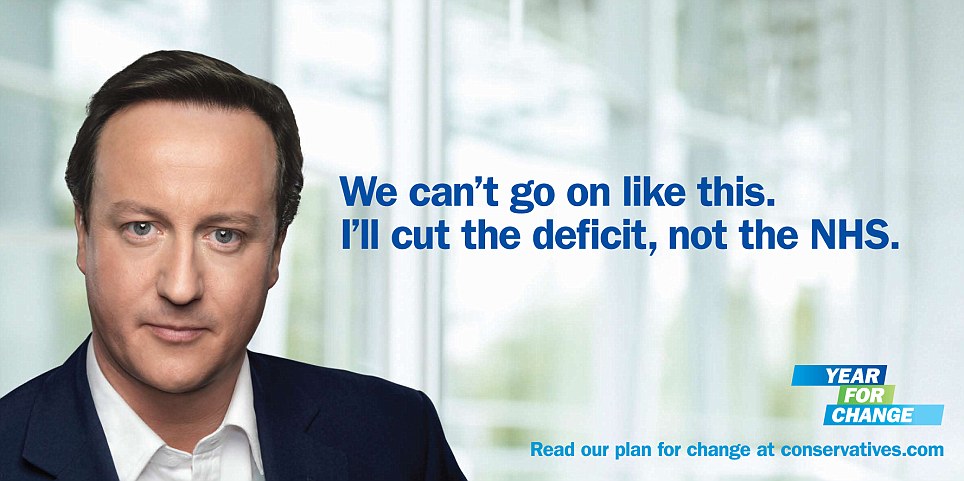
NHS news is still about listening but possibly not doing anything beyond listening. There is a suggestion that the campaign group 38 degrees is having an effect after compiling a huge petition.
I was mistaken when I wrote this yesterday: “There are claims that drastic changes are necessary to the NHS because of UK’s ageing population. I suspect that this justification has surfaced over the past few days and that previously alleged necessary change was presumed to be self-evidently true and no justification beyond “Doing nothing is not an option” was necessary.” Cameron presented proposed changes to the NHS on 17 January 2011. It’s reported that he “said the health service would start to collapse in two years without an overhaul to cope with the new pressures of obesity, an ageing population and costly new drugs.” That’s as well as saying that “doing nothing is not an option” and that critics should “grow up”.

- Conservative election poster 2010
A few recent news articles concerning the UK’s Conservative and Liberal-Democrat coalition government – the ConDem’s – brutal attack on the National Health Service.
Experts talk shop as Tory changes start to kick in / Britain / Home – Morning Star
Health experts and union leaders took part in a panel debate on their vision for the NHS on the last day of Unison’s health conference today.
In a bid to pick apart Health Secretary Andrew Lansley’s Health and Social Care Bill, NHS journalist Roy Lilley, Unison assistant general secretary Karen Jennings and British Medical Association GP committee chairman Laurence Buckman spoke out about where the health service would find itself in years to come.
Mr Buckman said the “main thing I want to see scrapped from these reforms” was Monitor, the body that regulates foundation trusts.
“It should not enforce competition between people who should be healing the sick.”
He also warned that the Health and Social Care Bill would see the NHS turned into a purchaser of healthcare rather than a practitioner.
David Cameron and Nick Clegg pledge to listen – UK Politics, UK – The Independent
David Cameron and Nick Clegg pledged today to listen to concerns about NHS reforms but warned “no change is not an option”.
Launching the Government’s listening exercise on the Health and Social Care Bill, the Prime Minister stressed the NHS was the nation’s most precious asset.
But he admitted the Government had been “charging ahead” with the reforms and must now pause to address worries coming from many quarters, including patient groups, Royal Colleges and unions.
The Deputy Prime Minister accepted it was an “unusual” move to launch a listening exercise when the Bill had already passed its Commons committee stage but said it was “extraordinarily important” the Government got it right.
The pair were joined by Health Secretary Andrew Lansley in addressing about 100 doctors and nurses at Frimley Park Hospital in Surrey.
Commitment To Listen Welcome, But BMA Says Real Change Needed On NHS Reforms, UK
Commenting on the launch of a listening exercise and the creation of a ‘Future Forum’ to advise the government on changes to its reforms of the NHS in England, Dr Hamish Meldrum, Chairman of Council at the BMA, said:
“We see it as positive that the government is committed to listening. How serious it is about making real changes remains to be seen, but we welcome the acknowledgement that NHS staff and many others in the healthcare world have genuine concerns. The BMA will co-operate to get across the views of doctors, and to work to ensure we get the best outcome for patients.
“While we share the objectives of improving services for patients and empowering staff, we believe the Bill as it is currently written is taking the NHS in England in the wrong direction. We have particular concerns about the emphasis on a statutory duty to promote competition in the NHS – with the accompanying risk of fragmentation of care, the proposed new model for the delivery of education and training, and the detail of how commissioning will work.”
NHS ‘listening exercise’ thrown into doubt | Society | The Guardian
A two-month “listening exercise” in which medical professionals will be asked to contribute to a review of changes to the NHS has been thrown into doubt by a confidential memo highlighting a series of government red lines that must be maintained.
As David Cameron and Nick Clegg joined the health secretary, Andrew Lansley, on Wednesday to launch the exercise at a hospital in Surrey, the memo by NHS chief executive David Nicholson indicated there may be little room for manoeuvre in reworking the health and social care bill.
The memo drew a red line beneath the fundamental planks of the bill that are not for changing: GP consortiums, an independent commissioning board to oversee them, every hospital to become a foundation trust, and Healthwatch and primary care trusts to be abolished by 2013.
The memo said there would be delays in setting up Monitor, a regulatory body for bringing competition in the NHS, to which many object, which will slip to July 2012, and the abolition of strategic health authorities will also be delayed to the same date.
The memo is likely to be seized on by Labour which says that the “listening exercise” is more of a PR exercise.
Why Tory MPs Have NHS Jitters | Boulton & Co. | Sky News Blogs
A Tory grandee in the Commons has explained to me why Conservative MPs – and particularly the 2010 intake – have got the jitters over the Government’s NHS reforms.
I can reveal that the Tory wobble is the result of a lobbying campaign by a pressure group called 38 DEGREES, which has launched an internet petition which already has more than 252,000 signatures.
Never heard of them?
No, nor had I, until my grandee friend told me it’s the same pressure group that was largely responsible for frightening Tory MPs into demanding a Government U-turn on the forest sell-off fiasco.
The group’s website tells me it was launched in 2009 and its members voted this month on its next big campaign priority: “Work together to protect the NHS.”
Minister: tell us your fears about NHS reforms – but we might not listen – Health News, Health & Families – The Independent
A Cabinet show of unity over the Government’s controversial health reforms was undermined when the Department of Health declined to confirm that a “listening exercise” would change the plans.
David Cameron, Nick Clegg and the Health Secretary Andrew Lansley joined forces in an attempt to woo health professionals into supporting Mr Lansley’s plans to transfer 60 per cent of the NHS budget to GPs. But cracks emerged only an hour after their carefully-choreographed appearance at Frimley Park Hospital in Surrey, where they promised to “pause, listen and reflect” but insisted the status quo is not an option.
Downing Street sources endorsed Mr Clegg’s pledge that the rethink would be followed by “substantive changes”. Mr Cameron is expected to order Mr Lansley to give councillors a role on the GP-led consortia that will commission services instead of primary care trusts (PCTs)—a key Liberal Democrat demand. More health professionals such as hospital doctors and nurses will be added to the commissioning bodies and limits imposed on competition to allay fears about “back door privatisation.”
27/11/13 Having received a takedown notice from the Independent newspaper for a different posting, I have reviewed this article which links to an article at the Independent’s website in order to attempt to ensure conformance with copyright laws.
I consider this posting to comply with copyright laws since
a. Only a small portion of the original article has been quoted satisfying the fair use criteria, and / or
b. This posting satisfies the requirements of a derivative work.
Please be assured that this blog is a non-commercial blog (weblog) which does not feature advertising and has not ever produced any income.
dizzy