NHS news review
Celebrations of the 63rd birthday of the NHS today are concerned for its future. The TUC highlights concerns about the Health and Social Care Bill (Destroy the NHS Bill) while Ozzy Osbourne pays tribute to the NHS and says that without the NHS’s dedication he could not have continued his career as the Prince of Darkness.
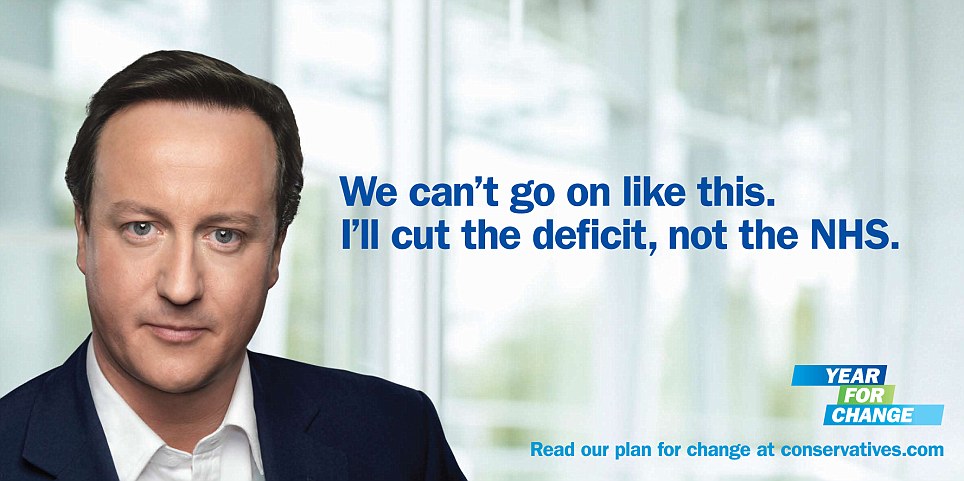
- Conservative election poster 2010
A few recent news articles concerning the UK’s Conservative and Liberal-Democrat coalition government – the ConDem’s – brutal attack on the National Health Service.
Trades Union Congress – Campaigners celebrate the 63rd birthday of the National Health Service
…
Despite the government’s response to the recent NHS Future Forum report, unions still have key concerns about the Health and Social Care Bill. These include fears about a vast and damaging extension of competition, and concerns that the abolition of the private patient income cap will see NHS patients pushed to the back of the queue as waiting lists grow and trusts prioritise care for paying patients.
Unions also have concerns relating to the clinical commissioning process. Many groups of staff will still have no voice within the process and it is also likely to mean mass subcontracting to private companies, and an overly complex system at local level.
Transparency and accountability remain a concern. Although the Bill requires trusts to hold their meetings in public, no such requirement will exist for private and voluntary sector providers of health services.
Commenting on the birthday celebrations, TUC General Secretary Brendan Barber said: ‘Despite some amendments to the controversial NHS reforms, many of the most damaging aspects of the Health and Social Care Bill remain. The changes presented to us by the government after its recent listening exercise amount to little more than smoke and mirrors.
…
Ozzy in tribute to ‘dedicated’ NHS – Scotsman.com News
…
The former Black Sabbath frontman, who was born five months after the service was created on this day in 1948, was one of the first generation of NHS babies.
The singer was also treated by NHS staff in 2003 after a near-fatal accident at his Buckinghamshire home left him with a fractured neck vertebra, eight fractured ribs and a broken collarbone.
He said: “If it wasn’t for the hardworking staff of the NHS following my serious quad bike accident, I may not be here today to continue my career as the Prince of Darkness.
“I want to say a big thank you to all of the dedicated doctors, nurses and everyone else who makes up the NHS across the country – from Birmingham to Berkshire. Just like me, it’s still going strong after 63 years. Long may we both keep it up.”[!]
…
Britain/Health service – An update on the British government’s piecemeal privatisation of healthcare
[NB This is a long article very useful for background]
[9.45a.m. 5/7/11edit: This article while mostly accurate is partly outdated by changes following the Future Forum’s ‘listening exercise’
e.g. this section is outdated re: exclusion of hospital doctors and nurses
Instead the Bill proposes that £80 billion of commissioning budgets are to be devolved to local consortia of GPs, which will decide how best to spend the money. The Bill lays down no specific requirements in terms of the size of population to be covered by a consortium, the organisational structure of a consortium, or for any public or non-GP involvement. The Bill specifically excludes hospital doctors however senior, and nursing staff and other health professionals from any specific role in this new management structure.]
The situation in England’s health care system reflects the broader picture on the European and a world scale. Healthcare is the world’s biggest industry with a turnover in excess of $5 trillion annually, 85% of which is spent in the wealthiest countries, in most of which the majority of spending takes place through tax funded systems all through social health insurance. The private sector, looking to rebuild its profit margins, is determined to recapture a larger share of this health budget, especially in Europe.
But because of the political obstacles to most European governments being seen to break up and privatise healthcare systems, which currently deliver near- universal care – in general with few copayments or charges at point of use – the privatisation process has been of a special kind.
This is very different from the process of privatisation in the UK and in other countries in the 1980s, in which whole utilities such as gas and telecoms and electricity were sold off to shareholders and became private for-profit businesses.
There are three reasons for this: the first is the political sensitivity of the issue for parties, which in general are trying to appear different from the old style Thatcherite neoliberal parties of the 1980s: and in a political climate in which there is little sympathy for the private sector and privatisation.
The second rason is that the private sector itself has limited interest in taking over the whole of healthcare systems: their focus is primarily on cherry picking those parts of the system which appeared to offer them a profit, primarily uncomplicated elective surgery – the mainstay of private medicine around the world. Certainly in England there has been very little pretence from private sector companies of any interest in taking over for example work on accident and emergency services, complex and risky surgery, or chronic care for older people and community services of any type.
And finally there is the issue of resources in the private sector: healthcare systems are far larger than the utilities of the 1980s, while the private health care sector is centred on small-scale hospitals and providing services to an elite wealthy minority of the population: it therefore has nowhere near the management or capital resources required to contemplate a takeover of the entire health systems.
In England the process of slicing off particular sections of health care for privatisation began in the mid-1980s with Margaret Thatcher’s government deciding to put non-clinical hospital services such as cleaning, catering, porters and other services out to competitive tender. The result of this was to stimulate the emergence of a new range of small-scale and untested private companies, and in the context of labour intensive and generally low paid work, these companies attempted both to undercut existing costs to win contracts and at the same time make a profit focused on employing fewer staff, working harder, and offering them worse pay and conditions.
This in turn brought the virtual casualisation of hospital cleaning in much of the UK, but also undermined staffing levels and standards of cleaning and hygiene, even in those hospitals where services remained in-house, since public sector managers were obliged to compete with the low standards and low wages of the private sector.
A generation later the legacy of this privatisation is still haunting the National Health Service in much of the UK, and especially in England, where fewest services have been brought back in-house in recent years. Hospital-borne infections, poor standards poor morale and gaps in staffing levels continue to create problems and often to dump work which should be done by private companies onto nursing and other staff who have other responsibilities as well.
…
BBC News – Social care costs ‘should be capped at £35,000’
Social care costs in England should be capped so people do not face losing large chunks of their assets, an independent review says.
Council-funded home help and care home places for the elderly and adults with disabilities are currently offered only to those with under £23,250 of assets.
The Dilnot report said the threshold should rise to £100,000 and a £35,000 lifetime cap on costs would be “fair”.
…
UNISON Press | Press Releases Front Page
UNISON, the UK’s largest union, said today that the Dilnot Commission’s report could be a stepping stone in the right direction towards an NHS style model of care for the elderly, free at the point of use. Raising the means-testing threshold and capping private contributions draws a line in the sand, but the public will want to see that cap move downwards towards tax-funded care, otherwise it will always be a hostage to political fortunes.
The union called on the government to act now on the recommendations, making sure every penny goes towards public care not private profit, and urged it to tackle the wider issues of quality in the system. And warned that public trust in an insurance based model will be low, given the poor track record of the financial services industry.
…
Healthcare Locums probes two execs over ‘misconduct’ | Business
Two senior recruiters at crisis-riven healthcare employment agency Healthcare Locums have been suspended pending investigations into serious misconduct allegations that will fuel criticism of the use of profit-driven private contractors by the NHS.
One executive, Christian Mansfield-Osborne, is being investigated for alleged “irregular invoicing” in an affair which has involved the company reimbursing one NHS trust in Birmingham with £200,000.
The other, Scott Whitehead, is being probed over allegations that ancillary staff were sent out to work for the NHS without having undergone the required checking procedures.
It is not clear which checks were allegedly not carried out, but the kind of paperwork required for such contractors include Criminal Records Bureau searches, right-to-work documentation and professional qualifications.
…