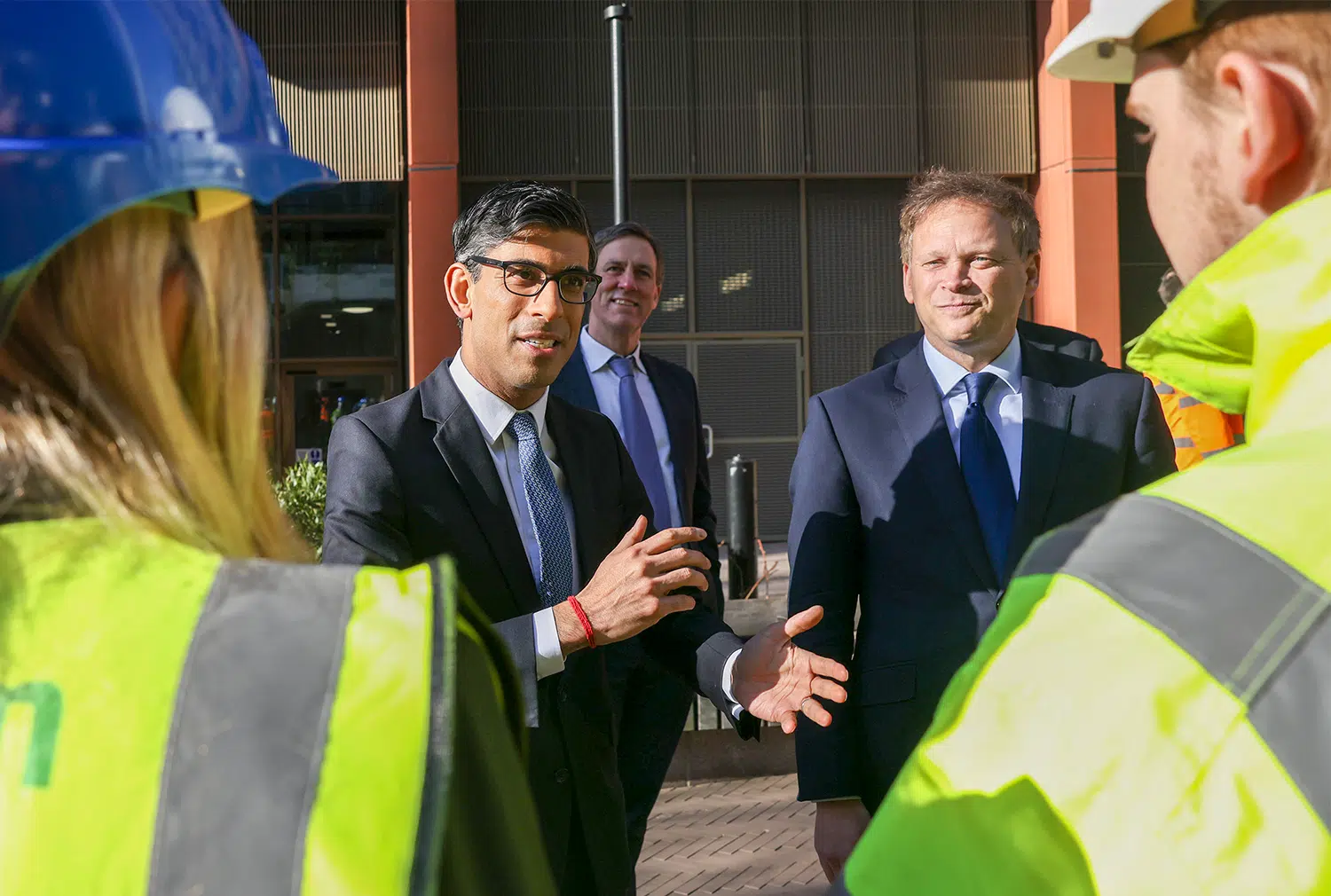
PRIME MINISTER Rishi Sunak jetted into Scotland today [Monday] to announce a cash bonanza for the oil majors, just days after the United Nations announced that “the era of global boiling has arrived.”
Companies such as Shell and BP, which coined £3 billion each in just the last three months, continue to enjoy the Prime Minister’s generosity.
Having already doled out billions of pounds worth of windfall tax breaks to fossil fuel majors in the North Sea, Mr Sunak has said he will back the granting of over 100 new oil and gas licences and provide up to £20bn in state handouts to carbon capture and storage.
Despite the proposed fields not likely to come on stream for over a decade, Mr Sunak and ministers such as Energy Secretary Grant Shapps claim that the supply would ensure energy security and aid in “safeguarding bills for British families.”
Mr Sunak argued his policy to prolong production of oil and gas by decades “is entirely consistent with our plans to get to net zero” — a target due to be met in just seven years.
The Prime Minister’s remarks united climate activists, anti-poverty campaigners, trade unionists and opposition politicians in their condemnation of a policy they argue ditches international commitments on climate change, fails to deliver a fair transition for workers, and will not help those struggling to pay heating bills this winter.
In a statement, climate activists Just Stop Oil branded the 100 new licences expected to be granted this autumn as “100 new crimes against humanity,” adding: “Rishi Sunak and his fossil fuel backers are taking us all for fools.
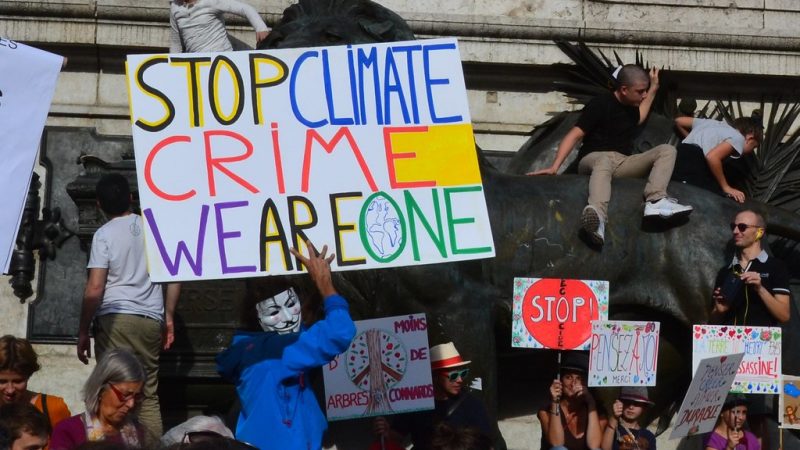
Protest banner reads Stop Climate Crime. We are One.
Radical action is essential to stop the transition from global warming to global boiling
Extreme weather events have increased in frequency and intensity over the past decade, with the last month seeing a rare combination of problems across North America, the Mediterranean and Middle East, northern China and South Korea. For the British, there has been the separate added shock of seeing tourists fleeing wildfires, especially in Greece.
These events are all part of the early stages of climate breakdown, which will get progressively worse unless the world makes a revolutionary and rapid transition to a low carbon economy, yet there is little evidence that political leaderships are even remotely prepared for this. At least UN secretary general António Guterres is using different language, not least his use of “global boiling” rather than “global warming” for his warnings of what is to come.
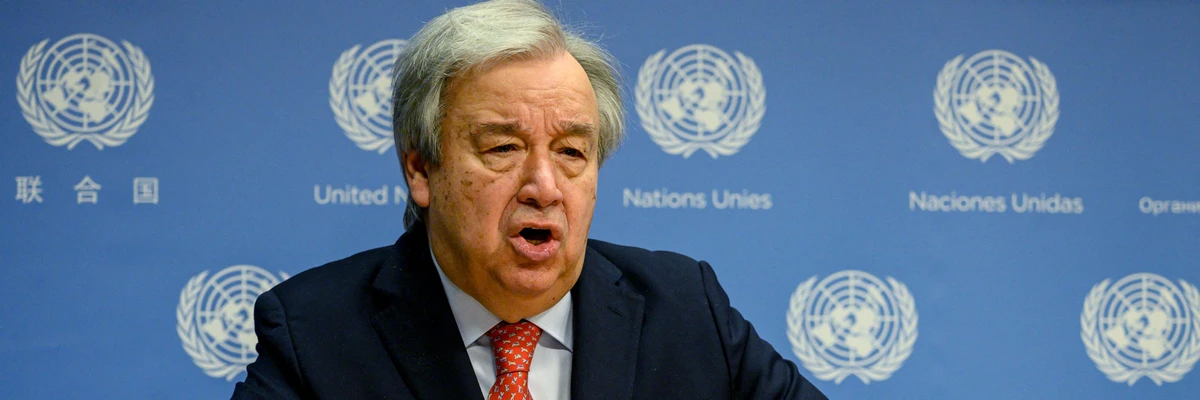
United Nations Secretary-General António Guterres discusses climate change at U.N. headquarters in New York City on July 27, 2023.
He is an exception, and public opinion overall is still not aware of the huge changes required. All the warnings from climate scientists, coupled with the evidence of our own eyes, seems to count for little as we move towards an unstable, chaotic and overheating planet.
Why is this? More importantly, why is it that radical decarbonisation isn’t happening, even though we know it’s possible? And, most important of all, how can things be turned round in time?
Let’s start with the inaction. Here, three elements interact. First, we are talking about fundamental changes in how we live, not just in the UK or western Europe but across the whole world. The result would be a cleaner, safer and healthier world, but it would involve years of huge change – which is a lot for ordinary people to take in. We shouldn’t underestimate this. Poorer communities, in particular, will find it very difficult to cope with the changes, while richer elites everywhere in the world will likely maintain the naive belief that their wealth will keep them secure.
Second, what must be done runs directly counter to the way the economy currently works. The market fundamentalist system is rooted in competition and the false belief that the millions of people left behind will benefit from trickle-down from the rich and be content. It believes that while central government, in partnership with wealth, may hold the ultimate levers of control, it should have a minimal role in how the market works. Cooperation is anathema to this way of thinking, but cooperation is essential to prevent global boiling.
Neoliberals see this market fundamentalist approach as necessary for an ordered and stable society, and believe that if the millions of marginalised people do not upset the apple cart, all will be well. At root is a belief that the elite knows best.
In Britain, there was the unexpected risk of a seriously radical Labour government taking over in 2017. Fortunately for the neoliberals, that was narrowly avoided and since then the threat from the Labour left has been well and truly suppressed.
Despite this, the system still has wider concerns over potentially violent responses from the margins. In many countries, and especially Britain, new laws have been brought in and others strengthened, and police and security forces are much better equipped and trained to handle public dissent. Heavy prison sentences for even small acts of nonviolent direct action are now there to be used.
The problem is that a market economy system simply cannot act fast enough to handle climate breakdown. The system knows this, so finds it preferable to support the view of any “experts”– of whom there are plenty – who still deny there is a problem.
The anti-climate breakdown forces are exceptionally well entrenched in society and have the easy job of convincing people that no action is required
This brings us to the third point: the relentless propaganda from the fossil fuel industry and associated think tanks over half a century to deny the problem, even when their own scientists are saying otherwise. In a fairer world there would be an offence of global corporate manslaughter, but in the real world there isn’t.
Overall, the anti-climate breakdown forces are exceptionally well entrenched in society and have the easy job of convincing people that no action is required – just when they are being told that action will be personally costly. Politicians will play on this, especially when elections are in the offing. This can even reap electoral favour. The current behaviour of Britain’s Sunak government is a case in point, with Sunak declaring that climate policy must be “proportional and pragmatic”, following a by-election win in a constituency where the Tory candidate had opposed extension of the ULEZ low-emissions scheme.
So where do we go from here? One way to look at it is to view the current issue as two very broad global trends that are on course to converge, and when they finally meet there will be a chance of radical change because there will be no alternative.
One of these trends, as we have seen, is a system set in its ways and highly unlikely to change. Carbon emissions will continue rising, temperatures will head well above 1.5°C and those with the power will reap the rewards, at least in the short term.
The other trend is much more positive and has three elements.
Climate science has come on by leaps and bounds in the past half century. The science community is far more confident of its expectations of climate breakdown and is, at last, saying so bluntly. That welcome change also has greater force because of the manner in which the beginnings of climate breakdown are frequently exceeding the warnings of predictive models.
The second trend is, at last, a growing public awareness that things must change, and change quickly. The power of the movements in many countries is remarkable, so much so that far more people are willing to risk prison for the sake of the future.
Finally, numerous impressive developments in renewable energy technology have brought down the cost of electricity by huge margins, bringing it well below grid parity in price with fossil fuels.
That leaves just two huge questions, on which so many futures depend, particularly for our children and grandchildren. When will the convergence happen, and how quickly can changes then be made?
If it takes another 20 years to the early 2040s, then the task will be almost insurmountable, with action only happening after numerous appalling catastrophes, and bitter anger from the marginalised billions. If change comes before the mid-1930s then prospects will be brighter, but the later the convergence the greater the challenge.
It is therefore a matter of the sooner the better, so the rest of the 2020s has to be a time of intense activism whenever and wherever possible. Whether it is by persuasion, argument, nonviolent direct action or other means, it might then be possible to convince enough people that radical action is essential before the transition from global warming to global boiling risks becoming irreversible.
Whatever you’re interested in, there’s a free openDemocracy newsletter for you. HAVE A LOOK
Rishi Sunak’s decision to mothball his green commitments risks doing no good to anyone, including the Tory party
Image of InBedWithBigOil by Not Here To Be Liked + Hex Prints from Just Stop Oil’s You May Find Yourself… art auction. Rishi Sunak, Fossil Fuels and Rupert Murdoch appear.
The hottest month in world history has just ended. It is only days since the United Nations general secretary, António Guterres, warned that the era of global warming has now become the era of global boiling. Climate crisis haunts all nations without exception. The case for a redoubling of efforts to curb greenhouse gases could hardly be more stark than today.
So what kind of leadership does Britain’s prime minister offer in response to this crisis? Answer: he announces an expansion in drilling for the oil and gas that are driving the emissions that are transforming the world’s climate. In other words, while the planet burns, Rishi Sunak stands accused of pouring fuel on the flames.
Mr Sunak confirmed on Monday that the UK is to press ahead with a new phase of North Sea oil and gas exploration and production. “Hundreds” of licences will be granted in September and in subsequent rounds of licensing. The aim is explicit. Rather than winding down the industry and keeping the resources in the ground as part of the transition to the net zero target, Mr Sunak wants to max out production of the North Sea’s remaining reserves.
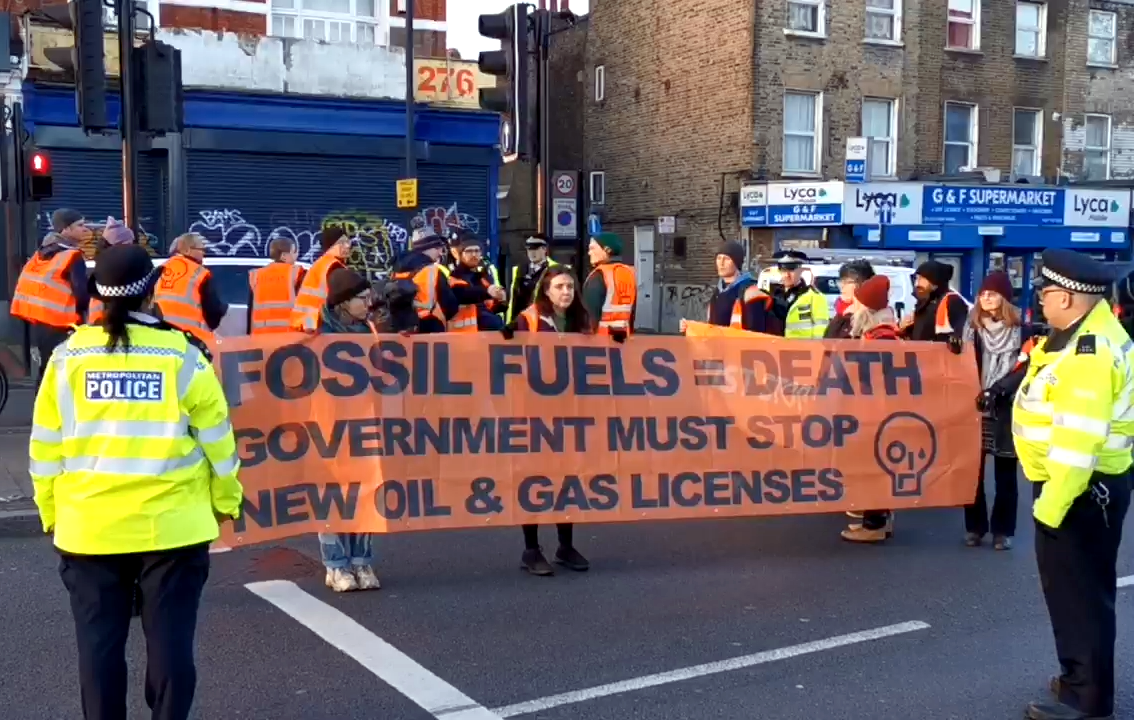
Just Stop Oil protesting in London 6 December 2022.
5/9/24 This content removed following DMCA takedown notices initiated from the Scotsman claiming copyright infringement. I disagree with them – i.e. I don’t accept that I’m infringing the Scotsman’s copyright – and they look to be produced by a simple automated routine without human supervision or intervention i.e. a stupid bot. I’m disappointed that my website host accepts these notices without question, has redirected some articles as a result and threatened further restrictions.
I have successfully defended one article that the Scotsman was claiming copyright to. That copyright is clearly owned by the letter’s authors. That’s the standard of competence I’m up against.