[Extinction Rebellion NL] are demanding that the bank stop providing financing and services for the fossil fuel industry. ING was based in the building near the planned blockade until 2014. Due to its unusual shape, it has nicknames alluding to its similarities to a boot, a shoe, an ice skate and a hairdryer. As such, it is somewhat of a landmark that is easily visible from the A10, and why XR believes it is the best place for the demonstration.
Amsterdam Mayor Femke Halsema has forbidden the blockade. The city indicated that the motorway is “irresponsible” as a demonstration location. The A10 is five driving lanes wide, and the speed limit is around 100 kilometers an hour. The VU Medical Center is nearby, and therefore, it is an essential route for ambulances. Traffic to and from the rest of Noord-Holland also passes through the road, which could lead to long traffic jams.
…
ING also announced last week that they will stop financing oil and gas projects by 2040. The climate activist group believes the commitments are “insufficient” to “secure a livable future.”
Experts say prolonged delay in replacing chair signals that government does not take net zero policy seriously enough and is harming investment
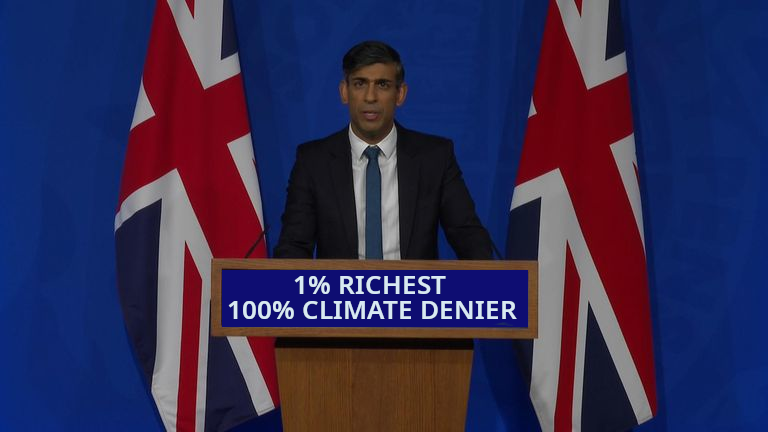
Rishi Sunak has come under fierce attack from UK climate experts for the Conservative government’s failure over the past 18 months to appoint a new chair of the independent committee that advises ministers on emissions targets.
In a letter to the prime minister leaked to the Observer, the UK’s leading organisation working on the economic effects of global warming condemned the “excessive delay” in finding a replacement to the previous chair, Lord Deben.
Bob Ward, the Grantham Research Institute on Climate Change’s head of policy, warned Sunak that the delay is harming efforts to control carbon emissions and damaging the UK’s reputation as a climate change leader.
“Given that the recruitment of the new chair began 18 months ago it is inexplicable that the appointment has still not been announced,” wrote Ward. The work of the committee is at a “critical stage”, he added. “It is not helpful that it does not yet have a new chair as it carries out this work.”
The economist Lord Stern, who is chair of the institute, said: “It seems to be yet another signal that the government does not take climate change policy seriously enough. All this is damaging the confidence of other countries and of investors in the UK’s commitment to climate action.”
The failure to find a new committee chair is the latest example of a lack of consistency displayed by Sunak towards his party’s green commitments. This year, he dismayed environmentalists when he announced legislation for an annual system of oil and gas licensing in the North Sea which followed a scaling back of other measures including delays to a ban on the sale of new petrol and diesel cars.
The Climate Change Committee is a body of experts set up under the 2008 Climate Change Act to guide national policies for controlling emissions and for helping the country prepare for the impact of global warming. In the past, it has been highly critical of Britain’s poor performance in areas including the nation’s flood defences and domestic energy efficiency.
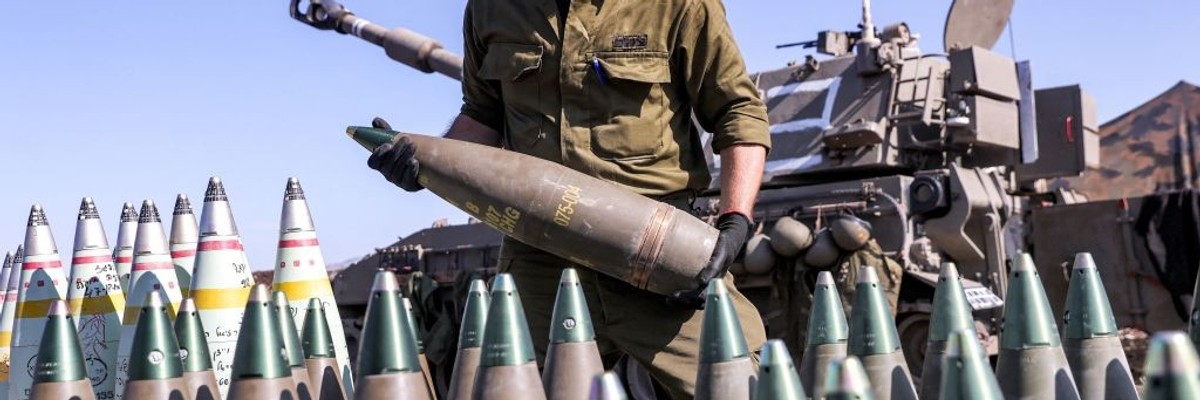
An IDF soldier readies a 155mm artillery shell for loading in a howitzer. An Israeli soldier carries a 155mm artillery shell near a self-propelled howitzer deployed at a position near the border with Lebanon in the upper Galilee region of northern Israel on October 18, 2023. (Photo: Jalaa Marey/AFP via Getty Images)
“When Israel runs out of rockets to murder children with they simply hold their hand out to daddy for more,” said one critic.
Citing “the urgency of Israel’s defensive needs,” the Biden administration on Friday said it would bypass Congress for the second time this month to approve an immediate arms sale to the key Middle East ally as it continues to wage a genocidal war against Gaza.
The Associated Press reported that U.S. Secretary of State Antony Blinken notified lawmakers of the new emergency determination involving the sale of $147.5 million in equipment including fuses, charges, and primers for 155mm artillery shells that Israel has already purchased from the United States.
The unguided explosive rounds—which Israel is using in heavily populated urban areas—have a “kill radius” of about 50 meters, with shrapnel able to inflict lethal wounds on people hundreds of meters away.
“The United States is committed to the security of Israel, and it is vital to U.S. national interests to ensure Israel is able to defend itself against the threats it faces,” the State Department explained.
The move follows a similar State Department determination on December 9, which expedited 13,000 rounds of tank ammunition to the Israel Defense Forces (IDF), whose troops have killed and maimed more than 80,000 Palestinians—mostly women, children, and elders—during 84 days of near-relentless attacks on Gaza.
Some of the deadliest Israeli attacks of the war have been carried out with U.S. weapons, including an October 31 airstrike with 2,000-pound bombs on the densely populated Jabalia refugee camp. More than 120 civilians were killed.
The State Department also said that “we continue to strongly emphasize to the government of Israel that they must not only comply with international humanitarian law, but also take every feasible step to prevent harm to civilians.”
“The U.S. administration wholeheartedly supports the mass slaughter of Palestinians.”
Critics pushed back against that language, with Ibrahim Zabad, a professor of international relations at St. Bonaventure University in upstate New York, asserting on social media that the State Department’s move to bypass Congress “shows the U.S. administration wholeheartedly supports the mass slaughter of Palestinians, their ethnic cleansing, and the demolition of Gaza.”
British journalist Andy Worthington, known for his work chronicling the cases of Guantánamo Bay detainees, asked: “Do they think not enough Palestinian children are being orphaned or killed in Gaza?”
Eli Clifton, a senior researcher at the Quincy Institute for Responsible Statecraft, noted Blinken’s lamentation Thursday that 2023 “has been an extraordinarily dangerous year for press around the world.” Blinken’s statement did not mention the scores of journalists killed—sometimes allegedly on purpose—by Israeli troops during the war.
Antony Blinken yesterday: Let’s commemorate the journalists who have lost their lives in wars this year.
Antony Blinken today: Let’s fast track artillery to Israel so they can continue the bombardment of Gaza that’s killed 105+ journalists and 20k+ civilians. pic.twitter.com/R7Tnbn8e7x
The U.S. already gives Israel almost $4 billion in nearly unconditional military aid each year. Since the October 7 Hamas-led attacks and Israel’s retaliatory onslaught, U.S. President Joe Biden has repeatedly affirmed his “unwavering” support for Israel. His administration has blocked multiple global cease-fire efforts at the United Nations while seeking an additional $14.3 billion in armed assistance for Israel.
While Biden recently decried Israel’s “indiscriminate bombing” of Gaza, he has refused to acknowledge what many international experts have called Israel’s genocide against the people of the besieged strip. Some activists have dubbed him “Genocide Joe.”
On Friday, South Africa filed a genocide case against Israel at the International Court of Justice.
Biden has, for the second time, bypassed Congress to sell $147.5million worth of military supplies to Israel, hours after South Africa files an application alleging Israel is committing a genocide in Gaza. Seriously?! This is who the Democratic Party wants in charge of the…
Hundreds of rights groups and a handful of progressives in the U.S. Congress have implored the Biden administration to suspend military aid to Israel, while others including Democratic lawmakers have called for conditions to be placed on such assistance.
Earlier this month, Sen. Elizabeth Warren (D-Mass.) led a letter urging Biden to boost oversight of how American arms are used against Palestinian civilians. The letter specifically mentions 155mm artillery shells.
“The IDF has previously used these shells to hit populated areas including neighborhoods, hospitals, schools, shelters, and safe zones, causing a staggering number of civilian deaths,” the senators noted.
According to a Quinnipiac University poll published on December 20, less than half of registered U.S. voters support sending military aid to Israel—an approximately 10-point decrease from the previous month.
A woman uses an iPhone in front of the building of the NSO Group, developer of the spyware Pegasus, on August 28, 2016, in Herzliya, Israel. (Photo: Jack Guez/AFP via Getty Images)
“Increasingly, journalists in India face the threat of unlawful surveillance simply for doing their jobs,” said one advocate.
Amnesty International on Thursday demanded transparency from the Indian government regarding its contracts with surveillance companies, including the Israeli firm NSO Group, after the rights organization joined The Washington Post in publishing what it called “shocking new details” about the use of spyware to target journalists in India.
Amnesty’s Security Lab revealed that a round of “state-sponsored attacker” notifications that were sent to Apple customers in October by the tech company went to more than 20 Indian journalists including Siddharth Varadarajan, founding editor of The Wire, and Anand Mangnale, South Asia editor at the Organized Crime and Corruption Report Project (OCCRP).
The Security Lab ran a forensic analysis of the two reporters’ devices and found evidence that the NSO Group’s highly invasive Pegasus spyware, which is capable of eavesdropping on phone calls and harvesting data, had been installed on phones owned by Varadarajan and Mangnale.
In Mangnale’s case, the journalist appeared to have received a “zero-click exploit” via iMessage on August 23, allowing the individual or group who sent it to covertly install Pegasus spyware on his phone without requiring Mangnale to take any action, such as clicking a link.
At the time of the attempted attack, said Amnesty, Mangnale was working on a story about alleged stock manipulation by a major Indian multinational firm with ties to Indian Prime Minister Narendra Modi. The journalist told Agence France Presse that his phone was targeted “within hours” of his sending interview questions to the company.
The timing of the attack—and the fact that NSO Group has said it only licenses Pegasus to governments and security agencies—was “a hell of a coincidence,” Mangnale said.
“We know Pegasus is only licensed to governments, and we know that the attack happened hours after we sent the email. I am not pointing at anyone, but that is a hell of a coincidence.”#Pegasus
I don’t have the evidence yet. So for now, it’s just a “coincidence”. For Now.
“Targeting journalists solely for doing their work amounts to an unlawful attack on their privacy and violates their right to freedom of expression,” said Donncha Ó Cearbhaill, head of Amnesty’s Security Lab. “All states, including India, have an obligation to protect human rights by protecting people from unlawful surveillance.”
The Indian government was previously accused of targeting journalists, opposition politicians, and activists with Pegasus in 2021, when leaked documents showed the spyware had attacked more than 1,000 phone numbers.
India has fallen 21 spots to 161 out of 180 countries in Reporters Without Borders’ World Press Freedom Index since Modi took office in 2014. In addition to the alleged use of spyware by the government, journalists have been arrested and detained while covering anti-government protests, and reporters have been targeted by coordinated social media campaigns inciting hatred and violence.
Varadarajan was the subject of an earlier report by Amnesty, which documented how he had previously been targeted by Pegasus spyware in 2018.
This past October the same email address used in the Pegasus attack on Mangnale was identified on Varadarajan’s phone, confirming he was targeted again.
Varadarajan toldThe Washington Post that at the time of the most recent covert spyware installation, he had been leading public opposition to the detention of a news publisher in New Delhi.
“Our latest findings show that increasingly, journalists in India face the threat of unlawful surveillance simply for doing their jobs, alongside other tools of repression including imprisonment under draconian laws, smear campaigns, harassment, and intimidation,” said Ó Cearbhaill.
The group called for the Indian Supreme Court to immediately release the findings of a technical committee report on Pegasus, which was completed in 2022 but has still not been made public.
“Despite repeated revelations,” said Ó Cearbhaill, “there has been a shameful lack of accountability about the use of Pegasus spyware in India which only intensifies the sense of impunity over these human rights violations.”
We know think tanks can shape government policy. But we often have no idea who is paying them to do so
openDemocracy’s Who Funds You? report finds think tanks raking in millions ahead of general election | Getty
You don’t have to follow UK politics too closely to have spotted the names of a handful of think tanks cropping up again and again in the news.
There is little doubt these organisations exert significant influence. Just last year, the Institute for Economic Affairs (IEA) was reported to have shaped then-prime minister Liz Truss’s disastrous budget.
And sometimes it seems like only hours have passed between the publication of a Policy Exchange research paper and the adoption and implementation of its content as government policy. This is perhaps unsurprising given even Policy Exchange says its “status as the UK’s most influential think tank is widely recognised”.
The influence of high-profile think tanks is also apparent in the revolving door between them and the government. The former CEO of Taxpayers’ Alliance (TA), for example, took up a job in Priti Patel’s office when she was home secretary.
So we know think tanks can shape public policy. What is often far less obvious, though, is who is paying them to do so.
openDemocracy’s annual Who Funds You? report, published today, assesses how transparent think tanks’ financial disclosures were in the past year, grading them on a scale from A to E based on how much they publish about their funders.
I should mention, at this point, that I am the CEO of Unlock Democracy, a think tank awarded an A rating (the most transparent possible) in the report.
The report has revealed that UK think tanks have raised more than £101m to influence public policy in the run-up to the next general election – £25m of which came from ‘dark money’-funded think tanks, which are opaque about funders.
Policy Exchange and the IEA were both awarded D ratings, the second lowest.
There is nothing in either think tank’s mission that indicates any requirement for high levels of secrecy surrounding their funders. So why are they so shy about revealing their backers?
Is it because the public and ministers might view any advocacy of slower action on climate change or accusations of ‘nanny-statism’ over limits on sugar, salt and fat in processed foods differently if their accounts revealed they were partly funded by oil or gas companies, large food manufacturers or private individuals with an interest in promoting deregulation or privatisation? Of course, they might not be. But that’s the point – we don’t know.
Or is it because much of the media might stop describing them, rather generously, as ‘independent’ if the truth were known about from where and whom they received financial support?
Or is it because pressure would build for Parliament to force these think tanks to register as consultant lobbyists?
Given the IEA, Policy Exchange, the Taxpayers’ Alliance and other think tanks have declined to take voluntary action to reveal their sponsors, it is time for the government to step in and require them to declare funders contributing over £5,000 a year.
The media could help by refraining from describing think tanks whose funding remains as murky as the waters in our polluted rivers as ‘independent’.
We would all then be better equipped to establish whether the exhortations of the most influential think tanks will help deliver ‘a stronger society’ or something far less attractive.