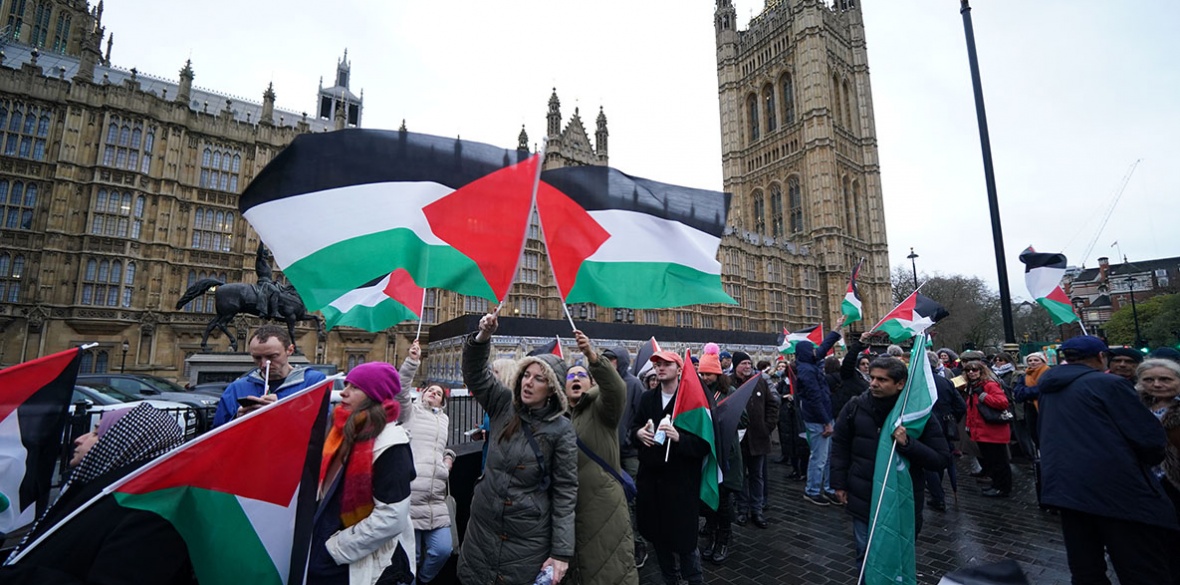
People take part in a Palestine Solidarity Campaign rally outside the Houses of Parliament, London, February 21, 2024
THE Prime Minister’s decision to frame the Speaker’s anti-democratic antics this week as “giving in to extremism” obscures reality.
Lindsay Hoyle’s claim he prioritised a Labour amendment over the SNP ceasefire motion because he was worried about MPs’ safety is a damage limitation bid.
But it chimes with ongoing Establishment propaganda painting peace demonstrators as extremists.
Every crisis of ruling-class legitimacy in recent years has prompted attacks on our democratic rights. Britain is racing towards an authoritarian future, with successive laws empowering police to make arrests on the vaguest grounds (such as causing a “nuisance”) and shut down protests before “disruption” even begins.
…
Now the idea that protest leaves MPs unsafe is used to justify curtailing democratic processes in Parliament itself. Keir Starmer did not browbeat Lindsay Hoyle into trashing procedures because he was worried about MPs’ safety.
He was trying to avoid the embarrassment of a revolt exposing divisions in his party.
Junior doctors walk through a hospital corridor. Photograph: sturti/Getty Images
Fears for impact on NHS workforce as leaked letter reveals ministers stall on aim to increase trainee doctors to 15,000 by 2031
Ministers have dramatically stalled plans to double the number of doctors being trained in England by 2031 in a move that has caused dismay across the NHS, as well in medical schools and universities, the Observer can reveal.
In June last year, ministers backed a long-term plan to expand the NHS workforce and pledged, amid great fanfare, to “double medical school places by 2031 from 7,500 today to 15,000, with more medical school places in areas with the greatest shortages to level up training and help address geographic inequity”. Labour is also committed to raising the number of doctors to 15,000 by 2031.
But a leaked letter written jointly by health minister Andrew Stephenson and the minister for skills, apprenticeships and higher education, Robert Halfon, to the independent regulator the Office for Students, says they will fund only 350 additional places for trainee doctors in 2025-26. This is less than a quarter of the annual number widely anticipated and there is no guarantee that even that level of resource will be repeated.
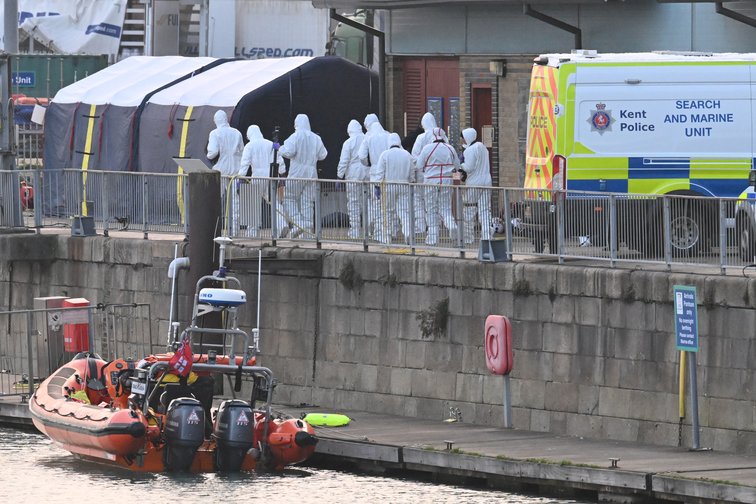
Forensic officers enter a tent containing the bodies of people who drowned while trying to cross the Channel in the boat piloted by Ibrahima Bah, who will be sentenced today under new legislation to criminalise ‘facilitating arrival’ for asylum seekers in the UK. ‘By convicting Bah of manslaughter, the jury effectively exonerated the UK of responsibility for its lethal border policies.’ | Leon Neal/Getty Images
Those who drive boats are often simply the poorest people on board. Those really at fault still walk free
Ibrahima Bah is today facing a possible life sentence for facilitating illegal entry into the UK, and for four counts of manslaughter by gross negligence. But the real culprits here remain off the hook – and this will almost certainly lead to more deaths.
Arrested in December 2022, Bah was steering an unseaworthy dinghy across the English Channel when it collapsed. The floor of the dinghy ripped when it approached the fishing vessel Arcturus and everyone stood up to try and be rescued. According to Utopia 56, a refugee charity that has announced legal action against the British coastguard and French agencies for this case, authorities failed to launch a search and rescue operation despite being alerted by Alarmphone, a hotline for migrants in distress at sea.
Eventually, four people were found dead while four were recorded missing. Some 39 survivors, most from Afghanistan, were rescued and claimed asylum in the UK.
Asylum seekers dying in the English Channel is not something new. In November 2021, 31 people, including a girl aged five and her teenage siblings, died after their dinghy sank in the Channel. And in October 2020, seven people, including five from one Iranian Kurdish family, lost their lives after a small boat carrying 20 migrants capsized off the French coast.
These are only a few examples in the long deadly history of the French-UK border. But Bah’s case marks a historic and troubling milestone: he is the first shipwreck survivor in the UK to face manslaughter charges for the deaths of fellow passengers.
A network called Captain Support that acts in solidarity with those accused of driving boats to Europe has been closely monitoring Bah’s case. Its members are right to point out the conviction marks a violent escalation in the criminalisation of migration by the UK government under its ‘stop the boats’ campaign and measures to cut net migration.
Ironically, this frontal assault on migrant rights comes at a time when polls for the first time since 2016 suggest that most British people hold positive views of immigration, exposing the ‘stop the boats’ battle for its deeply ideological nature. But other aspects of the policy, less routinely covered in the media, have been no less damaging – and these directly relate to Ibrahima Bah’s unjust conviction.
The Nationality and Borders Act came into force in June 2022, expanding the scope of immigration crimes in the UK in response to the so-called ‘small boats crisis’. This act introduced the offence of ‘illegal arrival’ with a maximum penalty of four years in jail. It also expanded the scope of the more serious offence of ‘facilitating arrival’, of which Bah was convicted, and increased the maximum penalty to life imprisonment.
Hundreds of people have since been arrested and imprisoned for simply trying to reach the UK to claim asylum, according to a forthcoming report by Victoria Taylor, published by the Centre for Criminology at the University of Oxford and Border Criminologies.
While the government repeatedly invokes the mantra of favouring ‘safe and legal routes’ when justifying this increasingly draconian legislation, existing laws don’t provide any. As Amnesty International has pointed out: “The UK government does not allow anyone to make a claim for asylum unless they are physically present in the UK… It is impossible to come to the UK for the purpose of seeking asylum in any way permitted by the government’s immigration rules.”
openDemocracy revealed last year that a toddler and a father were among those who had died while waiting vainly for officially sanctioned UN routes to take them to safety; their families remain stranded in Turkey.
Aside from two temporary visa schemes that have been beset with their own problems – for asylum seekers from Ukraine with family or hosts in the UK, and Afghans who are in danger due to having worked with the UK government – anyone wishing to apply for asylum in the UK has no choice but to travel to the UK in an unauthorised manner.
In simple terms, the UK government requires asylum seekers to endanger their lives and break the law in order to exercise their lawful right to claim asylum.
Countering this means more than debunking the myths of ‘safe and legal’ routes. It’s also about addressing the criminalisation of ‘facilitating arrival’ – often presented as a necessary measure to uproot the ‘criminal gangs’ exploiting vulnerable individuals.
In fact, human rights organisations and academic researchers have time and again shown that counter-smuggling policies and targeting of boat drivers harms migrant communities the most. These policies overlook the reality that, in many instances, those piloting boats are the poorest and least resourced among asylum seekers, agreeing to steer these vessels and take on significant legal risks in exchange for free passage.
And indeed, Ibrahima, who is from Senegal – a country still grappling with the effects of colonialism and with 40% of its population living below the poverty line – asserted that this was precisely why he agreed to pilot the boat.
Having journeyed from Senegal to Mali, then Algeria and Libya, before taking a boat from Libya to Italy with the aid of smugglers, Bah decided to pilot the vessel in exchange for free passage. During his trial, Bah said when he realised the boat was unseaworthy, he refused to drive it, but he was then assaulted by those that organised the trip who coerced him into complying. The jury not only dismissed Bah’s claims but also the testimonies of the survivors themselves, who portrayed Ibrahima as an “angel” trying to save lives.
As detailed in Captain Support’s court report, a witness statement from the captain of the Arcturus presented Bah as “mouthy” and ungrateful, both racial stereotypes. The all-white jury concluded that Bah, a Black teenager, had failed in his duty of care towards his fellow passengers. By convicting Bah of manslaughter, the jury effectively exonerated the UK of responsibility for its lethal border policies.
Britain’s emulation of these policies is both predictable and deeply alarming. British prime minister Rishi Sunak recently teamed up with Italy’s far-right leader Giorgia Meloni in her attempts to crack down on ‘illegal migration’. And in November 2023, Suella Braverman – then the UK home secretary and the architect of the ‘stop the boats’ campaign – lauded Greece’s “tough but fair migration policy” following her tour of one of Europe’s most harrowing borders. This dangerous coalition, which wields death and scapegoating as tools of deterrence, must be dismantled immediately.
Ibrahima Bah’s sentencing hearing is scheduled for Friday 23 February.Solidarity actionshave been called in response, including a call for support at 2pm at Canterbury Crown and a demonstration at 6pm at the Home Office.
The UK has withdrawn from an international treaty that lets fossil-fuel companies sue governments pursuing climate policies for billions in compensation for lost profits.
The Energy Charter Treaty (ECT) is meant to make it easier and cheaper to trade energy between countries.
But signatories have struggled to reform it – and late on Wednesday, the UK quit the treaty calling it “outdated”.
Green campaigners welcomed the news.
Energy Security and Net Zero Minister Graham Stuart said: “Remaining a member would not support our transition to cleaner, cheaper energy and could even penalise us for our world-leading efforts to deliver net zero.”
‘Cost of living support may be receding but the tide of people not being able to afford life’s essentials is not. It is time we moved from stop-gaps to sustainable solutions.’
February 22, 2024, marked the last of the cost of living payments being sent out. The cash top-ups had been awarded to people receiving means-tested benefits, disability benefits, and pension credits, at regular intervals over the course of the cost of living crisis. They have been a lifeline for around eight million low-income families.
But with rising living costs driving disadvantaged households further into poverty, with prices still rising despite inflation easing, and food and energy remaining at extortionate levels, charities and experts have warned that the payments are not enough. They have expressed fears about what may happen if the government does not announce additional payments.
The final cost of living payment has renewed calls for the introduction of a system that is there whenever anyone falls on hard times, rather than being just a ‘stop gap’ solution.
Ahead of the Spring Budget on March 6, anti-poverty charities and campaigners are calling on the Chancellor for bolder action to tackle poverty during the cost of living crisis.