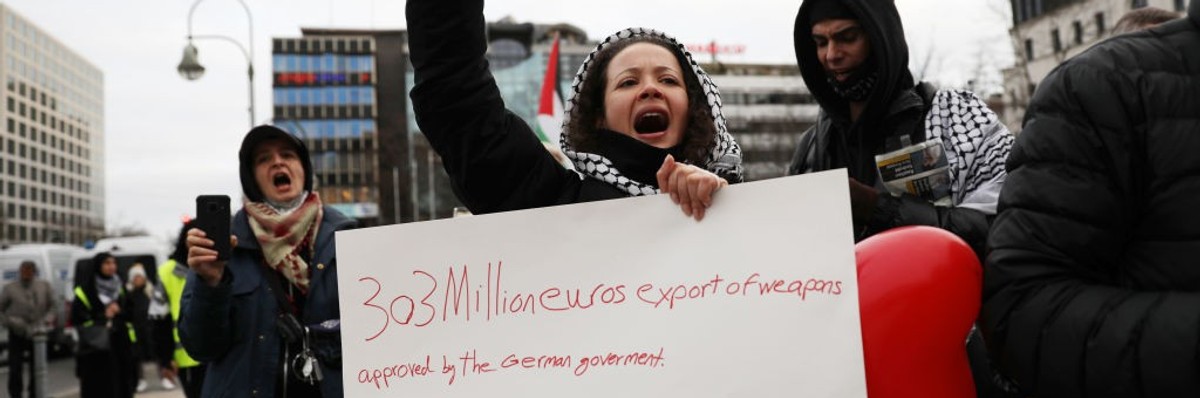
A woman protests the German government’s arms exports to Israel during a December 28, 2023 protest in Berlin. (Photo: Maryam Majd/Getty Images)
“There is reason to believe that these weapons are being used to commit grave violations of international law, such as the crime of genocide and war crimes.”
The Berlin-based Lawyers’ Collective on Friday sued the German government in an effort to stop weapons transfers to Israel, whose government and military are waging a genocidal war against Palestinians in Gaza.
According to the Stockholm International Peace Research Institute, Germany is the second-largest arms exporter to Israel, providing 30% of its imported weaponry from 2019-23. The top exporter, the United States, provided 69% of Israel’s imported armaments during that same period.
“As there is reason to believe that these weapons are being used to commit grave violations of international law, such as the crime of genocide and war crimes, the applicants are hereby demanding that the German government protect their right to life,” groups supporting the lawsuit—including the European Legal Support Center, Palestine Institute for Public Diplomacy, Law for Palestine, and Forensis—said in a statement.
Ahmed Abed, an attorney in the case who is representing Palestinian families, said during a Friday press conference in Berlin that “Germany has a constitutional responsibility to protect human life.”
“The German government must stop its arms exports to Israel, as they are in violation of international law,” he added. “The government cannot claim that it is not aware of this.”
🚨LEGAL ACTION AGAINST GERMAN ARMS EXPORTS TO ISRAEL🚨
Berlin lawyers stand with Gaza, filing an urgent application against German government officials to halt arms exports to Israel. 🔜Follow the live press conference here! https://t.co/FrEqtEzpxC /1
— European Legal Support Center (ELSC) (@elsclegal) April 5, 2024
According to the Lawyers’ Collective:
In 2023, the German government issued arms exports licenses to Israel worth €326.5 million, the majority of which were approved after October 7, 2023, a tenfold increase compared to 2022. The German government is currently supporting the Israeli army by approving the supply of 3,000 portable anti-tank weapons, 500,000 rounds of ammunition for machine guns, submachine guns, or other fully or semi-automatic firearms, as well as other military equipment, while in early 2024 Germany was preparing the authorization of 10,000 rounds of 120mm tank ammunition…
The arms deliveries and support provided by the Federal Government to Israel violate the Federal Republic’s obligations under the War Weapons Control Act. The criteria for the approval of arms exports include, among other things, that the weapons are not used against Germany’s obligations to international law.
The groups said that since the International Court of Justice (ICJ) found in January that Israel is plausibly committing genocide in Gaza, they believe that “the delivery of weapons is contrary to these obligations.”
Today, on behalf of three Palestinians in Rafah, we – a Berlin-based collective of lawyers – filed an urgent legal application against the German government to halt the export of war weapons to Israel. This legal action was taken in collaboration w/ @ForensicArchi & @elsclegalpic.twitter.com/XVF2EkaGm9
In February, lawyers from some of the same groups involved in the new lawsuit sued senior German officials, including Chancellor Olaf Scholz, for “aiding and abetting” Israel’s genocide in Gaza.
Last month, Nicaragua filed an ICJ lawsuit against Germany accusing its government of helping Israel commit genocide against Palestinians.
In addition to exporting hundreds of millions of euros worth of arms to Israel, Germany also suspended contributions to the United Nations Relief and Works Agency for Palestine Refugees in the Near East in response to unsubstantiated Israeli accusations that 12 of the agency’s 13,000 workers in Gaza were involved in the Hamas-led October 7 attacks on Israel. This, as Palestinians starve to death.
The German government has been intensely criticized for its nearly unconditional support for Israel and for violently cracking down on pro-Palestinian protests. Numerous observers contend that Germany’s actions are driven by historical guilt over the Holocaust, with some critics claiming the German government is weaponizing that guilt in order to demonize Palestinians and their defenders.
The new lawsuit came as the United Nations Human Rights Council on Friday voted 28-6 with 13 abstentions in favor of a resolution demanding that Israel be held accountable for possible war crimes and crimes against humanity in Gaza. The United States and Germany were the two biggest countries to vote against the measure.
#HRC55 | Draft resolution A/HRC/55/L.30 on the Human rights situation in the Occupied Palestinian Territory, including East Jerusalem, and the obligation to ensure accountability and justice was ADOPTED. pic.twitter.com/URttz9IFjv
— United Nations Human Rights Council (@UN_HRC) April 5, 2024
Palestinian and international human rights officials say at least 33,173 Palestinians—most of them women and children—have been killed by Israel’s bombing, invasion, and siege of Gaza since October 7. More than 75,800 others have been wounded, while over 7,000 Gazans are missing and believed dead and buried beneath the rubble of the hundreds of thousands of homes and other structures damaged or destroyed by Israeli attacks.
As more communities sue oil majors following climate disasters, a collection of evidence reveals the industry’s efforts to deny the link between extreme weather and climate change.
Illustration by Tess Abbot
This story was originally published by ExxonKnews.
When Bucks County, Pennsylvania, filed a lawsuit last week against major oil and gas companies for climate damages, Commissioner Chair Diane Ellis-Marseglia pointed to “unprecedented weather events here in Bucks County that have repeatedly put residents and first responders in harm’s way, damaged public and private property and placed undue strain on our infrastructure.” The county argues oil companies’ “campaigns to deceive and mislead the public about the damaging nature of their fossil fuel products” delayed climate action for decades, robbing communities of precious time to mitigate the climate-driven disasters they now face.
One of those disasters occurred last year, when a rainstorm in Bucks County caused deadly flash flooding that swallowed vehicles and killed 7 people, including two children. Scientists said the deluge and its aftermath — not the county’s first “100-year flood” in recent years — are a harbinger of the intense and dangerous rainstorms that a warming climate is making more likely.
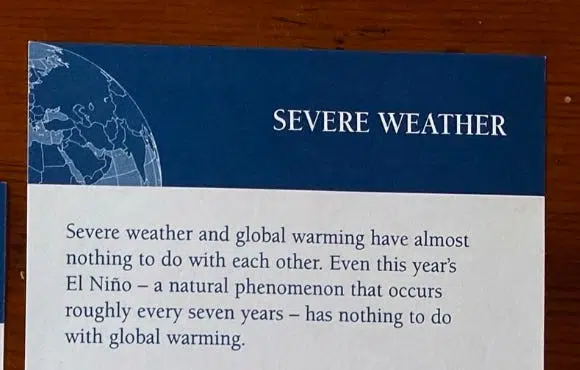
As the science connecting climate change to more frequent and severe weather events becomes clearer, there is mounting evidence that members of the fossil fuel industry coordinated to downplay that link — evidence that could be valuable to lawsuits seeking accountability.
Bucks County is just one in a growing list of communities taking legal action against fossil fuel companies in the wake of deadly extreme weather events. Multnomah County, Oregon sued oil, gas, and coal majors after a 2021 heat dome that killed nearly 70 people. On the 10 year anniversary of Superstorm Sandy, New Jersey’s attorney general took Exxon, Chevron, and other oil giants to court, citing the billions of dollars in damage and deaths the hurricane caused in the state. In the first-ever racketeering lawsuit against Big Oil companies, Puerto Rico municipalities are seeking to recover costs incurred by Hurricane Maria.
Fossil fuel majors, these cases argue, should help communities pay for the costs of adapting to and recovering from climate disasters given the industry’s early research into — and subsequent denial of — their products’ harm. “We’re already seeing the human and financial tolls of climate change beginning to mount,” said Commissioner Ellis Marseglia. “If the oil companies’ own data is to be believed, the trend will continue.”
It’s a trend that the fossil fuel industry worked to obscure for decades.A collection of evidence just published to ClimateFiles.com reveals the extent to which oil companies and their trade associations sought to deny and downplay the relationship between climate change and extreme weather.
Nicky Sundt, a climate expert and former communications director for the U.S. Global Change Research Program during the George W. Bush administration, said she tried to publicly communicate the science behind that link, but was “stymied over and over again” by industry interests inside and outside the White House — an experience she has discussed with The Guardian andPBS Frontline.
“By interfering with the communications of climate science to the public, [the fossil fuel industry] knew that the public was less likely to become agitated and do something about it,” Sundt said. “The consequence was to slow efforts to reduce our emissions, and to leave us more unprepared for the impacts of climate change. The longer you wait, the more expensive it is to deal with all of these issues, and they’ve eaten up incredibly important time we needed.”
“A new norm”
In 1997, fossil fuel interests successfully convinced prominent United States officials to oppose U.S. ratification of the Kyoto Protocol — an international climate agreement that would have limited greenhouse gas emissions decades ago.
A year later, the American Petroleum Institute (API) — the largest oil and gas trade association in the U.S. — bluntly outlined a plan to keep drumming up opposition to the Kyoto Protocol as negotiations continued. According to a newly uncovered February 1998 internal strategy proposal reviewed by ExxonKnews, API would “develop and implement a campaign-style ‘rapid response’ team… to respond to op-eds that make exaggerated claims about climate science… and to media events staged by government officials and/or environmental organizations seeking to tie extreme weather events to possible human impacts on global climate.”
Long before that campaign began, internal industry memos and promotional materials show, major oil companies knew about the role that climate change would play in intensifying hurricanes, floods, droughts, heatwaves, precipitation patterns, and other extreme weather events.
One 1979 memo distributed to Exxon management, about a report conducted by Steve Knisley of Exxon’s Research and Engineering Department, accurately predicted the growth of atmospheric carbon dioxide concentrations by 2010 and referenced the “ecological consequences of increased CO2 levels.” Those consequences were listed in detail, including global temperature increases, water shortages in the U.S. southwest, increased rainfall, and “violent storms.”
In a 1991 film production by Shell, called “Climate of Concern,” a narrator warns that “if the weather machine were to be wound up to such new levels of energy, no country would remain unaffected,” and that “what is now considered abnormal weather could become a new norm.”
Another film produced that year by BP, called “This Earth – What Makes Weather?”, alludes to the ways climate change would increase the frequency and damage caused by extreme weather events like storms, flooding, and drought. “From warmer seas, more water would evaporate — making storms and the havoc they cause more frequent,” the narrator predicts. “Catastrophic floods could become commonplace and low-lying countries like Bangladesh would be defenseless against them.”
But around the same time, the industry began to worry about how public understanding of those phenomena could affect their core business. A 1989 presentation by Duane LeVine, a senior executive at Exxon, expressed concern that an extreme heat and drought event the year before had “drawn much attention to the potential problems and we’re starting to hear the inevitable call for action. Exactly what happens now is not clear… but this critical event has energized the greenhouse effort and raised public concern over PEG [potential enhanced greenhouse].”
Under the cover of trade associations and front groups, through PR campaigns and funded academic research, the industry developed a strategy to undermine the link between climate change and weather-related disasters — and discredit those who sought to communicate that science to the public.
A Campaign to Turn the Tide
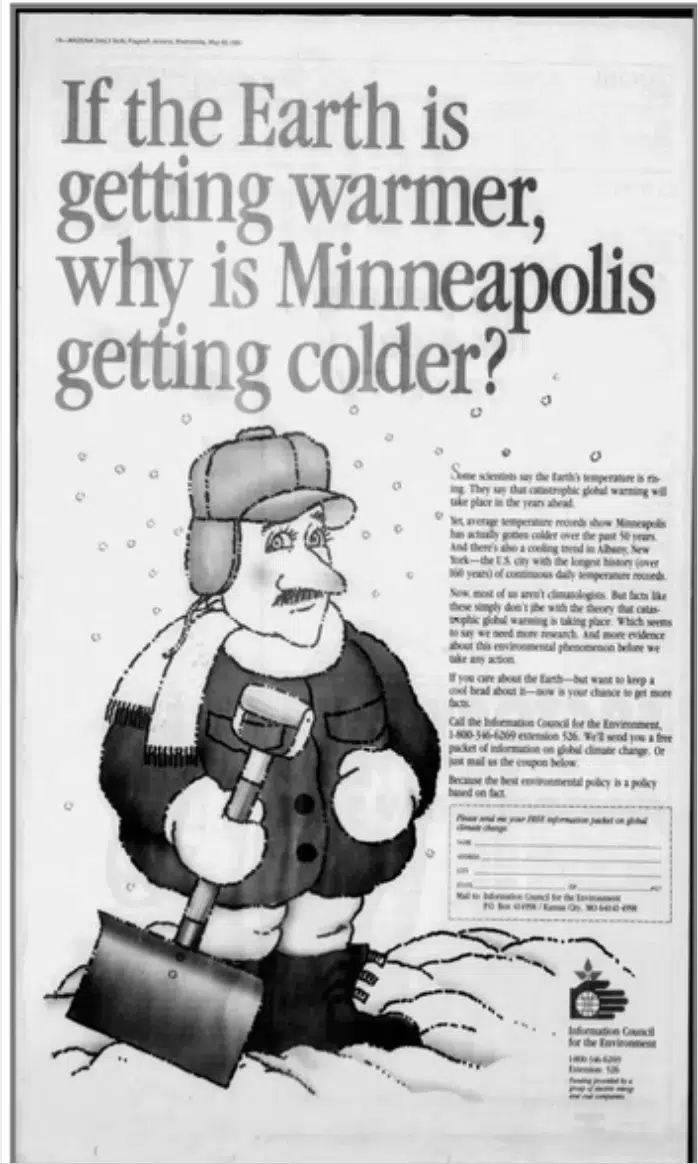
One ad from a PR campaign by the “Information Council on the Environment,” funded by fossil fuel and electric utility interests. Minnesota is now suing ExxonMobil, Koch Industries, and the American Petroleum Institute for climate fraud.
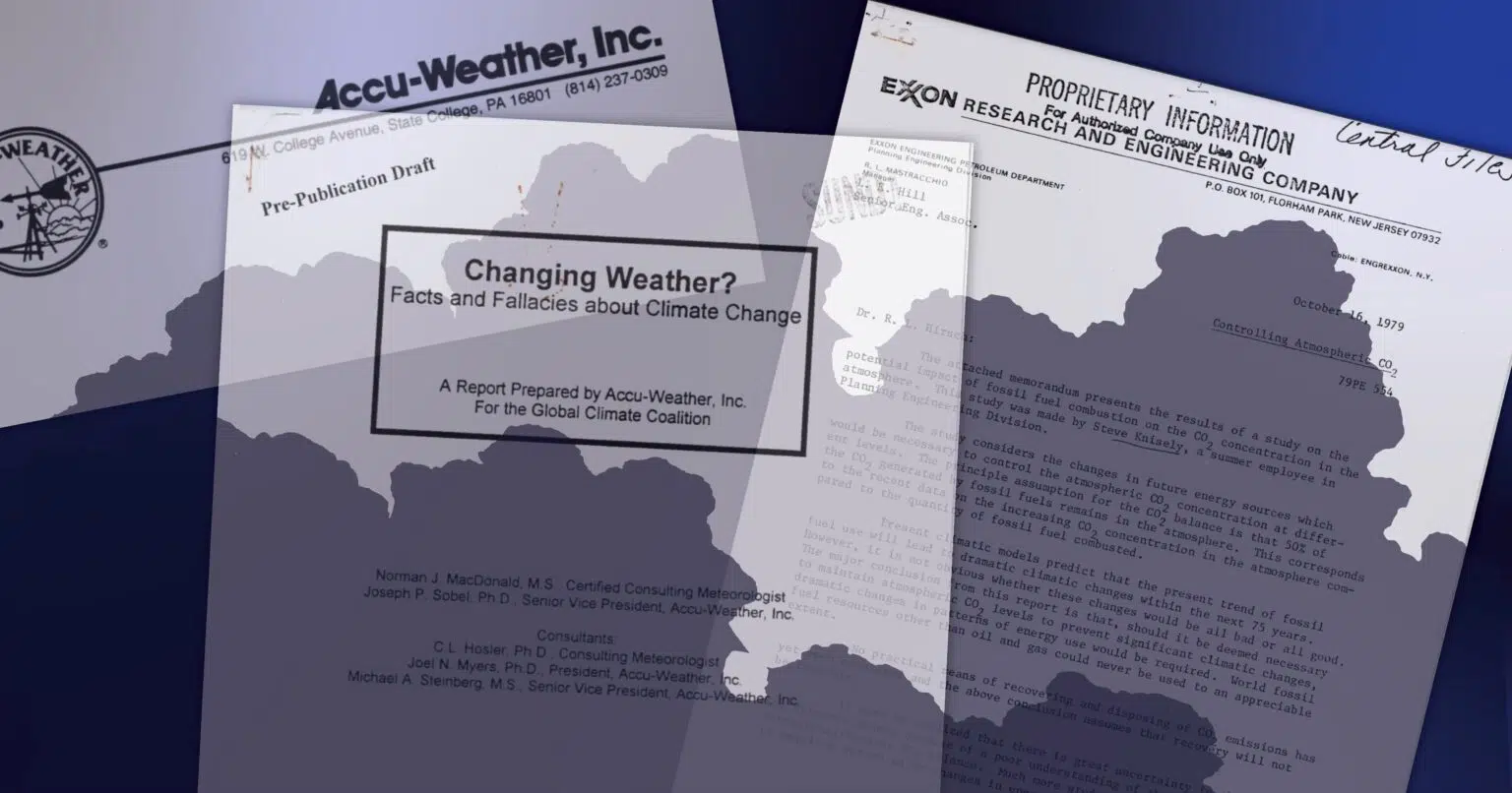
One key player was the Global Climate Coalition (GCC) — an international industry lobbying group that was instrumental in early efforts to deny climate change and generate opposition to policy action to reduce emissions. In 1994, the GCC hired weather forecasting service AccuWeather Inc. to produce a report minimizing the impact of global warming on extreme weather, which the GCC would cite in a pamphlet distributed at the United Nations climate convention the following year.
“No convincing, observational evidence exists that hurricanes, tornadoes and other extreme temperature and precipitation events are on the rise because of the recent slight increase in the Earth’s surface temperature,” the report states.
A report that AccuWeather produced minimizing the impact of global warming on extreme weather in 1994.
In response to ExxonKnews’ requests for comment on the report, a spokesperson for AccuWeather said that “AccuWeather and the other leading consulting meteorologists involved had been engaged to produce an analysis based upon the available data at that time. There was much debate and uncertainty in the scientific community over the causes and effects of global warming during that time period, and a new generation of computer modeling studies was just beginning to emerge that would create an important shift in scientific judgment.”
“As an organization rooted in science, AccuWeather’s view on global warming and extreme weather has evolved over the past three decades, as has the view of many other scientific organizations,” they said, noting that data now shows a “marked increase in billion-dollar disasters due to extreme weather events.” Today, the spokesperson added, AccuWeather has signed the “Global Climate Science-Media Action Pledge”, and is committed to communicating the impacts of climate change on extreme weather to the public.
The GCC also hired academics to further their cause. Internal meeting notes from July 1997 show that the GCC commissioned a research paper from Robert E. Davis, a University of Virginia climatologist, explicitly denying the climate and extreme weather connection.
Excerpt from Global Climate Coalition meeting notes in 1997.
“A belief commonly held is that global warming will produce more extreme weather,” the published paper read. “While this thinking serves as convenient fuel for sensationalist headlines linking what only a decade ago would have been viewed as the normal vagaries of weather to some approaching climatic apocalypse, it is not based on sound science.”
From a folder handed out by the GCC at the UN climate negotiations in 1999.
In 1999, in the wake of Hurricane Floyd, Frank Maisano, then a spokesman for the GCC, faxed a memo to “Communicators Interested in Global Climate Issues.” “As millions of people flee Hurricane Floyd, many climate activists have again suggested — despite the facts — that hurricanes and global warming are connected,” the memo stated.
In response to questions about the memo and the GCC’s positions, Maisano told ExxonKnews that “Any fair review of the debate over any link between climate and severe weather has always been the subject of significant discussion between the experts themselves, especially with regard to hurricanes.”
“Importantly,” Maisano said, “GCC’s main focus at the time was on the economic impacts, sovereignty and effectiveness of any policy proposed to address climate change.”
Maisano now runs a strategic communications practice for Bracewell LLP, whose separate law practice provides services for oil and gas companies including Eni (currently being sued for climate deception in Italy) and Phillips 66 (which is a defendant in many U.S. climate lawsuits, including those filed by Bucks County and the state of New Jersey). Since 2005, the group has also advocated for renewables, Maisano said.
The industry’s campaign stretched on for years. In 2006, shortly after Hurricane Katrina, the DCI Group — a lobbying and campaign contractor with ties to Exxon — produced and sent VHS tapes of videos designed to look like a national news broadcast to Gulf of Mexico area news stations. The tape featured Dr. William Gray, a (now deceased) hurricane scientist at Colorado State University and climate change denier, stating that in the past 20 years, scientists had seen “no significant change in the frequency and intensity of major hurricanes around the globe…. This is the way nature sometimes works.” (Scientists have since concluded that climate-driven warming contributed to the increased rainfall and severity of storm surge during Hurricane Katrina, which killed nearly 2,000 people.)
According to Sundt, after Hurricane Katrina hit, the communications arm of the U.S. Global Change Research department proposed hosting a session on the implications for preparing for climate change on the Gulf Coast. “We had a well developed proposal, and it was just killed [by the White House] without explanation,” she said.
“A more resilient world”
Today, the steady growth of attribution science — or research investigating the role of climate change in altering or intensifying extreme weather events — has put a dent in Big Oil’s designs. The field of study has developed to even be able to tie the emissions of specific corporate actors to climate-worsened disasters — opening up more possibilities for those companies to be held liable for climate damages in court.
One such study, from researchers from the Union of Concerned Scientists and the University of California, Merced, found that nearly 40% of all forests burned in the Western U.S. and Canada since 1986 can be tied to emissions from just 88 of the world’s largest fossil fuel and cement manufacturers. That research was cited in Multnomah County’s lawsuit against oil and gas majors for climate damages last year.
Delta Merner, lead scientist for the Union of Concerned Scientists’ climate litigation hub and a co-author of the study, pointed out that many of the same companies that fought regulation of climate-warming emissions adapted their own fossil fuel infrastructure to account for rising seas, warming temperatures, and worsening storms decades ago.
“As you look through the oil industry’s own reactions to their knowledge about climate change, they were able to build better infrastructure to be resilient,” Merner said. “We would have a more resilient world, we would not be facing the realities of climate change that we’re seeing today if it wasn’t for the lies the industry propped up for so long.”
At least one oil major anticipated legal action decades ago. In a planning scenario from 1998, Shell made an eerie prediction: “In 2010, a series of violent storms causes extensive damage to the eastern coast of the U.S. … Following the storms, a coalition of environmental NGOs brings a class-action suit against the US government and fossil-fuel companies on the grounds of neglecting what scientists (including their own) have been saying for years: that something must be done.”
Shell was ahead of its time. Between the increased frequency, severity, and costs of extreme weather events, the advancing science connecting them to polluters, and mounting legal theories, Merner said she expects more communities to file suit. Even as she sees the industry’s deception evolving in content and sophistication — like companies trying to shift the blame for emissions onto consumers to avoid responsibility — Merner believes attribution research is evolving faster.
“It’s a testament to the power of science that climate litigation has been able to withstand an additional onslaught of disinformation from the fossil fuel industry and is now a key part in the fight for climate justice,” she said.
Note: Additional individuals mentioned here were asked to provide comment. The piece will be updated if they respond.
CLARIFICATION 4/3/24:This story has been updated to clarify the difference between Bracewell LLP’s strategic communication practice and its law practice.
Speaking to PoliticsJOE, Khan said that we should be “holding the Israeli government to account” over its actions in Gaza.
The Mayor of London has called for an immediate halt on British arms exports to Israel.
Sadiq Khan’s intervention comes after more than three former supreme court justices, including the court’s former president Lady Hale, were among more than 600 lawyers, academics and retired senior judges who warned that the UK government is breaching international law by continuing to arm Israel.
The signatories have warned that the present situation in Gaza is “catastrophic” and that given the international court of justice (ICJ) finding that there is a plausible risk of genocide being committed, the UK is legally obliged to act to prevent it.
Speaking to PoliticsJOE, Khan said that we should be “holding the Israeli government to account” over its actions in Gaza.
His comments come after seven international aid workers, including three British citizens, were killed by an Israeli airstrike in Gaza on Monday. John Chapman, 57, James Henderson, 33, and James Kirby, 47, were among the seven World Central Kitchen (WCK) workers killed in Monday’s strike.
‘To be fair – margarine was a French invention… although they probably don’t know that…’
The National Trust regularly finds itself in the right-wing firing line, as anti-woke insurgents attempt to present it as some kind of dangerously radical cake-and-countryside organisation.
This week, the cakes that Europe’s largest conservation charity serves in its hundreds of tearooms across the country, have literally been under attack.
The rant was initiated by the Daily Mail, which ran an ‘exclusive’ on the National Trust’s use of vegetable-based spread instead of butter in its scones. Customers are, according to the newspaper, complaining that the new scones taste like ‘dry biscuits.’
…
the assault on the Trust’s scones attracted ridicule, with a ‘wokesconegate’ hashtag trending.
…
Celia Richardson, the charity’s director of communications, joined the mockery, writing on X:
“GB News claims the National Trust ‘holds our heritage in contempt,’ over #wokesconegate. But margarine (which we’ve used in scones for decades) has been part of UK heritage since at least WW2. And am I alone in remembering Bruce Forsyth’s Stork SB challenge? Classic heritage TV!”
The fact that margarine was a creation of the French and not the British was also pointed out.
‘Through this decision, Leeds Pride asserts its position as an advocate for inclusivity, striving to ensure that Pride celebrations remain a platform for equality.’
Leeds Pride has terminated its sponsorship partnership with Leeds-based software company Phoenix Partnership (TPP), following the row over alleged racist comments the organisation’s founder and CEO Frank Hester said about Diane Abbott.
Organisers of Leeds Pride, which is due to take place on July 21, in celebration of LGBTQ+ culture, said they were ‘discontinuing’ the partnership, saying it was now ‘imperative it reassesses its association’ with Hester.
In a statement on social media, Leeds Pride said: “In light of recent developments involving alleged racist comments made by the TPP’s chief executive, it became imperative for Leeds Pride to reassess its association with the company. The decision to terminate the sponsorship agreement underscores the organisation’s dedication to upholding the values of diversity within the LGBTQ+ community and beyond.
“Leeds Pride acknowledges the concerns voiced by members of the community and recognises the importance of taking steps to uphold its principles. Through this decision, Leeds Pride asserts its position as an advocate for inclusivity, striving to ensure that Pride celebrations remain a platform for equality.”
…
Controversy consumed the businessman after the Guardian reported that Hester had allegedly made racist comments about MP Diane Abbott. The newspaper claimed he had said: “It’s like trying not to be racist but you see Diane Abbott on the TV, and you’re just like… you just want to hate all black women because she’s there.
“And I don’t hate all black women at all, but I think she should be shot.”