ENVIRONMENTAL campaign group Greenpeace has warned that its future is under financial threat because of legal action by oil giant Shell.
It says its work in Britain and internationally will be in jeopardy if it loses a court case in which the company is demanding $1 million (£803,000) in damages after activists occupied a drilling platform being towed in the Atlantic last year.
The occupation attracted international attention.
The case is due to go to trial in July.
Greenpeace says it is facing similar legal action by “Big Oil” companies in the United States and Italy and has launched an appeal for donations to help it fight in court.
Ian Duff, who heads Greenpeace’s “Stop Drilling, Start Paying” campaign, said: “Greenpeace is under attack globally like never before.
“Right now, our colleagues in Italy, the USA, and here in the UK are all targets of intimidation lawsuits from oil giants, strategically deployed with one aim: silence anyone brave enough to stand up to their planet-wrecking business.”
…
“Let’s be clear — it’s not about the money,” he said. “Shell makes the $1 million it is suing us for every half an hour.
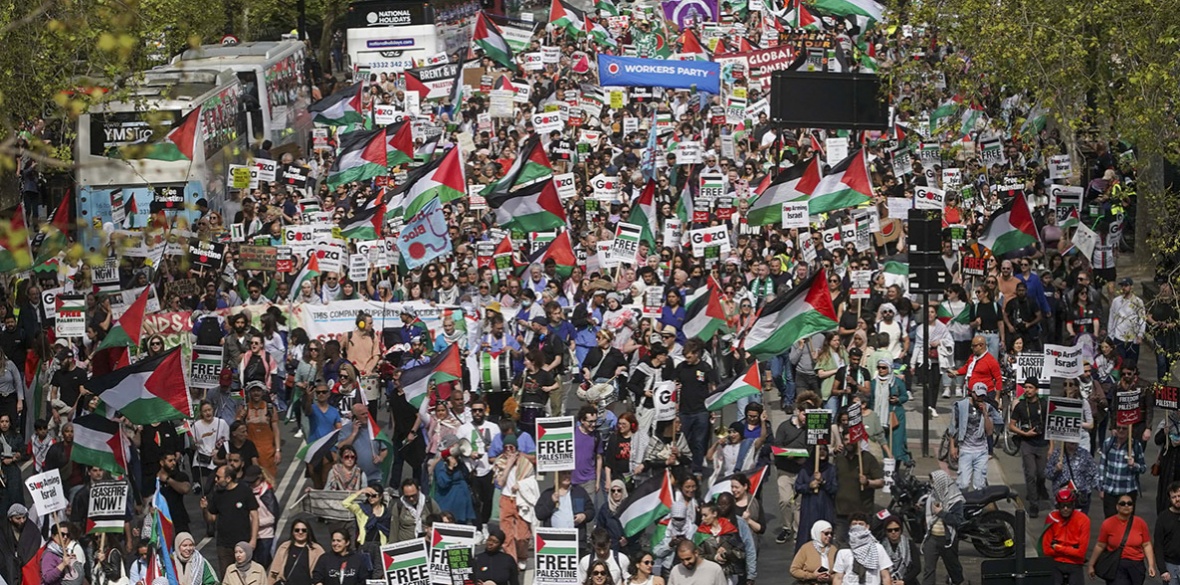
People take part in a pro-Palestine march in central London organised by the Palestine Solidarity Campaign, April 13, 2024
THE British government dragged the nation a step closer to war in the Middle East after the Prime Minister admitted today it had sent RAF fighter jets to shoot down Iranian drones and missiles.
The escalation of the Iranian and Israeli tensions over the weekend prompted calls for “a halt to this terrifying slide to wider conflict” in addition to the continuing demands by tens of thousands of protesters for a ceasefire in Gaza.
But Labour leader Sir Keir Starmer said that while supporting “all measures designed to restore calm” and prevent a wider regional war, “we continue to stand up for Israel’s security and that of our other partners in the region.”
And shadow home secretary Yvette Cooper supported the government’s decision to involve the RAF.
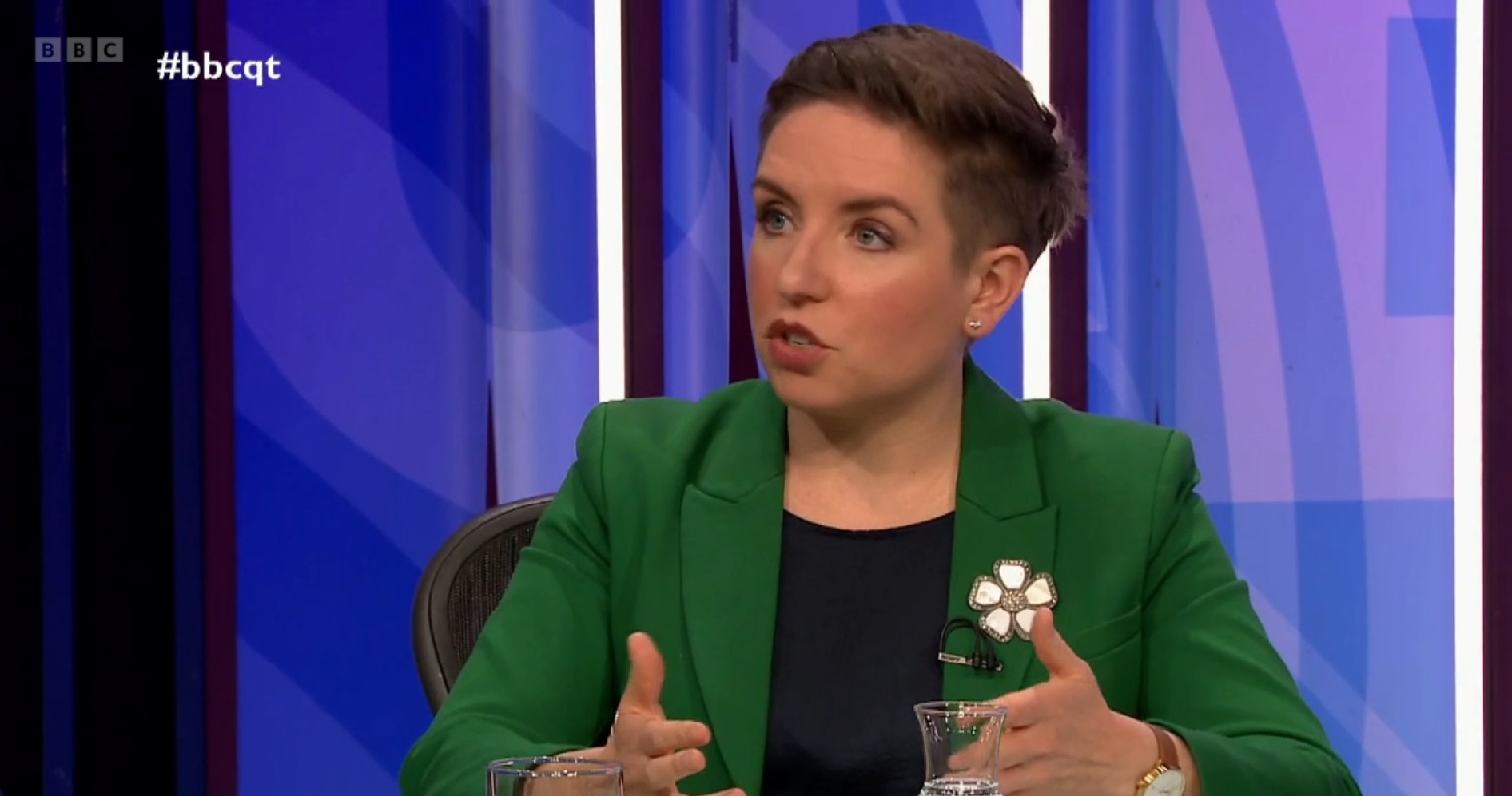
Image of the Green Party’s Carla Denyer on BBC Question Time.
Following news of the Iranian attack on Israel and the involvement of UK aircraft in Israel’s defence, Green Party co-leader, Carla Denyer, has urged the UK not to be dragged into a Middle East war. She said:
“The Green Party condemns Iran’s attacks against Israel, which were targeted on civilian as well as military targets. This represents a concerning escalation of the current conflict in the Middle East. We call on all parties now to find ways to de-escalate this conflict, which risks spreading across the region.
“We are concerned by the use of British aircraft in the night’s events. We question why Britain should be involved in this confrontation, where there is a risk that we could become embroiled in a regional war. The record of Afghanistan and Iraq suggests that involvement in such conflict brings great risks, especially when the military and strategic objectives are unclear.”
Denyer also questioned at what level the decision to engage UK defence forces was made:
“I am deeply concerned about how this decision to deepen our involvement was made and in what further action the government proposes to involve UK armed forces. Britain’s military involvement must be scrutinised and debated by parliament. We should not allow ourselves to be dragged into a Middle East war.
‘There is a growing perception that the water industry cares more about profit than the service it provides.’
Public trust in water companies has hit a new low.Less than one in four people believe water companies will help protect the environment.
Just 23 percent of water consumers in England and Wales say they trust their water companies to “do what’s right for the environment,” marking a 9 percent drop from 31 percent two years ago.
These were the findings of a consumer survey commissioned by Ofwat and the consumer watchdog Consumer Council for Water (CCW). The Savanta study was conducted between December 4 and 18, 2023. It surveyed 2,399 UK adults in England and Wales.
The research found that satisfaction with the quality of water services has fallen to 58 percent from 65 percent in 2021. Similarly, consumer satisfaction with wastewater and drainage services has dropped to 49 percent from 56 percent.
The water regulator Ofwat says the findings underscore the importance of the need for a transformative change in the water sector, so that it “delivers better outcomes for customers and the environment.”
“We can’t go beyond the laws of a country,” Musk has said (Wall Street Journal, 4/8/24)—unless, of course, he doesn’t like the government making the laws.
Elon Musk, the right-wing anti-union billionaire owner of Twitter (recently rebranded as X), has cast his defiance of a Brazilian judicial ruling as a free speech crusade against censorship. Such framing is, of course, bullshit. It is instead a political campaign by a capitalist to use social media to reshape global politics in favor of the right. And it’s important that we all understand why that is.
As Reuters (4/7/24) reported, Brazilian Supreme Court Justice Alexandre de Moraes ordered “the blocking of certain accounts” on Twitter, prompting Musk to announce that Twitter would defy the judge’s orders “because they were unconstitutional.” He went on to call for Moraes’ resignation.
It isn’t clear which accounts are being targeted, but the judge is investigating “‘digital militias’ that have been accused of spreading fake news and hate messages during the government of former far-right President Jair Bolsonaro.” He’s also probing “an alleged coup attempt by Bolsonaro.”
The AP (4/8/24) then reported that the judge opened up an inquest into Musk directly, saying the media mogul “began waging a public ‘disinformation campaign’ regarding the top court’s actions.”
Musk claimed that he’s doing this in the name of free speech at the expense of profit, saying “we will probably lose all revenue in Brazil and have to shut down our office there” (Wall Street Journal, 4/8/24). He added that “principles matter more than profit.”
Michael Shellenberger (Public, 4/8/24), an enthusiastic pro-Musk pundit, was less restrained, saying the judge “has taken Brazil one step closer to being a dictatorship.” To Shellenberger, it’s “clear that Elon Musk is the only thing standing in the way of global totalitarianism.”
‘Par for the course’
Verge (1/25/23): “The documentary’s ban isn’t an example of Musk violating a vocal ‘free speech absolutist’ ethos. It’s a reminder that Musk has always been fine with government censorship.”
Anyone with a memory better than Shellenberger’s will recall that Musk’s Twitter has been all too eager to censor content at the request of the Indian government, including a BBC documentary that was critical of Prime Minister Narendra Modi (Verge, 1/25/23). India under Modi, who heads the right-wing Hindu nationalist BJP party, has seen a steep decline in press freedom, worrying journalists and free speech advocates (New York Times, 3/8/23; NPR, 4/3/23; Bloomberg, 2/25/24). At the same time Musk was pretending to defend free speech in Brazil, he was bragging about traveling to India to meet with Modi (Twitter, 4/10/24).
Musk suppressed Twitter content in the Turkish election in response to a request from Turkish President Recep Erdoğan, saying the “choice is have Twitter throttled in its entirety or limit access to some tweets. Which one do you want?” This move, he insisted, was “par for the course for all Internet companies” (Vanity Fair, 5/14/23). Turkey, with its laws against insulting the Turkish identity (Guardian, 11/16/21), is a country that is almost synonymous with the suppression of free speech—it ranks 165 out of 180 on Reporters Without Borders’ press freedom index. Yet Musk didn’t seem to feel the need to intervene to save democracy through his social media network.
The impact of Musk’s decision to censor Twitter when it comes to Turkey and India isn’t just that it exposes his duplicity when it comes to free speech, but it robs the global public of vital points of view when it comes to these geopolitically important countries. In essence, the crime is not so much that Musk is hypocritical, but that his administration of the social media site has kept readers in the dark rather than expanding their worldview.
Grappling with balance
AP (10/25/22) reported that Brazilian social media posts claimed that Lula “plan[ned] to close down churches if elected” and that Bolsonaro “confess[ed] to cannibalism and pedophilia.”
The context in Brazil is that in the last presidential election, in 2022, the leftist challenger Lula da Silva ousted the incumbent, Bolsonaro (NPR, 10/30/22), who has since been implicated in a failed coup attempt that closely resembled the January 6, 2021, riot at the US Capitol (Reuters, 3/15/24). Ever since, tech companies have bristled at Brazil’s attempt to curb the influence of fake news, such as a bill that would put “the onus on the internet companies, search engines and social messaging services to find and report illegal material” (Guardian, 5/3/23).
Brazil experienced a flurry of disinformation about the candidates in the run-up to the election, inspiring the country’s top electoral court to ban “false or seriously decontextualized” content that “affects the integrity of the electoral process” (AP, 10/25/22).
The Washington Post (1/9/23) reported that social media were “flooded with disinformation, along with calls in Portuguese to ‘Stop the Steal,’” and demands for “a military coup” in response to a possible Lula victory. And while these problems existed in various online media, a source told the Post that this occurred after Musk fired people in Brazil “who moderated content on the platform to catch posts that broke its rules against incitement to violence and misinformation.”
While Turkey and India are brazenly attempting to suppress opinions the government doesn’t like, a democratic Brazil is grappling with how to balance maintaining a free internet while protecting elections from malicious interference (openDemocracy, 1/3/23).
Despotic future
Brazilian Report (4/9/24): “Billionaire Elon Musk joined this week a campaign led by the Brazilian far-right to characterize Brazil as a dictatorship.”
Lula’s victory, in addition to being a source of hope for Brazil’s poor and working class (Bloomberg, 4/25/23), was seen as a blow to the kind of right-wing despotism espoused by people like Bolsonaro, who represents a past of US-aligned terror-states that use military force to protect US interests and suppress egalitarian movements in the Western Hemisphere (Human Rights Watch, 3/27/19). As Brazilian Report (4/9/24) put it, Musk has joined a “campaign led by the Brazilian far right.”
Indeed, the Wall Street Journal (4/10/24) noted that Musk’s tussle in the Brazilian judiciary was an extension of his alignment with the Brazilian right:
Supporters of former right-wing President Jair Bolsonaro, who gave Musk a medal during his visit in 2022 to announce plans to install satellites over the Amazon rainforest, have reveled in Musk’s defiance, declaring him a “hero,” as the dividing lines in Brazil’s culture wars deepen.
Erdoğan and Modi represent more successful iterations of neo-fascist ideology over liberal democracy. The dystopian societies they oversee make up the political model that the MAGA movement would like to impose in the United States, where a caudillo is unchecked by independent courts, the press and other civil institutions, while rights for workers and marginalized groups are eviscerated.
Musk isn’t simply displaying hypocrisy when he pretends to fight for free speech in Brazil while Twitter censors speech when it comes to India and Turkey. If anything, he is being consistent in his quest to use his corporate wealth to alter the political landscape against liberal democracy and toward a dark, despotic future.