‘Progress Almost Invisible’: World Set to Produce 220 Million Tonnes of Plastic Waste

Spread the love

Original article by JAKE JOHNSON republished from Common Dreams under Creative Commons (CC BY-NC-ND 3.0). 
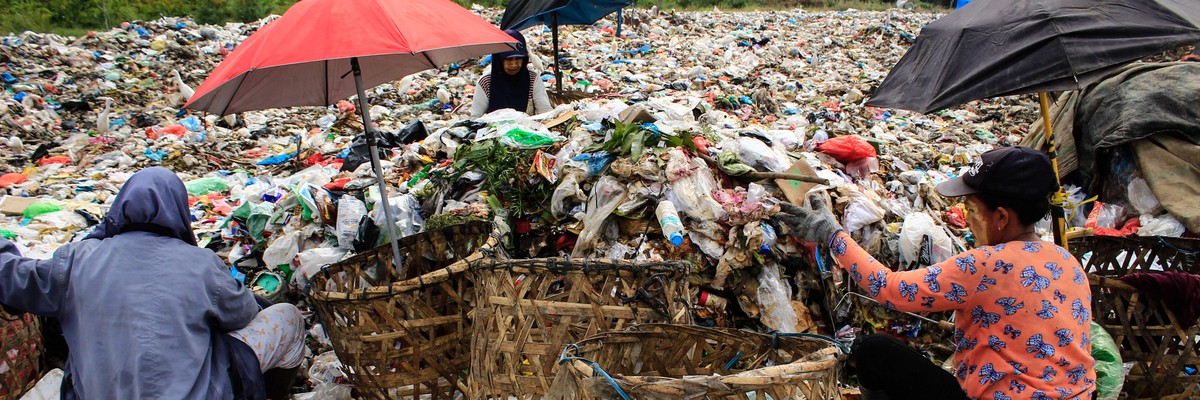
People collect plastic waste at a landfill in North Sumatra, Indonesia on March 27, 2024.  (Photo: Kartik Byma/AFP via Getty Images)

“The question for every government now is this—will you negotiate a treaty to protect the health of your people; or will you negotiate a treaty to protect the profits of the fossil fuel industry?”

A report released Thursday estimates that countries worldwide are on pace to generate 220 million tonnes of total plastic waste this year, a finding that comes as governments are set to convene in Ottawa, Canada later this month to hash out a binding global treaty to limit the toxic pollution that is inundating waterways and communities across the planet.

The new report from EA – Earth Action (EA) projects that Plastic Overshoot Day—the point at which the amount of plastic waste produced exceeds the capacity of global management systems—will arrive on September 5 this year. Over a third of the total plastic waste created this year will end up in nature, according to the analysis.

On average, each person globally contributes 28 kilograms of plastic pollution per year. Previous research has shown that just 20 companies are responsible for more than half of the world’s total single-use plastic waste.

“The findings are unequivocal; improvements in waste management capacity are outpaced by rising plastic production, making progress almost invisible,” EA co-CEO Sarah Perreard said in a statement Thursday, criticizing the “assumption that recycling and waste management capacity will solve the plastics crisis.”

That assumption has been peddled for decades by the fossil fuel industry, which has a major interest in thwarting attempts to curb the production, use, and waste of plastics. Nearly all plastic is made from chemicals sourced from fossil fuels.

Sian Sutherland, co-founder of A Plastic Planet, said the new report underscores that “plastic pollution has set humanity on the road to ecological and humanitarian disaster.”

“We have a narrow window of opportunity this year to create a global plastics treaty that will protect not only our ocean, our air, our soil but our own children,” said Sutherland. “The question for every government now is this—will you negotiate a treaty to protect the health of your people; or will you negotiate a treaty to protect the profits of the fossil fuel industry? Viable solutions are already available at scale, giving us materials and systems that work in harmony with nature, not against it.”

“Close to 50% of the world’s population currently lives in areas where waste generated has already exceeded the capacity to manage it.”

Late last year, the third round of U.N. plastics treaty talks ended without a breakthrough as major oil-producing countries such as Saudi Arabia obstructed the proceedings, the fossil fuel industry worked to sabotage the negotiations, and the U.S. declined to forcefully push for a global pact that meaningfully curtails plastics production.

The U.S. is among the world’s leading generators of plastic waste, producing nearly 100 kilograms per capita each year. The U.S. and other rich nations also export tremendous amounts of plastic waste around the world, undercutting efforts to tackle the pollution crisis.

A Greenpeace International survey released earlier this month found that two-thirds of the U.S. public wants a global plastics treaty that bans single-use plastic packaging. A separate poll commissioned by WWF and the Plastic Free Foundation showed that 88% of global citizens support banning “unnecessary single-use plastic products” such as shopping bags.

In an op-ed for Euronews Green on Thursday, Perreard of EA wrote that “whilst policy has been mooted, schemes devised, and initiatives launched, plastic has continued to rise, and our planet and its people have sat under an ever-darkening cloud of pollution that showers its toxic consequences upon us.”

“Close to 50% of the world’s population currently lives in areas where waste generated has already exceeded the capacity to manage it, with the figure projected to rise to 66% by 5 September,” Perreard noted. “With the fourth round of negotiations in Ottawa at the end of this month, we can no longer ignore the facts, we can no longer afford to resist the change that should be set in motion through the treaty.”

Original article by JAKE JOHNSON republished from Common Dreams under Creative Commons (CC BY-NC-ND 3.0). 

Continue Reading‘Progress Almost Invisible’: World Set to Produce 220 Million Tonnes of Plastic Waste

Milei celebrates violent repression of thousands protesting hunger in Argentina

Spread the love

Original article by peoples dispatch republished under a Creative Commons Attribution-ShareAlike 4.0 (CC BY-SA) license.

Police attacked the protest organized by UTEP in Buenos Aires. Photo: UTEP

Police cracked down on a protest of thousands of workers in the capital who demanded the government listen to its demands to send food to the community kitchens and address the growing hunger in the country

On Wednesday April 10, the Federal Police and the Police of the city of Buenos Aires violently evicted and repressed a peaceful demonstration on 9 de Julio Avenue in the center of the capital. The mobilization organized by the Union of Workers of the Popular Economy (UTEP) was one of many which took place in cities across the country to raise awareness to the critical situation faced by workers in the popular, or informal, economy in Argentina.

Organizations part of UTEP claim that the national government has suspended programs providing food to community kitchens and has also refused to dialogue with organizations who have repeatedly denounced the suspension and now, are unable to provide food to the thousands of families that they previously worked with. Many poor families across the country have also suffered from a freezing and arbitrary reduction of their “Social Complementary Salary”, a government program which provided supplementary economic aid to workers of the popular economy.

In Buenos Aires, thousands of protesters attempted to march to the Ministry of Human Capital when they were violently attacked by police with gas, water cannons. Over 10 were arrested in the brutal police repression and several were injured, including one protester who was dragged down the street and hit against the asphalt. Additionally, a journalist with the outlet Crónica TV driver was hit with a rubber bullet in the face.

The Ministry of Human Capital is a creation of the Milei government as a part of his promise to cut the majority of ministries and secretaries and create “super ministries”. It is the combination of the former Ministry of Labor, Ministry of Employment and Social Security, Ministry of Education, Ministry of Culture, and the Ministry of Social Development. This move, in addition to massively reducing the number of people working for the ministry, also saw severe cuts be made to the dozens of social programs run by those areas.

Milei, who was in Miami visiting with zionist and far-right US leaders such as Ben Shapiro, celebrated the repression of the protesters who were demanding government action against hunger amid unprecedented levels of poverty in the country. Milei reposted a publication from user Diego Álzaga Unzué on X which said: “Applause, gentlemen, see how the fire hydrant truck came out to remove the picketers who wanted to get dirty and cut off 9 de Julio Avenue, harming the workers. This is cinema. Enjoy, my friends.”

His Minister of Security Patricia Bullrich declared: “Law and order” in her post praising the “effective” crackdown on the mobilization through her “anti-picket protocol”.

Following the repressive operation, UTEP wrote in a statement: “We tried to create a channel of dialogue by all possible means, but once again the only response to the social and economic crisis is batons, gas and bullets. We denounce the violent actions of this Government, which the only thing it proposes for the people is planned misery. Our fight plan will continue to deepen to get food for our community kitchens, work and projects in our working class neighborhoods and social wages for the workers of the popular economy.”

The past week saw mass unrest across Argentina after over 10,000 public sector workers lost their jobs. As the “chainsaw” austerity of Milei continues alongside a growing military partnership with the United States, Argentina’s robust social organizations continue to be engaged in fierce struggle and opposition.

Original article by peoples dispatch republished under a Creative Commons Attribution-ShareAlike 4.0 (CC BY-SA) license.

Continue ReadingMilei celebrates violent repression of thousands protesting hunger in Argentina

Food security threatened by extreme flooding, farmers warn

Spread the love

https://www.bbc.co.uk/news/science-environment-68792017

Record-breaking rain over the past few months has left fields of crops under water and livestock’s health at risk, adding to pressures on food producers.

The flooding and extreme weather linked to climate change will undermine UK food production unless farmers get more help, the National Farmers Union said.

The NFU is calling on the government to do more to compensate flooded farmers and support domestic food production.

The government said it was looking to expand a new compensation scheme.

The NFU has warned of “substantially reduced output” and “potential hits” to the quality of crops in this year’s harvest thanks to weeks of rain since the autumn.

NFU vice president Rachel Hallos said UK farmers were “on the front line of climate change – one of the biggest threats to UK food security”.

“These extremes could soon become the norm,” she told the BBC. “We need a clear plan from government to prepare, adapt and recover from our changing climate in the short and long term so that we can continue to produce food and care for the countryside.”

https://www.bbc.co.uk/news/science-environment-68792017

Dead lambs and ‘decimated crops’ on rain-soaked farms

“We’ve been underwater for coming up to six months”

Continue ReadingFood security threatened by extreme flooding, farmers warn

The heat is on: what we know about why ocean temperatures keep smashing records

Spread the love
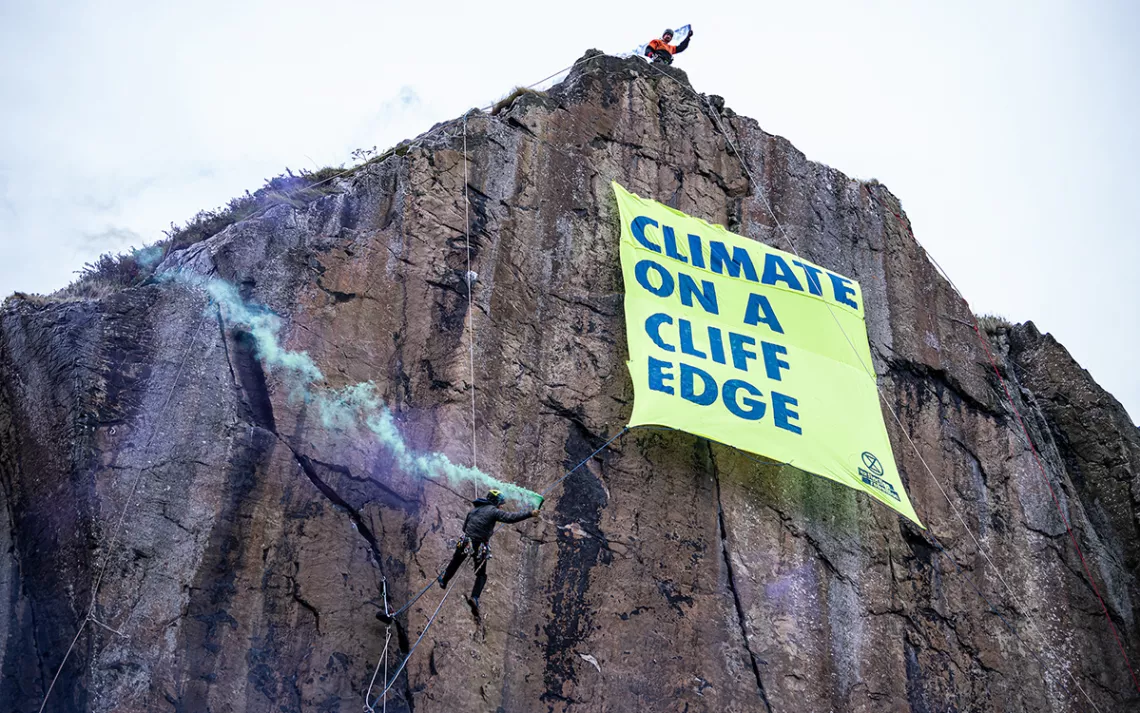
Experienced climbers scale a rock face near the historic Dumbarton castle in Glasgow, releasing a banner that reads “Climate on a Cliff Edge.” One activist, dressed as a globe, symbolically looms near the edge, while another plays the bagpipes on the shores below. | Photo courtesy of Extinction Rebellion and Mark Richards


Alex Sen Gupta, UNSW Sydney; Kathryn Smith, Marine Biological Association; Matthew England, UNSW Sydney; Neil Holbrook, University of Tasmania; Thomas Wernberg, The University of Western Australia, and Zhi Li, UNSW Sydney

Over the last year, our oceans have been hotter than any time ever recorded. Our instrumental record covers the last 150 years. But based on proxy observations, we can say our oceans are now hotter than well before the rise of human civilisation, very likely for at least 100,000 years.

This isn’t wholly unexpected. Ocean temperatures have been steadily rising due to human-caused global warming, which in turn means record hottest years have become increasingly common. The last time ocean temperature records were broken was 2016 and before that it was 2015. The last year we experienced a record cold year was way back at the start of the 20th century.

But what is remarkable about the past year is the huge ongoing spike in global ocean temperature which began in April last year. Last year was hotter than the previous record year by a whopping 0.25°C. In contrast the margins of other previous record years were all less than 0.1°C.

Why? Global warming is the main reason. But it doesn’t explain why the heat spike has been so large. Climate drivers such as El Niño likely play a role, as do the random alignment of certain weather events and possibly the reduction in sulfur emissions from shipping. Researchers around the world are trying to understand what’s going on.

How big is the jump in heat?

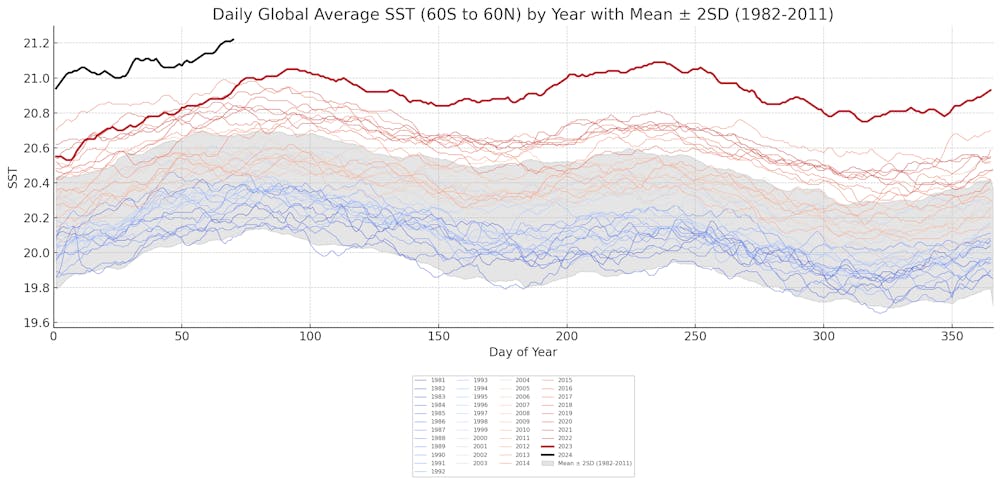
You can see the surge in heat very clearly in the near-global ocean surface temperature data.

dasd
Averaged ocean surface temperatures between 60 degrees south and 60 degrees north of the equator, inspired by ClimateReanalyzer.org. Each coloured line represents the temperature of a single year.
Author provided, CC BY

The trend is clear to see. Earlier years (in blue) are typically cooler than later years (in red), reflecting the relentless march of global warming. But even with this trend, there are outliers. In 2023 and 2024, you can see a huge jump above previous years.

These record temperatures have been widespread, with the oceans of the southern hemisphere, northern hemisphere and the tropics all reaching record temperatures.

What’s behind the surge?

We don’t yet have a complete explanation for this record burst of warming. But it’s likely several factors are involved.

First, and most obvious, is global warming. Year on year the ocean is gaining heat through the enhanced greenhouse effect – indeed over 90% of the heat associated with human-caused global warming has gone into the oceans.

The extra heat pouring into the oceans results in a gradual rise in temperature, with the trend possibly accelerating. But this alone doesn’t explain why we have experienced such a big jump in the last year.

Then there are the natural drivers. The El Niño event developing in June last year has certainly played a substantial role.

El Niño and its partner, La Niña, are opposite ends of a natural oscillation, the El Niño Southern Oscillation, which plays out in the tropical Pacific ocean. This cycle moves heat vertically between the ocean’s deeper waters and the surface. When El Niño arrives, warmer water comes up to the surface. During La Niña, the opposite occurs.

You can see the impact of an El Niño on short term temperature spikes clearly, even against a backdrop of strong long-term warming.

But even climate change and El Niño combined aren’t enough to explain it.

Other natural heat-transferring oscillations, such as the Indian Ocean Dipole or the North Atlantic Oscillation, may play a role.

It may also be that our successful efforts to cut aerosol pollution from the dirty fuel shipping relies on has had an unwanted side effect: more warming. With less reflective aerosols in the atmosphere, more of the Sun’s energy can reach the surface.

But there’s probably also a level of random chance. Chaotic weather systems over the ocean can reduce cloud cover, which can let in more solar radiation. Or these weather systems could weaken winds, reducing cooling evaporation.

Why is this important?

To us, a warmer ocean might feel pleasant. But the extra heat manifests underwater as an unprecedented series of major marine heatwaves. The ocean’s organisms are picky about their preferred temperature range. If the heat spikes too much and for too long, they have to move or die.

Marine heatwaves can lead to mass death or mass migration for marine mammals, seabirds, fish and invertebrates. They can cause vital kelp forests and seagrass meadows to die, leaving the animals depending on them without shelter or food. And they can disrupt species important for fisheries and tourism.

This year’s heat stress has caused widespread coral bleaching around the world. Bleaching has been seen on reefs in the Caribbean, Florida, Egypt, and the Great Barrier Reef.

In the cooler waters of Tasmania, extraordinary conservation efforts have been put in place to try and protect endangered fish species such as the red handfish from the heat, while in the Canary Islands, small scale commercial fisheries have popped up for species not normally found there.

Last year, Peru’s anchovy fishery – the country’s largest – was closed for long periods, leading to export losses estimated at A$2.1 billion.

What’s going to happen next?

Given the record temperatures stem from a combination of human-induced climate change and natural sources, it’s very likely ocean temperatures will drop back to more “normal” temperatures. Normal now is, of course, much warmer than in previous decades.

In the next few months, forecasts suggest we have a fair chance of heading into another La Niña.

If this eventuates, we might see slightly cooler temperatures than the new normal, but it’s still too early to know for sure.

One thing is certain though. As we struggle to rein in greenhouse gas emissions, the steady march of global warming will keep adding more heat to the oceans. And another spike in global ocean warming won’t be too far away.The Conversation

Alex Sen Gupta, Senior Lecturer, School of Biological, Earth and Environmental Sciences, UNSW Sydney; Kathryn Smith, Postdoctoral Research Scientist, Marine Biological Association; Matthew England, Scientia Professor and Deputy Director of the ARC Australian Centre for Excellence in Antarctic Science (ACEAS), UNSW Sydney; Neil Holbrook, Professor, University of Tasmania; Thomas Wernberg, Professor, The University of Western Australia, and Zhi Li, Postdoctoral researcher, Centre for Marine Science & Innovation, UNSW Sydney

This article is republished from The Conversation under a Creative Commons license. Read the original article.

Continue ReadingThe heat is on: what we know about why ocean temperatures keep smashing records

UK Government ‘making a mockery’ of international law

Spread the love

https://morningstaronline.co.uk/article/government-making-mockery-international-law

Prime Minister Rishi Sunak departs 10 Downing Street, London, to attend Prime Minister’s Questions at the Houses of Parliament, March 20, 2024

‘Morally bankrupt’ Sunak doubles down on Israel arms sales

THE GOVERNMENT is “making a mockery” of international law, campaigners charged after Rishi Sunak doubled down on continuing arms sales to Israel.

Mr Sunak was ridiculed today after he said that Israeli Prime Minister Benjamin Netanyahu “needs to do more” to alleviate suffering in Gaza while dodging calls to suspend arms sales to Israel.

Speaking to LBC, the British Prime Minister admitted that the humanitarian situation in Palestine is “dire” but that there had been “no change” in continuing arms sales.

When asked if the government had received fresh advice on arming Israel, after air strikes murdered three British aid workers earlier this month, Mr Sunak said assessments had been “carried out periodically.”

Lindsey German from Stop the War Coalition said that the decision to continue the exports while providing “weak criticism of Israel” demonstrates nothing but “moral bankruptcy and cowardice.”

https://morningstaronline.co.uk/article/government-making-mockery-international-law

Continue ReadingUK Government ‘making a mockery’ of international law