‘Genocidal Actions’ Persist in Gaza as Israel Blocks Aid and US Weapons Flow

Spread the love

Original article by JULIA CONLEY republished from Common Dreams under Creative Commons (CC BY-NC-ND 3.0). 

Palestinian children, holding banners and empty bowls, gather to protest the food shortages in the city due to Israel’s attacks and blockade on humanitarian aid on March 12, 2024 in Gaza City, Gaza. (Photo: Omar Qattaa/Anadolu via Getty Images)

“President Joe Biden must act now to make famine prevention a top priority and be prepared to deploy meaningful U.S. leverage—including pausing arms sales,” said two humanitarian aid group leaders.

A week after Israeli officials promised the Biden administration they would open a border crossing and a port to allow humanitarian aid into Gaza, relief organizations and the United Nations reported Friday that life-saving supplies are still being blocked, and warned that the White House must take more decisive action to force Israel to stop starving Palestinians.

The U.N. reported that just 212 aid trucks entered Gaza on Tuesday, far lower than the 467 reported by Israeli Defense Minister Yoav Gallant, who promised to “flood Gaza with aid” after a tense phone call between Prime Minister Benjamin Netanyahu and U.S. President Joe Biden last Thursday.

The phone call came in response to Israel’s bombing of a World Central Kitchen aid convoy that killed seven aid workers. On the call, Biden reportedly threatened to halt weapons deliveries unless a surge in humanitarian aid was allowed into Gaza.

But as The Guardian reported Friday, the Ashdod port has not been opened yet, and instead of opening the Erez crossing last Sunday as promised, Israel has opened another crossing into northern Gaza but has not yet allowed U.N. agencies to use it.

“Netanyahu scammed Biden again: A week after he promised to open the Erez crossing and Ashdod port to increase aid to Gaza, the [Israel Defense Forces] & port authorities say they NEVER received any instructions of this nature,” said Muhammad Shehada, communications chief for Euro-Med Human Rights Monitor, citing reporting from Israel’s N12 channel.

The Guardianreports that Israel has set an ultimate target of 500 aid trucks per day to enter Gaza—the same amount that delivered relief to residents before the Israeli bombardment rendered the enclave’s food system, healthcare facilities, and other public services inoperable.

“The call for 500 trucks, with a combination of commercial and humanitarian shipments, is the absolute minimum,” Juliette Touma, communications director for the U.N. Relief and Works Agency for Palestine Refugees in the Near East (UNRWA) toldThe Guardian. “Probably what Gaza needs is at least 1,000 trucks a day.”

The U.N. found that just 141 aid trucks entered the enclave on Wednesday. The Washington Postreported that Israeli authorities have blocked aid deliveries containing items such as chocolate croissants, maternity kits, sleeping bags, stone fruits, and oxygen cylinders.

Jamie McGoldrick, the U.N. humanitarian coordinator, said Friday that “very limited” aid deliveries have continued to contribute to low birth weights in babies who have been born in northern Gaza in recent weeks.

“It’s very easy for Israel to say, ‘We’ve sent you 1,000 trucks so please deliver them inside Gaza,'” McGoldrick said, noting that Israel has held trucks up at checkpoints “for hours” and that many roads are not open to deliveries.

“At no point in time in the last month and more have we had three or even two of those roads working at the same time simultaneously,” said McGoldrick.

The news that Israel has not allowed a “flood” of aid into Gaza since Biden threatened Netanyahu with an end to weapons transfers came days after Samantha Power, administrator of the U.S. Agency for International Development (USAID), admitted to U.S. Rep. Joaquin Castro (D-Texas) that reports of famine in parts of Gaza are now “credible.”

Save the Children confirmed on April 2 that at least 27 children have died of starvation and disease as a result of Israel’s blockade, and U.N. agencies said in February that 5% of children under age 2 were acutely malnourished.

At least 33,634 Palestinians in Gaza have been killed by Israeli forces since October, with U.S. weapons used in much of the bombardment.

At Foreign Affairs on Friday, Refugees International’s president, Jeremy Konyndyk, and vice president for programs and policy, Hardin Lang, wrote that “as negotiations about a econd cease-fire and hostages-for-prisoners swap gain steam, the United States has a crucial opportunity to press Israel to change course and allow a major famine-prevention effort.”

Namely, they said, Biden must make good on his threat to cut off Israel’s military aid—of which the U.S. is the largest international provider.

“The United States is likely the only outside power that can ensure a famine is avoided, given the leverage it has with its ally Israel,” they wrote. “U.S. President Joe Biden must act now to make famine prevention a top priority and be prepared to deploy meaningful U.S. leverage—including pausing arms sales—if the Israeli government does not comply. Famine would not only constitute a humanitarian cataclysm; it would also represent a geopolitical failure that would damage U.S. credibility in the Middle East for years to come.”

Konyndyk and Lang’s call was echoed by the Council on American-Islamic Relations (CAIR), which said Power’s comments must push the president to take action.

“Inducing a famine by besieging an entire population and slaughtering innocent civilians are acts which no one can ignore, let alone justify,” said CAIR national executive director Nihad Awad. “President Biden and his administration are enabling this famine and the deliberate cruelty targeting the Palestinian people in Gaza. He must take action to prevent further atrocities by demanding an immediate cease-fire, securing full access to humanitarian aid, ending all weapons transfers and other funding for Israel, and holding the war criminals in the Netanyahu government accountable for their genocidal actions.”

Also on Friday, a U.S. coalition of groups including the Working Families Party, the Service Employees International Union, and the National Education Association wrote to Biden and urged him to enforce the Foreign Assistance Act, which bars the government from providing military support to countries that restrict humanitarian aid deliveries.

Ending arms transfers “will send a clear message that the Netanyahu government is not above the law and that the U.S. will not stand by while the war kills innocent Palestinians and continues to drive escalation throughout the region,” reads the letter. “U.S. law is unequivocal: Countries that obstruct U.S. humanitarian aid cannot receive U.S. military aid under the Foreign Assistance Act or the Arms Export Control Act.”

Original article by JULIA CONLEY republished from Common Dreams under Creative Commons (CC BY-NC-ND 3.0). 

Continue Reading‘Genocidal Actions’ Persist in Gaza as Israel Blocks Aid and US Weapons Flow

Save our seabed – the bottom of the ocean needs to become a top priority, and the UN agrees

Spread the love


Seagrass meadows are a hugely important store of blue carbon – and so is the rest of the ocean sea floor.
Philip Schubert/Shutterstock

William Austin, University of St Andrews

“The science we need for the ocean we want” – this is the tagline for the UN Ocean Decade (2021-2030), which has just held its first conference in Barcelona, Spain. Marine scientists from around the world, including me, gathered alongside global leaders to chart the progress of this ten-year mission to improve ocean health and marine biodiversity. That includes finding ways to better protect the seabed which we still know relatively little about.

Some areas of sediment on the sea floor hold large stores of carbon. Without greater protection, disturbance from bottom-trawling fishing practices for example, could release some of that stored carbon back into the atmosphere.

I joined discussions in Barcelona that have led to the launch of a new sustainable ocean planning initiative, to be coordinated by Julian Barbière, global coordinator of the Ocean Decade. This aims to encourage commitment to sustainable management of 100% of sea area under a nation’s jurisdiction.

With this in place, there’s scope to reimagine the role of the ocean in our wider climate system and recognise that all marine natural systems sequester and store carbon in their soils and sediments.

I’m here on behalf of the global ocean decade programme for blue carbon – that’s any carbon that is stored in the ocean. This project is one of the UN’s 50 programmes aimed at delivering transformative ocean science solutions for sustainable development, connecting people and our ocean. That’s a big ask.

My work focuses on the extraordinary ability of coastal ecosystems – such as mangroves, salt marshes and seagrass – to sequester or store organic carbon in unusually high densities. Our blue carbon team of international research scientists from more than 20 countries is beginning to define emerging blue carbon ecosystems such as kelp forest and sub-tidal sediments as solutions to manage the climate and biodiversity crises.

The 360 million sq kilometres of ocean and sea floor, from coastal seagrass meadows to the sediment that slowly accumulates within the deepest trenches, are massively overlooked as a precious carbon store. Oceans hold vast stores of carbon – the top metre of the ocean holds an estimated 2.3 trillion metric tonnes.

The seafloor is not a resource to be relentlessly exploited, but a vulnerable repository of global biodiversity and carbon that needs protecting. These highly productive, yet vulnerable, ecosystems have been greatly affected by habitat loss and destructive practices such as deforestation of mangroves for shrimp aquaculture in the relentless development of the world’s coastal zones.

Blue carbon has huge potential to provide ocean-based solutions to help mitigate climate change, and thankfully, at the global scale at least, these losses have slowed in recent years.

The potential for blue carbon to reduce greenhouse gas emissions is relatively modest, but healthy, restored ecosystems have the potential to store an extra 2.96 million tonnes of carbon annually. Certain countries, such as Indonesia, offer huge potential as blue carbon hotspots where the protection and restoration of nature are an opportunity, for both the environment and local communities.

Carbon credits, the means by which additional carbon can become a source of investment income in that community, are gaining much interest. Off the coast of Kenya, the community-based Miko Pamojo project enhances direct benefits to local people from mangrove restoration.

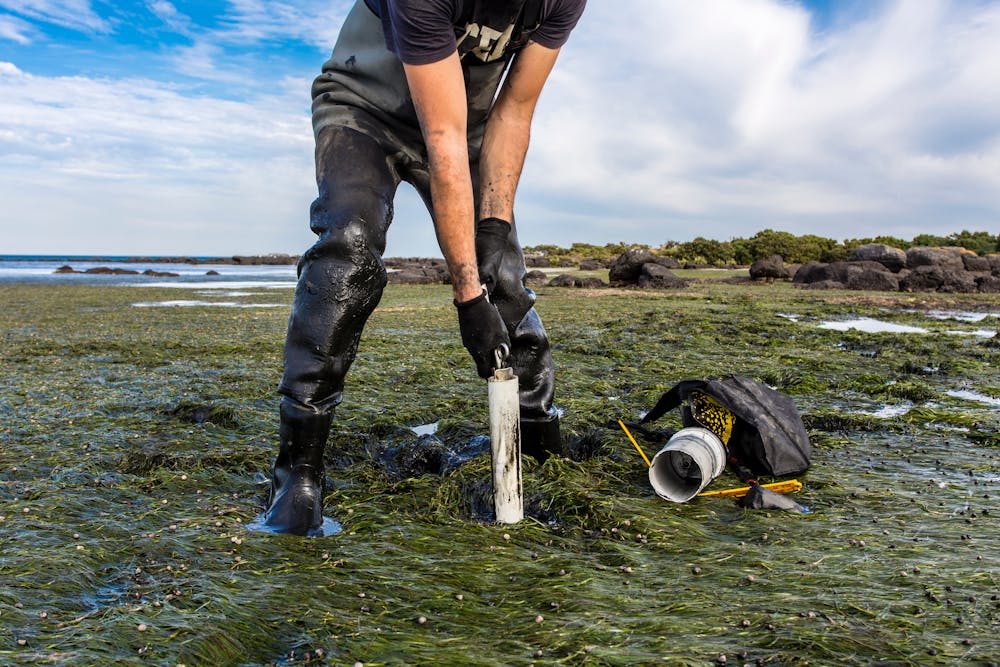
green foreshore, man in wellies with gloves placing white sampling equipment into seabed
Collecting a sediment core to assess carbon sequestration rates in the sediment of a tidal seagrass bed.
I. Noyan Yilmaz/Shutterstock

Blue carbon ecosystems can help countries meet their climate obligations and have been attracting considerable interest. However, if nations want these ecosystems to continue to provide a whole range of services our governments must protect them and, where possible, restore lost habitats.

Most governments have been stubbornly slow to prioritise ocean-based solutions high up on the agenda of global climate negotiations. At this conference, I’ve heard more people, including Unesco’s director general Audrey Azoulay, driving home the need to protect and effectively manage our ocean resources.

Members from the traditional owners of the Great Barrier Reef spoke of “country” from a perspective of a long and sustained human relationship with nature and are intimately connected to the ocean. There is a growing recognition and respect for this indigenous knowledge and our need to integrate that into a sustainable ocean future.

Reimagining the ocean’s role

It makes sense to start by protecting these natural systems that already hold vulnerable stores of carbon – this is sensible risk management.

As nations continue to exploit the marine environment for fishing, fossil fuels and even precious metals which are now being mined from the sea floor in certain places, it is time to rethink the value of these vast natural stores of ocean carbon.

Space science gets way more funding than our oceans, yet vast areas of the global deep ocean remain largely unmapped. “Life below water” is by far the least funded of the UN’s 17 Sustainable Development Goals. That needs to change through a sustained and increased investment in ocean science and greater recognition for the value of our blue economy – defined by the UN as the sustainable use of the ocean’s resources for economic growth, improved livelihoods and jobs.

Stepping back to pause and preserve what already exists in the ocean can help the planet, and us, build resilience and create a healthier and more sustainable marine environment. The seabed forms the foundation for an interconnected ocean ecosystem and acts as an important long-term global sink for carbon that involves the whole ocean and its exchanges with the atmosphere and wider Earth system.

While plans are finally moving in the right direction, there are huge challenges ahead. To paraphrase Cynthia Barzuna, director of ocean action 2030 at the World Resources Institute, “there is no wealthy ocean without a healthy ocean”. The biggest takeaway from the Barcelona conference is that a sustainable ocean future depends on a shared vision that works for all of us and marine life too.The Conversation

William Austin, Professor, University of St Andrews

This article is republished from The Conversation under a Creative Commons license. Read the original article.

Continue ReadingSave our seabed – the bottom of the ocean needs to become a top priority, and the UN agrees

Starmer supports nuclear weapons, Greenpeace says nuclear power an obstacle to net zero, climate change moves into uncharted territory

Spread the love

‘Starmer’s only spending commitment is to weapons of war’

Peace campaigners blast Sir Keir for pledging to boost arms spending while backing austerity for public services

LABOUR leader Sir Keir Starmer faced backlash as he vowed to put billions into the pockets of war-hungry arms companies after claiming there are no funds for cash-starved public services.

Today, Sir Keir announced plans to boost Britain’s defence budget to 2.5 per cent of GDP.

Matching the Tories’ current pledge, costs could amount to £9 billion.

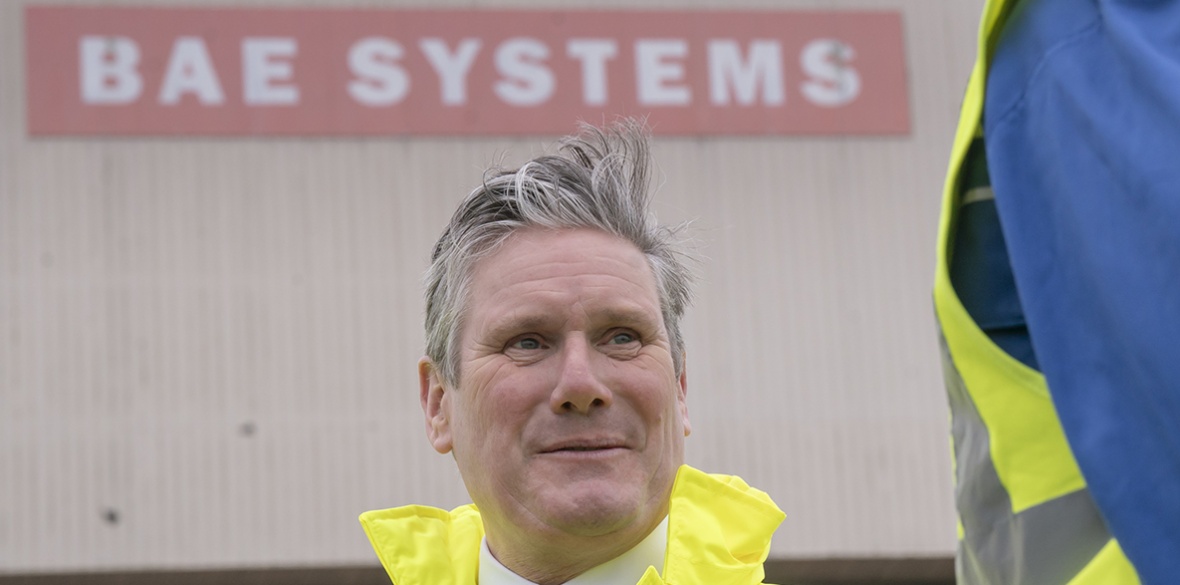
He made the announcement ahead of a visit to a BAE Systems shipyard in Barrow-in-Furness, where the next generation of Trident nuclear submarines are being built.

According to the Campaign for Nuclear Disarmament, costs for the programme could spiral as high as £205bn.

During the visit he pledged to “triple lock” Labour’s commitment to Britain’s nuclear submarine programme, backing the building of the four new submarines.

He reiterated his support for Aukus, a security pact with Australia and the United States, which involves the development of nuclear submarines as part of Washington’s bid to encircle China with military alliances.

Morning Star: The case for nuclear weapons is morally and logically bankrupt

Phase 3 of the Atom Bomb explosion in the Lapoon of Bikini Island

Starmer claims that we need nuclear weapons “in the face of rising global threats and growing Russian aggression.” Well, Britain is already deeply embroiled in a conflict involving Russia. Nuclear weapons have done nothing to avoid that conflict and indeed, the expansion of nuclear-armed Nato to the borders of Russia is a huge contributing factor.

If Starmer truly believed in advancing international security, he would be calling for a ceasefire in Ukraine now, alongside a ceasefire in Gaza, where Israel (a nuclear-armed state) is committing genocide against the Palestinian people.

However, the biggest lie in today’s announcement is the idea that investment in weapons of mass destruction will “build a secure future” for families in Barrow or elsewhere.

If Labour really cares about the creation of secure well-paid jobs, it would take the money to be wasted on Trident and invest in rebuilding Britain’s manufacturing base, creating high-skilled, well-paid jobs for communities which has suffered the ravages of 40 years of deindustrialisation.

As former Labour leader Jeremy Corbyn said today, “Security is being able to put food on the table. It’s having a roof over your head.”

Nuclear energy ‘now an obstacle to delivering net zero’ – Greenpeace

Construction of one of the two nuclear reactors at Hinkley Point C in Somerset, UK. Credit: Anna Barclay/Getty.

Nuclear energy provides around 10% of electricity globally and around 25% of the world’s low-carbon electricity. With 439 operable reactors already in existence and a further 61 under construction, governments are investing in nuclear as a bridge in the energy transition.

However, according to Greenpeace director of policy Doug Parr: “Nuclear power can’t bridge the gap between anything and anything. It is too slow. It is too expensive. It is a massive distraction.”

Speaking about the role of nuclear energy in the UK’s transition, Parr tells Energy Monitor: “It doesn’t help with the kind of grid system that we need, which is going to be renewables heavy. I think the UK focus on nuclear power is now an obstacle to delivering net zero because it is sucking up time, energy and political bandwidth, which can be spent on more useful things.”

Parr disagrees, arguing that governments should be investing in more immediate solutions. He points to investment in Sizewell C – the 3.2GW power station set to be built in the English county of Suffolk – where construction is set to commence this year. It is likely to take between nine and 12 years to complete, but delays at Hinkley C (of which Sizewell C will be a close copy) have stirred doubt.

“We will be putting a lot of money into something like Sizewell C, when actually we will find that it is a white elephant by the time it has opened,” he contends. “We will have spent all that time, energy and effort, which could have been put into improving our housing stock, improving our grid or improving the ability of electric vehicles to meet the needs of people through a proper charging network – things that would actually would deliver this decade, not in 15 years time. So, we would cut a lot more carbon, we would get something done that is useful and we wouldn’t have piles of messy radioactive waste that we still don’t know what to do with.”

Climate change: ‘Uncharted territory’ fears after record hot March

“By the end of the summer, if we’re still looking at record breaking temperatures in the North Atlantic or elsewhere, then we really have kind of moved into uncharted territory,” Gavin Schmidt, the director of Nasa’s Goddard Institute for Space Studies, told BBC News.

March 2024 was 1.68C warmer than “pre-industrial” times – before humans started burning large amounts of fossil fuels – according to the EU’s Copernicus Climate Change Service.

Continue ReadingStarmer supports nuclear weapons, Greenpeace says nuclear power an obstacle to net zero, climate change moves into uncharted territory

Young people and scientists occupy new coal-sponsored Science Museum gallery, joined by broadcaster and wildlife campaigner Chris Packham

Spread the love

April 12, 2024 by Extinction Rebellion

  • 30+ young people, scientists and supporters occupy Science Museum’s new climate gallery in protest over its sponsorship by coal-producing conglomerate Adani
  • Group announce plan to remain over weekend ahead of the opening to school groups next week
  • Naturalist Chris Packham says sponsorship deal is “beyond greenwash – it’s grotesque” and attends to support the protesters
  • Science Museum criticised over ties to conglomerate involved in manufacturing drones for the Israeli military amidst bombardment of Gaza and destructive coal mining operations in India and Australia opposed by Indigenous groups

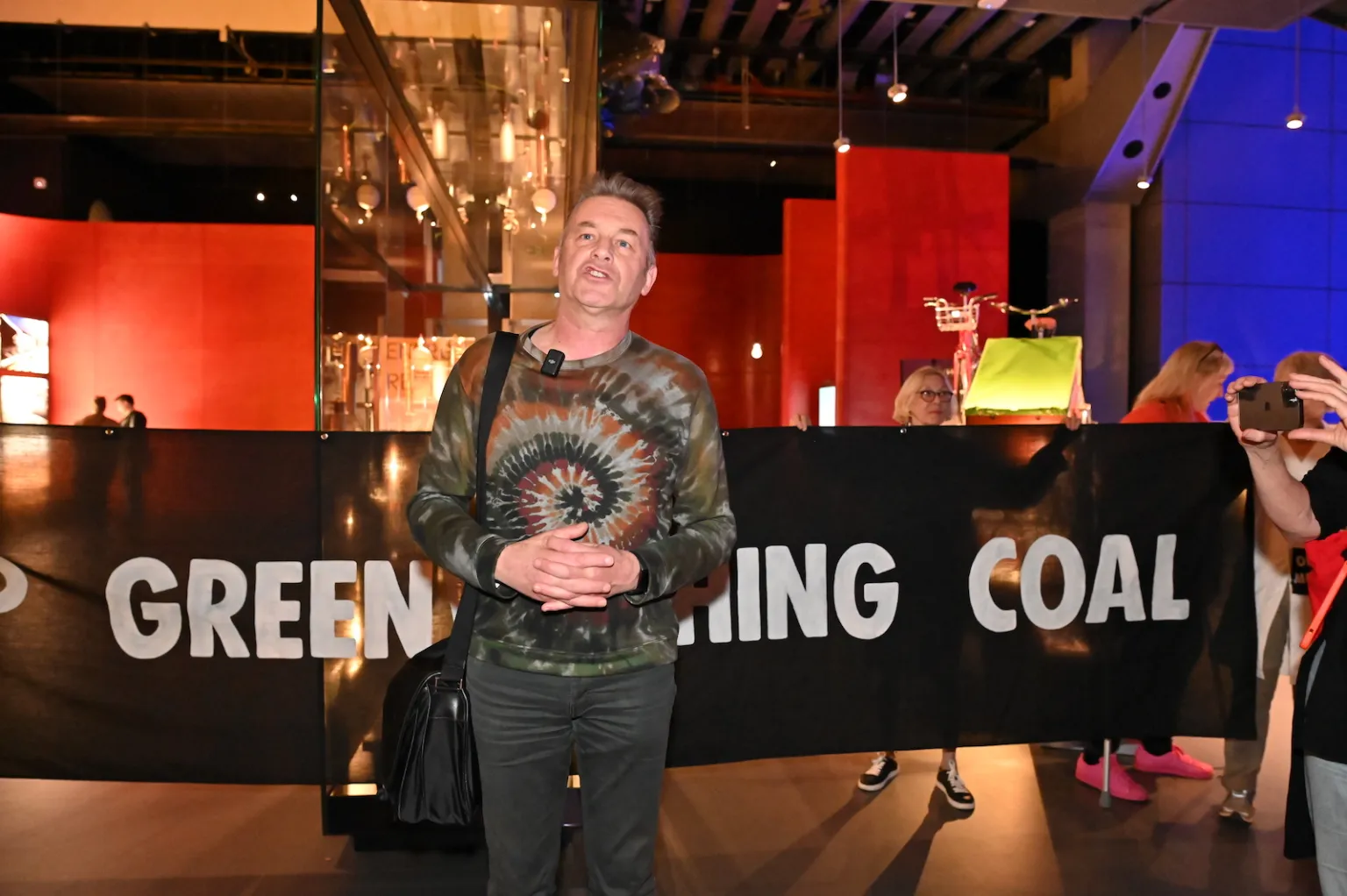
This evening, more than 30 protesters led by young people from Youth Action for Climate Justice and members of Scientists for Extinction Rebellion have occupied the Science Museum’s new climate gallery, Energy Revolution, over its sponsorship by the coal giant and arms manufacturer, Adani. Naturalist and broadcaster Chris Packham joined the group as they began their protest, with scientists and young people now intending to remain in the museum over the weekend, with the first school visits to the gallery beginning on Monday.

Chris Packham, who famously claimed that peacefully breaking the law is the ethically responsible thing to do when it comes to protecting the planet, told the protesters: “For me science is the art of understanding truth and beauty and a lot of that beauty lies in the natural world. Science tells us that the fossil fuel industry is responsible for the accelerating destruction of our natural world. The Science Museum is a place to spark imagination, to provide answers but also to encourage us to ask questions. The question I’m asking today is a big one, “why on earth are we allowing a destructive industry to sponsor an educational exhibition whilst simultaneously setting fire to young peoples futures?” This is beyond greenwash – it’s grotesque. We urgently need an ‘Energy Revolution’ to steer us away from the course of planetary destruction on which we are heading. We need a rapid, just transition to renewables – that revolution means an end to coal, and starts with the young people and scientists occupying this space this evening. Science tells us the truth, and the truth is that we must change.”

Naturalist Chris Packham at the Science Museum occupation 12 April 2024. Image: Extinction Rebellion.

The Energy Revolution gallery opened to the public just a few weeks ago amidst protest, with over 150 people taking part in a day of creative action. A few days earlier, guests arriving for the private VIP launch were greeted by protesters as they arrived, as well as the museum throwing a lavish dinner for the Adani Group’s billionaire chairman, Gautam Adani, with the Adani Group’s logo plastered on screens around the room. 

To coincide with today’s protest, activists have released a new video exposing the truth behind the misleading claims made by Gautam Adani during his speech at the opening of the gallery. While he discussed the energy transition from oil and gas, he neglected to mention coal, the industry from which the Adani Group derives 60% of its revenue. The Science Museum has attempted to defend its sponsorship deal by claiming it has only partnered with the Green Energy division, although evidence clearly shows that it is directly linked to Adani’s coal business and that the museum has maintained a relationship with the main Adani Group.

At 2pm on Saturday, the occupiers will invite members of the public to join them for an interactive assembly inside the gallery to discuss alternatives to toxic fossil fuel sponsorship at the Science Museum. The group plans to tell the public the truth about the gallery’s sponsor and the urgency of keeping fossil fuels in the ground for a liveable future. Throughout their occupation, the protesters are also constructing sculptures of fragments of coal as a poignant reminder of Adani’s core polluting business.

Since the announcement of Adani sponsorship of the gallery in 2021, the museum has faced a raft of opposition and protests, including the resignation of two trustees, and of former museum director Chris Rapley from the Advisory Board. The museum has also recently faced protests over Adani’s involvement in the ongoing genocide of Palestinians in Gaza via its partnership with Israeli arms firm Elbit Systems.

Ian McDermott, a Chemistry teacher who will no longer organise school trips to the museum, has said: “For decades I ran a couple of trips to the museum a year, but I just don’t think it’s in the students’ interests to engage with the greenwashing of the companies destroying their futures.”

Protest placard reads Greenwash detected

Adani is the world’s largest private developer of new coal mines and coal-fired power plants, including Australia’s largest, the Carmichael Coal Mine built on Wangan and Jagalingou ancestral land. This ongoing investment in coal mining and power flies in the face of the scientific warning that most fossil fuel reserves cannot be burned and emitted if global warming increase is limited to 1.5°C, or even 2°C above pre industrial levels.

Anya, a young person occupying the gallery said: “To have a coal company sponsoring an exhibition on the future of energy is blatantly deceiving. Through this sponsorship deal, the Science Museum is helping Adani attach itself to the image of a positive and sustainable future when in reality it is a coal giant, weapons manufacturer and genocide supporter. It’s plain wrong for the Science Museum to be deceiving visitors, including young people like me, when it comes to the climate crisis.”

This is not the only instance of the museum welcoming fossil fuel companies to sponsor and influence its science education programmes and galleries. The Museum’s STEM Training Academy, which aims to support teachers in delivering science education, is sponsored by oil and gas giant BP, while the Museum’s interactive children’s gallery is named after Norwegian oil and gas company, Equinor. 

Dr. Aaron Thierry, a scientist, who has researched climate impacts in the Arctic, is among those currently occupying the museum: “It’s not just Adani’s brand that the science museum is greenwashing, they’re also allowing the oil and gas giants BP and Equinor to sponsor their exhibits, disregarding the fact that these companies continue to expand fossil fuel production against the warnings of climate scientists. The latest science has shown we must leave the majority of fossil fuels unburned to prevent catastrophic changes to our climate. That an institution like the Science Museum is working with such rouge companies is a disgrace. The museum’s management needs to follow the example of Britain’s other leading cultural institutions and drop all ties to the fossil fuel industry.

Scientists for Extinction Rebellion and Youth Action for Climate Justice (who have led this action) are members of Fossil Free Science Museum Coalition who are campaigning for the Science Museum to end its sponsorship by fossil fuel companies.

Youth Action for Climate Justice (formerly UKSCN London) is a radical youth organisation mobilising for climate justice. YACJ aims to create a new generation of young activists who are educated about society and the change we need, in order to work with other movements to change the system we live in. The group was previously part of Youth Strike for Climate Movement and coordinated the London youth climate strikes in 2019 and 2020, which brought thousands of young people to the streets of London. Instagram | Twitter

Scientists for Extinction Rebellion are scientists who agree with Extinction Rebellion that it is time to take direct action to confront catastrophic climate and ecological breakdown. Instagram | Twitter

Other groups involved are: International Solidarity for Academic Freedom in India (InSAF India), India Labour Solidarity (UK), Students for Survival; and numerous Extinction Rebellion groups.

Continue ReadingYoung people and scientists occupy new coal-sponsored Science Museum gallery, joined by broadcaster and wildlife campaigner Chris Packham

USAID Chief Admits Famine Is Underway in Gaza as US Keeps Arming Israel

Spread the love

Original article by JAKE JOHNSON republished from Common Dreams under Creative Commons (CC BY-NC-ND 3.0). 
USAID Administrator Samantha Power testifies at a hearing in Washington, D.C. on April 9, 2024.  (Photo: Allison Bailey/Middle East Images/AFP via Getty Images)

“In northern Gaza, the rate of malnutrition prior to October 7th was almost zero, and it is now one in three—one in three kids,” said Samantha Power.

The head of the U.S. Agency for International Development admitted during congressional testimony on Wednesday that famine is already underway in the Gaza Strip, publicly confirming an assessment that her agency’s officials outlined in a cable to the White House last week.

USAID Administrator Samantha Power, a well-known liberal interventionist and the author of a famous book on American leaders’ failure to act in the face of genocide, answered in the affirmative after U.S. Rep. Joaquin Castro (D-Texas) asked whether “famine is already occurring” in Gaza, which is under a suffocating Israeli siege and relentless bombing campaign.

“Yes,” said Power. “In northern Gaza, the rate of malnutrition prior to October 7th was almost zero, and it is now one in three—one in three kids.”

During her opening statement at Wednesday’s House Foreign Affairs Committee hearing, Power said that “nearly the entire population” of Gaza is “living under the threat of famine.”

“USAID teams have been working day and night to address the catastrophic humanitarian crisis,” said Power, who earlier this year was confronted by current and former USAID officials over the Biden administration’s support for Israel’s assault on the Palestinian territory, which the United Nations’ highest court has deemed a plausible genocide.

The hearing was interrupted by peace activists with CodePink, who pointed to the number of children Israeli forces have killed in Gaza and condemned the USAID chief for “not using her power and influence to end” the assault.

“Will Samantha Power continue to be a bystander and be complicit in genocide? Or will she, in her own words, be an upstander to stop the genocide?” asked Jennifer Koonings, one of the activists who took part in the protest.

Power’s remarks to the House panel came after HuffPost‘s Akbar Shahid Ahmed reported that USAID officials drafted a cable describing the spread of malnutrition in Gaza as “unprecedented in modern history” and warning that deaths from starvation will likely “accelerate in the weeks ahead”—echoing the conclusions of U.N. experts and human rights organizations.

The cable, Ahmed wrote, “shows the Biden administration is aware of the risk that the death toll there will rise dramatically as it continues to support Israel’s operation and resist calls for a permanent end to the war.”

Last week, hours after Israeli forces killed seven World Central Kitchen aid workers in a series of targeted airstrikes, The New York Timesreported that the Biden administration is pressing Congress to approve a proposed sale of $18 billion worth of F-15 fighter jets to Israel despite U.S. laws barring aid deliveries to nations committing war crimes and obstructing the delivery of American humanitarian assistance.

In late March, the Biden administration quietly approved weapons packages that included more than 1,800 2,000-pound bombs, which the Israeli military has repeatedly dropped on densely populated areas of Gaza.

“The idea that we have supplied and are continuing to supply 2,000-pound bombs which could wipe out an entire block and other military aid is unacceptable,” U.S. Sen. Bernie Sanders (I-Vt.) told journalist Christiane Amanpour in an interview that aired earlier this week.

“There is an imminent risk of famine for the majority, if not all, the 2.2 million population of Gaza. This is not a point in debate.”

Fears of mass starvation in the Gaza Strip have mounted in recent days as Israel continues to restrict the flow of necessary aid to Gaza, sparking accusations that the Netanyahu government is using hunger as a weapon of war—a grave violation of international law.

“There is an imminent risk of famine for the majority, if not all, the 2.2 million population of Gaza,” David Satterfield, the U.S. special envoy for Gaza humanitarian efforts, said Wednesday during a virtual event hosted by the American Jewish Committee.

“This is not a point in debate,” he added. “It is an established fact, which the United States, its experts, the international community, its experts assess and believe is real.”

report released earlier this week by the International Crisis Group found that the Israeli government has been directing limited Gaza aid to “big families who agree to embrace its agenda, while targeting those who refuse.”

“It has not coordinated military with humanitarian action, endangering aid workers and recipients, and frequently halting convoys,” reads the damning report. “It has attacked civilian police, citing links to Hamas, and compelled their retreat, which leaves supplies vulnerable to plunder, whether by profiteers or the desperately hungry. It has tried to work around the international aid system and its protocols for famine prevention and response, doling out assistance on an ad hoc basis in hopes of building a network to administer Gaza on its behalf after the war.”

Original article by JAKE JOHNSON republished from Common Dreams under Creative Commons (CC BY-NC-ND 3.0). 

US Tax Day Campaign Urges Congress to Stop Arming Israel’s Genocide in Gaza

‘History Will Judge’: Sanders Says US Must Stand With Gaza Children, Not Netanyahu

Continue ReadingUSAID Chief Admits Famine Is Underway in Gaza as US Keeps Arming Israel