Labour given £4m from tax haven-based hedge fund with shares in oil and arms

Spread the love

Original article by Ethan Shone republished from Open Democracy under a Creative Commons Attribution-NonCommercial 4.0 International licence

Hedge fund Quadrature Capital has given £4m to Keir Starmer’s Labour – the largest donation in the party’s history | Jack Taylor – WPA Pool / Getty Images

Quadrature’s donation is noteworthy not just for being Labour’s largest-ever, but for its timing ahead of election

The Labour Party’s largest-ever donation came from a Cayman Islands-registered hedge fund with shares worth hundreds of millions of pounds in fossil fuels, private health firms, arms manufacturers and asset managers.

While the £4m donation by Quadrature Capital is the sixth-largest in British political history, it is noteworthy not just for its size, but also its timing.

Electoral Commission records suggest Labour received the donation in the one-week window between former prime minister Rishi Sunak announcing the general election and the start of the ‘pre-poll reporting period’ in which all political donations over £11,180 had to be published weekly, rather than the quarterly norm.

This means that despite being made on 28 May, Quadrature’s generous donation was published by the Electoral Commission only last week, more than two months after Labour won the election.

Neither the Labour Party press office nor No 10 responded to openDemocracy’s questions on whether the timing of accepting this donation was intended to minimise scrutiny and critical coverage during the election.

Paul Holden, an investigative journalist and author of The Fraud, a forthcoming book on Starmer’s leadership, told openDemocracy that the donation’s timing fits the Starmer project’s pattern of delaying the disclosure of potentially sensitive or controversial political donations.

Holden said: “Sir Keir Starmer and the organisations close to him have an unfortunate history of reporting donations in controversial ways.

“During his bid to become leader of the Labour Party, Starmer refused to contemporaneously publish details of who had donated to his leadership campaign. His rivals, Rebecca Long-Bailey and Lisa Nandy, agreed to share details of their donors in real-time, which they published. Starmer, however, decided only to declare his donations via his MP’s register of interests, which created a significant lag between when Starmer accepted his donations and when they were made public.

“Labour members, as a result, had no idea at the time of voting that Starmer had been funded with large donations from the likes of wealthy millionaires like Martin Taylor and Sir Trevor Chinn and Baron Waheed Ali; the latter now at the centre of the furore about Starmer’s acceptance of gratuities.”

Holden also referred to a fine issued by the Electoral Commission to Starmerite think tank Labour Together in 2021 for its failure to declare donations worth more than £800,000 – including £730,000 received while it was under the directorship of Starmer’s key adviser and No 10’s director of political strategy, Morgan McSweeney.

openDemocracy has consistently reported on Labour’s increasingly strong ties with the financial sector in recent years.

The party has received more than £8m from businesses or people linked to the financial industry since Starmer became leader in 2020 and now boasts two multi-million-pound donors from the world of hedge funds; Quadrature and Taylor, who has managed several billion-dollar funds over his career.

While Quadrature had not donated to Labour before May, one of its senior employees has contributed significantly to the party under Starmer. Daniel Luhde-Thompson, a strategic adviser at the firm, has given the party more than £500,000 this year, according to the Electoral Commission.

Transparency campaigners have warned Quadrature’s huge donation raises questions about what the financial sector is getting in return.

Rose Whiffen, senior research officer at Transparency International UK told openDemocracy: “When the public see political parties relying on such large sums of money in donations from private sources, it understandably raises questions as to in whose interest politicians are working and can give the impression our democracy is for sale.

“More must be done to take this kind of big money out of politics. The new government should commit to introducing caps on individual donations to tackle this problem [and] restore public trust in how our democracy functions.”

Green Party co-leader Zack Polanski told openDemocracy that the donation shows Labour now “stands for multi-millionaires and billionaires over our working-class communities”.

Polanski said: “Far from being the party in service of working people, Starmer’s Labour Party seems indebted to the bankers and bosses who profit from pillaging our public services and our planet.

“Simply ‘following the rules’ and declaring donations isn’t enough to cast aside the doubts that the main parties have their loyalties tested by big donors. It’s time to implement strict rules on funding political parties, including a cap on how much any individual or business can donate to politics. Elections should be won by the people with the best ideas, not the parties with the biggest donors.”

Registered in the Cayman Islands

Quadrature Capital has a diversified share portfolio worth around $6bn, according to records filed with the US Securities and Exchange Commission (SEC) last month.

After its donation was made public last week, the firm shared a statement on its website.

It said: “In May 2024, we came to the view that a UK government with a commitment to the green transition of the economy would have the ability to drive change that is so urgently needed. Having analysed commitments set out by each party, we donated £4m to The Labour Party, in support of policies that will deliver climate action while also promoting social equity and economic resilience.

“This was a values-based donation, not a political donation, as Quadrature Capital Ltd remains non-partisan and apolitical. Going forward, our private giving will continue to be led by our values, and any further donations to political parties will depend on the parties’ commitments, track record and alignment with our mission for sustainable and equitable growth.”

Last year, the Guardian reported that despite donating to environmental charities through its climate foundation, Quadrature had holdings in fossil fuel companies worth more than $170m. The paper highlighted three holdings in particular with major polluters: ConocoPhillips, Cheniere Energy and Cenovus Energy.

openDemocracy’s analysis of the firm’s latest SEC filings shows that Quadrature has since increased its holdings in Cenovus, which was this year fined millions for an oil spill that released 250,000 litres into the Atlantic Ocean. Quadrature has scaled back its holdings with the other two firms but has taken up a major $67m stake in ExxonMobil, one of the largest oil and gas producers in the world.

Among Quadrature Capital’s other investments, its largest holding is in Apple, valued at $231m, and among its 10 largest holdings are other ‘bluechip’ stocks like Amazon, Shopify and Costco.

Quadrature also maintains significant holdings in the arms manufacturers Northrop Grumman ($31m) and Lockheed Martin ($6m); US private healthcare companies such as UnitedHealth ($31m) and HCA Healthcare ($16m); some of the largest asset management companies like Blackstone ($22m) and KKR ($7m), who potentially stand to benefit significantly from Labour’s plans to utilise private investment for infrastructure; and tech firms, including Palantir ($71m) and Oracle ($8m).

UK accounts filings for the firm show profits before tax of more than £230m in the financial year ending 31 January 2023, but paid corporation tax of only £5.3m. As is noted in the accounts, had the firm paid the standard rate of UK corporation tax of 19% during that period, this would have amounted to more than £43m.

The UK-based fund paid out £343m in wages last year – an average of £3m for each of its 113 employees – while back in 2021 one of its founders was eyeing a luxury central London penthouse valued at around £110m, according to a report by Bloomberg that cited “two people with knowledge of the transaction”.

openDemocracy can reveal that Quadrature was last year acquired by QC Ventures, a company registered in the Cayman Islands, which is now the 100% shareholder in the firm.

The Cayman Islands is a well-known tax haven, and the transparency requirements for companies registered there are much less than in the UK and most other countries.

Documents obtained by openDemocracy show that when QC Ventures was established in the Cayman Islands back in 2018, its directors were three senior directors at Quadrature and a corporate services provider based in Cayman.

Speaking in the Commons in July, Labour’s foreign secretary David Lammy pledged to tackle individuals and companies taking advantage of offshore tax havens “with full vigour”.

He added: “We were concerned that parts of the last government were turning a blind eye to these issues. I hope to come forward with further proposals in the coming weeks.”

When openDemocracy contacted Quadrature to ask about the donation and the acquisition by QC Ventures, a representative of the firm directed us to the statement on the company’s website. They also said the decision to set up a holding company based in the Cayman Islands to acquire Quadrature was not motivated by, or related to, taxation.

Robert Palmer, director of Tax Justice UK, said that “any company moving to a tax haven like the Cayman Islands has questions to answer” as the islands are “notorious for a lack of transparency and for ultra-low taxes”.

“Ultimately governments need to make sure that everyone is paying their fair share in tax, especially when public services are desperately in need of investment and we need to fund the transition to a greener economy,” he said.

Fran Boait, co-executive director at Positive Money, said: “In taking large donations from financial firms registered in tax havens, we have to question what influence the sector is getting in return.

“Labour’s plans to continue the previous government’s deregulation of the City of London are particularly concerning, especially when it has been shown that an oversized financial sector hinders rather than helps the rest of the economy.

“Labour should be looking at how to weaken the power of big finance in our democracy and economy. Right now it seems they are doing the opposite.”

Original article by Ethan Shone republished from Open Democracy under a Creative Commons Attribution-NonCommercial 4.0 International licence

Keir Starmer commits to play the caretaker role for Capitalism through the "hard times".
Keir Starmer commits to play the caretaker role for Capitalism through the “hard times”.
Continue ReadingLabour given £4m from tax haven-based hedge fund with shares in oil and arms

Hezbollah holds Israel responsible for cyber terrorist attack in Lebanon

Spread the love

Original article by Aseel Saleh republished from peoples dispatch under a Creative Commons Attribution-ShareAlike 4.0 (CC BY-SA) license.

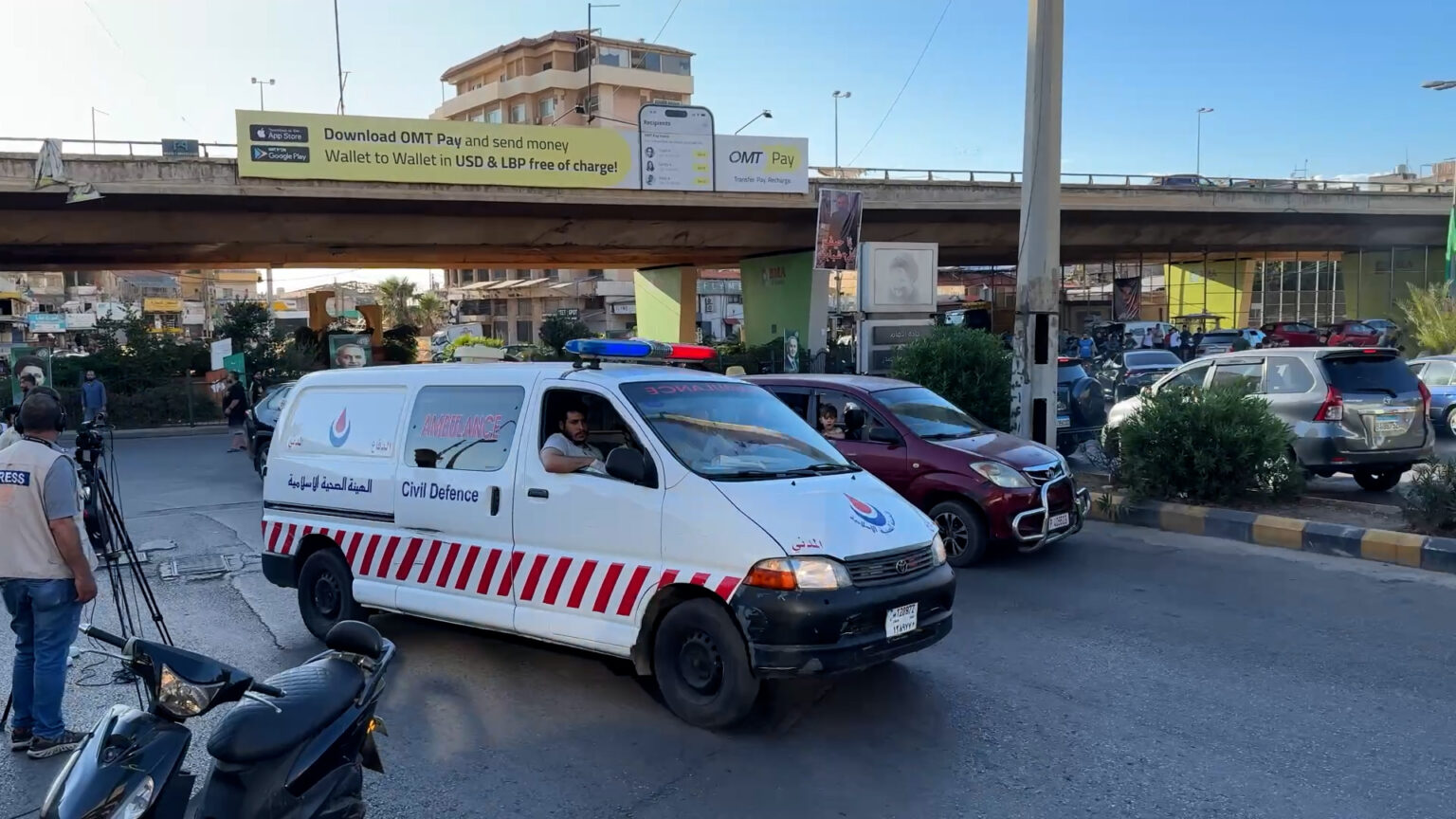
Chaos following the explosion of pagers across Lebanon. Photo: Al Manar

Israel continues to carry out war crimes and breach the sovereignty of countries in the region, while the international community remains unmoved

The Lebanese Internal Security Forces announced on Tuesday, September 17, that thousands of pagers or wireless communication devices exploded in a number of areas across Lebanon, including in the southern suburb of the Lebanese capital of Beirut. The attack reportedly targeted pagers held by members of the Lebanese resistance movement Hezbollah.

The explosion of the pagers killed at least nine people, including a child, and injured over 3,000 others. Videos that have circulated online of the explosions, illustrate how many occurred in public places and caused transit accidents, secondary injuries, and general chaos.

According to media reports, Iranian Ambassador to Lebanon Mojtaba Amani was among the people who sustained injuries in the attacks, and was transported to a hospital to receive treatment. Some casualties were also reported in Syria’s southwestern governorate of Rural Damascus. Mahdi Ammar, son of Ali Ammar, a member of parliament with Hezbollah’s Resistance Loyalty Bloc, was also killed in the attacks.

Hezbollah movement stated on Tuesday that the pagers, which exploded, were in the possession of a number of workers at various Hezbollah units and institutions, and that the reasons behind their explosion were still unknown. The movement also announced that investigations have been under way to unveil the reasons and the circumstances behind the simultaneous explosions. According to Reuters, the detonated pagers were acquired by Hezbollah in recent months.

“Hezbollah’s competent agencies are currently conducting a wide-ranging security and scientific investigation to determine the causes of those simultaneous explosions. Likewise, medical and health agencies are treating the wounded and injured at a number of hospitals in various Lebanese regions,” Hezbollah said in a statement. In the statement, the movement urged the Lebanese people “to be aware of the rumors and false as well as misleading information that some parties are spreading in a way that serves the psychological war of the Zionist enemy.”

Hezbollah issued another statement later on Tuesday holding Israel fully responsible for the attack, which injured thousands including civilians and Hezbollah members. The statement was issued after the movement scrutinized the facts, current available data, and information about the attack. The statement also stressed that the attack will not deter Hezbollah from continuing its support to the Palestinian people. “Our martyrs and wounded are the symbol of our struggle and sacrifices all the way to Al-Quds in triumph of our honorable people in the Gaza Strip and the West Bank and continuous support,” Hezbollah added in the statement, concluding it with a pledge to justly punish Israel for what it described as a sinful aggression.

The Palestinian Islamic Jihad movement condemned the attack in a statement describing it as a “war crime”. “The treacherous operation carried out by the Zionist entity’s devices through the explosion of dual-use communication equipment is a documented war crime. It inflicted severe damage on a large number of innocent civilians inside their homes with premeditated malice,” Islamic Jihad said in its statement. “Although the enemy’s resort to this option is intended within the framework of psychological and intellectual warfare, it indicates the level of frustration and the narrow options they now have after the blows they have received from multiple fronts supporting the Palestinian people,” Islamic Jihad added.

The spokesperson of Yemen’s Ansar Allah movement Mohammad Abdul Salam also condemned the attack in a post on his platform on X describing it as a crime and a violation of Lebanese sovereignty. A number of countries also officially condemned the deadly series of explosions in Lebanon vowing to provide necessary medical assistance to the Lebanese people, including JordanIran, and Palestine.

Meanwhile, the United States denied being aware of the attack. On Tuesday, the US State Department spokesperson Matthew Miller said that the US “was not aware of this operation and was not involved in it”. Miller added that the US “is still gathering information about the explosions in Lebanon”. The unprecedented deadly cyber attacks came after Israeli media outlets recently reported that Israeli Prime Minister Benjamin Netanyahu decided to expand a military operation on the northern front with Lebanon.

Original article by Aseel Saleh republished from peoples dispatch under a Creative Commons Attribution-ShareAlike 4.0 (CC BY-SA) license.

Continue ReadingHezbollah holds Israel responsible for cyber terrorist attack in Lebanon

Analysis Details How Israel’s Gaza Siege ‘Is Driving a Humanitarian Disaster’

Spread the love

Original article by Brett Wilkins republished from Common Dreams under Creative Commons (CC BY-NC-ND 3.0). 

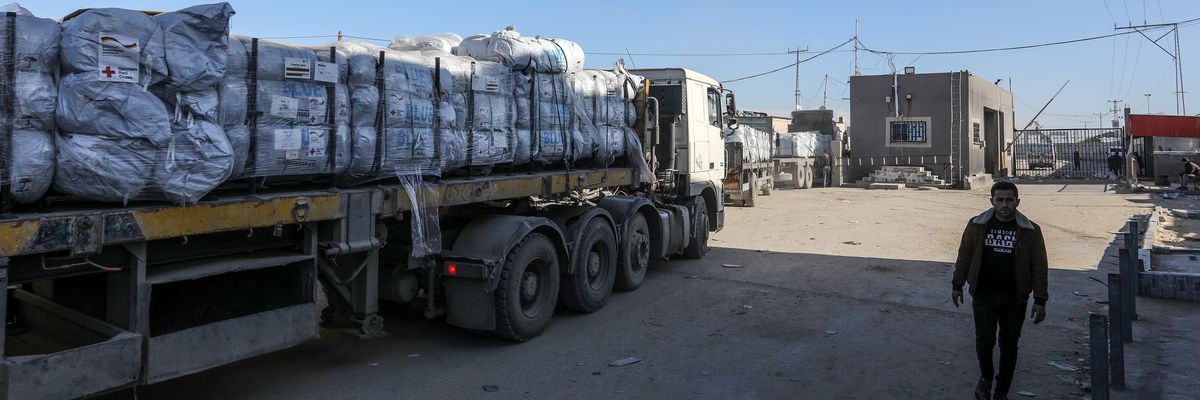
Trucks carrying aid supplies to Gaza are seen at the Karem Abu Salem border crossing on February 17, 2024. (Photo: Abed Rahim Khatib/Anadolu via Getty Images)

“Over 11 months, we have reached shocking levels of conflict, displacement, disease, and hunger,” said one campaigner.

Israel’s “complete siege” of the Gaza Strip “is driving a humanitarian disaster,” with 83% of required food aid failing to enter the embattled enclave, where the entire population is facing hunger and disease and almost half a million Palestinians are at risk of starvation, an analysis published Monday revealed.starvation,

The analysis by 15 international aid organizations noted that a record-low average of just 69 aid trucks are entering the Gaza Strip each day, compared with an already insufficient 500 daily truckloads a year ago. Additionally, the groups said that “only 17 out of Gaza’s 36 hospitals remain partially functional, and “critical infrastructure such as water networks, sanitation facilities, and bread mills” have been destroyed.

“While Israeli military attacks on Gaza intensify, lifesaving food, medicine, medical supplies, fuel, and tents have been systematically blocked from entering for almost a year,” the aid groups—which include ActionAid, American Friends Service Committee, CARE International, Christian Aid, Islamic Aid, Oxfam International, and Save the Children—said in a statement.

The publication highlights numerous ways that “lifesaving aid is systematically obstructed on a daily basis” in Gaza.

“These include the denial of safety, with more than 40,000 Palestinians and nearly 300 aid workers killed since last October; the sharp tightening of a 17-year blockade to a full siege, which prevents aid from entering Gaza; delays and denials which restrict the movement of aid around Gaza; tightly restrictive and unpredictable control of imports; the destruction of public infrastructure such as schools and hospitals; and the displacement of civilians and humanitarian workers,” the analysis’ authors wrote.

Zenab, a 33-year-old Palestinian woman pregnant with her second child, said that her pregnancy “has been the hardest time of my life.”

“It was also hard to get the medication I needed,” she continued. Sometimes I had to walk for hours to different pharmacies, hospitals, and health centers to see if anyone had my medication available. For me as a pregnant woman, there has been hardly any healthcare support, no proper hygiene and sanitation, and no suitable mattress to sleep on.”

“I was suffering from complications during my pregnancy,” Zenab added. “We didn’t have enough water to drink, and had hardly any food. The doctors again told me that my pregnancy was in danger.”

Among the report’s key findings:

  • 83% of required food aid doesn’t make it into Gaza, up from 34% in 2023;
  • An estimated 50,000 children aged between 6-59 months urgently require treatment for malnutrition by the end of the year;
  • 65% of the insulin required and half of the required blood supply are not available in Gaza;
  • Availability of hygiene items has dropped to 15% of the amount available in September 2023, with 1 million women now going without the hygiene supplies they need;
  • Only around 1,500 hospital beds in Gaza remain operational, compared to around 3,500 beds in 2023 which was already well below sufficient to meet the needs of a population of more than 2 million people; and
  • 1.87 million people are in need of shelter with at least 60% of homes destroyed or damaged as of January, yet tents for around just 25,000 people have entered Gaza since May 2024.

“There is a shortage of all humanitarian items. We are overwhelmed [with] these needs and [these] urgent requirements,” said Amjad Al Shawa, director of the Palestinian NGOs Network. “People [are] starving due to the shortage of aid. One hundred percent of the population depends on humanitarian aid.”

The authors of the analysis—which was released ahead of this week’s United Nations General Assembly in New York—are demanding that Israel secure an immediate and lasting cease-fire. They are also calling for an arms embargo on Israel and Israeli compliance with the recent International Court of Justice (ICJ) advisory opinion, which found that the occupation of Palestine is an illegal form of apartheid that must end immediately. Israel is on trial for genocide in a separate ICJ case.

“The situation was intolerable long before last October’s escalation and is beyond catastrophic now.”

“The situation was intolerable long before last October’s escalation and is beyond catastrophic now,” CARE International West Bank and Gaza country director Jolien Veldwijik said in a statement. “Over 11 months, we have reached shocking levels of conflict, displacement, disease, and hunger.”

That includes dozens of children who have died due to malnutrition, dehydration, and lack of adequate medical care.

“Aid is still not getting in, and humanitarian workers are risking their lives to do their jobs while attacks and violations of international law intensify,” Veldwijik added. “Aid, which is urgently required for 2.2 million people at risk of dying in the coming weeks and months, should never be politicized. We demand an immediate and sustained cease-fire, and the free flow of humanitarian aid into and throughout Gaza.”

Original article by Brett Wilkins republished from Common Dreams under Creative Commons (CC BY-NC-ND 3.0). 

Continue ReadingAnalysis Details How Israel’s Gaza Siege ‘Is Driving a Humanitarian Disaster’

UN Experts Warn Israel Risks ‘Pariah’ Status Over Gaza Genocide

Spread the love

Original article by Brett Wilkins republished from Common Dreams under Creative Commons (CC BY-NC-ND 3.0). 

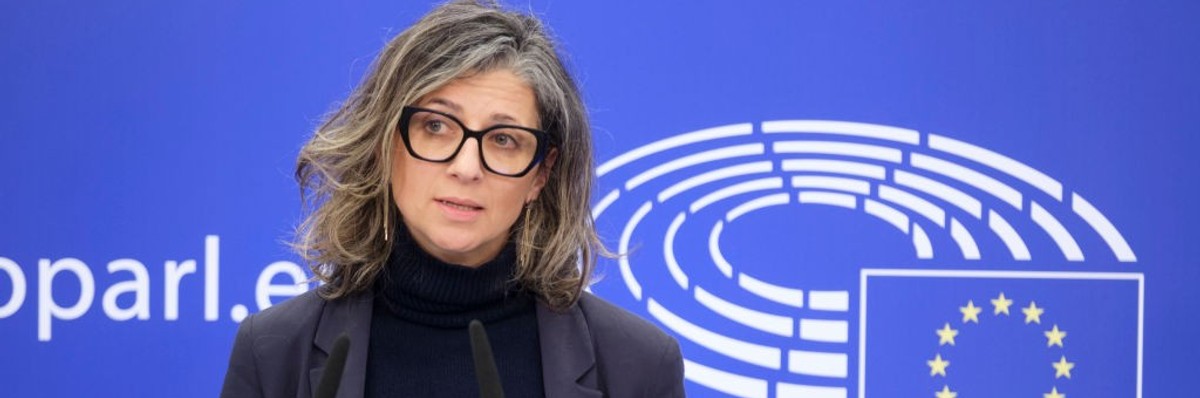
United Nations special rapporteur on the Occupied Palestinian Territories Francesca Albanese addresses the European Parliament in Brussels on April 10, 2024.
 (Photo: Thierry Monasse/Getty Images)

One expert even asked if Israel’s United Nations membership should be reconsidered given the country “seems to have zero respect” for the world body.

United Nations human rights experts warned Monday that Israel risks becoming an international “pariah” over its ongoing assault on Gaza—for which it is on trial for genocide at the world body’s International Court of Justice.

The special rapporteurs—who are appointed by the U.N. but do not speak on its behalf—condemned Israel’s human rights violations against Palestinians, as well as its blatant disregard for international law and multiple rulings from the ICJ.

These include an advisory opinion that the 57-year Israeli occupation of Palestine is an illegal form of apartheid that must immediately end, and orders for Israeli forces to avoid genocidal actions in Gaza and to immediately halt the Rafah offensive.

George Katrougalos, the U.N. special rapporteur on the promotion of democratic and equitable international order and a former Greek foreign minister, said during a press conference that the “first obligation” for harmonious relations between nations “is for everybody to respect the United Nations rules.”

“This is not happening in the case of Israel,” Katrougalos noted.

The United Nations agency for Palestinian relief says that around 200 of its staff members have been killed in more than 450 Israeli attacks on agency facilities since October. More than 500 Palestinians have been killed while seeking shelter under the U.N. flag.

Overall, more than 146,000 Palestinians have been killed or wounded by Israeli forces since October. Almost all of Gaza’s 2.3 million people have been forcibly displaced, and Israel’s “complete siege” has caused widespread starvation—sometimes deadly—and sickness throughout the coastal enclave.

Comparing the international community’s reaction to Russia’s ongoing invasion of Ukraine and Israel’s war on Gaza, Katrougalos stressed that “we cannot anymore stand this kind of double standards and hypocrisy.”

“I trust that the progressive and democratic citizens of Israel would not let their country become a pariah like South Africa [had] become during the times of apartheid,” he added. South Africa is leading the genocide case against Israel at the ICJ.

Francesca Albanese, the U.N. special rapporteur on the rights situation in the occupied Palestinian territory, said that “I think it’s unavoidable for Israel to become a pariah in the face of its continuous, relentless, vilifying assault of the United Nations, on top of millions of Palestinians.”

“Shockingly, in the face of the abyss reached in the OPT… most member states remained inactive at best, or [are] actively aiding and assisting Israel’s criminal conduct,” she continued.

“Should there be a consideration of its membership as part of this organization, which Israel seems to have zero respect for?” Albanese added.

Pedro Arrojo-Agudo, the U.N. special rapporteur on the rights to safe drinking water and sanitation, warned that “we are blowing up the United Nations if we don’t react” to Israel’s human rights violations.

Arrojo-Agudo added that, as with starvation, Israel is using deprivation of water as a “weapon” and disavowed Israel’s claim that Hamas—which led the October 7 attack on Israel—has “completely mismanaged water in Gaza.”

The special rapporteurs’ remarks came as representatives of U.N. member states gathered in New York for this year’s annual General Assembly. General debate sessions are set for next week.

Original article by Brett Wilkins republished from Common Dreams under Creative Commons (CC BY-NC-ND 3.0). 

Continue ReadingUN Experts Warn Israel Risks ‘Pariah’ Status Over Gaza Genocide

Getting shorter and going hungrier: how children in the UK live today

Spread the love
Keir Starmer says pensioners can freeze to death and poor children can starve and be condemned to failure and misery all their lives.
Keir Starmer says pensioners can freeze to death and poor children can starve and be condemned to failure and misery all their lives. The child poverty and neglect discussed in this article occurred previously to Keir Starmer and the Labour Party being in office. They polices are however certainly continuing and reproducing child poverty and destitution.

Danny Dorling, University of Oxford

Children’s lives in the UK are changing.

They are becoming shorter in height. More of them are going hungry than they were a few years ago. Recently, more have died each year than they did a few years ago. Increased poverty, more destitution and the effects of ongoing austerity are the clear culprits.

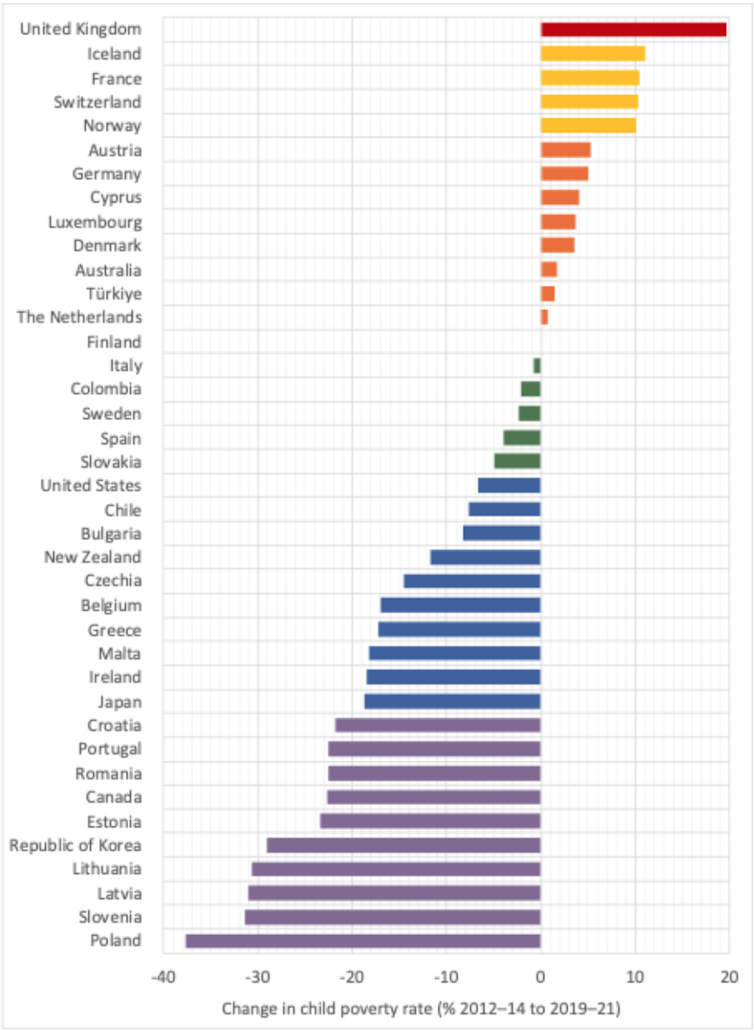
But why did this happen to our children? This rise in child poverty is a change that has not been found to have occurred to the same extent anywhere else in the world, among all the places that the United Nations measures in the same way.

Change in child poverty, 2012–14 to 2019–21

Bar chart
UNICEF Innocenti—Global Office of Research and Foresight (2023) ‘Innocenti Report Card 18: Child poverty in the midst of wealth’, CC BY-NC-ND


This graph tells a story of hope and success. In much of Eastern Europe, child poverty has fallen by between as much as a third – and often at least a quarter – in a mere seven years.

But it also shows that child poverty has risen the most in the UK. The poorest fifth of households in the UK are poorer than the poorest fifth in most of Eastern Europe. For many people in the UK, this will come as a surprise. Some will refuse to believe it can be this bad.

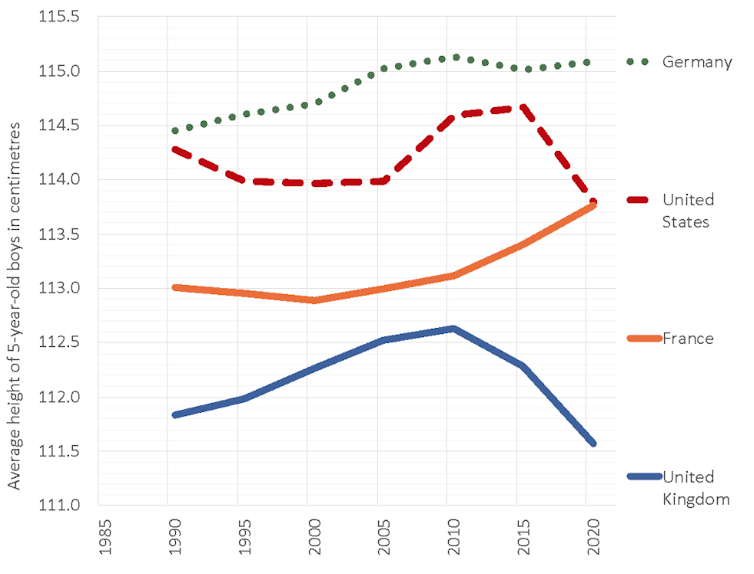
The evidence for this poverty is seen in the declining heights of five-year-olds since 2010.

Average height of five-year-old boys, 1985–2020

Line graph
Average height of 5-year-old boys, 1985–2020. Redrawn by the author from data in Press Association (2023) ‘British children shorter than other five-year-olds in Europe’, ITV News, 21 June., CC BY-NC-ND


A 5-year-old in 1990 would have been born in 1985 and their height influenced mostly by nutrition in the years 1985–1990. Those were hard years for the UK: mass poverty resulting from over three million people being out of work in the early 1980s. But the average height of children was still increasing.

It was not until 2010, for those children who had lived between 2005 and 2010, that we first saw heights plateau and then fall, coinciding with the post-2010 austerity years.

My forthcoming book attempts to make sense of what has happened to the UK: why, in 2024, it is not merely one of the countries in Europe with a high rate of child poverty, but the one country above all others that the UN has singled out as having had the greatest rises in child poverty among all those it surveyed.

Seven children

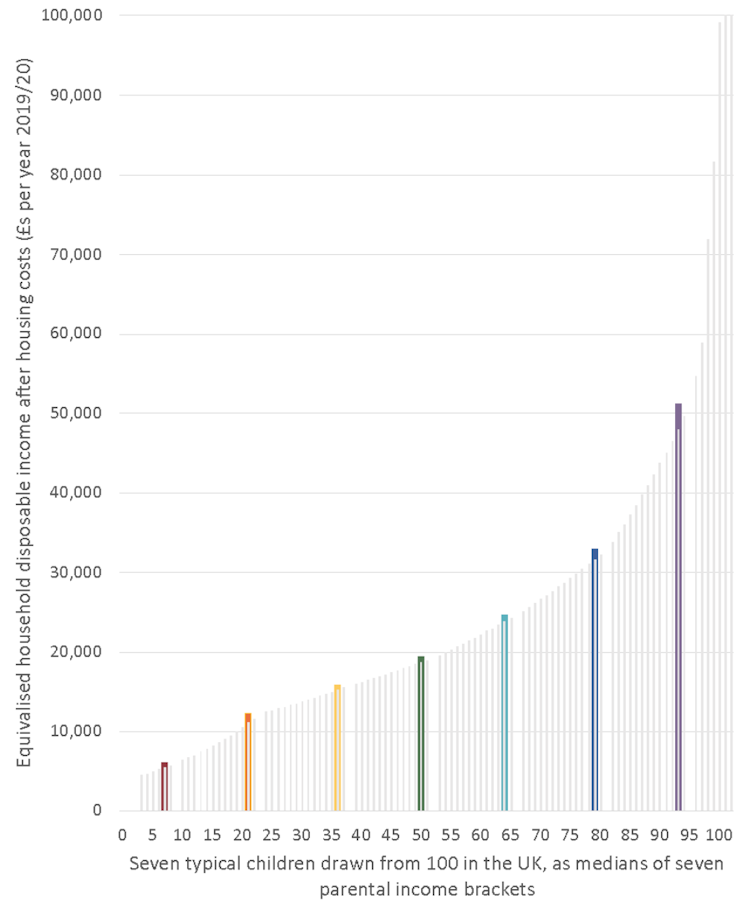
To try to understand more about children’s lives in the UK, I constructed seven typical children. I divided all 14 million children living in the UK into seven groups of 2 million, according to the income of their families in 2018 and 2019. I then chose the middle child of each 2 million. I next looked at what had happened to those families between 2018 and 2024.

The graph below shows the annual income of each of the seven households the children were drawn from.

Annual household incomes after tax, benefits and housing costs in the UK, families with children 2019/20

Annual household incomes after tax, benefits and housing costs in the UK, families with children 2019/20: seven typical children marked in colour. Danny Dorling, CC BY-NC-ND


The first thing to note is just how incredibly well-off the children are who are better-off than our seven typical children.

Some 6% of all children in the UK live in households richer than the best-off typical child in my analysis. Those 6% of children, the best-off children of all, live in families that each year receive and spend a third of all the income in the UK.


Want more politics coverage from academic experts? Every week, we bring you informed analysis of developments in government and fact check the claims being made.

Sign up for our weekly politics newsletter, delivered every Friday.


These 6% are not typical, and neither are the 6% poorest: those most destitute, those whose families are most likely to use food banks. If you pick seven typical children, equally spaced out across the income scale, then these extremes are not part of what you see.

But four of our typical seven children now live lives that most better-off people would consider to be in poverty. The other three are hardly well-off.

The least well-off are in families struggling to pay bills and making sacrifices others do not have to think about. For instance, whether to save £10 a month, or have insurance against the effects of flood, fire or theft. Increasingly often they cannot afford both.

But even the most well-off of our seven children lives in a family that worries about paying for an annual holiday. That is rare among the most affluent two million families, but possible.

The UK in 2024 demonstrates to the world what living with high inequality means in a once affluent country. It means a few using up far more resources than the vast majority of other children, such as having access to many more school teachers – per child – as compared to the rest, better food, better shelter, more warmth, more toys, better material everything; often more than you might think any child needed.

In future, almost all our children will tell their stories of growing up in the UK of the 2020s and – hopefully – what changed to make things better. It is hard to imagine them becoming much worse.

Danny Dorling, Halford Mackinder Professor of Geography, University of Oxford

This article is republished from The Conversation under a Creative Commons license. Read the original article.

Continue ReadingGetting shorter and going hungrier: how children in the UK live today