Seabirds: 40% of UK species in trouble – bird flu, climate change and overfishing to blame
Spread the love

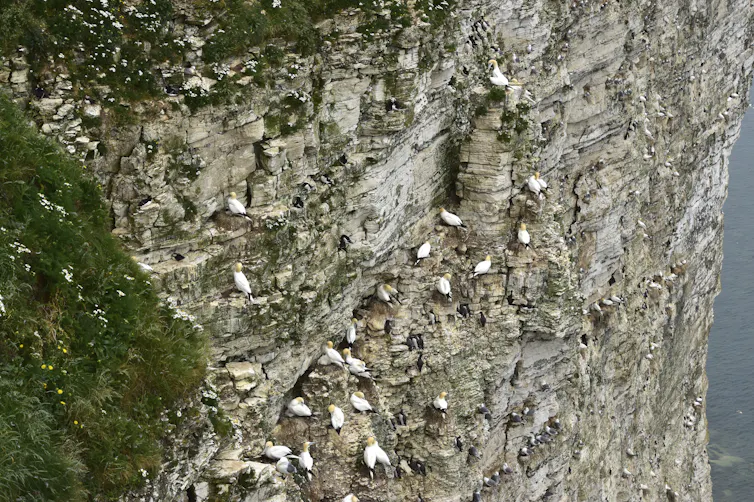
Nesting northern gannets, guillemots and razorbills at the RSPB Bempton Cliffs reserve on the Yorkshire coast. Robert Simmons

Richard Gregory, UCL

A visit to a seabird colony in summer is an assault on the senses. First there’s the noise, then the overwhelming ammonia smell that stains the memory, and then the swirl of colour and activity on the white-washed cliffs.

When you’re standing hundreds of metres above the crashing sea, there can be hundreds or thousands of breeding seabirds in the air or on the sea below, or precariously perched on poorly made nests or ridiculously narrow ledges.

In these seabird cities you can spot tender moments, like an auk delicately turning its single egg for incubation while another feeds its oversized youngster. Brutality is never far either: a chick snatched to feed a bigger brood, an incoming parent robbed of its hard-won fish supper by a piratical gull, a dead bird bobbing face down on the sea.

All life is here in the seabird colony, and the British Isles is particularly rich.

This string of islands in the North Atlantic is home to nearly 30 species of seabird and hosts large portions of their total populations. Most of the world’s Manx shearwaters (90%), northern gannets (70%) and great skuas (60%) nest here, as do more than 20% of the European population of nine seabird species.

British people have a special responsibility to protect these birds that are a harbinger of ocean health, sitting as they do at the top of a delicate food chain.

Sadly, a new scientific assessment has reported alarming declines over the last 25 years in the UK’s seabird populations. Five new species have joined the “red List”, which denotes the highest category of conservation concern: Leach’s storm-petrels, common gulls, great black-backed gulls, Arctic terns and great skuas. These join the already listed kittiwakes, herring gulls, roseate terns, Arctic skuas and puffins, which are all highly threatened.

On the upside, if there is an upside, two seabirds were judged to be less threatened based on new data. Shags and black guillemots moved to the amber and green list respectively, though both are gradually declining. Nearly 40% of breeding seabirds are now red-listed in the UK – and 73 bird species overall (30% of the UK total).
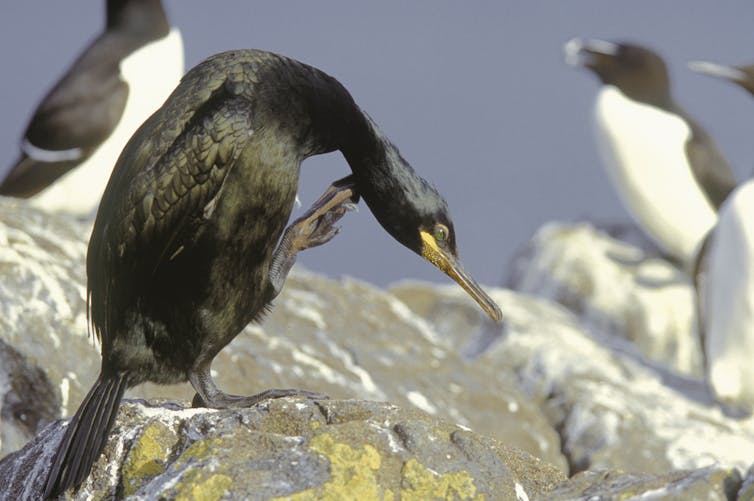
A large black bird scratching its neck with a webbed foot.
A silver lining: shags have recovered enough to be removed from the red list. Andy Hay

Looking down

Seabirds face many threats. Among the gravest are changes to their food supply linked to overfishing and climate change.

Ocean warming disrupts and shifts the life cycles of seabird prey, such as sandeels, and the resulting scarcity can cause populations to collapse. Increasingly severe winter storms and summer heatwaves also kill seabirds.

The broader effects of climate change and the warming of the ocean are difficult to predict, but the associated increase in acidification and lower oxygen levels are certain to upset food webs.

Entanglement in fishing gear, invasive predators and collisions with offshore turbines present yet more challenges.

On top of all this came the highly pathogenic HPAI H5N1, a new strain of the avian influenza virus that was first detected in the UK in 2021 and has resulted in the deaths of tens of thousands of seabirds and affected almost every seabird species.

HPAI H5N1 was first identified in domestic waterfowl in southern China in 1996 and rapidly spread into their wild relatives. Migratory species carried the virus around the world, and still do. Thankfully, human deaths remain extremely rare. The jump into seabirds was unexpected as, until then, it was found mostly in wild waterfowl and domestic poultry.

Seabirds such as terns, gulls, auks and northern gannets were hit hard but the impact on great skuas was most striking. Their numbers are down by over 70% from the last census, which was taken between 2015 and 2021.
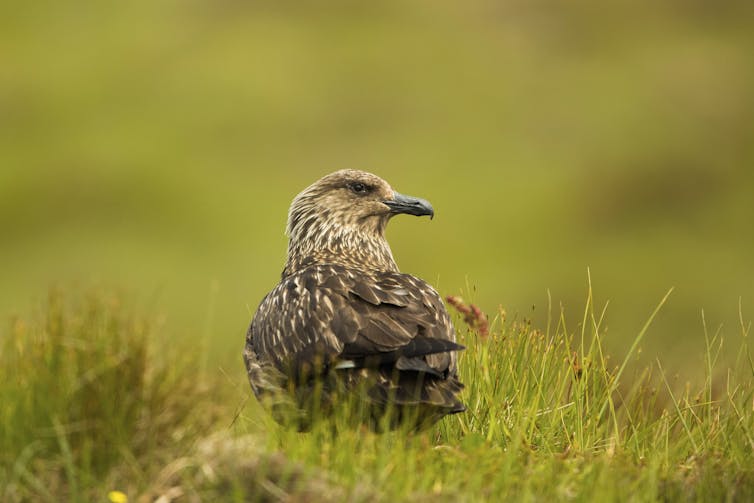
A large brown seabird.
A great skua at nest on Handa Island off the west coast of Scotland. Louise Greenhorn

Seabird lifestyles predispose them to infectious disease and make it hard for them to recover. Seabirds typically produce just a few young (often only one) in a single brood each year. At least these birds are long-lived and can continue to breed throughout their lives. But living in dense, crowded colonies at a few sites that they can fly between means diseases can easily spread and take hold.

Looking up

The story is not all doom and gloom – much is happening to aid their recovery.

The UK and Scottish government decided to close sandeel fisheries in the English North Sea and all Scottish waters from 2024. Many seabirds, including kittiwakes and puffins, depend on sandeels to feed their chicks, and so the moratorium is a positive move that should be sustained.

Far-sighted projects to remove invasive predators, especially rats, from seabird islands across the UK are also showing great results. The removal of brown and black rats from Lundy Island, Devon, led to the immediate return of breeding Manx shearwaters and puffins after an absence of many years.
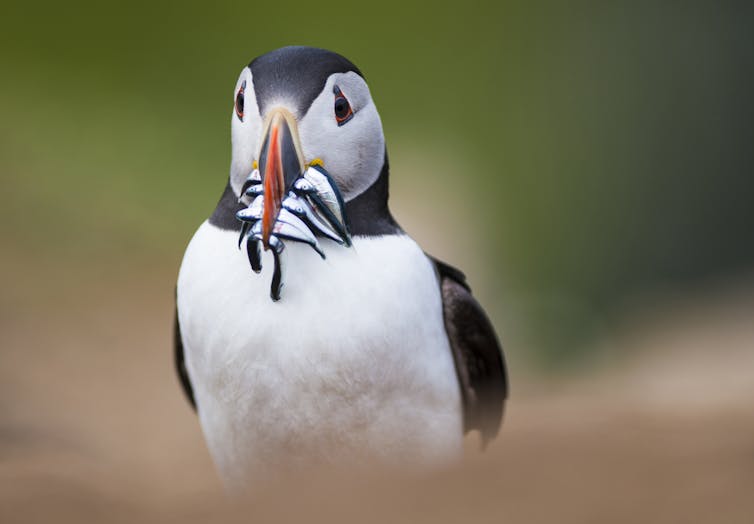
A puffin with a beak full of sand eels.
Atlantic puffins remain on the red list, but will benefit from a sandeel fishing ban. Katie Nethercoat

Marine protected areas such as Lyme Bay on the south coast of England are proof that sustainable fishing and conservation can go hand in hand (even if these sites are typically tiny). Trawlers were excluded from Lyme Bay in 2008 and the area has been managed by the local fishing industry and conservationists. A decade on from the ban, bottom-living seafans, rare corals, shellfish and fishes have all bounced back wonderfully.

More is needed to reverse the fortunes of seabirds. Well-resourced national seabird conservation strategies should protect colonies from invasive predators, extend and improve the country’s patchwork of marine protected areas, encourage more nature-friendly marine development (including for renewables) and better manage fisheries to ensure there is enough for seabirds to eat and less accidental bycatch in fishing gear, which kills thousands of seabirds in UK waters each year.

Our seabirds are special in many ways. I’d recommend a visit to a seabird colony, to drink in the spectacle and reflect on the lives of these birds and our responsibilities to them.


Imagine weekly climate newsletter

Don’t have time to read about climate change as much as you’d like?
Get our award-winning weekly roundup in your inbox instead. Every Wednesday, The Conversation’s environment editor writes Imagine, a short email that goes a little deeper into just one climate issue. Join the 35,000+ readers who’ve subscribed so far.


Richard Gregory, Honorary Professor of Genetics, Evolution & Environment, UCL

This article is republished from The Conversation under a Creative Commons license. Read the original article.
Continue ReadingSeabirds: 40% of UK species in trouble – bird flu, climate change and overfishing to blame

Jeremy Corbyn to form alliance with four independent pro-Gaza MPs

Spread the love

https://www.theguardian.com/politics/article/2024/sep/02/jeremy-corbyn-alliance-independent-pro-gaza-mps

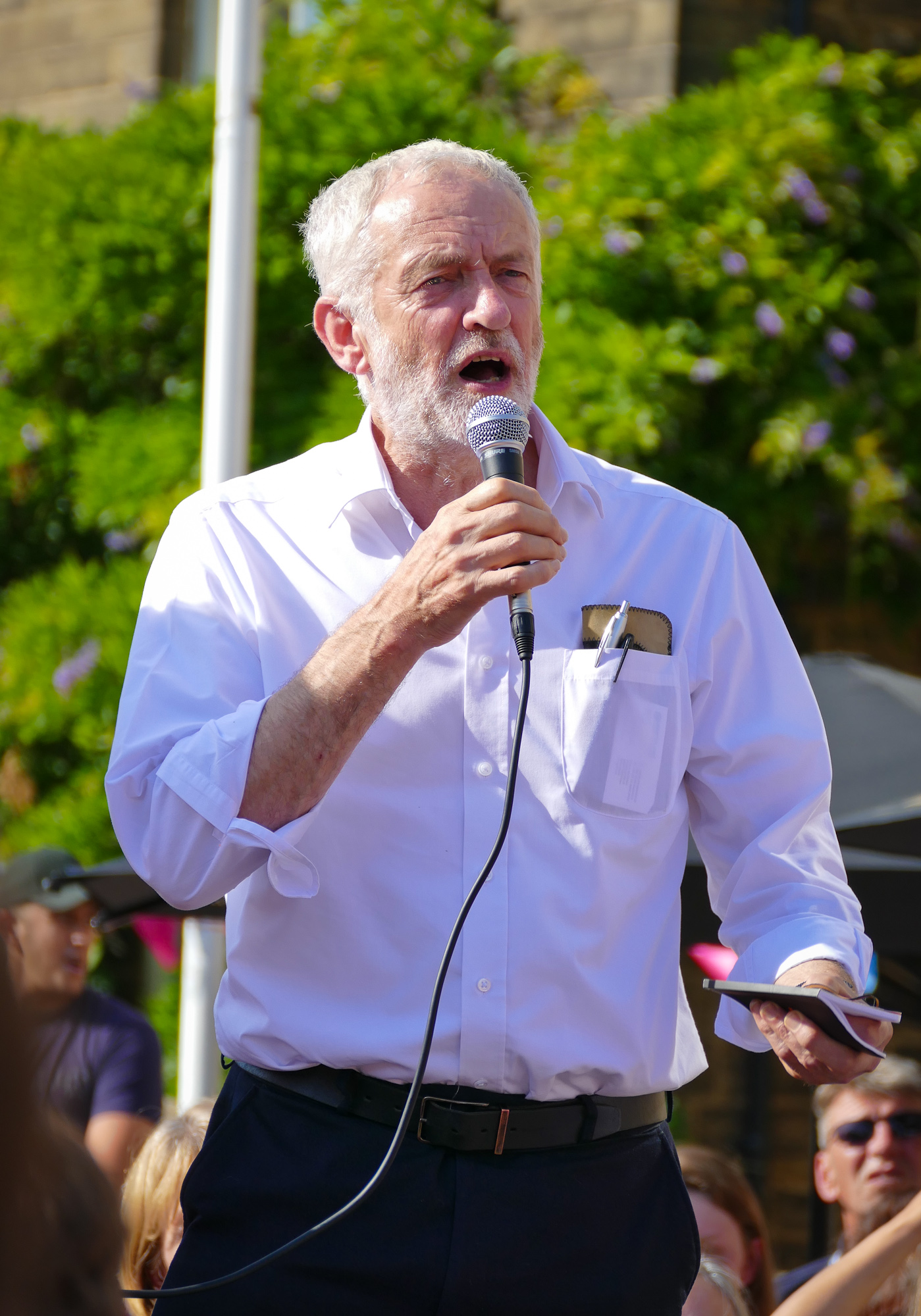
Image of Jeremy Corbyn MP, former leader of the Labour Party
Jeremy Corbyn MP, former leader of the Labour Party

Group calls for more MPs to join and vows to campaign on issues such as austerity and two-child benefit cap

Jeremy Corbyn is to form an official parliamentary alliance with four independent MPs who were elected on pro-Gaza platforms – issuing a call for more MPs to join.

The group will have the same number of MPs as Reform UK and the Democratic Unionist party, who each have five MPs, and more than the Green party and Plaid Cymru on four.

Promising to fight austerity and campaign on issues including the winter fuel allowance, the two-child benefit limit and arms sales to Israel, the group also explicitly invited MPs to join them, a reference to seven rebel Labour MPs suspended by the party for voting to axe the two-child benefit cap.

Corbyn, a former Labour leader, was elected as an independent MP for Islington North after being barred from standing as a Labour candidate at the last election. The group will also include the MPs Shockat Adam, Ayoub Khan, Adnan Hussain and Iqbal Mohamed.

The MPs said: “We were elected by our constituents to provide hope in a parliament of despair. Already, this government has scrapped the winter fuel allowance for around 10 million pensioners, voted to keep the two-child benefits cap, and ignored calls to end arms sales to Israel.

“Millions of people are crying out for a real alternative to austerity, inequality and war – and their voices deserve to be heard. As individuals we were voted by our constituents to represent their concerns in parliament on these matters, and more, and we believe that as a collective group we can carry on doing this with greater effect.

“The more MPs who are prepared to stand up for these principles, the better. Our door is always open to other MPs who believe in a more equal and peaceful world.”

https://www.theguardian.com/politics/article/2024/sep/02/jeremy-corbyn-alliance-independent-pro-gaza-mps

Continue ReadingJeremy Corbyn to form alliance with four independent pro-Gaza MPs

More economic pain and hardship isn’t what people voted for, says Carla Denyer

Spread the love
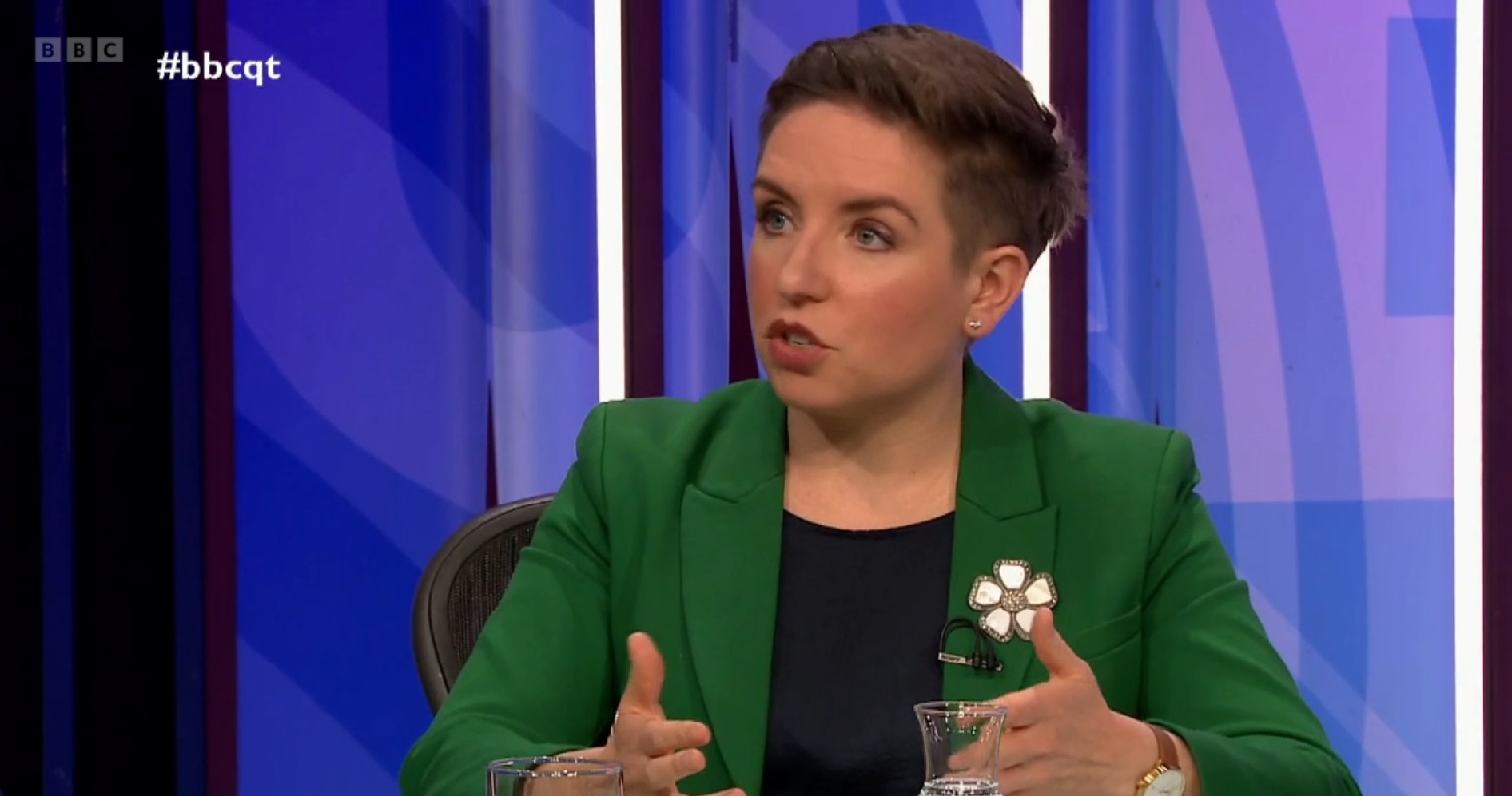
Image of the Green Party's Carla Denyer on BBC Question Time.
Image of the Green Party’s Carla Denyer on BBC Question Time.

Responding to Keir Starmer’s speech in which he said that the Labour government has inherited a £22bn black hole in the nation’s finances, as well as a “societal black hole”, co-leader of the Green Party Carla Denyer MP said:

“Enduring more economic pain and hardship isn’t what people voted for. They were told they were voting for change. Not voting for things to get worse before they get better. Labour needs to be honest about the fact that they could choose to make things better for everyone if they were bolder and braver.

“What is being framed as tough choices is actually about political choices. People don’t need a constant reminder that the Tories broke Britain. They need a new approach, not misguided fiscal rules that are set to make things worse.  

“We must generate the funds needed for investment by shifting the burden away from the poorest onto the wealthiest. Labour’s refusal to tax the super-rich shows that business as usual is very much still in business.  

Continue ReadingMore economic pain and hardship isn’t what people voted for, says Carla Denyer

UK announces partial suspension of arms exports to Israel

Spread the love

https://www.aljazeera.com/news/2024/9/2/uk-announces-partial-suspension-of-arms-exports-to-israel

An Israeli soldier holds a weapon atop an armoured personnel carrier [File: Baz Ratner/Reuters]

Thirty out of 350 licences to be suspended, citing ‘clear risk’ they could be used in breach of international humanitarian law.

The United Kingdom says it would suspend 30 out of 350 arms exports licences to Israel, citing a “clear risk” they could be used in a serious breach of international humanitarian law.

Foreign Secretary David Lammy told parliament on Monday the partial ban covered items “which could be used in the current conflict in Gaza” against Hamas but did not include parts for the F-35 fighter jets.

He said the decision to suspend the licences did not amount to a blanket ban or an arms embargo, adding that the UK continues to support Israel’s right to self defence in accordance with international law.

“It is with regret that I inform the House [of Commons, lower house of parliament] today the assessment I have received leaves me unable to conclude anything other than that for certain UK arms exports to Israel, there does exist a clear risk that they might be used to commit or facilitate a serious violation of international humanitarian law,” Lammy said.

https://www.aljazeera.com/news/2024/9/2/uk-announces-partial-suspension-of-arms-exports-to-israel

UK Labour Party Shadow Foreign Secretary repeatedly heckled at a speech to the Fabian Society over his and the Labour Party's support for and complicity in Israel's genocide of Gaza.
UK Labour Party Shadow Foreign Secretary repeatedly heckled at a speech to the Fabian Society over his and the Labour Party’s support for and complicity in Israel’s genocide of Gaza.
Continue ReadingUK announces partial suspension of arms exports to Israel

Thousands march for Palestine as Israel intensifies war on Gaza and West Bank

Spread the love

https://morningstaronline.co.uk/article/thousands-march-for-palestine-as-israel-intensifies-war-on-gaza-and-west-bank

People march through Manchester demanding Britain impose an arms embargo on Israel, August 31, 2024 Photo: John Nicholson

THOUSANDS of protesters across Britain again marched for Palestine on Saturday as Israel intensified its war on Palestinians in Gaza and the West Bank.

In major towns and cities calls were made to step up the worldwide Boycott, Divestment and Sanctions campaign against Israel following news that international coffee shop chain Starbucks saw its market share fall by billions of dollars as customers rebel against the company’s involvement with Israel.

Protests also took place in Israel demanding a ceasefire after Hamas said that six Israeli hostages found dead in Gaza had been killed in Israeli bombing and shelling. Israel said the hostages had been murdered by Hamas as its troops approached.

Calling for more action against organisations investing in firms involved in Israel, Palestine Solidarity Campaign (PSC) said its research has revealed that local government pension scheme funds in Britain collectively invest over £4.4 billion in companies complicit in Israel’s oppression of Palestinians.

The PSC said: “Councils must take immediate action to end ties with companies that are complicit in abuses of Palestinian rights, including by divesting pension funds they administer from companies enabling Israel’s genocide. The deferred wages of local government workers must not be used to fund injustice.”

https://morningstaronline.co.uk/article/thousands-march-for-palestine-as-israel-intensifies-war-on-gaza-and-west-bank

Continue ReadingThousands march for Palestine as Israel intensifies war on Gaza and West Bank