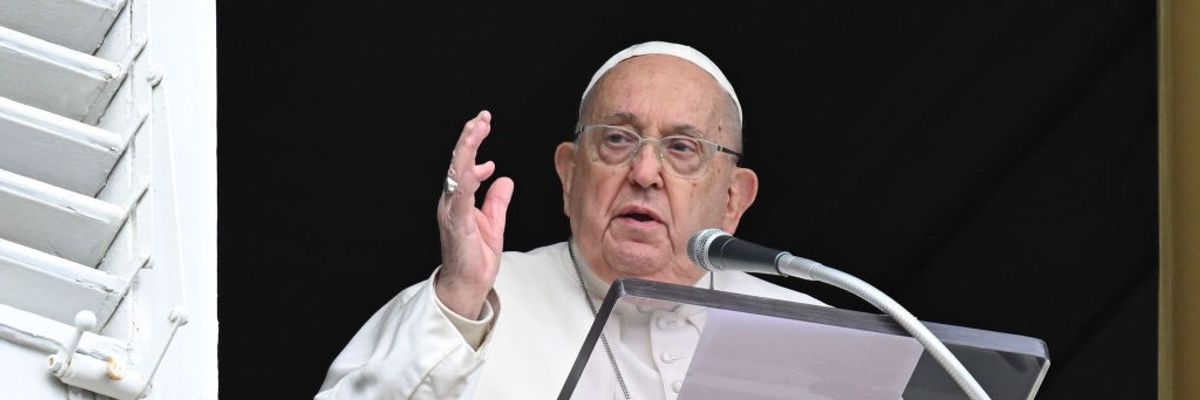
Pope Francis delivered a Sunday Angelus blessing from the window of his studio overlooking St. Peter’s Square on January 12, 2025 in Vatican City. (Photo: Vatican Media via Vatican Pool/Getty Images)
“Will the millions who will mourn his death these coming days respect this wish of his? Will they care for Gazans and Palestinians the way he did?”
The Vatican announced Monday that Pope Francis has died at the age of 88, hours after he appeared at an Easter mass and appealed for an end to Israel’s war on the Gaza Strip.
The pope’s Easter address, read aloud by Archbishop Diego Ravelli, decried the “terrible conflict” in Gaza that “continues to cause death and destruction and to create a dramatic and deplorable humanitarian situation.”
“I appeal to the warring parties: call a cease-fire, release the hostages, and come to the aid of a starving people that aspires to a future of peace!” said the message from the pope, an outspoken opponent of military conflict and war profiteers, climate destruction, and runaway economic inequality.
“In the face of the cruelty of conflicts that involve defenceless civilians and attack schools, hospitals, and humanitarian workers, we cannot allow ourselves to forget that it is not targets that are struck, but persons, each possessed of a soul and human dignity,” the pope’s address continued.
News of Pope Francis’ death came after a bout with double pneumonia left him hospitalized for more than a month. The Vatican did not specify a cause of death in its announcement.
The Nation‘s John Nichols wrote Sunday that Pope Francis’ calls for peace have made him “arguably the most consistent high-profile defender of the humanity of the Palestinian people during a period when the Israeli assault on Gaza has been pursued with relentless violence.”
Nichols continued:
With a boldness and specificity that has often sparked controversy, this pope has challenged economic injustice, racism, environmental neglect, militarism, and the abuses of new technologies that increase inequality. He has faced his share of criticism, not just from conservatives who disapprove of his views but also from reformers who sincerely wish that he would do more to modernize the church. Yet, in a time of too much indifference and impunity, this pope has remained uniquely engaged with the embattled regions that political and media elites neglect or abandon.
That’s been especially true when it comes to Gaza, where Pope Francis has long argued for cease-fires, arms blockades, aid convoys, and a diplomatic urgency that recognizes that Palestinians and Israelis are “fraternal peoples [who] have the right to live in peace.”
In a tribute to Pope Francis, Palestinian theologian Munther Isaac wrote Monday that “he conveyed true compassion to Palestinians, most notably to those in Gaza during this genocide.”
“The pope left our world today, and the occupation and the wall remained. Even worse, he left our world while a genocide continues to unfold,” Isaac wrote, pointing to the pontiff’s call for a thorough international investigation of Israel’s assault on Gaza.
“Today I wonder: Will the millions who will mourn his death these coming days respect this wish of his?” Isaac asked. “Will they care for Gazans and Palestinians the way he did?”
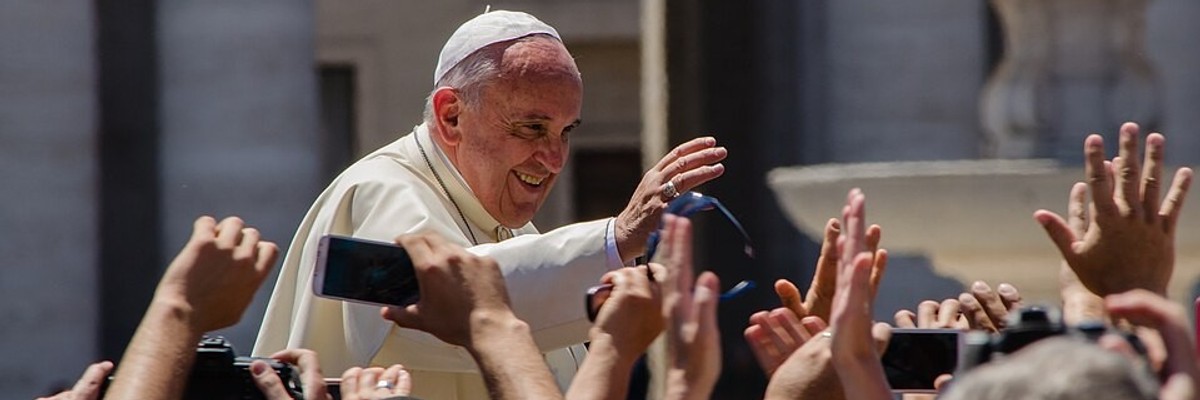
Pope Francis greeting people in St. Peter’s Square in Vatican City in 2014. (Photo: Alfredo Borba/Creative Commons)
Again and again, Pope Francis railed against our collective indifference to widespread suffering and urged humanity, especially world leaders, to do better. It’s not too late to heed his call.
Like millions of other people, I was deeply saddened to hear of the passing of Pope Francis, one of the most vocal and humble advocates for sharing the world’s resources.
But at the heart of his advocacy was a focus on ending inequality both globally and on a national basis, repeatedly calling upon governments to redistribute wealth and benefits to the poor in a new spirit of generosity.
I first recall being struck by Pope Francis’ headline-grabbing speech in 2014, when he urged the United Nations to promote a ‘worldwide ethical mobilization’ of solidarity with the poor to help curb an ‘economy of exclusion’ that is taking hold everywhere today.
A year later in 2015, the papal encyclical Laudato Si’—subtitled ‘On care for our common home’—made bigger headlines around the world with its powerful critique of laissez-faire ideology and its destructive effects on the environment. The trenchant letter expounded on the responsibility of rich countries to address their ‘ecological debt’ to less developed countries, with an acknowledgement of ‘differentiated responsibilities’ in addressing climate change. It was a radical entreaty for resource transfers between the Global North and South, and significant reductions in the consumption of non-renewable energy within developed countries.
The eloquent discourse of Laudato Si’ also reflected the core understanding of many environmental activists—that the climate and inequality crises are inextricably interconnected. Again and again, Pope Francis railed against our collective indifference to widespread human suffering. He persistently argued that the welfare of nations is interrelated, so the massive poverty and hunger experienced in the fragile economies of developing nations is, in turn, reflected in the destruction of the natural environment. Hence the urgency of remediating the enormous discrepancies in living standards throughout the world, which calls for a sense of global solidarity and interdependency that is tragically lacking in human affairs.
During the coronavirus pandemic, Francis also set out the challenge for rich nations to cooperate and distribute the vaccine freely to the world, rather than hoarding resources and treating one’s own nation first. The 2020 encyclical titled Fratelli tutti—‘Brother’s all’—made clear that Covid-19 was exposing existing inequalities, and fraternity on a state level requires richer countries to help poorer ones if we are to give meaning to the equality of human rights. Clearly, the world failed to heed Pope Francis’ plea to ensure recovery from the crisis tackled poverty, inequality and the climate emergency by ‘sharing resources in a just and respectable manner’.
Another theme that Francis constantly returned to was the need for cancelling the debts of countries unable to repay them. In his final papal bull for the Jubilee Year 2025, titled Spes non confundit—‘Hope does not disappoint’—he described debt forgiveness as a matter of justice more than generosity, and again decried the true ecological debt that exists between the Global North and South.
Francis was rightly known as the ‘Pope of the peripheries,’ standing up for the most vulnerable and marginalized peoples. He made clear his opposition to Western government policies of battening down the hatches and draconian responses to international migrants. Soon after taking office, Francis visited the Italian island of Lampedusa where he condemned European ‘indifference’ to the drowning of migrants crossing the Mediterranean in small boats. He later visited numerous camps for excluded migrants and refugees living ‘ghost lives in limbo,’ calling upon us to see Christ in the stranger and outsider. This was a sharp rebuke to reactionary politicians like Trump, Meloni, and Orbán, instead emphasizing the need for ‘universal fraternity’ as influenced by St. Francis of Assisi, after whom the Pope took his name.
It was a fitting testament to Francis’ advocacy for the poor and forgotten that he died hours after calling for a ceasefire in Gaza. In his annual Urbi et Orbi —‘To the City and World’—message on Easter Sunday, the day before he died, Francis repeated his appeal to the warring parties to “come to the aid of a starving people that aspires to a future of peace.” Few politicians, it seems, have followed the Pope’s counsel throughout his 12-year-long pontificate. Which now leaves it up to us, the ordinary people of goodwill, to uphold Francis’ tireless advocacy and hope for a better world.
What makes Pope Francis and his 183-page encyclical so radical isn’t just his call to urgently tackle climate change. It’s the fact he openly and unashamedly goes against the grain of dominant social, economic and environment policies.
While the Argentina-born pope is a very humble person whose vision is of a “poor church for the poor”, he seems increasingly determined to play a central role on the world stage. Untainted by the realities of government and the greed of big business, he is perhaps the only major figure who can legitimately confront the world’s economic and political elites in the way he has.
However his radical message potentially puts him on a confrontation course with global powerbrokers and leaders of national governments, international institutions and multinational corporations.
The backlash has begun even before the encyclical has been officially published. US presidential candidate Jeb Bush, a Catholic, feels the pope should stay out of the climate debate, joining other Republicans, fossil fuel lobbyists and climate denier think-tanks in seeking to discredit Pope Francis’s intervention.
What makes the pope so radical?
There are several meanings of the word “radical” that can be applied to the Pope and in particular his forthcoming encyclical.
First, radical can be understood as going back to the roots (from Latin radix, root). The majority of Catholics live in the Global South; in Latin America and sub-Saharan Africa. Francis is the first pope from the Global South, and naming himself in honour of Saint Francis of Assisi, “a man of poverty and peace who loved nature and animals”, signalled to the world a commitment to going back to the roots of human existence.
The pope knows the plight of the majority world. Before he became Archbishop of Buenos Aires, he was a priest in the vast, poor neighbourhoods, the villas miserias or slums, of Argentina’s capital.
Improving the lives of slum dwellers and addressing climate change is, for Pope Francis, one and the same thing. Both require tackling the structural, root causes of inequality, injustice, poverty and environmental degradation.
Even as the quality of available water is constantly diminishing, in some places there is a growing tendency, despite its scarcity, to privatize this resource, turning it into a commodity subject to the laws of the market. Yet access to safe drink- able water is a basic and universal human right, since it is essential to human survival and, as such, is a condition for the exercise of other human rights. (p. 23)
This stands in stark contrast to, for example, Peter Brabeck-Letmathe, the chairman of Nestlé, the world’s largest food and bottled water company, who thinks water is a normal commodity with a market value, and not a human right. Nestlé is far from unusual. Its stance is backed up by the official water privatisation policies of the World Bank, IMF and other international institutions.
In fact, the encyclical is a radical – for a pope and international leader, unprecedented – attack on the logic of the market and consumerism, which has been expanded into all spheres of life.
The document states:
Since the market tends to promote extreme consumerism in an effort to sell its products, people can easily get caught up in a whirlwind of needless buying and spending. Compulsive consumerism … leads people to believe that they are free as long as they have the supposed freedom to consume. But those really free are the minority who wield economic and financial power. (p. 149-150)
The pope rejects market fundamentalism, instead arguing that “the market alone does not ensure human development and social inclusion.”
The strategy of buying and selling “carbon credits” can lead to a new form of speculation which would not help reduce the emission of polluting gases worldwide. This system seems to provide a quick and easy solution under the guise of a certain commitment to the environment, but in no way does it allow for the radical change which present circumstances require. Rather, it may simply become a ploy which permits maintaining the excessive consumption of some countries and sectors. (p. 126)
The pope’s right. The same criticisms of carbon markets have been made by myself and others.
Climate change is a global problem with grave implications: environmental, social, economic, political and for the distribution of goods. It represents one of the principal challenges facing humanity in our day. (p. 20)
While the pope is not a politician – or maybe precisely because he is not one – he commands high moral and ethical authority that goes beyond traditional partisan lines. His encyclical speaks truth to power, and he might be the only person with both the clout and the desire to meaningfully deliver a message like this:
Many of those who possess more resources and economic or political power seem mostly to be concerned with masking the problems or concealing their symptoms, simply making efforts to reduce some of the negative impacts of climate change. However, many of these symptoms indicate that such effects will continue to worsen if we continue with current models of production and consumption. There is an urgent need to develop policies so that, in the next few years, the emission of carbon dioxide and other highly polluting gases can be drastically reduced, for example, substituting for fossil fuels and developing sources of renewable energy. (p. 21)
The bosses of Shell, ExxonMobil and other fossil fuel companies will not like this message, as it threatens their fundamental business model, and it also stands in contrast to the underwhelming ambitions of the G7 leaders who recently pledged to phase out fossil fuels only by 2100.
The time for bold, radical action on the environment as well as poverty eradication has come. This seems to be Pope Francis’ message: “The same mindset which stands in the way of making radical decisions to reverse the trend of global warming also stands in the way of achieving the goal of eliminating poverty.” (p. 128)
We need to think beyond the current, taken-for-granted logic that believes only markets and consumerism can solve the world’s social and environmental problems. The pope himself believes the situation is so grave that only a new, “true world political authority” will be able to address these problems.
This article was updated on 18 June to include quotes from the final encyclical rather than the earlier draft leaked to L’Espresso magazine.
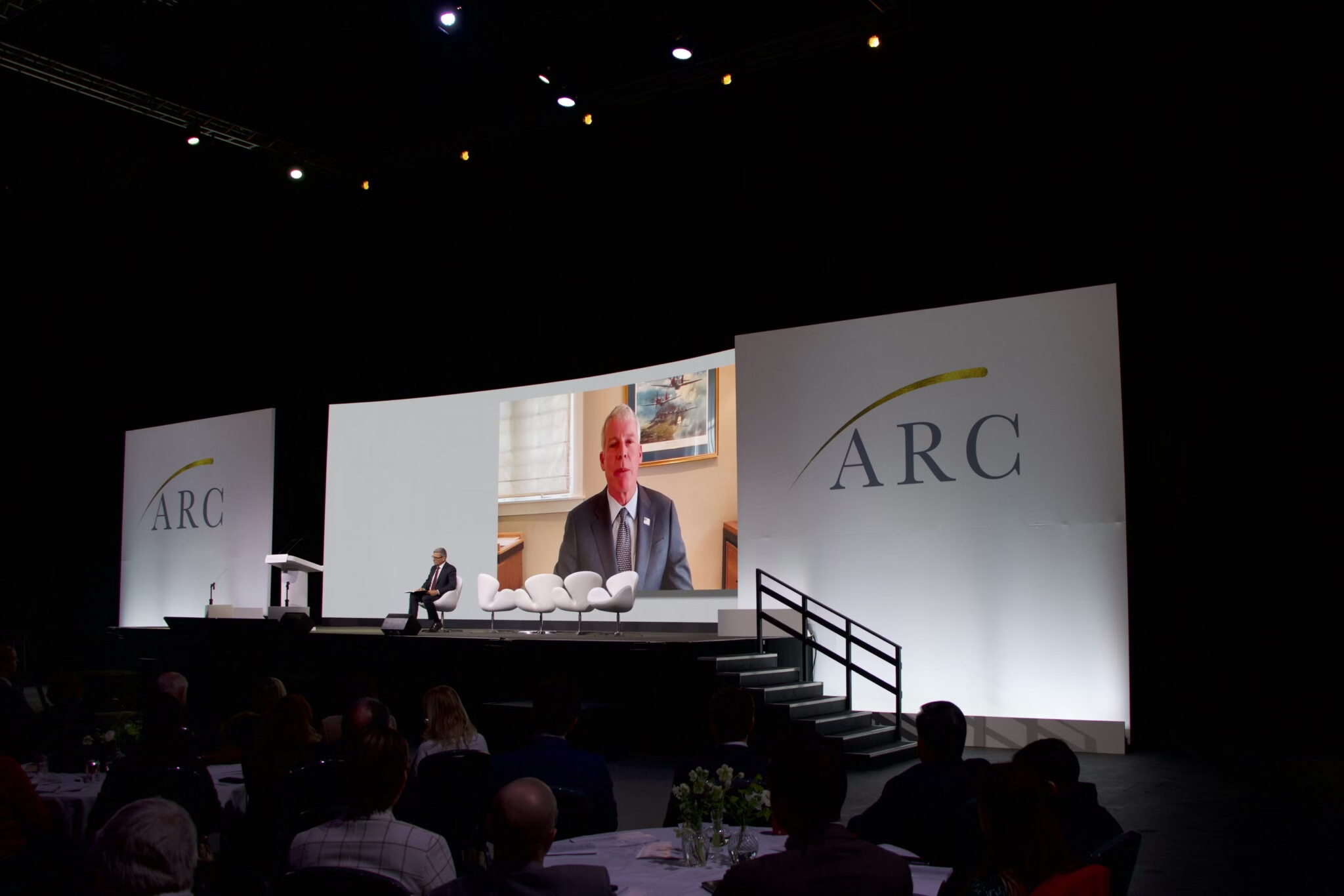
U.S. Energy Secretary Chris Wright speaks to ARC by video. Credit: Marc Fawcett-Atkinson
In exclusive interviews, they called the Trump administration official “terrific,” “very smart,” and someone who “gets it.”
In mid-February, U.S. Energy Secretary Chris Wright described the global effort to stabilize greenhouse gas emissions in dark and conspiratorial terms.
“Net zero 2050 is a sinister goal,” he told the Alliance for Responsible Citizenship (ARC), an international gathering of conservatives convened by Canadian podcaster, author, and anti-climate powerbroker Jordan Peterson. “It’s certainly been a powerful tool used to grow government power [and], top-down control, and shrink human freedom.”
Then in March, Wright did a speech at the 43rd annual CERAWeek where he attacked the Biden administration’s climate policies as a “quasi-religious” agenda “that imposed endless sacrifices on our citizens.”
Those views put Wright, formerly a CEO with the fracking company Liberty Energy, far outside the Paris Agreement consensus among many world leaders and heads of major corporations that climate change is an urgent issue that requires fundamental changes to our global energy system.
But Wright’s reactionary statements are winning him praise from fossil fuel advocates who acknowledge that human-caused climate change is real but deny that it presents existential threats to civilization – what watchdog nonprofits such as the Center for Countering Digital Hate refers to as “the new denial.”
In exclusive interviews with DeSmog and Canada’s National Observer conducted during the ARC conference, three prominent figures who deny there is a climate emergency explained why they’re excited that Wright holds one of the most consequential cabinet posts in the Trump administration, with one referring to the U.S. energy secretary as “a good friend.”
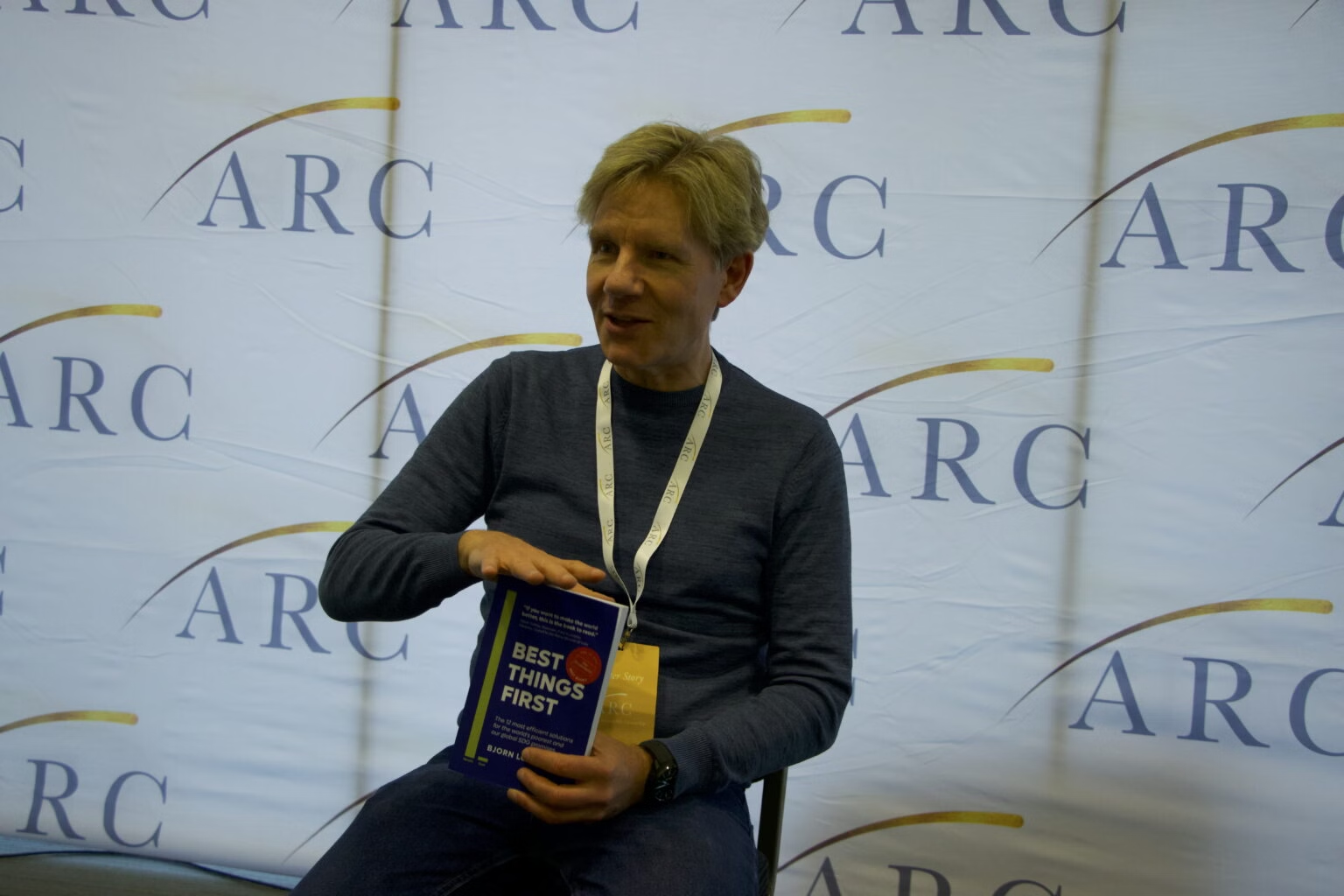
Bjorn Lomborg speaks about his most recent book during a press briefing at ARC. Credit: Marc Fawcett-Atkinson
Bjorn Lomborg
One particularly influential climate crisis denier is Bjorn Lomborg, a Danish political scientist who for decades has been trying to convince policymakers and the public that there are more important global challenges to address than climate change. This is the subject of his most recent book, Best Things First, which Lomborg was promoting at ARC. Last year, Peterson personally presented a copy of the book to Elon Musk.
“We’ll have to wait and see if he actually reads it,” Lomborg said of Musk in an interview with DeSmog and Canada’s National Observer at the conference.
Lomborg, who is an advisor to ARC, said during a keynote speech that efforts to transition off fossil fuels are a “green fantasy.” Lomborg acknowledges that climate change is real but claims, contrary to decades of scientific and economic evidence, that it will be relatively easy and painless for humankind to adapt.
Those arguments have resonated with Wright, who during a 2020 podcast referred to Lomborg’s previous book False Alarm as “fantastic,” and earlier this year described him as a “friend” on LinkedIn.
Asked what he thinks about Trump’s pick for energy secretary, Lomborg replied: “Look, Chris Wright is a great guy and he’s very smart. And I’m very happy that we can get a more sense-based approach to how we do energy.”
Part of that, according to Lomborg, is acknowledging — despite low-carbon investment surpassing $2 trillion in 2024 — that a transformative global shift to green energy isn’t happening anytime soon. “We’re not there yet,” he said. “And that, I think, is what Chris Wright can help us to do, which is to say, ‘let’s be realistic now and let’s find smarter ways to have greener energy sources in the future.’”
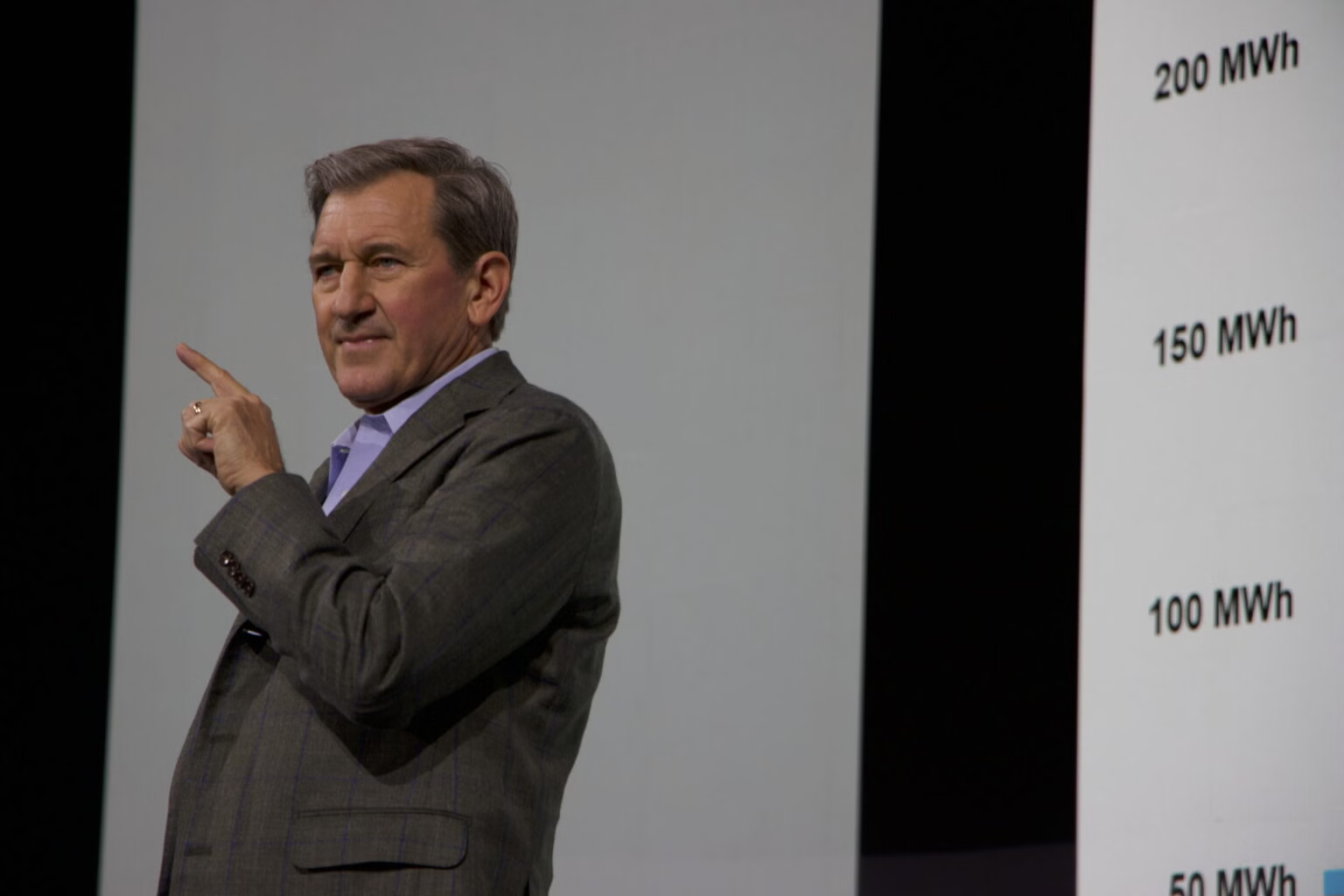
Scott Tinker does a speech at ARC. Credit: Marc Fawcett-Atkinson
Scott Tinker
During his 13-minute presentation at ARC, Scott Tinker outlined his view that energy has to be affordable, reliable, and clean, criteria that in his view disadvantages renewable energy. “If you want 100 percent clean you don’t get much of these other things,” he told the conference. “There are trade-offs in the real world.”
Tinker runs an organization called Switch Energy Alliance that creates videos about energy and climate change for classrooms, museums, and professional training sessions. The organization says that it wants an “energy-educated future that is objective, nonpartisan, and sensible.”
But Tinker tends to promote the benefits of fossil fuels while downplaying the urgency of addressing global temperature rise. During a podcast interview in March, Tinker said it was “a very strange form of economic colonialism” to argue against developing world countries burning fossil fuels “because we’ll wreck the climate.” We shouldn’t fear a bit of atmospheric warming, Tinker added, urging listeners to instead consider “all the positive things” countries gain from oil, gas, and coal.
Wright has used similar language, telling a gathering of African leaders in March that it would be “a paternalistic post-colonial attitude” for the U.S. to stand in the way of their fossil fuel resources.
The similarities between Wright’s and Tinker’s views aren’t a coincidence. Tinker told DeSmog in an interview at ARC that he and the U.S. energy secretary have known each other for years. “Chris is a good friend,” Tinker said. “We’ve bounced a lot back and forth.”
One other area they seem to agree on is rejecting carbon dioxide’s legal status as a pollutant in the U.S., which helps provide the basis for the Environmental Protection Agency to regulate emissions. That’s been a long-time goal of climate denial organizations such as the CO2 Coalition and Heartland Institute.
“We shouldn’t confuse [CO2] with being a pollutant,” Tinker said.
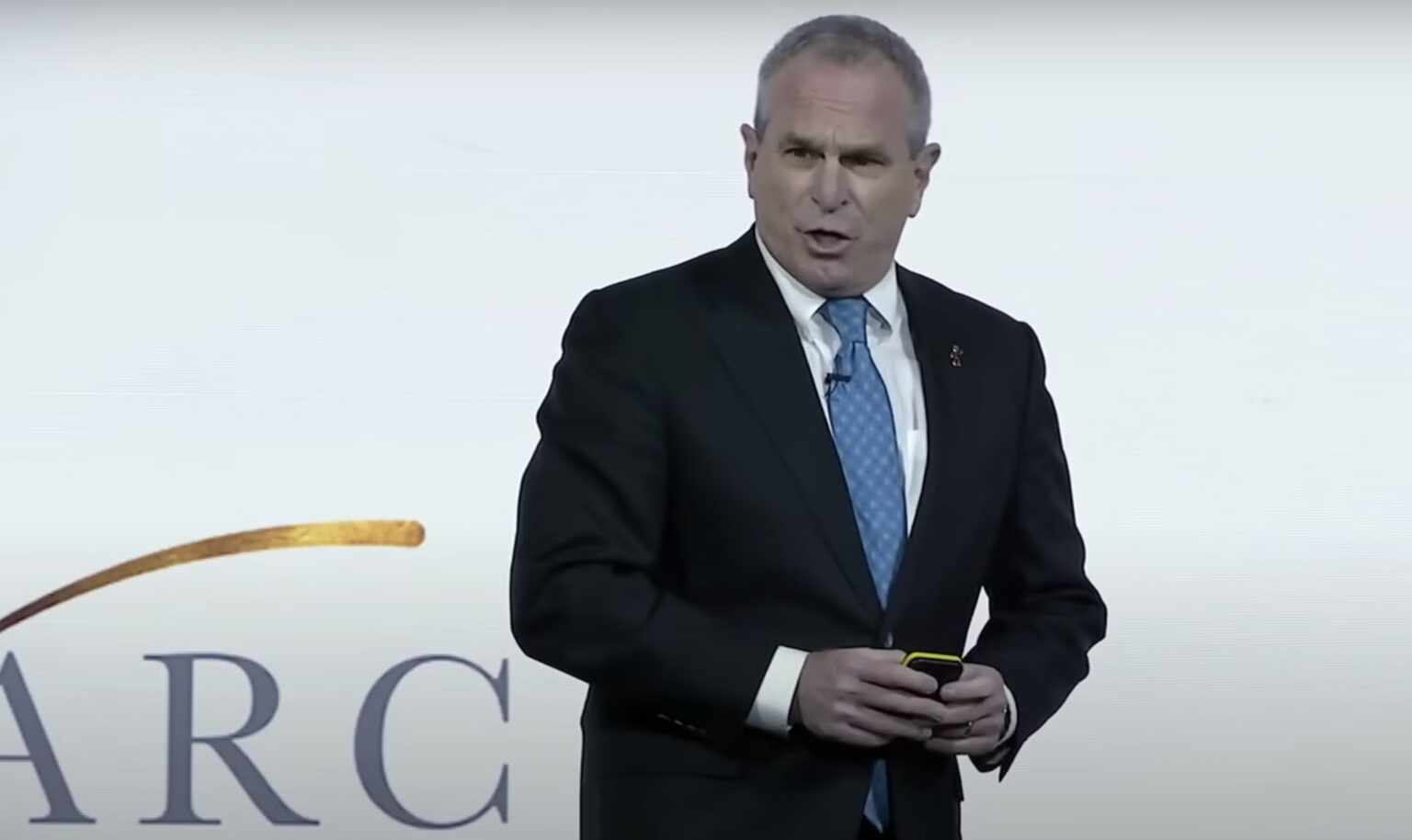
Robert Bryce speaks at ARC. Credit: ARC / YouTube
Robert Bryce
For years Robert Bryce has been on a mission to convince the world that renewable energy can never replace or out-compete coal, gas, and oil. Previously a senior fellow with the Manhattan Institute— a think tank with a long history of accepting fossil fuel money and questioning the scientific consensus on climate change — Bryce now attacks climate solutions as an author, speaker, and filmmaker.
During his speech at ARC, he claimed that “we are inundated with climate catastrophism,” and argued without evidence that the primary motivation for environmentalists to be opposed to fossil fuels is because their organizations have “enormous” budgets, saying “it’s a big business.”
Bryce is a long-time proponent of nuclear energy, something he shares in common with Wright, who stepped down as a member of the board of directors at the nuclear company Oklo after he was confirmed as energy secretary in February.
“Chris gets it,” Bryce said in an interview with DeSmog. “Chris knows what the score is. He’s a natural gas guy, a hydrocarbon guy. He’s promoting nuclear power. Hopefully this administration, now that they’re actually talking about nuclear, can actually move the ball forward, it’s overdue.”
Bryce and Wright also seem to share opposition to carbon capture and storage, a technology widely favored by oil and gas producers, which tout it as key to reducing emissions from their operations despite it being widely used to pull more oil from the ground. Under Wright, the U.S. Department of Energy is considering cutting billions of dollars’ worth of funding for projects utilizing the technology.
“There is only one reason why any of these hydrocarbon companies are doing carbon capture,” Bryce said. “Subsidies, that’s it.”
“It will never work at scale,” he added. “Once you get that CO2 super-compressed and you’re pushing it down underground, there are very few places where you can actually sequester it. So it’s a lot of money wasted.”
This special investigation between Canada’s National Observer and DeSmog was produced in collaboration with the I-SEA and TRACE Foundation.
Neo-Fascist Climate Science Denier Donald Trump says Burn, Baby, Burn.Elon Musk urges you to be a Fascist like him, says that you can ignore facts and reality then.
The BBC has stopped Evan Davis, one of its senior presenters, from hosting a personal podcast informing the public about heat pumps, a flagship clean heating solution.
Speaking on the final episode of the show, launched in January, Davis said that the BBC had become “concerned” that the podcast was “somehow treading on areas of public controversy”.
He added: “I take their shilling; they dictate the rules. They know they have to try and keep their presenters out of areas of public controversy and they have decided heat pumps can be controversial so they’ve asked me not to be involved.”
Heat pumps, powered by electricity, are currently set to play a key role in decarbonising heating and replacing gas boilers, which heat around 85 percent of Britain’s homes and account for 15 percent of greenhouse gas emissions nationwide. The government has set a target of 600,000 heat pump installations every year by 2028, up from just 55,000 in 2022.
The Happy Heat Pump podcast co-hosted by Davis attempted to educate listeners about how to use a heat pump, how much they cost, and which properties are best suited to a heat pump.
Heat pumps can be more expensive to install than alternatives, though experts have blamed the government for not matching the incentives offered by its European counterparts. Heat pump uptake in the UK is among the lowest in Europe, with more than 500,000 heat pumps sold in France last year, and more than 400,000 in both Italy and Germany.
However, gas industry lobbyists and sections of the right-wing media have attempted to stoke a “culture war” around the uptake of heat pumps in the UK. DeSmog revealed in July 2023 that a barrage of negative press about heat pumps had been funded by a gas lobby group.
Davis’s podcast co-host, Bean Beanland, criticised the BBC’s decision. Beanland, the director for growth and external affairs for the Heat Pump Federation, said the corporation’s judgement was “extraordinary”.
“It does seem to me that somehow the technologies we espouse have fallen victim to some sort of culture war,” he added.
Davis said that he believes the BBC’s decision was “more about net zero than this particular form of heating”. The legally-binding target of reaching net zero emissions by 2050 has also been weaponised by campaigners and conservative media outlets, despite a broad public consensus for reducing emissions and building new green infrastructure.
“Cars are controversial, they kill and maim thousands every year, but that hasn’t stopped the BBC glamorising car use in its decades broadcasting hundreds of episodes of Top Gear,” said Andrew Simms, co-director of the New Weather Institute.
“Heat pumps, on the other hand, don’t kill or maim, they just cheaply and safely warm homes. It’s been estimated that swapping all 23 million gas boilers in the UK to heat pumps could save roughly £11 billion in wholesale gas costs.
“The technology is already hugely successful in some of the coldest countries in Europe. In those with the longest, harshest winters like Norway, Finland and Sweden, heat pumps dominate. Already by 2022 around 41 percent of Finnish households had a heat pump installed, with two-thirds in Norway and nearly half in Sweden. Try telling them that their heating systems are controversial.”
A number of commentators have expressed their dismay on social media at the BBC’s decision. Financial Times associate editor Stephen Bush accused the BBC of “muzzling one of its best presenters from making an excellent, wholly factual programme”. Bush added that the broadcaster was an “organisation badly in need of new leadership.”
A BBC spokesperson told DeSmog: “The BBC editorial guidelines are clear that anyone working for the BBC who does an external public speaking or writing engagement should not compromise the impartiality or integrity of the BBC or its content, or suggest that any part of the BBC endorses a third-party organisation, product, service or campaign.”
As previously revealed by DeSmog, the BBC’s commercial content arm, BBC StoryWorks, has been paid to promote oil and gas companies, agricultural giants, fossil fuel states, and high-emission transport firms.
Experts have also highlighted that Davis’s podcast was simply reflecting basic facts about heat pumps.
Energy policy expert Jan Rosenow said: “Heat pumps are a mature technology that has been around for more than 100 years. All authoritative analyses indicate that we need to deploy millions of them to reach net zero. Public controversy stems from poor reporting – Evan tried to change that.”
These sentiments were reflected by fellow climate expert Andrew Sissons, who said: “I’ve said this before but… heat pumps are really quite boring, and it says quite a lot about the state of debate in Britain that we’ve managed to make them controversial. Credit to Evan for trying to make them not controversial.”