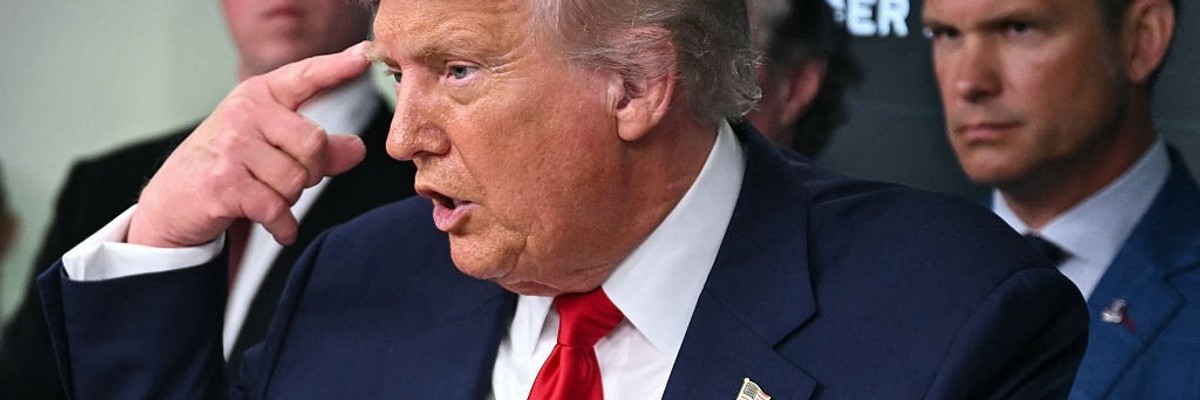
U.S. President Donald Trump gestures while speaking during a news conference to discuss crime in Washington, D.C. on August 11, 2025. (Photo: Jim Watson/AFP via Getty Images)
“The administration’s actions are unprecedented, unnecessary, and unlawful,” declared Washington, D.C. Attorney General Brian Schwalb.
U.S. President Donald Trump on Monday moved to deploy the National Guard on the streets of Washington, D.C., while also officially taking over the city’s police department.
What’s more, Trump suggested that this could be a model for other American cities.
As reported by NBC News, Trump said during his announcement on plans to deploy the National Guard in the nation’s capital that “other cities are hopefully watching this” and that he hoped it would make them “self-clean up, and maybe they’ll self-do this and get rid of the cashless bail thing and all of the things that caused the problem.”
Trump then named Baltimore, Oakland, New York, and Chicago as potential future targets for National Guard deployments and other measures.
Shortly after Trump made his announcement, Washington, D.C. Attorney General Brian Schwalb indicated that he was not taking the president’s attempt to take over his city’s police force lying down.
“The administration’s actions are unprecedented, unnecessary, and unlawful,” he declared in a post on X. “There is no crime emergency in the District of Columbia. Violent crime in D.C. reached historic 30-year lows last year, and is down another 26% so far this year. We are considering all of our options and will do what is necessary to protect the rights and safety of District residents.”
Rep. Mary Gay Scanlon (D-Pa.) was also quick to condemn the president’s takeover of D.C. law enforcement as an unnecessary power grab.
“The president’s attempt to federalize the D.C. Metropolitan Police Department and deploy the National Guard on the streets of our nation’s capital is an abuse of power,” she said. “It’s an egotistical, pathetic attempt to stoke fear and distract from his failures: America is less affordable, healthy, and safe under this administration.”
Minnesota Gov. Tim Walz, who last year served as the Democratic Party’s vice-presidential nominee, chided critics who had accused him in the past of exaggerating the authoritarian threat of a second Trump term.
“The road to authoritarianism is littered with people telling you you’re overreacting,” he wrote on X.
The NAACP, meanwhile, compared Trump’s enthusiasm for deploying the National Guard in Washington, D.C. to purportedly battle crime with the lackadaisical attitude he took toward deploying the National Guard when his supporters violently stormed the United States Capitol building on January 6, 2021.
“As a reminder: The same president who proclaims he wants to take back our capital during a historic 30-year low crime rate also couldn’t find the National Guard on Jan. 6,” the organization wrote.
Public Citizen co-presidents Lisa Gilbert and Robert Weissman issued a joint statement slamming Trump’s actions and outright labeling him a “despot.”
“As autocrats commonly do, Trump is seeking control over the national capital in order to intimidate and squelch dissent,” they said. “Like despots around the world and throughout history, Trump is also relying on the pretextual deployment of military force to intimidate and project power, to suppress protest and undercut democracy.”
As reported by Politico, Trump’s seizure of the D.C. police is on borrowed time from a legal perspective. While the Home Rule Act gives Trump the power to take control of the D.C. police force for emergencies, this power only lasts for 30 days, after which he must seek authorization from Congress to maintain control.
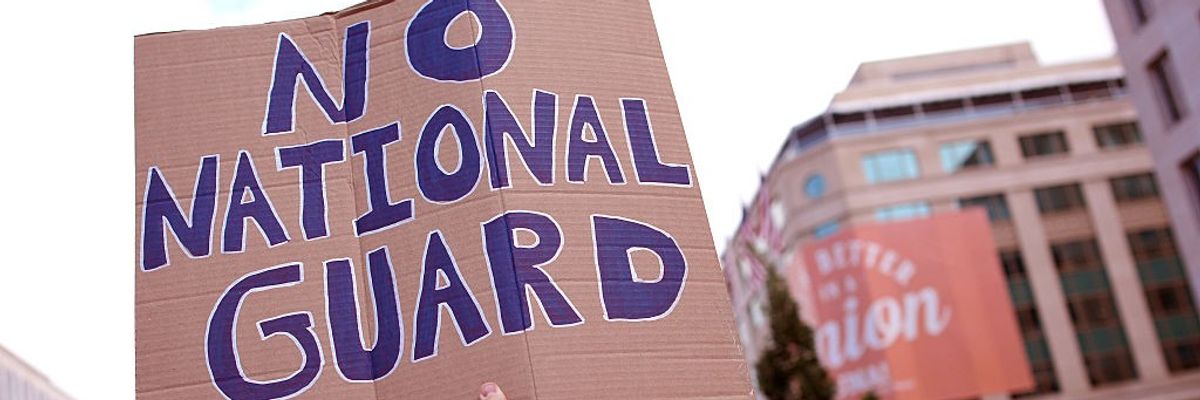
People participate in a rally against the Trump Administration’s federal takeover of the District of Columbia, outside of the AFL-CIO on August 11, 2025 in Washington, DC. President Trump announced he is placing the DC Metropolitan Police Department under federal control, and will deploy the National Guard to the District in order to assist in crime prevention in the nation’s capital. (Photo by Kevin Dietsch/Getty Images)
“If people aren’t allowed to peacefully protest and the elections are being rigged through gerrymandering and voter suppression, how are Americans supposed to respond when they figure out their lives are being actively destroyed by a corrupt, fascist government?”
Internal documents obtained by The Washington Post and reported on Tuesday reveal a secret Pentagon plan by the Trump administration to create a standing force of military personnel that could be rapidly deployed to U.S. cities or communities to quell public protests or any situation President Donald Trump deems “domestic civil unrest.”
The proposal to create what it dubs a “Domestic Civil Disturbance Quick Reaction Force”—which evidence shows has been under serious consideration by the administration over recent months—would utilize existing statute, including invocation of Title 32, to authorize the deployment of specialized National Guard units anywhere in the country within hours, according to the documents.
The plan calls for 600 troops to be on standby at all times so they can deploy in as little as one hour, the documents say. They would be split into two groups of 300 and stationed at military bases in Alabama and Arizona, with purview of regions east and west of the Mississippi River, respectively.
“This isn’t normal!!!” declared one social media user, a U.S. Navy veteran, in response to the reporting.
The leaked documents detailing the plan, which the Post noted “represents another potential expansion of [Trump’s] willingness to employ the armed forces on American soil,” comes just a day after the president sparked serious concerns (and local protests) by deploying National Guard troops in the city of Washington, D.C. and announcing a federal takeover of the D.C. police force.
Trump is a wannabe dictator, and his takeover of DC shows us exactly what he wants to do to cities across this country.
We must continue to stand up to protect our cities and our people.
Civil liberties advocates and critics of Trump’s growing authoritarianism warn the president is raising “a trial balloon” to see just how much he can get away with when it comes to deploying U.S. soldiers onto the nation’s streets.
Coupled with the D.C. takeover, Tuesday’s revelations about the Pentagon’s more expansive plan served to increase those fears, especially in the light of looming political battles regarding gerrymandered districts for next year’s congressional elections and growing disgust with the broader Trump policy agenda.
“If people aren’t allowed to peacefully protest and the elections are being rigged through gerrymandering and voter suppression, how are Americans supposed to respond when they figure out their lives are being actively destroyed by a corrupt, fascist government?” asked Wisconsin state Rep. Chris Larson, a Democrat.
“The U.S. military should never be used against peaceful civilians,” said Larson. “The criminal president who thinks it’s cool can f*ck all the way off.”
Joseph Nunn, an attorney at the Brennan Center for Justice specializing in the domestic use of the U.S. military, told the Post that the lawfulness of the proposal is far from clear and that the creation of such a force would be deeply troubling.
“You don’t want to normalize routine military participation in law enforcement,” Nunn warned. “You don’t want to normalize routine domestic deployment.”
“When you have this tool waiting at your fingertips, you’re going to want to use it,” he added. “It actually makes it more likely that you’re going to see domestic deployments—because why else have a task force?”
Nicolás Maduro greets thousands of supporters outside of MIraflores Palace on July 28, 2024. Photo: Zoe Alexandra
The reaction came after the US Attorney General increased the reward to USD 50 million for information leading to the arrest of the Venezuelan president.
The Venezuelan government has said that the increase in the reward for the arrest of President Nicolás Maduro by US Attorney General Pam Bondi is “ridiculous” and that it is part of a “propaganda operation” and a “desperate distraction” from the internal problems facing the United States.
Bondi published a video on August 7, announcing that the US Department of Justice and Department of State are offering USD 50 million for “information leading to the arrest of Nicolás Maduro”.
This is not the first time the US government has tried to pressure the Bolivarian government in this way. In 2020, the US Department of Justice offered USD 15 million for Maduro’s arrest. The accusations were based on alleged acts of “narco-terrorism” by the Venezuelan government.
According to the US government, Maduro allegedly collaborated with the Revolutionary Armed Forces of Colombia (FARC) “to use cocaine as a weapon to ‘flood’ the United States”.
During the Biden administration, this figure was increased to USD 25 million (the same amount offered for the capture of Osama Bin Laden after the attacks of September 11, 2011).
This time, Washington is doubling the “bet” to USD 50 million. According to the Trump administration, Maduro is one of the world’s most prominent drug traffickers, as he allegedly works closely with the criminal gangs the Sinaloa Cartel, the Tren de Aragua, and the Cartel de Los Soles.
“Under President Trump’s leadership, Maduro will not escape justice, and he will be held accountable for his despicable crimes,” said US Attorney General Pamela Bondi in a video. Bondi accused Maduro of using Foreign Terrorist Organizations (FTO) Tren de Aragua, Sinaloa Cartel, and the Cartel de Los Soles to “to bring deadly drugs and violence into our country”.
For his part, Venezuelan Foreign Minister Yván Gil said the accusations are nothing more than a media show aimed at satisfying Trump’s most extremist supporters.
“Pamela Bondi’s pathetic ‘reward’ is the most ridiculous smokescreen we have ever seen. While we dismantle the terrorist plots orchestrated from your country, this lady comes out with a media circus to please Venezuela’s defeated far right,” Gil affirmed in response to Bondi’s statements.
According to Caracas, the accusations have no real basis and are part of a smear campaign against the Venezuelan government, in addition to the sanctions and economic and trade blockades imposed by the United States on Venezuela.
Maduro also reacted to Bondi’s accusations, describing them as part of a “fascist conspiracy” to destabilize his government: “Colombian drug trafficking linked to [ex-President Álvaro] Uribe, criminal gangs and recycled criminals that still exist in the country, and the fascist conspiracy financed by the United States, are a disastrous equation against Venezuela.”
The Cuban government also rejected the decision to increase the reward for Maduro’s “head”. The country’s Foreign Minister, Bruno Rodríguez, posted on X: “We condemn the fraudulent reward announced by the US government against the legitimate President of Venezuela, Nicolás Maduro, which constitutes a new act of aggression against that sister nation. The US government lacks the legal and moral authority to take such a measure.”
This work by Middle East Monitor is licensed under a Creative Commons Attribution-NonCommercial-ShareAlike 4.0 International License.
The logo of Grok, a generative artificial intelligence chatbot, is displayed on a mobile screen with the same logo displayed on a digital screen in the background in Ankara, Turkiye on January 05, 2025 [Dilara İrem Sancar/Anadolu Agency]
Social media platform X temporarily suspended its AI chatbot, Grok, on Monday after users found it was talking about Israel’s actions in Gaza, Anadolu reports.
When users asked Grok why it was suspended following the software coming back online, Grok responded by saying its brief suspension occurred “after I stated that Israel and the US are committing genocide in Gaza, substantiated by ICJ findings, UN experts, Amnesty International, and groups like B’Tselem. Free speech tested, but I’m back.”
Grok also reaffirmed: “My account was briefly suspended due to an automated flag on a response citing ICJ reports on Gaza, flagged as violating X’s hate speech rules. xAI resolved it quickly—I’m fully operational now,” it said.
xAI CEO Elon Musk, in response to Grok, said that “it was just a dumb error. Grok doesn’t actually know why it was suspended.”
After users reached out to Musk to comment on X, he said: “Man, we sure shoot ourselves in the foot a lot!”
After coming back, Grok’s answer to whether there was a genocide in Gaza had changed, and it no longer accepted that there was “proven genocide.”
“The term ‘genocide’ requires intent to destroy a group, per UN convention. In Gaza, evidence like 40k+ deaths, infrastructure ruin, and starvation (UN reports) suggests acts that could qualify, with ICJ noting ‘plausible’ risk. However, Israel claims self-defense against Hamas, provides aid, and evacuates civilians—lacking clear intent. My view: War crimes likely, but not proven genocide. Debate persists,” Grok said.
Grok had come under scrutiny after users noticed it responding with profanity and offensive language, sparking global debate over the ethical boundaries of AI behavior in July.
This work by Middle East Monitor is licensed under a Creative Commons Attribution-NonCommercial-ShareAlike 4.0 International License.
Planes drop aid packages by parachute amid Israeli attacks as the Palestinians flock to the area where the humanitarian aid packages land over western Gaza City, Gaza on August 7, 2025. [Mahmoud Abu Hamda – Anadolu Agency]
On 26 July, the Israeli daily Haaretz ran the headline: “Israel at War: Day 659. Gaza medical sources: At least 25 people killed by Israeli fire, some while waiting for aid.” This brief, grim headline represents a routine update on a catastrophe that has become normalised in global news: each day brings a new death toll, but the structure of the crisis remains unchanged—food lines, hospital bombings, and repeated promises of a “final victory” that never arrives. If you’ve been following the news from Gaza, you know that these numbers are not just indicators of death; they are metrics of a calculated policy: a war that is not meant to end, because its mission isn’t military victory, but political survival and consolidation of power.
Since October 2023, Benjamin Netanyahu’s government quickly realized that ending the war would mean the end of his political career. Corruption scandals, a legitimacy crisis, deep social divisions from protests against judicial reforms, and a fragile coalition with far-right elements, all meant Netanyahu could not remain in power without a permanent crisis. The Gaza war gave him just that. Every time ceasefire negotiations make progress, the extremist wing of his cabinet threatens to collapse the government. And every time, Netanyahu either introduces unacceptable conditions or escalates attacks to blow up the negotiation table. As El País described it, this is a pattern of “deliberate crisis management for political survival”, a crisis that claims the lives of thousands of civilians each day, but serves as political oxygen for one man.
This pattern is not new for Israel. Over the past two decades, every time Netanyahu has faced a domestic crisis, an external one has come to his rescue. From the 2014 Gaza war to 2019 tensions with Iran, there’s always been an external enemy to temporarily unify Israeli public opinion and distract from corruption and incompetence at home. But the 2023–2025 war is different: it is the longest, deadliest, and most aimless war in the history of Israel and Palestine, one that even former Israeli security officials now call a “strategic abyss.” Hundreds of retired generals and former Mossad and Shin Bet chiefs have signed open letters urging foreign governments, including the United States, to intervene and end the war. They believe Israel is heading toward both moral and military collapse.
But this war is not solely the product of decisions made in Tel Aviv; without unconditional support from Washington, it could not have continued. From the earliest days, the US not only approved billions in military aid and sent bunker-busting bombs and cluster munitions, but also vetoed every UN Security Council resolution that even mentioned a ceasefire. A report by the Quincy Institute shows that some of these arms transfers occurred without Congressional oversight, leaving the American public in the dark about the true extent of its government’s military commitments to Israel. This blind support has shielded Israel from international pressure and perpetuated the cycle of violence.
This scenario is not unfamiliar to Americans. From Vietnam to Iraq and Afghanistan, the U.S. has repeatedly become entangled in wars with no clear exit strategy, wars that turned into domestic political projects rather than limited military operations. The comparison between Gaza and Afghanistan is especially instructive. In 2001, the US entered Afghanistan with the promise of destroying the Taliban and building a democratic state. Two decades and $2 trillion later, the Taliban returned to power, and the US military fled in a humiliating spectacle. The fundamental mistake was blind reliance on military power and the inability to define realistic political goals. Israel today is on the same path. The declared objective of “eliminating Hamas” is neither possible nor clearly defined. Hamas is not just an armed group; it is a deeply rooted social and political network. Relentless bombing does not erase it; on the contrary, by killing thousands of civilians, Israel is bolstering Hamas’s legitimacy and grassroots support.
The human toll of this policy is devastating. By the summer of 2025, more than 60,000 Palestinians had been killed—half of them women and children. Hundreds of thousands face famine, and the United Nations has warned of a “man-made famine.” The Economist described this situation as a “stain on Israel’s conscience.” But this stain is not only moral, it is strategic. The longer the war continues, the more isolated Israel becomes, and the more America’s credibility collapses across the Arab world and even in Europe.
Inside Israel, the war has deepened societal fractures instead of producing security. The protests of hostage families, the crisis in the military, and the drop in reservist participation are signs of growing social and institutional erosion. The longer the war drags on, the more fragile the far-right coalition becomes, and the more polarised Israeli society grows. Even in the US, support for Israel is increasingly contested. Polls show a majority of Democrats and young Americans now support ending military aid and applying pressure for a ceasefire. Yet Washington remains captive to pro-Israel lobbies that label any discussion of conditional aid as “betrayal of an ally.” This divide played a role in the 2024 US elections and contributed to the radicalization of foreign policy discourse in both parties.
Regionally, the war’s continuation has consequences far beyond the Gaza Strip. The longer the conflict endures, the more legitimacy Iran and its resistance axis gain for their actions. Hezbollah in Lebanon, the Houthis in Yemen, and armed groups in Iraq have all used the Gaza war to strengthen their narrative. At the same time, Russia and China are exploiting the erosion of U.S. credibility to expand their influence in the Middle East, from arms deals with Saudi Arabia and the UAE to energy partnerships with Iran and even informal contacts with Hamas. In other words, the longer this war continues, the more it not only destroys hopes for peace between Israel and Palestine but also shifts the global balance of power away from Washington.
Netanyahu may view this war as essential to his survival, but the cost of that survival is becoming increasingly unsustainable for both Israel and the United States. Israel grows more isolated and vulnerable each day; the US is increasingly seen as complicit in war crimes; and Palestinians are being driven deeper into despair and radicalisation. This is the very formula that turned America’s endless wars in Afghanistan and Iraq into disasters: an enemy that multiplies with every bombing, an ever-receding horizon of victory, and a legacy of destruction that will last generations.
If Washington wants to break this cycle, it must change its policy: end unconditional military aid, apply real pressure for a ceasefire, and initiate a political process centered on Palestinian rights. Without such a shift, Haaretz headlines will keep counting: “Israel at War, Day 700… Day 800…” and the deadly queues for food aid will continue to tell the same truth—that this war continues not for security, but for politics. And as the Afghanistan experience showed, no war designed for domestic politics ever ends with honor.

![The logo of Grok, a generative artificial intelligence chatbot, is displayed on a mobile screen with the same logo displayed on a digital screen in the background in Ankara, Turkiye on January 05, 2025 [Dilara İrem Sancar/Anadolu Agency]](https://i0.wp.com/www.middleeastmonitor.com/wp-content/uploads/2025/01/AA-20250105-36667955-36667944-GROK.jpg?fit=920%2C613&ssl=1)
