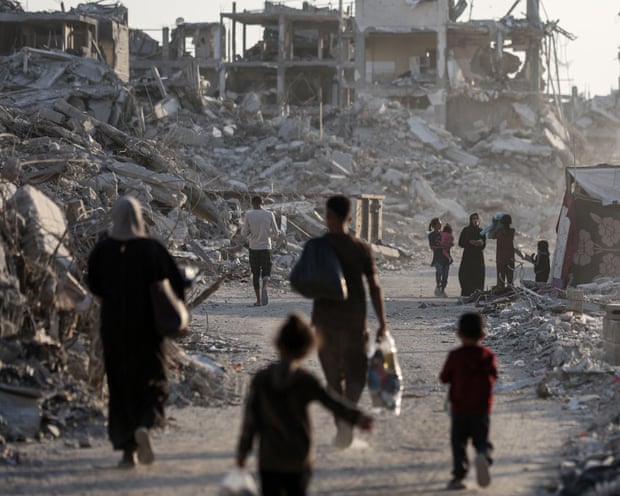
Palestinians returning to the Zeitoun area of Gaza City, where 11 people were killed on Friday. Photograph: APAImages/Shutterstock
Authorities urge UN to intervene ‘to protect unarmed civilian populations’ after attack on bus that killed 11
Gaza’s media office has accused Israel of violating the ceasefire with Hamas 47 times since the truce came into effect in early October, killing 38 Palestinians and wounding another 143.
“These violations have included crimes of direct gunfire against civilians, deliberate shelling and targeting, and the arrest of a number of civilians, reflecting the occupation’s continued policy of aggression despite the declared end of the war,” reads the statement.
Authorities in Gaza called on “the United Nations and the guarantor parties of the agreement to intervene urgently to compel the occupation to end its ongoing aggression and to protect unarmed civilian populations”.
Benjamin Netanyahu meanwhile said the Rafah crossing – a crucial entry point for aid – would only reopen after Hamas hands over the bodies of all deceased hostages still held in Gaza.
Genocide denier and Current UK Prime Minister Keir Starmer is quoted that he supports Zionism without qualification. He also confirms that UK air force support has been essential in Israel’s mass-murdering genocide. Includes URLs https://www.declassifieduk.org/keir-starmers-100-spy-flights-over-gaza-in-support-of-israel/ and https://youtu.be/O74hZCKKdpAKeir Starmer objects to criticism of the IDF. He asks how could anyone object to them starving people to death, forced marches like the Nazis did, bombing Gaza’s hospitals and universities, mass-murdering journalists, healthworkers and starving people queuing for food, killing and raping prisoners and murdering children. He calls for people to stop obstructing his genocide for Israel.Orcas discuss Genocide-supporting and complicit Zionists. Donald Trump, Keith Starmer, David Lammy, Rachel Reeves, Angela Rayner and Wes Streeting are acknowledged as evil genocide-complicit and supporting cnuts.
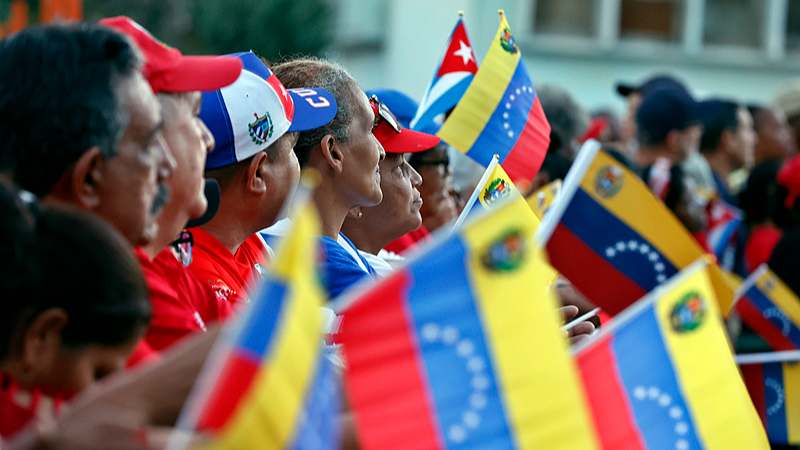
People hold up Cuban and Venezuelan national flags during a rally in support of Venezuela, in Havana, Cuba, October 17, 2025. Photo: CGTN
The demonstration rejected US interference in Venezuela’s internal affairs as US military operations in the Caribbean Sea increase.
On October 17, tens of thousands of Cubans took to the streets of Havana to show their support for Venezuela in the face of a potential intervention by the United States following its recent military deployment in the Caribbean Sea.
Under anti-imperialist and pro-sovereignty slogans, nearly 50,000 participants gathered in front of the statue of Simón Bolívar, the Venezuelan military leader and independence politician. The event was led by the country’s president, Miguel Díaz-Canel.
The event was also attended by Pedro Infante Aparicio, vice president of the United Socialist Party of Venezuela and the National Assembly, who told those present that both Cuba and Venezuela are victims of the supremacism and warmongering of the White House. He added: “From this platform, we join President Nicolás Maduro in calling for an end to the xenophobic attempts to compare the dignity of Venezuelans with criminal groups, and we demand an end to the policy of terrorism against our people.”
For his part, Díaz-Canel wrote on X: “At a time when the empire and its misguided leader are approving covert CIA operations against Venezuela, we express our solidarity with that brotherly people and, especially, with its President Nicolás Maduro. Today, Cuba is more mindful than ever of the words of [José] Martí: ‘Give me Venezuela to serve, she has in me a son,’ and of Fidel [Castro]: ‘For Venezuela, we must give everything. We are confident that Venezuela and its popular, military, and police forces will once again overcome the threats and actions of the empire.”
In addition, Díaz-Canel presented a book containing more than 4 million signatures from Cubans who support the Bolivarian Revolution and condemn attempts to destabilize the government of Nicolás Maduro.
For its part, the official newspaper of the Communist Party of Cuba, Granma, wrote in an editorial: “Because the sister nation of Venezuela is not alone and because its resistance symbolizes the history of all peoples who believe in sovereignty, more than 50,000 Havana residents, representing all Cubans, gathered today in front of the statue of liberator Simón Bolívar in solidarity with that country.
Military pressure against Venezuela intensifies
Several weeks ago, the United States deployed a large number of ships and troops to the Caribbean Sea to supposedly stop drugs from entering the United States. In addition, Washington declared the Cartel of the Suns an international terrorist organization and claimed that Maduro and other senior Chavista leaders were running the cartel.
The United States is offering a USD 50 million reward for information leading to Maduro’s arrest and conviction. These accusations have been categorically denied by Venezuelan authorities, who see them as an attempt to legitimize a possible armed invasion of the South American country.
Under this premise, which many have questioned, Washington has claimed that it has sunk five small boats allegedly carrying drugs, killing 27 people on board. This type of pressure is in addition to the economic sanctions and trade blockades imposed by Washington for several years.
In addition, it was revealed a few days ago that Donald Trump had authorized secret CIA operations in Venezuela, according to the New York Times. Among the covert operations are lethal actions carried out in coordination with or independent of the US military.
Donald Fuhrump says that Amerikkka doesn’t bother with crimes or charges anymore, not being 100% Amerikkkan and opposing his real estate intentions is enough.Orcas discuss how Trump was re-elected and him being an obviously insane, xenophobic Fascist.
This article by republished from peoples dispatch under a Creative Commons Attribution-ShareAlike 4.0 (CC BY-SA) license.
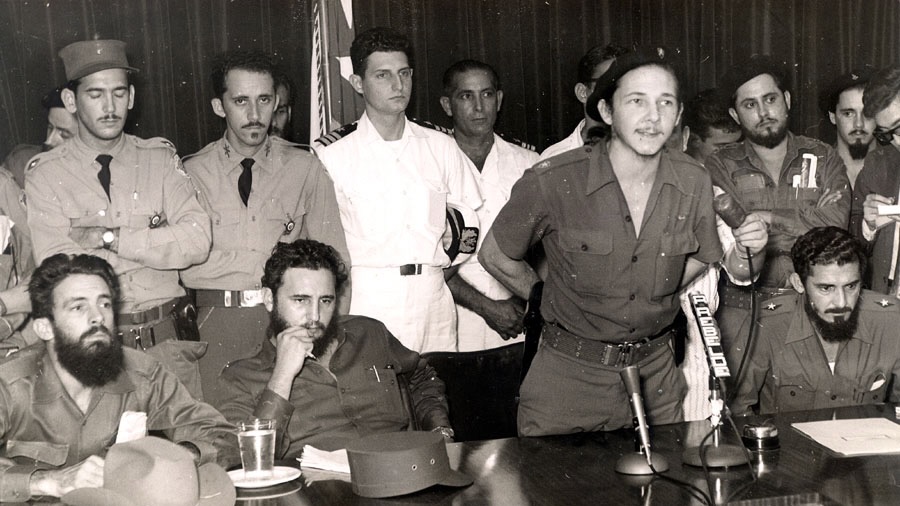
On February 16, 1959, Cuba established the Ministry of the Revolutionary Armed Forces, the executive body of their defense force, and its first Army General, Raúl Castro Ruz. Photo: Miguel Díaz-Canel/X
A recent webinar by Pan Africanism Today and the International Peoples’ Assembly looked at global struggles, from Africa to Latin America, showing how Cuba’s enduring resistance offers vital lessons in organization, unity, and internationalism for today’s movements fighting oppression and war.
The world is in an era marked by relentless wars and overlapping crises, from the devastating civil war in Sudan and violence in the Democratic Republic of Congo to the unfolding genocide in Palestine. The demand to end all wars has never carried greater urgency. And in the midst of all these visible battlegrounds persists a more enduring and insidious conflict; the hybrid war and economic blockade waged against the Cuban people and their revolution.
This was the central focus of a recent global webinar convened under the banner of Pan-African and internationalist solidarity, bringing together progressive voices to draw lessons from Cuba’s anti-imperialist struggle. The session, held on October 15, was facilitated by Mbali Gwenda from Pan Africanism Today, who situated the discussion within a broader historical and moral framework, invoking the revolutionary spirits of Thomas Sankara, martyred on the same date in 1987, and Assata Shakur who recently passed, and whose life consistently symbolized uncompromising resistance to oppression.
“We are dealing with the question of the hybrid war and blockade against the Cuban Revolution and her people,” Gwenda said. “A revolution that has been a source of inspiration for all oppressed peoples throughout the world till this day.”
The keynote address was delivered by Manolo De Los Santos, executive director of The People’s Forum and a researcher at the Tricontinental: Institute for Social Research, who framed Cuba’s defiance not as a miracle, but as the outcome of a centuries-long process of people’s struggle, organization, and consciousness.
The long arc of revolution
De Los Santos began by looking at Cuba’s revolution more than an event confined to the years 1953–1959, when Fidel Castro, Che Guevara, and others led the guerrilla war against the Batista dictatorship. Revolutions, he reminded the audience, are not events but processes, collective journeys of resistance that unfold across generations.
Cuba’s revolution, he argued, has roots reaching back to centuries of anti-colonial and anti-slavery resistance, when the island was still a colony of the Spanish Empire. Unlike many independence movements in Latin America, Cuban revolutionaries understood that genuine freedom required addressing three interlinked questions:
Could Cuba truly be independent if it remained a slaveholding society?
Could it be free if it continued under the exploitative system of capitalism?
Could it claim sovereignty while dominated by imperial powers, first Spain and later the United States?
These questions shaped the consciousness of generations of Cuban patriots, culminating in the 1959 triumph of the socialist revolution. But as he explained, the revolution’s endurance has rested on three essential pillars: organization, unity, and internationalism.
Organization: the bedrock of resistance
Organization, De Los Santos emphasized, has been the Cuban people’s greatest weapon against imperial aggression. From the early independence wars to the 26th of July Movement led by Fidel Castro, Cubans have understood that only a disciplined, organized people can confront an empire with infinite resources.
This organizational spirit persisted after 1959, with the creation of mass democratic structures that unite workers, women, peasants, students, and youth. The Federation of Cuban Women, for example, mobilizes millions in defense of gender equality and revolutionary ideals, while student and peasant organizations remain vital spaces for political education and collective problem-solving.
Even under today’s extreme shortages such as the lack of fuel to power garbage collection, Cuban communities respond not with despair but with collective initiative, a reflection of their revolutionary organization and social consciousness.
Unity, he continued, has been the second indispensable lesson from Cuba. Every time the people were divided, the empire gained the upper hand; every time they stood together, they won. This unity has transcended class, race, and regional divisions, dismantling the legacies of slavery and racism that imperialism imposed.
The Cuban Revolution’s unity was forged not just through ideology but through practice, through collective participation in building a new society. It remains, as Manolo put it, “the most important defense the Cuban people have.”
Internationalism is the soul of the revolution
If organization is the body and unity the shield, then internationalism is the soul of the Cuban Revolution.
Quoting Fidel Castro, the New York-based researcher reminded participants that “a people who are not willing to fight for the freedom of others will never be able to fully fight for their own freedom.”
This principle drove Cuba to send tens of thousands of its sons and daughters to fight alongside liberation movements in Angola, Namibia, and South Africa, contributing directly to the defeat of apartheid. As he noted, “Cuba doesn’t need gold or minerals from Africa, it knows that its freedom is tied to the freedom of the peoples of the African continent.”
Even today, with over 24,000 Cuban doctors working abroad, many across Africa, Cuba continues this legacy of solidarity. The US, in its campaign of distortion, now accuses Cuba of “human trafficking” for this very act of humanitarianism.
The United States’ war against Cuba has been fought through unconventional means. It is a hybrid war, a combination of economic blockade, financial strangulation, media disinformation, and covert sabotage.
For more than 65 years, the blockade has inflicted immense human and economic damage. In 2024 alone, it cost Cuba USD 7.5 billion, money that could have been used to buy food, medicine, or oil for its 11 million citizens.
The war is also fought in the terrain of ideas. US-funded media campaigns spread false narratives about repression and poverty in Cuba while erasing the country’s achievements in health, education, and solidarity.
Socialism and survival
When asked on how Cuba has managed to survive more than six decades of blockade, Manolo’s answer was clear: because Cuba made a socialist revolution.
Socialism, he said, allowed Cuba to create a system where the needs of the people come before profit. In capitalist societies, when crises hit, the rich survive and the poor starve. In Cuba, food, healthcare, and education are distributed equitably, even in times of scarcity. This social organization transforms a siege economy into a community of resilience.
This difference, he explained, is what makes Cuba unique among nations facing US aggression. It’s also what inspires global movements seeking alternatives to neoliberalism and imperial domination.
Cuba, Sankara, and the spirit of resistance
The session also honored Thomas Sankara linking a symbolic bridge between the African and Latin American revolutionary traditions. Both embodied a commitment to self-reliance, dignity, and international solidarity.
Sankara’s vision of a self-determined Africa resonated deeply with the Cuban experience. His assassination on October 15, 1987 marked a turning point in African politics, yet his ideas continue to inspire movements across the continent, just as Cuba continues to stand as living proof that another world is possible.
In closing, Manolo issued a clear call; the Cuban people will overcome the blockade, but they cannot and should not do it alone. Their survival depends on the solidarity of all who believe in justice, sovereignty, and equality.
Cuba’s endurance is not simply a Cuban story; it is a lesson for all peoples resisting imperial domination. As the world faces renewed militarization and economic warfare, the spirit of organization, unity, and internationalism must also be crucial as ever.
“When they stand with the Palestinians, when they stand with the Congolese, when they stand with the peoples of the African continent,” Manolo concluded, “they are breaking the blockade too.”
This article by republished from peoples dispatch under a Creative Commons Attribution-ShareAlike 4.0 (CC BY-SA) license.