Zarah Sultana endorses Hannah Spencer, Green Party candidate at the Gorton & Denton by-election.

This blog also endorses Hannah Spencer, Green Party candidate at the Gorton & Denton by-election.
This blog also endorses Hannah Spencer, Green Party candidate at the Gorton & Denton by-election.
Original article by Mark Gruenberg republished from People’s World under http://creativecommons.org/licenses/by-nc-nd/3.0/us/
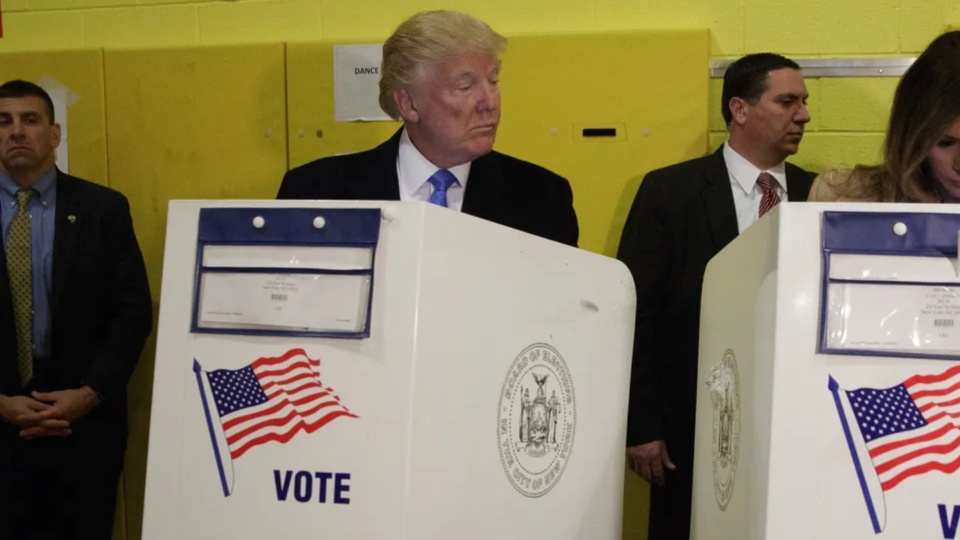
WASHINGTON—Donald Trump wants to take over the 2026 elections, though “steal” might be a better word.
No, the president isn’t planning to send another 1,600 invaders—Proud Boys and other assorted thugs—to rampage through the U.S. Capitol, as they did five years ago in an attempted coup. Nor is he asking secretaries of state to “find” ballots for him this time around.
Instead, he’s working to rig things to ensure certain votes either aren’t cast in the first place or don’t get counted even if they do make it to the ballot box.
Since his 2020 loss to Democratic presidential nominee Joe Biden, Trump has tried to stuff state and local elections boards with his sycophants. In some red states and red sections of “purple” states, he’s succeeded. But it’s not enough.
He’s once again talking about election “fraud” in majority-Black cities like Milwaukee, Philadelphia, Atlanta, and Detroit and using that as justification for what he calls the “nationalization” of elections.
Trump has a four-part plan to commandeer states’ election machinery and have the federal government run the voting and the counting. Thus, no matter who you vote for at the ballot box this fall, it’s his administration that will take the tally.
Though many Republicans are downplaying the likelihood of Trump pursuing the plan, it’s clear that he’s got some willing helpers on Capitol Hill, especially in the GOP-run U.S. House. Last year, lawmakers there pushed a massive voter restriction bill called the SAVE Act. They tried to insert it into the money bill Congress approved the first week of February and have signaled that they’ll try again.
There’s just one big thing wrong with Trump’s plan: It’s unconstitutional. But when did the U.S. Constitution, which Trump swore an oath to “preserve, protect and defend,” ever stop him?
Unconstitutional
Trump’s been quite open about what he wants to do and how he wants to do it. The federal government should “get involved” in running the voting, he says—everything from demanding voter registration rolls from every state to banning mail-in ballots.
All but a few states have already received such demands. Half (24) have refused, so Trump’s Justice Department is suing them. Voter rolls contain personal information, such as addresses, phone numbers, and Social Security numbers.
Besides, the Constitution is explicit: Article 1 Section 4 says the states shall run elections. “The Times, Places and Manner of holding Elections for Senators and Representatives, shall be prescribed in each State by the Legislature thereof; but the Congress may at any time by Law make or alter such Regulations, except as to the Places of chusing Senators” it says.
“The Supreme Court has interpreted the Elections Clause expansively, enabling states to provide a complete code for congressional elections, not only as to times and places, but in relation to notices, registration, supervision of voting, protection of voters, prevention of fraud and corrupt practices, counting of votes, duties of inspectors and canvassers, and making and publication of election returns,” says an authoritative source lawmakers use, The Constitution Annotated.
Now listen to Trump at an Oval Office ceremony this week:
“If a state can’t run an election, I think the people behind me”—Republican members of Congress—“should do something about it,” Trump said. “Because, you know, if you think about it, the state is an agent for the federal government in elections. I don’t know why the federal government doesn’t do ’em anyway.
“The federal government should get involved. These are agents of the federal government to count the votes. If they can’t count the votes legally and honestly, then somebody else should take it over.”
The Constitution’s rather explicit about that, too. Its 10th Amendment, part of the Bill of Rights, says powers “not reserved to the federal government” are “reserved to the states or the people.” Running elections is one of those latter powers.
Needless to say, Trump’s drawn flak for his comments. But his prior attempts to rig the outcome this fall appear to have flopped, so now he’s turning to the takeover.
Gerrymandering prelude
First, Trump demanded Texas redo its congressional districts to elect more Republican U.S. House members and preserve or even expand the GOP’s slim control there. The party’s majority is now 218-214, with three vacancies. Defection by two or three Republicans would doom Trump policy initiatives.
The Texas GOP complied with Trump’s order and redistricted the state’s map, potentially adding five GOP congressional districts. But it boomeranged. Democratic-run states, led by California, redistricted, too. Independent analysts call the national result a virtual wash.
And it didn’t help Trump’s temper when the GOP won only one off-year House election—in Tennessee, narrowly, in a GOP-gerrymandered district Trump carried by double digits in 2024.
MAGA Republicans have lost everywhere else since he’s returned to power: Governorships in New Jersey and Virginia, open-seat congressional races, the New York City mayoral race, where Trump endorsed loser Andrew Cuomo, and even two statewide Public Service Commission seats in Georgia.
The latest Trump loss was a 14-point win for a Democratic Machinists union local president, Taylor Rehmet, running on a progressive platform, in a Texas State Senate district. Trump won there in 2024 by 17%. The district had elected Republicans since 1979.
So, with the gerrymandering effort and off-year elections all failing to decisively shift the political terrain in Trump’s favor, he’s turned to the election “nationalization” scheme.
Trump’s four-part plan
Mark Elias, an election law specialist who often works with Democrats, says Trump would cancel the 2026 election, if he could. Barring that, though, Elias sees a four-step Trump plan to rig the vote.
“First, he will falsely claim there is widespread illegal voting,” Elias said in a post at Democracy Docket. “He will merge his demonization of immigrants with his long-standing election denialism.
Second, he will “use the pretext of non-citizen voting to execute a partisan takeover of voting rules and election administration in swing districts with high concentrations of Democratic voters.”
Trump is executing part one already and trying to launch into part two. At the White House this week, referring to undocumented immigrants, the president claimed, falsely: “These people were brought to our country to vote, and they vote illegally.”
He said the GOP in Congress has to be “tougher” in cracking down on non-existent migrant voter fraud. “The Republicans should say, ‘We want to take over.’ We should take over the voting—the voting in at least many—15 places. The Republicans ought to nationalize the voting.”
Saying he must prevent illegal voting, Elias speculates that Trump may even “use federal paramilitary forces already at his disposal to block voting access.” That means ICE and other federal agents could potentially be sent to patrol polling places.

Third, Trump will “use the Department of Justice to seize ballots and take over vote counting.” Elias argues that recent raid to seize ballots in Fulton County, Georgia, was in part “a dry run to work out the logistics” of how this could happen in the future in more places.
“With the public now accustomed to ballot seizures,” Trump will have set the stage, Elias believes, for trying to seize control of elections in at least 15 states in 2026.
“If this targeted approach does not guarantee a Republican majority,” Trump will go even further—to the fourth part of his scheme—“a complete federal takeover,” or what Trump is calling nationalization.
Voter purge already underway
Trump’s demand that the feds take over elections drew immediate criticism from non-partisan groups as well, with Eileen O’Connor of the Brennan Center for Law at New York University leading the way. She says that even if Trump’s nationalization plan isn’t carried out to the last detail, the situation is still bad enough.
“The Trump administration’s campaign to undermine future elections is in full swing,” O’Connor warns. “One part is its bid to sweep up voter rolls across the nation, which began last spring and has now made its way to the courts.”
Trump’s Justice Department began its voter roll campaign in May, demanding the lists from at least 44 states and D.C. “Most have refused to provide these records and instead provided publicly available versions of their voter files,” O’Connor says, so Trump Attorney General Pam Bondi is now suing 24 of the states. Trump and Bondi have already lost in California and Oregon.
“Make no mistake about what these actions represent: An attempt to take over election administration, a role the Constitution grants to states, not the federal government,” O’Connor continues.
“The Trump administration has made clear one of its goals in collecting nationwide voter files is to run its own analyses and attempt to force states to remove voters from the rolls based on incomplete and likely inaccurate information.”
In plain English, that amounts to a voter roll purge. The past U.S. history of such purges shows voters most likely to be tossed off the rolls, almost always illegally, are voters of color. As Trump and his allies know, they mostly vote Democratic.
Multiprong attack on democracy
Then, added to the mix, is the House GOP majority’s own voter suppression scheme: The SAVE Act, or the Safeguard American Voter Eligibility Act, by its full name. It would require voters to prove they’re citizens before they can register to vote for a federal election.
The forms of proof would be limited, and the cost of getting them would be prohibitive for many. Only a passport or original birth certificate would suffice; driver’s licenses and tribal IDs won’t cut it. The legislation would invert the responsibility of eligibility verification from election officials to citizens and force them to convince the government that they have the right to vote.
In August, Elias explained this multipronged attack on democracy in stark detail and also predicted Trump will attempt to ban mail-in voting and decertify voting equipment he does not like. With fewer ways to vote, Elias expects the electorate to skew more Republican. If that fails, Trump would, he forecast, take over vote counting and ballot tabulation from the states. That is where we are now.
“The States,” Trump wrote on Truth Social, “are merely an ‘agent’ for the Federal Government in counting and tabulating the votes. They must do what the Federal Government, as represented by the president of the United States, tells them…to do.”
As a matter of constitutional law, this is flat-out wrong. “But Trump is not interested in following the Constitution. As we have seen before, he prefers to act by force” Elias said.
We hope you appreciated this article. At People’s World, we believe news and information should be free and accessible to all, but we need your help. Our journalism is free of corporate influence and paywalls because we are totally reader-supported. Only you, our readers and supporters, make this possible. If you enjoy reading People’s World and the stories we bring you, please support our work by donating or becoming a monthly sustainer today. Thank you!
Original article by Mark Gruenberg republished from People’s World under http://creativecommons.org/licenses/by-nc-nd/3.0/us/


Original article by W. T. Whitney, Jr republished from People’s World under http://creativecommons.org/licenses/by-nc-nd/3.0/us/
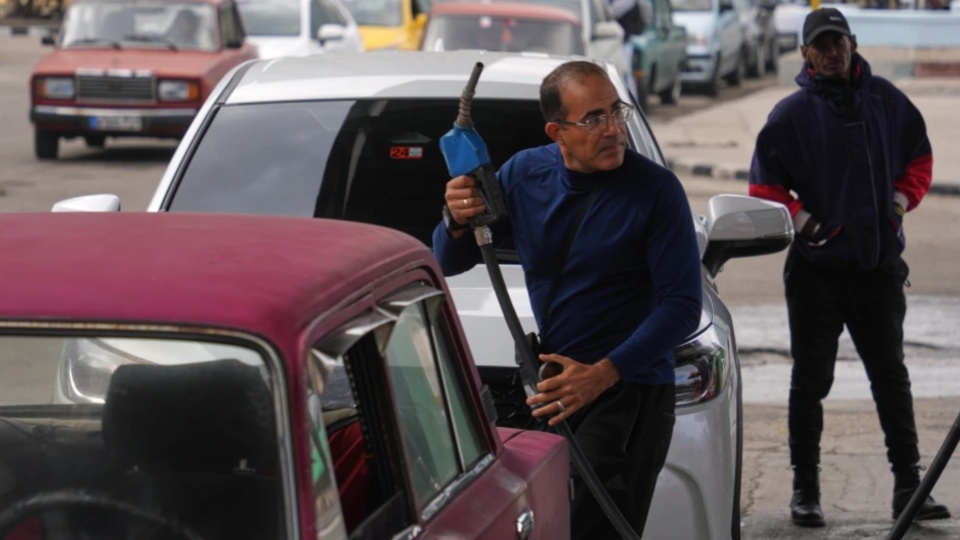
The U.S. president issued an executive order on Jan. 29 “declaring a national emergency and establishing a process to impose tariffs on goods from countries that sell or otherwise provide oil to Cuba.” The order mentioned “confronting the Cuban regime” and “countering Cuba’s malign influence.” “I think we would like to see the regime there change,” declared Secretary of State Rubio, testifying before the Senate Foreign Relations Committee the day before.
Cuba faces catastrophe. At work now are the cumulative effects of six decades of the U.S. economic blockade, a tightened stranglehold during the two Trump administrations, increasingly desperate living conditions, worsening shortages of essential goods, serious electrical power shortages, and the cut-off of oil from Venezuela after the U.S. invasion there on Jan. 3.
Mounting humanitarian danger and U.S. assault on Cuba’s sovereign independence are moving the international and U.S. Cuba solidarity movements into action.
The matter is urgent. In a statement, the U.K. Cuba Solidarity Campaign declares that, “This latest escalation…will cripple the electricity system and devastate every aspect of daily life” in Cuba. Th organization predicts:
“Hospitals without power. Incubators and life-support machines unable to function. Emergency surgeries carried out without light. Schools and workplaces forced to close. Bakeries unable to operate. Fuel shortages preventing the transport of food and medical supplies. Food spoiling in fridges and freezers. Hunger, illness, and suffering will spread. This is a deliberate attack on an entire civilian population, intended to inflict pain, deprivation and desperation. It is cruel, calculated, and it will cost lives.”
Victory for U.S. imperialism over Cuba’s socialist revolution would have dire implications. A European analyst explains that, “Cuba remains the only living example of a country that continues to attempt socialist construction on the basis of social ownership, planning, and working-class power, rather than market dominance and capitalist accumulation.”
Trump’s executive order sanctioning suppliers of oil to Cuba prompted a crescendo of statements supportive of Cuba, including from many Communist Parties of the world, from China, Russia, Vietnam, the Arab League, the African National Congress, the Bolivarian Alliance for the Peoples of Our America, multiple Cuba solidarity organizations, organizations of Cubans living abroad, and the World Federation of Trade Unions.
Cuban President Miguel Díaz-Canel commented on Jan. 30 that, “Under a false pretext and empty arguments, peddled by those who engage in politics and enrich themselves at the expense of our people’s suffering, President Trump seeks to stifle the Cuban economy by imposing tariffs on countries that trade oil with Cuba as is their sovereign right.”
Denying U.S. accusations, Cuba’s Foreign Ministry insisted that Cuba “does not harbor, support, finance, or permit terrorist or extremist organizations.” Nor does Cuba “harbor foreign military or intelligence bases” or represent “a threat to the security of the United States.”
Cuba soon may be unable to import any oil at all. According to a Financial Post report on Jan. 29, “Cuba has 15 to 20 days left of oil left as Donald Trump turns the screws.”
As explained by analyst Gabriel Vera Lopes, Cuba itself produces 30% of the 120,000 barrels of oil (BPD) used in the country each day. Venezuela in 2025 provided up to 35,000 BPD, representing 29% of the total. Mexico sold Cuba 17,200 BPD during the first nine months of 2025, until oil exports lagged due to U.S. pressure.
Vera Lopes indicates that even oil sent for humanitarian reasons will be blocked, as will be the small amounts of oil sent to Cuba through China or Russia. Apart from oil produced in Cuba itself, all that remains is oil from Mexico. Crucially, “The new executive order now appears to be aimed directly at Mexican supplies.”
Mexican President Claudia Sheinbaum, speaking to reporters on Jan. 30, highlighted humanitarian considerations and respect for international law. Insisting that Mexico’s government will negotiate with officials in Washington, she stated that “contractual considerations,” not political pressures, accounted for the PEMEX oil company’s recent suspension of shipments. Sheinbaum added that “ Mexico will always stand in solidarity, always seeking the best way to support the Cuban people.”
Mexico has been sending only 1% of its total oil production to Cuba. Up to 84% of it goes to the United States. In fact, Mexico and the United States have a mutually dependent but asymmetric relationship as regards hydrocarbon products. Maintaining that relationship may take precedence over Cuba’s needs.
Mateo Crossa’s recent article appearing in Monthly Review titled “The Shale Revolution, U.S. Energy Imperialism, and Mexico’s Dependence” is relevant. He writes:
“In the context of the Shale Revolution positioning the United States as the world’s top oil producer and as the leading exporter of refined oil, Mexico has become the largest market for the United States, importing $30 billion worth of refined oil in 2023—accounting for 28% of the $107 billion the United States exported that year.”
He adds: “This pattern highlights a troubling shift in energy dynamics, with Mexico increasingly locked into a subordinate role that weakens its economic autonomy and energy independence…. Mexico has not only become the largest importer of U.S. natural gas but also plays a pivotal role in the broader U.S. imperial energy strategy, serving as a platform for liquefied natural gas exports to Asia.”
Cuba solidarity activists in the United States are responding. In a communication shared with the International U.S.-Cuba Normalization Coalition Committee, labor activist Mark Friedman, associated with the Los Angeles Hands off Cuba Coalition, stated:
“We need to go on an emergency footing and reach out to those forces who in the past have not been willing to take a stand.… We need to fight for unity in the Cuba solidarity movement.”
At an emergency meeting of the coalition on Feb. 1, emphasis was given to significant expanding the existing material aid campaign for Cuba, outreach to the labor movement and to activists mobilizing against ICE and U.S. wars, local teach-ins, and a focus on defending Cuba’s sovereign independence.
Renewed action now on Cuba’s behalf is continuation of the struggle for Cuba that began in earnest in the United States under the leadership of Cuba’s national hero, José Martí. Revolutionaries inside Cuba who opposed the U.S.-dominated pseudo-republic (1902-59) carried it on. Anti-imperialist struggle intensified after 1959 with the defense of Cuba’s socialist revolution.
Under unprecedented threat now, the revolution’s fall would undo the long struggle of untold numbers of people against U.S. imperialism.
Fidel Castro, in his “Second Declaration of Havana” of Feb. 4, 1962, gave voice to Cuba’s struggle against U.S. Imperialism. A relevant excerpt follows:
“In 1895, Martí already pointed out the danger hovering over America and called it by its name: imperialism. He pointed out to the people of Latin America that more than anyone, they had a stake in seeing that Cuba did not succumb to the greed of the Yankee.… Sixty-seven years have passed. Puerto Rico was converted into a colony and still is a colony…. Cuba also fell into the clutches of imperialism. Their troops occupied our country. The Platt Amendment was imposed on our first Constitution, as a humiliating clause which sanctioned the odious right of foreign intervention. Our riches passed into their hands, our history was falsified, our government and our politics were entirely molded in in the interest of the overseers; the nation was subjected to 60 years of political, economic, and cultural suffocation. But Cuba was able to redeem itself.… Cuba broke the chains which tied its fortunes to those of the imperialist oppressor…and unfurled its banner as the Free Territory of America.”
We hope you appreciated this article. At People’s World, we believe news and information should be free and accessible to all, but we need your help. Our journalism is free of corporate influence and paywalls because we are totally reader-supported. Only you, our readers and supporters, make this possible. If you enjoy reading People’s World and the stories we bring you, please support our work by donating or becoming a monthly sustainer today. Thank you!
Original article by W. T. Whitney, Jr republished from People’s World under http://creativecommons.org/licenses/by-nc-nd/3.0/us/
Original article by Ana Vračar republished from peoples dispatch under a Creative Commons Attribution-ShareAlike 4.0 (CC BY-SA) license.
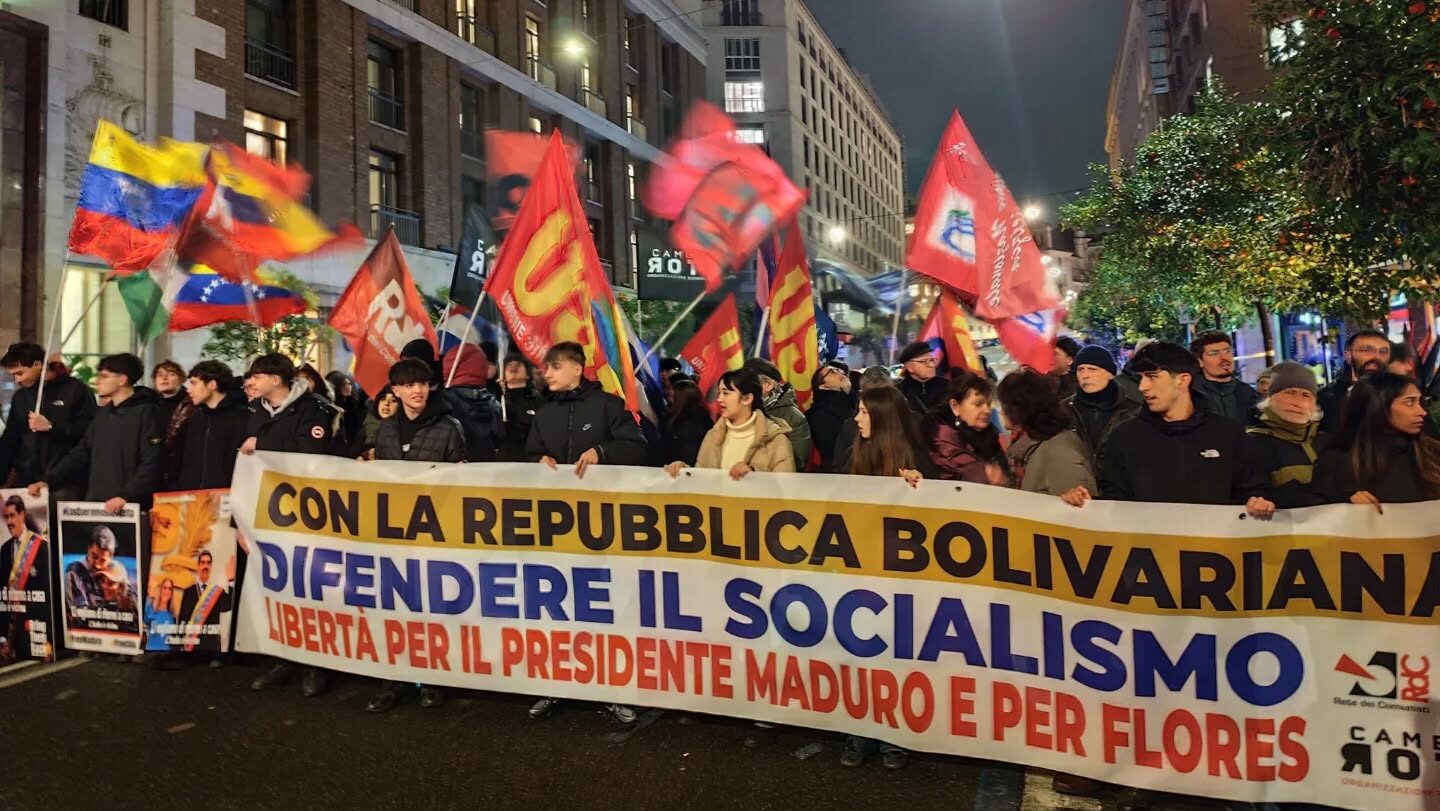
One month after the US attack on Venezuela, dozens of Italian cities once again took to the streets in support of the Bolivarian process, demanding the release of President Nicolás Maduro and Cilia Flores. Organized under the international slogan “Bring them home!”, the decentralized actions represent a stepping stone toward a national assembly in Rome on Sunday, February 8, as well as permanent mobilization against war and rearmament.
Students and youth made up a significant portion of participants in Tuesday’s demonstrations. “In response to the United States’ military action, a clear expression of its desire to reassert control over the continent, we once again stand alongside the Bolivarian Revolution […] against US imperialism and to demand the immediate release of Maduro and Flores,” the organizations Cambiare Rotta and OSA wrote on the day.
Left groups also denounced the Trump administration’s threats and attacks against other countries in Latin America, particularly Cuba and Colombia, warning that the strategy is rooted in a model of imperialism that harms people all over the world. Marta Collot, spokesperson for the left party Potere al Popolo, emphasized that the protests were also aimed at opposing a “model based on extractivism that seeks to seize the resources of other countries.”
“The ambitions of the US are not limited to Venezuela, but extend to all the countries of Nuestra América, which are to be turned into mere territories for resource extraction, from oil to rare earths, from vast freshwater reserves to a ‘disposable’ workforce,” Potere al Popolo wrote ahead of the protests. Venezuela, with its socialist transformation, “has always been a thorn in their [the West] side, against which they have directed all weapons of hybrid warfare, from economic and military aggression to cognitive warfare,” the party added.
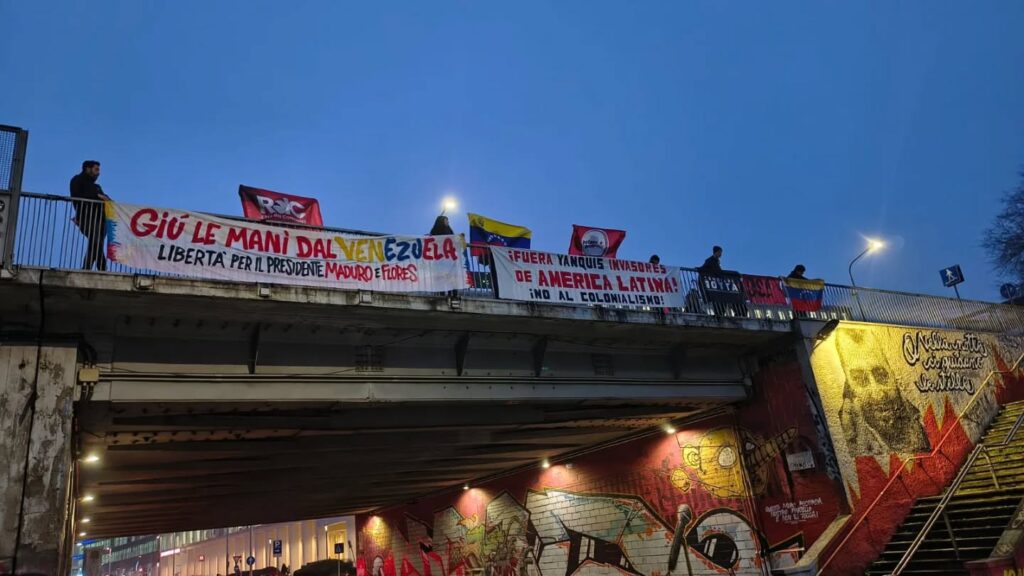
“We condemn this attack, which was not only an attempt to seize Venezuela’s oil, a nationalized oil, but also an effort to restore US hegemony over Latin America, which the US continues to regard as its backyard,” activists from Potere al Popolo Turin said on the day.
“But Latin America does not bow to US imperialist ambitions,” they added. “It resists, as shown by the massive crowds in Caracas, where the Venezuelan people are not celebrating, as our subservient media would have us believe, but are instead fighting loudly for the release of President Maduro and the primera combatiente.”
“We are here to say it once again: hands off Venezuela,” Collot said. “Today we are facing a paradox in which Trump not only allows himself to kidnap President Maduro, but also threatens half the world, from socialist Cuba to Iran, Colombia, and even Greenland.”
“All of this must end,” she concluded. “We need to reverse course and focus on policies that genuinely support workers and peoples, promote solidarity, and oppose the war-driven agenda that is pushing us toward the brink of World War III.”
Original article by Ana Vračar republished from peoples dispatch under a Creative Commons Attribution-ShareAlike 4.0 (CC BY-SA) license.