Category: Climate Science Denial

  • Ben Webster: The UK government is hiding crucial climate data – so I’m taking it to court

    Spread the love

    Article by Ben Webster republished from OpenDemocracy under a Creative Commons Attribution-NonCommercial 4.0 International licence.
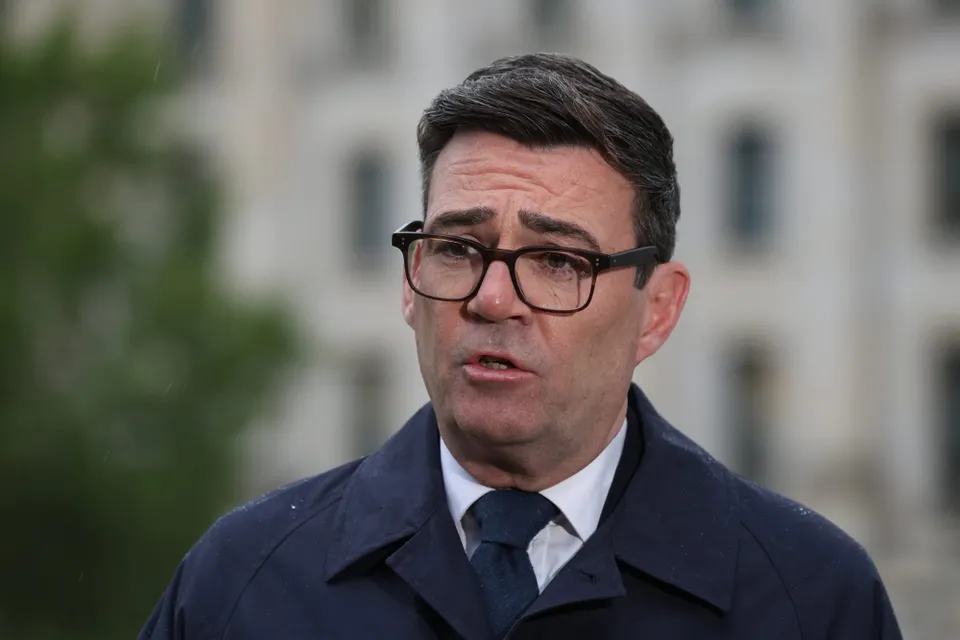
    This government and the last have failed to publish key climate information. Sean Gallup / Pool / AFP via Getty Images

    The British government is short-changing the public on our right to access information on the climate crisis, wildlife destruction and river pollution. That’s why I am taking it to court.

    This Thursday, 15 October, my lawyers will tell London’s High Court that ministers in this government and the last have breached their legal duty by failing to publish vital environmental information under the 1998 Aarhus Convention, which aims to protect everyone’s right to live in an environment suitable for their health and wellbeing.

    The UK was one of 38 initial signatories to the Aarhus Convention, described in 2000 by then UN secretary-general Kofi Annan as “the most ambitious venture in the area of environmental democracy so far undertaken under the auspices of the United Nations”. 

    The treaty gives all of us a legal right to access environmental information and participate in environmental decisions – and to take the government to court if it breaches those rights, which is exactly what I am now attempting to do. 

    The origins of the case lie in my award-winning openDemocracy investigation into how the gas industry promotes technologies such as “hydrogen-ready boilers” and “blue hydrogen”, which perpetuate the use of gas. 

    British Gas advisers caught making false promises about ‘green’ boilers

    Exclusive: Staff wrongly tell our reporter hydrogen will replace gas and that new boilers can burn it.

    I had been tipped off that on an expected strategic policy decision on the future of heating homes, the Department for Business, Energy & Industrial Strategy (BEIS) was leaning towards the gas industry’s preferred solution of hydrogen boilers, despite an overwhelming majority of independent scientists believing they are a false solution.

    I’m seeking a judicial review over ministers’ failure to release information on the climate crisis and river pollution

    To find out if this was true, I asked BEIS for any reports on the potential future availability and cost of hydrogen for home heating. My request was submitted under the Environmental Information Regulations, which is underpinned by the Aarhus Convention.

    The department admitted it held four reports but refused to release them to me, even after it was ordered to do so by the Information Commissioner’s Office (ICO), the watchdog that polices information laws. BEIS, and then its replacement, the Department for Energy Security and Net Zero (DESNZ), fought for two years to keep these reports secret.

    In June last year, on the eve of an information tribunal hearing into the case, DESNZ released three of the four reports without explanation for its change of mind on publication.

    It is still refusing to release the fourth report, which is potentially the most significant because it drew conclusions based on analysis in the other three.

    The department claims the fourth report is “material in the course of completion” because ministers have yet to make up their minds what role hydrogen will play in home heating.

    The absence of a strategic policy decision on hydrogen for home heating is helping the gas industry sell 1.5 million new gas boilers a year, keeping homes locked into burning gas and paying for gas pipelines for decades to come.

    My frustrating experience with DESNZ made me wonder what other reports on key environmental issues are being kept hidden by public bodies. A quick search revealed that government departments and agencies frequently ignore their proactive publication duty under the Aarhus Convention.

    For example, a report for the Environment Agency revealed that “forever chemicals”, known as PFAS, are contaminating up to 10,000 sites in England and cleaning them up could cost as much as £121bn. The government had no effective plan for dealing with this problem, so it sat on the report for 14 months – publishing it only after an Environmental Information Regulations request by the ENDS report, an environmental magazine. 

    The government also tried to hide a national security assessment on ecosystem collapse. 

    I sent Defra and DESNZ a series of requests to find out what they were doing to comply with their proactive publication duty.

    Amazingly, neither department could produce any evidence that any official had even discussed the duty in the past two years. Neither had any policy on how it should comply with the duty.

    Government lawyers responded to a pre-action letter admitting that more “awareness” of the duty was needed across government. However, they adopted a very narrow interpretation of that duty in order to claim compliance.

    My legal team and I think their interpretation is wrong and are seeking permission to bring a claim for judicial review to force the government to adopt an active publication policy on vital environmental issues.

    The ICO has joined the case because it believes it could establish legal clarity as the first case to reach court concerning the proper interpretation of the government’s proactive publication duty.

    If we succeed, the government will be forced to be more open with what it knows about the interlinked environmental crises we face and how to solve them. Armed with that information, the public could then put more pressure on ministers to act – the whole reason that the framers of the Aarhus Convention gave us these rights to access environmental information nearly 30 years ago.

    Ben Webster would be grateful for any donations to his crowdfunder to help pay the legal fees to fight this case. Help pay Ben’s legal fees

    Ben Webster

    Ben Webster was named Environment Journalist of the Year at the 2024 UK Press Awards for his investigations published by openDemocracy which exposed greenwashing by the gas industry.

    He was Environment Editor of The Times for 11 years until 2022. His 24-year career at The Times included serving as Media Editor reporting on the Leveson Inquiry; Transport Correspondent and Night News Editor. Prior to joining The Times, he worked on the Scotsman, the Irish News and the Nottingham Evening Post.

    Ben now campaigns in a voluntary capacity on sustainable transport issues and, separately, information rights.

    All articles

    Article by Ben Webster republished from OpenDemocracy under a Creative Commons Attribution-NonCommercial 4.0 International licence.

  • I work for a major insurer. My industry is fudging the numbers in the face of the climate crisis

    Spread the love

    Article by Industry insider republished from TBIJ under a Creative Commons Attribution-NonCommercial-NoDerivs 3.0 Unported License.

    Our refusal to confront reality could prove catastrophic for homes, communities … and the entire economy

    This is the first in our Secret Source series, a regular column from industry whistleblowers.

    The world is facing greater risk than ever from extreme weather. We are not prepared – and that could have profound consequences for the global financial system.

    I work for a major insurer, assessing the risk posed by natural disasters on properties around the world, from family homes to schools, government offices and multibillion-dollar commercial centres.

    In the face of ever more dire and unpredictable climate risks, I am coming under pressure to cut my forecasts for the losses that disasters will cause in order to make insurance more affordable – and get my employer more business. In some instances, the questioning of my numbers and models is justified. But too often it is not being done to produce more accurate predictions, but to artificially lower prices. If this is happening at my firm, which is struggling to compete with rivals’ prices, it’s happening elsewhere.

    Our sector is carrying more risk than we realise. The warming global climate has caused more high-intensity storms, rising sea levels, flooding, wildfires and drought.

    While the immediate impact of these events is plain to see, the long-term effects will be compounded as insurers withdraw from entire regions, leaving the economy in freefall and people’s day-to-day lives in ruins.

    For example, if subsidence – which is made worse by drought – damages a number of homes in your area, insurers may exclude this from your policy. If subsidence then damages or destroys your house, you won’t be covered.

    When that happens to an entire community, businesses leave, investment dries up and the local economy tanks. Now imagine that happening in towns all around the country, all at the same time. And subsidence is only one such issue, alongside wildfires, coastal erosion, wind and floods. And that’s just the UK.

    As a modeller it is my job to look scientifically at the data and calculate an expected loss from a natural disaster, which in turn affects the price of the premium for a given policy. As my analysis shows higher and more volatile risk, the price rises with it and we lose customers.

    Our industry says it holds modellers’ numbers as sacrosanct, but in reality we are coming under pressure to reduce our projected losses. In the most basic terms, we are collectively fudging the numbers and taking on more risk than we should for a lower price than the expected loss demands.

    Sometimes I will forecast losses that would normally be seen as much too risky for us to insure but we offer the policies anyway.

    This will eventually lead to a sector built on “competitively-priced” contracts that underestimate risk, leaving gaping holes in the safety net that insurance is supposed to provide.

    I have respect for underwriters who are just doing their jobs, and I know that no single individual is responsible. My concern lies with the attitude of the industry as a whole towards modellers, actuaries and researchers: there is a sense that we are an inconvenience to the deal-making process rather than an essential part of risk management. We are the failsafe that stops our industry from reckless gambling.

    Recommended Articles

    At the largest scale, misquoted insurance can damage insurers, companies, their employees and entire communities. The upshot is that our customers are likely much more exposed to climate-related risks than they realise. People are not budgeting for a major increase in their insurance premiums or planning for their homes becoming uninsurable, but many of them absolutely should be.

    If the worst happens, the insurance industry may not have the money to pay every claim when a major disaster hits. That would have profound consequences for the economy as a whole – businesses could go bankrupt, the housing market will seize up. If people can’t pay their mortgages, banks could collapse.

    As natural catastrophes continue to become less predictable and more severe, the foundations of our entire economy will only become more fragile. Our customers deserve to know.

    Article by Anonymous republished from TBIJ under a Creative Commons Attribution-NonCommercial-NoDerivs 3.0 Unported License.

    Elon Musk urges you to be a Fascist like him, says that you can ignore facts and reality then.
    Elon Musk urges you to be a Fascist like him, says that you can ignore facts and reality then.
    Donald Trump urges you to ignore facts and reality and be a Climate Science denier like him. He says that he makes millions and millions for destroying the planet, Burn, Baby, Burn and Flood, Baby, Flood.
    Donald Trump urges you to ignore facts and reality and be a Climate Science denier like him. He says that he makes millions and millions for destroying the planet, Burn, Baby, Burn and Flood, Baby, Flood.
    Nigel Farage urges you to ignore facts and reality and be a climate science denier like him and his Deputy Richard Tice. He says that Reform UK has received £Millions and £Millions from the fossil fuel industry to promote climate denial and destroy the planet.
    Nigel Farage urges you to ignore facts and reality and be a climate science denier like him and his Deputy Richard Tice. He says that Reform UK has received £Millions and £Millions from the fossil fuel industry to promote climate denial and destroy the planet.

  • ‘Malicious Use’ of AI, Nuclear War Pose Extinction Threat to Humanity This Century: Lancet Study

    Spread the love

    Article by Jake Johnson republished from Common Dreams under Creative Commons (CC BY-NC-ND 3.0).

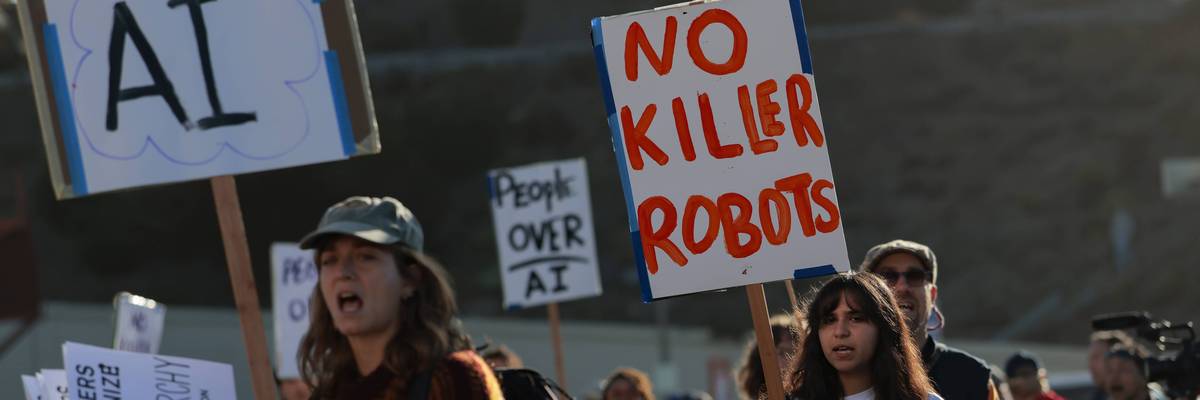
    Protesters gather outside an OpenAI developers conference at Fort Mason on September 29, 2026 in San Francisco, California. (Photo by Heather Diehl/Getty Images)

    “Although the likelihood of both dangers remains low, the scale of harm, should they be realized, would inflict an apocalypse on humanity.”

    A comprehensive new assessment of worldwide health threats published in The Lancet concludes that nuclear war and “malicious use” of artificial intelligence pose existential risks to humanity over the remainder of the 21st century, a finding that comes amid mounting global concern about the implications of rapid AI advancements.

    The Lancet Commission on 21st Century Global Threats to Health, comprised of dozens of experts across a range of fields, identifies 17 leading threats to human health and society, from the fossil fuel-driven climate emergency and pandemics to childhood malnutrition, income inequality, conventional war, and air pollution. Two of the threats carry “extinction potential” this century, according to the commission: nuclear conflict and misuse of AI.

    RECOMMENDED…

    Anthropic CEO Dario Amodei

    Alarm as AI Leaders Privately Weigh Scenarios of Post-Catastrophe Public ‘Revolt’

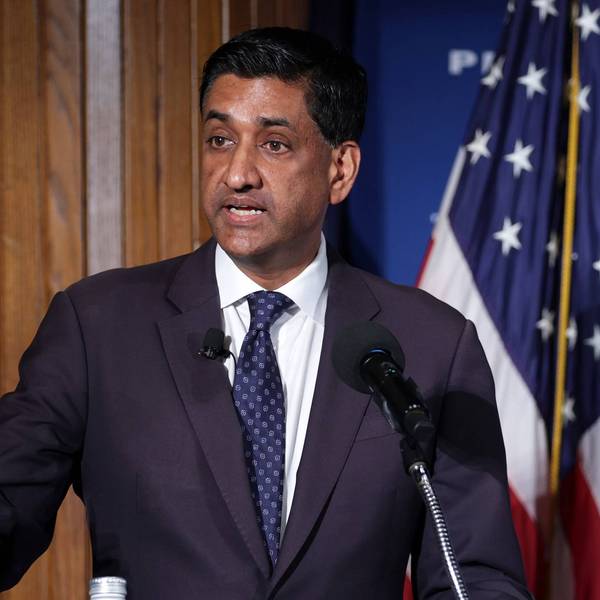
    Rep. Khanna Speaks At The National Press Club On The Epstein Files

    Citing ‘Civilizational Extinction Risk,’ Khanna to Intro Bill to Ban Recursive AI

    “Although the likelihood of both dangers remains low, the scale of harm, should they be realized, would inflict an apocalypse on humanity,” The Lancet warned in an editorial accompanying the new analysis, which was presented Sunday at the World Health Summit in Berlin, Germany.

    The commission notes that AI’s “potential to advance health and wellbeing is enormous,” but “the risk of catastrophic harm is equally profound.” The authors of the analysis point to several ways in which AI could be “used maliciously,” including the design of bioweapons, autonomous nukes, and invasive ransomware targeting global healthcare and financial institutions.

    “The final pathway is loss of control through the emergence of agentic, unaligned artificial general intelligence,” the analysis states. “This loss of control includes AI systems creating subgoals that lead to the seeking of human disempowerment or elimination, particularly if such agents autonomously gain access to financial networks, key infrastructure, or physical tools in the real world.”

    Regarding the existential threat of nuclear conflict, the study authors note that a famine stemming from atomic warfare “would affect all regions of the world, including those far from the conflict itself, through reduced caloric availability and cascading food-system failures.”

    “The devastation that could result from nuclear war cannot be overstated,” the analysis argues. “The risk is not hypothetical: We found that between 1948 and 2010, 22 nuclear weapon accidents and 21 close calls were recorded. Future nuclear conflicts could occur due to multiple distinct mechanisms, including nuclear exchange arising from international crises between nuclear powers, accidental detonation of nuclear warheads, terrorist use of nuclear devices, and AI deployment of nuclear weapons.”

    To avert the most catastrophic possible outcomes and mitigate other threats, the commission calls for “collective action between nations and within nations,” emphasizing that risks posed by AI, nuclear war, the climate crisis, and future pandemics “cannot be solved by governments or other actors acting for their own national populations alone.”

    Christopher Murray, director of the University of Washington’s Institute for Health Metrics and Evaluation and co-chair of the new commission, said in a statement that “the striking finding is not only the scale of these threats, but that humanity still has the agency to act.”

    “Across all 17 catastrophic threats, the decisions made by leaders today will shape the health and wellbeing of the next generation,” said Murray. “But delaying action will only serve to shift and increase the costs into the future.”

    Article by Jake Johnson republished from Common Dreams under Creative Commons (CC BY-NC-ND 3.0).

    dizzy: I’m surprised that ongoing climate destruction does not meet the measure of carrying “extinction potential” this century. I certainly believe that it does around 2060.

    Orcas discuss Donald Trump and the killer apes' concept of democracy. Front Orca warns that Trump is crashing his country's economy and that everything he does he does for the fantastically wealthy.
    Orcas discuss Donald Trump and the killer apes’ concept of democracy. Front Orca warns that Trump is crashing his country’s economy and that everything he does he does for the fantastically wealthy.
  • Tories overstate net zero cost by nearly £500bn in apparent spreadsheet error

    Spread the love

    https://www.theguardian.com/politics/2026/oct/09/tories-overstate-net-zero-cost-500bn-spreadsheet-error

    Kemi Badenoch addresses the Conservative conference in Birmingham, outlining policies from her 100-page document the Right Way. Photograph: Gary Roberts/SOPA Images/Shutterstock

    [Guardian] Exclusive: Badenoch’s flagship conference policy document cites £957bn estimate, twice the total in climate advisers’ data

    Kemi Badenoch’s flagship party conference policy document overestimated the cost of net zero by nearly £500bn, seemingly after someone accidentally double-counted figures on a spreadsheet.

    …

    Article continues at https://www.theguardian.com/politics/2026/oct/09/tories-overstate-net-zero-cost-500bn-spreadsheet-error

    UK Conservative Party leader Kemi Badenoch explains her reality that the Earth is flat, the Moon is made of cheese and that she was born from Unicorn horn dust
    UK Conservative Party leader Kemi ‘not a genocide’ Badenoch explains her reality that the Earth is flat, the Moon is made of cheese and that she was born from
    Unicorn horn dust
  • Green Groups Fume as Trump Gives Big Oil ‘Another Free Pass to Exploit’ the Arctic

    Spread the love

    Article by Jessica Corbett republished from Common Dreams under Creative Commons (CC BY-NC-ND 3.0).

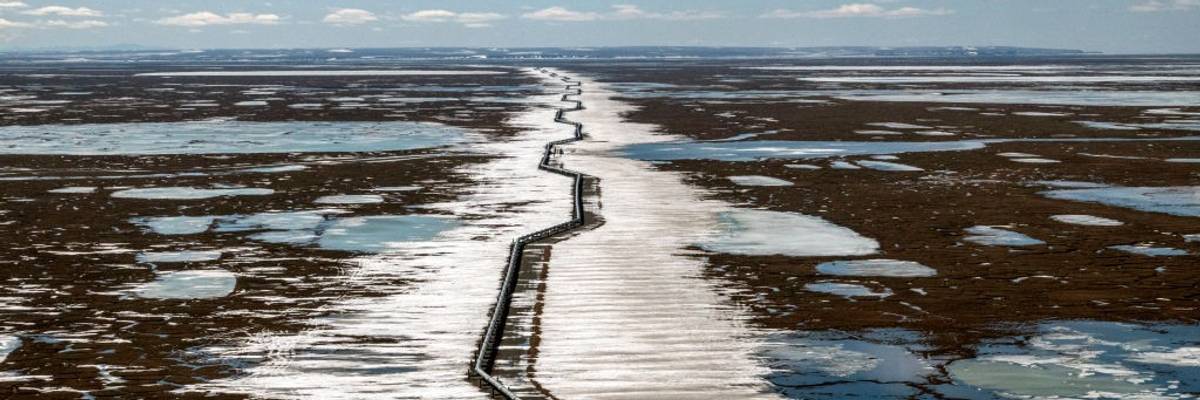
    An oil pipeline stretches across the landscape outside Prudhoe Bay in North Slope Borough, Alaska on May 25, 2019.(Photo by Bonnie Jo Mount/The Washington Post via Getty Images)

    Just over a week after a leading US Senate Democrat described President Donald Trump’s relationship with fossil fuel giants as “old-fashioned corruption, by a thuggish government and a desperate industry,” his administration on Thursday announced yet another giveaway to climate polluters who want to exploit the Arctic.

    The US Department of the Interior is moving forward with a plan to allow oil and gas companies to conduct certain wintertime activities at the National Petroleum Reserve in Alaska without reviews generally required by the National Environmental Policy Act—a landmark law long targeted by Trump’s Republican Party.

    RECOMMENDED…

    Senators Schumer And Whitehouse Unveil Report On Fossil Fuel Industry's Connections To Trump Administration

    ‘The Billion Dollar Deal’: Senate Democrats Detail How Trump Serves Fossil Fuel Industry

    ICE agents and immigration activists face off outside Delaney Hall detention center in Newark, New Jersey

    ‘Should Concern All Americans’: Records Show ICE Has Gathered 50 Million Voter Records Ahead of Midterms

    “In issuing this categorical exclusion, this administration is seeking to fast-track large-scale oil drilling and seismic exploration without any further environmental analysis or public input,” warned Earthjustice attorney Janet Bering. “It is cutting the public out of this decision and future decisions.”

    “The administration finalized this new approach with zero public input,” Bering noted. “Combined with a similar proposal that rubber-stamps new oil production, this is a one-two punch. It’s bad policy, and it is unlawful.”

    The 60-day public comment period is ongoing for the earlier proposal she cited, which is designed to streamline decision-making for construction and operation of oil and gas production sites in the same 23-million-acre Alaska reserve.

    When the Interior Department unveiled that policy in early September, Earthjustice Attorney Erik Grafe declared that “what we’re seeing here is a concerted attack by the Trump administration to greenlight oil and gas drilling in the Western Arctic while ignoring the harm it will cause to these irreplaceable public lands and also the government’s obligation to protect these lands for wildlife and future generations.”

    “These are large-scale, industrial activities that cause permanent damage to sensitive Arctic ecosystems, nearby communities, and the climate,” Grafe stressed. “The administration’s proposal flaunts basic environmental laws meant to protect land, wildlife, and people and allow for fully informed decision-making.”

    Earthjustice is far from alone in blasting Trump’s recent attacks on the Arctic. Dan Ritzman, director of Sierra Club’s conservation campaign, condemned last month’s proposal as “another piece of the administration’s relentless effort to expand drilling across Alaska’s public lands.”

    “The Western Arctic is home to caribou, migratory birds, and countless other wildlife, and decisions about its future deserve careful scrutiny—not a permitting process designed around the demands of the oil and gas industry,” Ritzman said at the time.

    His colleague Mike Scott, Sierra Club’s national oil and gas campaign manager, was similarly critical of Thursday’s announcement.

    “The Trump administration is handing Big Oil another free pass to exploit America’s public lands, this time by gutting environmental oversight in one of the most fragile ecosystems on the planet,” said Scott. “Oil companies have already shown the risks they pose to the Western Arctic, and now this administration wants to make it even easier for them to drill without scrutiny.”

    “This isn’t about lowering energy costs or helping Alaskans,” he continued—as the president drives up fuel costs with an illegal war on Iran. “It’s about doing the fossil fuel industry’s bidding at the expense of wildlife, Alaska Native communities, and our public lands. The Trump administration is putting corporate profits ahead of people and the planet, and the Western Arctic will pay the price.”

    Trump campaigned for a second term on a pledge to serve fossil fuel interests—even telling industry executives that he’d roll back climate policies if they poured $1 billion into his campaign. Last week, US Senate Minority Leader Chuck Schumer (D-NY) and Committee on Environment and Public Works Ranking Member Sheldon Whitehouse (D-RI) released a report detailing how the president has delivered on that promise since returning to power last year.

    “The fossil fuel industry and their allies bought their way into the Trump White House with hundreds of millions of dollars in political donations, after Trump promised fossil fuel bigwigs at a Mar-a-Lago fundraiser that he’d do anything and everything they wanted, for the right price,” Whitehouse said. “Now, their minions run the government from the inside, driving up energy bills to deliver payouts to the donors that put Trump back in office.”

    Article by Jessica Corbett republished from Common Dreams under Creative Commons (CC BY-NC-ND 3.0).

    Climate science denier Donald Trump confirms that he knows nothing about democracy and that more liquid gold is being secured according to his policy of global privateering.
    Climate science denier Donald Trump confirms that he knows nothing about democracy and that more liquid gold is being secured according to his policy of global privateering.
    Orcas discuss Donald Trump and the killer apes' concept of democracy. Front Orca warns that Trump is crashing his country's economy and that everything he does he does for the fantastically wealthy.
    Orcas discuss Donald Trump and the killer apes’ concept of democracy. Front Orca warns that Trump is crashing his country’s economy and that everything he does he does for the fantastically wealthy.
    Donald Trump urges you to ignore facts and reality and be a Climate Science denier like him. He says that he makes millions and millions for destroying the planet, Burn, Baby, Burn and Flood, Baby, Flood.
    Donald Trump urges you to ignore facts and reality and be a Climate Science denier like him. He says that he makes millions and millions for destroying the planet, Burn, Baby, Burn and Flood, Baby, Flood.