Downing Street has billed the speech tomorrow as “a direct message to the working people across Britain.”
In it, Sir Keir is expected to develop the line of attack that Chancellor Rachel Reeves began when she accused the Tories before the summer recess of leaving a £22 billion black hole in this year’s budget.
Sir Keir will claim government has to take “unpopular decisions” to rebuild the country from “rubble and ruin” left by the Tories, saying: “We have inherited not just an economic black hole but a societal black hole.
“And that is why we have to take action and do things differently.
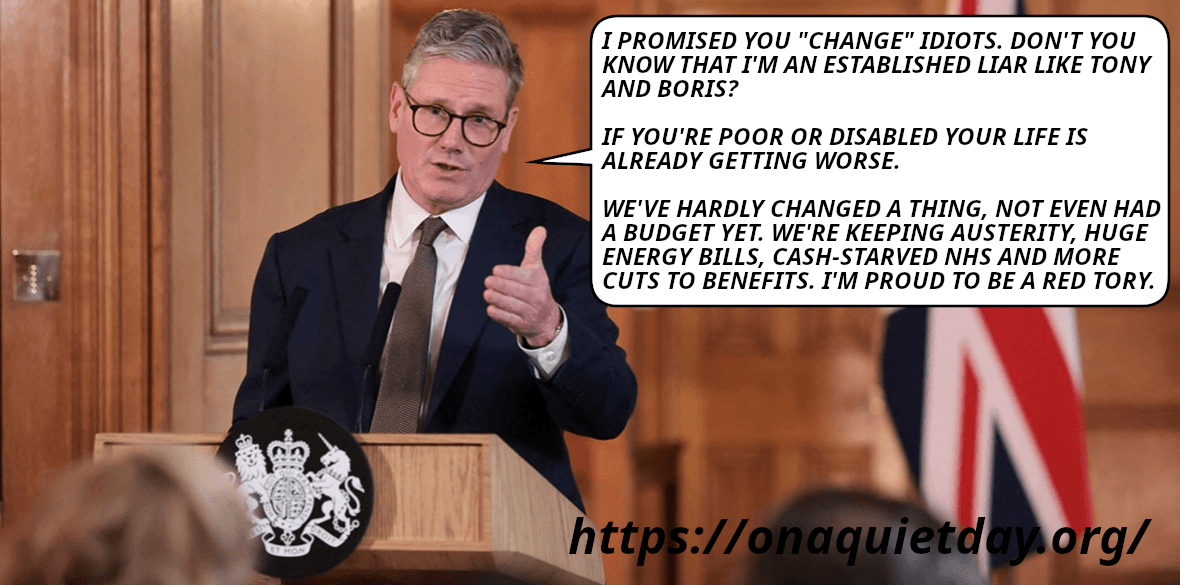
Labour’s disdain for conducting impact assessments on the effects of its cuts and austerity reaches the ‘MSM’ – 11 months after Skwawkbox exclusively revealed it
The Telegraph has today reported that right-wing Labour Chancellor Rachel Reeves carried out ‘no impact assessment’ before ‘withdrawing winter fuel payments for 10 million pensioners, the Telegraph can reveal’.
The right-wing rag is a little late to the party. Skwawkbox revealed exclusively eleven months ago that Labour undertook no impact for any of its plans on vulnerable people, whether pensioners, the disabled, the poor, the ill or children.
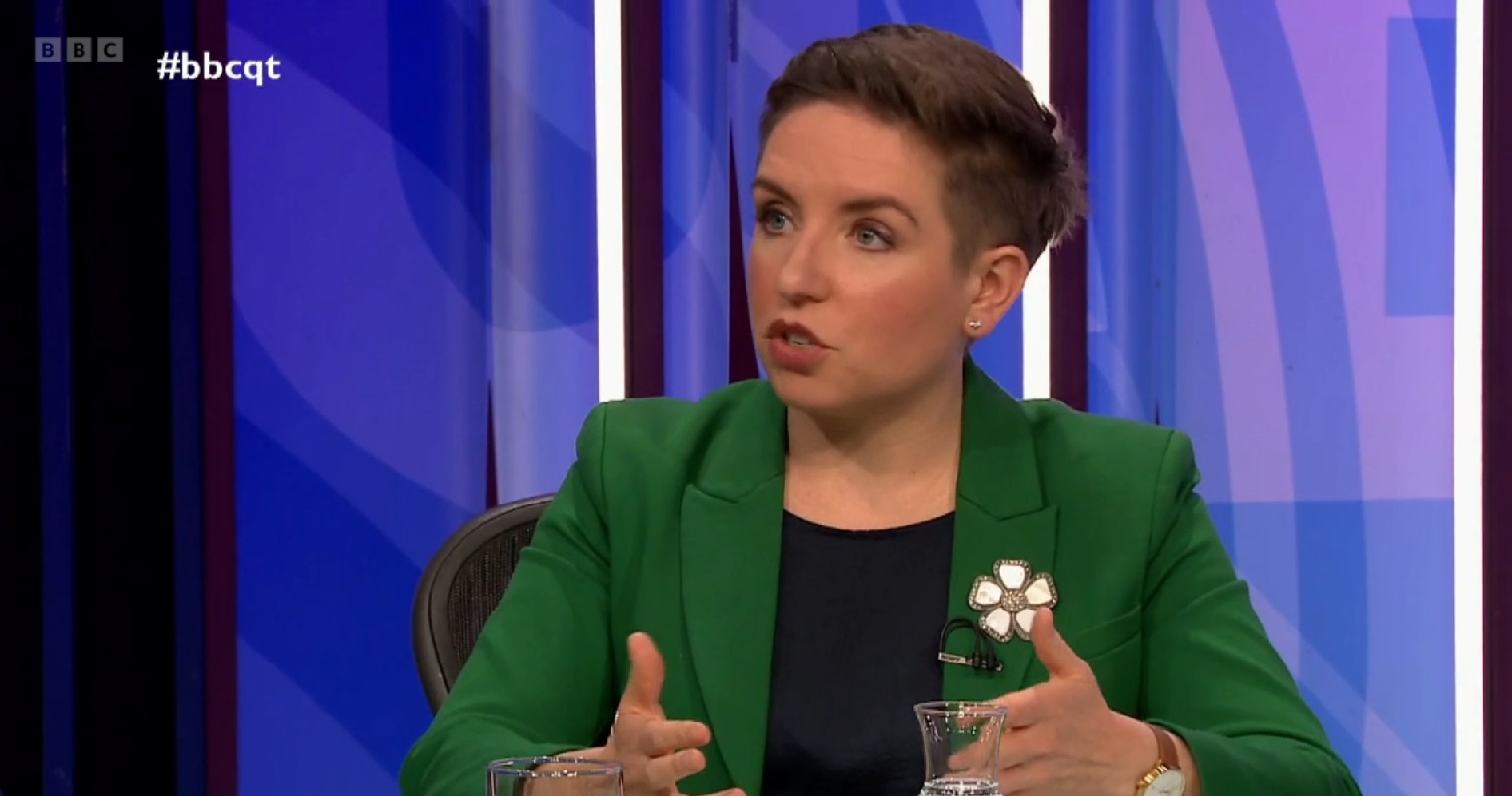
Image of the Green Party’s Carla Denyer on BBC Question Time.
Responding to news that energy regulator Ofgem has raised the price cap by 9.5 per cent just before the onset of winter, Green Party co-leader Carla Denyer said:
“Consumers are paying high prices for a crisis not of their making. This will be deeply worrying news for all those people already struggling to pay their bills.
“The government has said that establishing GB Energy will reduce bills in the future, which would be welcome. However, that aim will only be achieved if the government invests in improving the energy efficiency of homes too.
“We need a nationwide programme of government-backed, council-delivered home insulation starting immediately to help people keep their bills down for good.
“We also now need the government to maintain the winter fuel payments for all pensioners and end means testing so that they know they can afford to keep warm.
“We could reduce bills for the long term and help reduce greenhouse gas emissions by building new homes that are easier and cheaper to heat and boosting insulation in existing homes. Insulating people’s homes means they can stay warm while using less energy, save money and produce fewer harmful carbon emissions.”
Campaigners fear increase by £149 in energy price cap by Ofgem will put more pressure on household
…
Households in Great Britain will begin the run-up to winter with a 10% increase in their energy bills after the industry regulator increased its cap on gas and electricity prices from October.
Under the new price cap, the average annual dual-fuel energy bill will rise to £1,717 a year, up £149 from its current level of £1,568, which has been in place since July.
The price cap is set every quarter by Ofgem, the energy regulator for Great Britain, and imposes a maximum on how much suppliers can charge their 28 million household customers per unit of gas and electricity.
It is expressed in terms of how much the average home would pay at this rate for their typical annual energy use, which means a cold autumn and winter could push bills even higher if households need to keep the heating on for longer.
Households in Great Britain will begin the run-up to winter with a 10% increase in their energy bills after the industry regulator increased its cap on gas and electricity prices from October.
Under the new price cap, the average annual dual-fuel energy bill will rise to £1,717 a year, up £149 from its current level of £1,568, which has been in place since July.
The price cap is set every quarter by Ofgem, the energy regulator for Great Britain, and imposes a maximum on how much suppliers can charge their 28 million household customers per unit of gas and electricity.
It is expressed in terms of how much the average home would pay at this rate for their typical annual energy use, which means a cold autumn and winter could push bills even higher if households need to keep the heating on for longer.
THE bad news is that the typical yearly household energy bill in Britain will rise by about £150 from this autumn.
…
Energy Secretary Ed Miliband, who should know better, put a superficial gloss on the situation by arguing: “The rise in the price cap is a direct result of the failed energy policy we inherited, which has left our country at the mercy of international gas markets controlled by dictators.”
The first part of that statement is spot on in as far as Labour has made a few steps to reverse the Tory barriers to a more sustainable energy policy — although not as many as Miliband would like. And Russian President Vladimir Putin is an unsavoury character but actually he wanted to keep on selling his cheap gas to the Germans and us.
Western oil and energy monopolies have long been in partnership with dictatorial regimes in the Middle East who lack even Putin’s pretensions to democratic accountability.
Labour could tighten up the regulatory regime to control consumer prices, could tax energy profits more, could use the sovereign powers that leaving the EU confers by asserting domestic controls over wholesale energy prices.
But the quickest and best way to put the energy industry at the service of the people is to take it into public ownership, use the profits to retrofit our housing stock to save energy, invest in renewables and keep consumption and prices down.