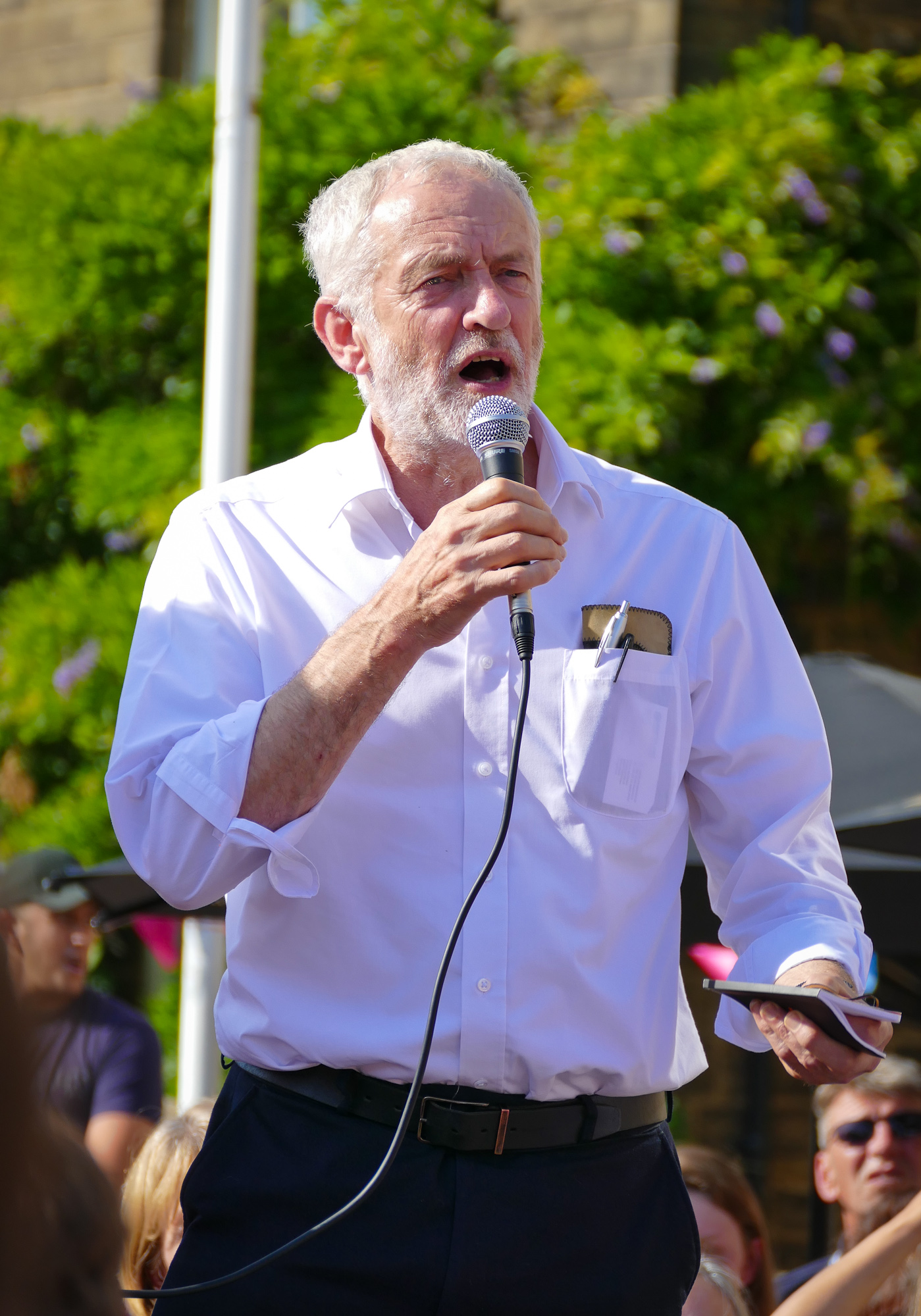
Jeremy Corbyn MP, former leader of the Labour Party
JEREMY CORBYN and four other pro-Palestine independent MPs could form a new parliamentary group.
The former Labour leader, Shockat Adam, Ayoub Khan, Adnan Hussain and Iqbal Mohamed have been exploring options on how they can affect policy more effectively.
Mr Adam, who unseated Labour’s Jonathan Ashworth to become MP for Leicester South, told the BBC that the group was “looking at options that would give us more access to the levers of power.”
The potential grouping of five independents would equal the number of Reform UK MPs and outnumber the Greens.
Last month they vowed to work with seven Labour MPs who had their party whip suspended for voting to scrap the two-child benefit cap to offer a “real alternative.”
…
It is thought there has so far been no formal co-ordination between independent MPs and suspended Labour MPs.
Becoming an official group in Parliament would increase the independents’ chances of taking part in debates and committees, which are usually decided proportional to party size.
Original article by JESSICA CORBETT republished from Common Dreams under Creative Commons (CC BY-NC-ND 3.0). I am proud that I participated at one of these protests. It was a community response of people opposing Fascism and nobody else should be permitted to claim credit for it.
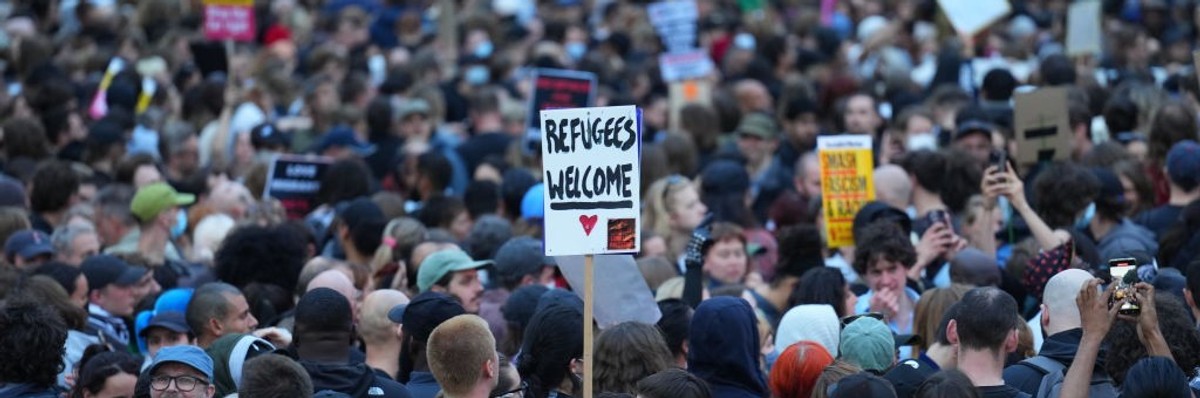
Counterprotesters gathered ahead of potential anti-immigration demonstrations on August 7, 2024 in Walthamstow, United Kingdom. (Photo: Carl Court/Getty Images)
“The majority of people in Britain abhor Robinson and the far right,” says one joint statement. “We are the majority, they are the few.”
From Birmingham, Brighton, and Bristol, to Liverpool, London, Newcastle, and Northampton, counterprotesters gathered across the United Kingdom on Wednesday to decry far-right riots and attacks against immigrants and Muslims.
Since the weekend, far-right protesters have targeted mosques, libraries, and even a hotel housing asylum-seekers—responding at least in part to online disinformation about the suspect in a deadly stabbing attack on a children’s dance class. The demonstrations and expectations they would continue Wednesday evening drew anti-racists to the streets in several U.K. cities.
“The far right are spreading racism, Islamophobia, and hatred,” says a Stand Up to Racism statement published in the Daily Mirror Wednesday and signed by actors, artists, drag performers, journalists, labor leaders, musicians, peace advocates, and members of Parliament—including Jeremy Corbyn, an Independent, along with Labour’s Diane Abbott and Zarah Sultana.
When far-right mobs seek to sow hate and division, we must fight back with our message of love, hope and solidarity.
From London to Liverpool, Bristol to Brighton and numerous other cities, the people have taken to the streets to resist racist attacks on our communities. pic.twitter.com/8LA54PPmoi
— Peace & Justice Project (@corbyn_project) August 7, 2024
The statement calls out far-right activist Tommy Robinson as well as political figures in the United Kingdom—including MP Nigel Farage of Reform U.K. and former Conservative Home Secretary Suella Braverman—and across Europe, emphasizing that “racism and Islamophobia in Parliament is leading to racism and Islamophobia on the streets.”
Despite Labour’s unpopularity under Prime Minister Keir Starmer, the party last month ended 14 years of Conservative rule at the national level with a landslide electoral victory. While Starmer has condemned the recent far-right riots, critics including Sultana have called on him and other British to explicitly denounce the attacks as Islamophobic.
“All those who oppose this must join in a united mass movement powerful enough to drive back the fascist. The majority of people in Britain abhor Robinson and the far right,” the new joint statement says. We are the majority, they are the few. Britain has a proud history of defeating fascists and racists. We can defeat them again. We must Stand Up to Racism, Islamophobia, and antisemitism.”
In response to such calls, as The Independent reported Wednesday, “up to 25,000 protesters, some chanting ‘hate not welcome’ and ‘refugees welcome here,’ gathered in towns and cities like Walthamstow, Finchley, Birmingham, Newcastle, and Blackpool as nearly 100 far-right rallies failed to materialize.”
Anti-fascist counter protest outside the targeted refugee centre in Jewellery Quarter, Birmingham. Growing fast! Not a fascist in sight. pic.twitter.com/8SaG4Zrrw9
In Birmingham, several hundred anti-racism protesters—some carrying signs such as “no place for hate” and “bigots out of Brum”—gathered outside a migrant center in the Jewellery Quarter.
A large group then marched into the center of the city, with no signs of any far-right groups in the area.
Meanwhile, “counterprotesters are outnumbering anti-immigration protesters in Brighton tonight by about a hundred to one,” and chanting, “Fascist scum, off our streets,” according to Brighton and Hove News.
BBC News reported that “thousands of people gathered in Old Market in Bristol to counter a rumored anti-immigration rally,” specifically, “claims on social media that protestors were planning to target an immigration lawyer’s business premises.”
“Bristol is a very vibrant and a welcoming city,” a man who is originally from Gambia named Habib told the BBC. “Bristolians would not allow anybody to bring chaos into Bristol… I’m gonna join the Bristolians to stop what’s going to happen tonight.”
“Like the old saying goes—divided we fall, together we stand,” he said. “I think standing here together tonight is very significant.”
The crowd in Bristol chanted, “Say it out loud, say it clear, refugees are welcome here,” a message repeated by signs carried in the English city and beyond it. Their posters and banners also forcefully denounced racism and fascism.
“In Liverpool they held banners such as ‘Nans Against Nazis,’ ‘Immigrants welcome. Racists not,’ and ‘When the poor blame the poor only the rich win,” The Guardian reported. “An elderly man with a portable speaker resting on his walking frame played John Lennon’s ‘Give Peace a Chance’ on repeat.”
In the city known as the birthplace of The Beatles, counterprotesters were protecting the Asylum Link building, according to The Liverpool Echo. Addressing the crowd, Ewan Roberts, who manages the center thanked everyone for coming out “even when you weren’t asked” and declared that “the people are stronger when they are united.”
Thousands turn out in Liverpool to stand against racism.
All across the country.
From Newcastle to Liverpool, to Bristol, to London, to Brighton.
Counterprotesters came together in multiple locations across London, with some chanting, “When fascists attack, we fight back.”
In Walthamstow, a town in an outer London borough, Clara Serra López told the BBC that “England wouldn’t be anything without immigration.”
“I’m here because I am an immigrant, a European immigrant, which comes with a lot of privilege,” the demonstrator added. “It is quite an important time for white British and white immigrants to show up for the ones that might be really fearful to come here.”
A bird's-eye view of the huge anti-racist mobilisation happening in Walthamstow right now.
Thousands of people gathered in Newcastle‘s West End on Wednesday evening in a counterprotest in moving scenes outside The Beacon on Westgate Road. The crowd is estimated to have exceeded 3,000 as locals vowed to stand up to the far-right. Demonstrators held up signs reading “Geordies are of all colours” and “We love our West End”.
One attendee of the counterdemonstration vowed: “This is a peaceful protest. We will defend our community.”
“We were expecting big numbers of people, but you do have to see it to believe it. It makes me so happy to have seen so many here,” Madina Mosque Imam Ali Asad, who attended the Newcastle demonstration, told the outlet. “It makes me happy to see the fact that this is beyond race or religion. It’s about community.”
In Northampton, footage shared on social media showed counterprotesters dancing on Kettering Road.
There were also demonstrations in cities including Sheffield and Southampton. In the latter, “around 50 far-right demonstrators turned up,” according toThe Telegraph, “but their chants were drowned out by around 400 counterprotesters who sang ‘there are many, many, many more of us than you.’”
Original article by JESSICA CORBETT republished from Common Dreams under Creative Commons (CC BY-NC-ND 3.0). I am proud that I participated at one of these protests. It was a community response of people opposing Fascism and nobody else should be permitted to claim credit for it.
Jeremy Corbyn MP, former leader of the Labour Party
Migrants and refugees are not responsible for Britain’s ills – a message we must make absolutely clear, says JEREMY CORBYN MP
LAST week, a horrendous murder took place in Southport as three children were brutally hacked to death in a violent knife attack. What followed showed both the best and worst of society.
The best was the outpouring of support for the grieving families of the children. The worst was the far-right forces who attacked the mosque in Southport, a hotel housing refugees in Rotherham, and Muslim-run businesses across the country.
These far-right attacks on the Muslim community echo the tactics of the Nazis against Jewish people, shops and businesses in Germany in the 1930s. In both scenarios, the far right use violence against minorities and blame them for poverty, housing shortages and pressures on health and education services.
The emboldening of the racist right has come from the growing use of anti-migrant language by supposedly mainstream politicians, claiming that desperate people crossing the Channel in flimsy boats are an “invading force.”
The same voices seem unable or unwilling to acknowledge that wars cause refugee flows, and that the migrants who have made their homes in Britain work tirelessly to try and make underfunded services work at all.
At the same time, we are witnessing an economic strategy inherited from the Tories which increases the huge wealth gap in our society, perpetuates austerity and ignores the desperate poverty of so many children.
The response of the left must be to stand with the victims of far-right terror, challenge the far-right racism and call for the government to address the common issues facing all communities: the housing crisis, crumbling education and the collapse of our NHS.
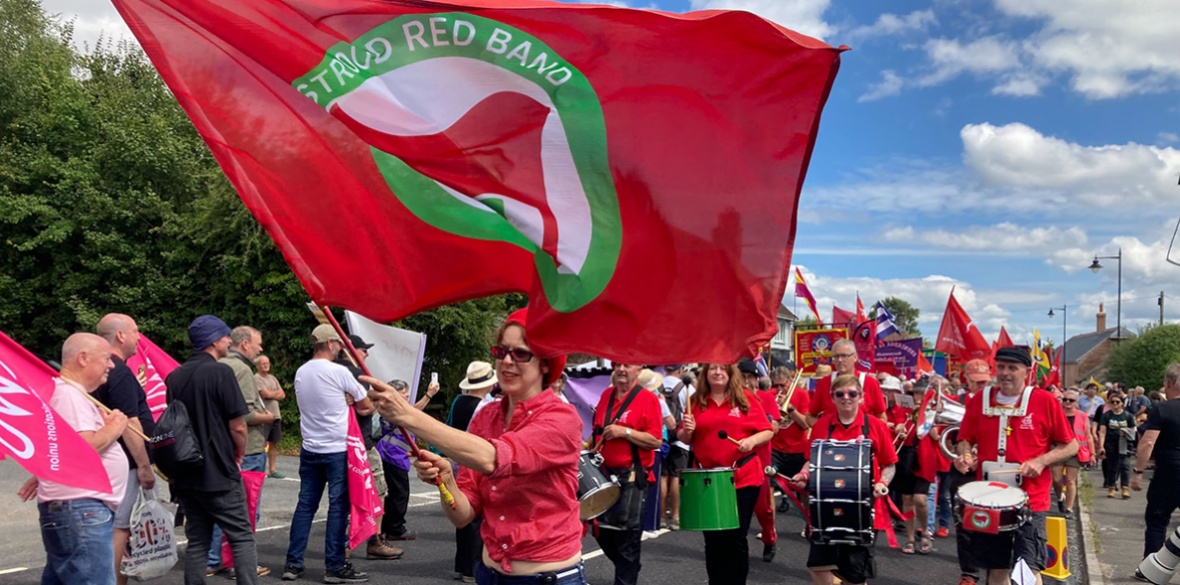
The Stroud Red Band take part in a march at the Tolpuddle Martyrs Festival in Dorset, July 21, 2024
Union leaders demand Labour deliver ‘deep and ambitious change’ as thousands attend the Tolpuddle Martyrs Festival in Dorset
UNION leaders issued a stark warning today, urging the new Labour government to deliver real change as thousands lined the streets at the Tolpuddle Martyrs Festival in Dorset.
Trade unionists taking part in the annual procession marched to brass bands and chanted “Oh Jeremy Corbyn” and “Keir Starmer you can’t hide, we charge you with genocide.”
They then cheered Bibby Stockholm refugees as they took centre-stage alongside general secretaries Matt Wrack (FBU), Paul Nowak (TUC) and Sharon Graham (Unite).
TUC president Matt Wrack said Prime Minister Sir Keir Starmer must raise expectation that Labour will use its overwhelming party majority to deliver the “significant change” the public wants to see.
“We want to see our rights restored, we want to see public services restored, we want to see homes rebuilt we want to see our wages rebuilt and restored after 14 years of attacks,” he said.
“I say this to the new Labour government as a Labour-affiliated union: this government needs to start to offer hope, because there are some stark warnings within that election.”
Noting the historically low vote share for Labour and high support for Reform in this month’s general election, he said: “What we cannot afford is further disillusionment within traditional Labour voters.
The new Labour government laid out its legislative plans in the King’s Speech and, whilst there are a few commitments to celebrate, there are far more glaring omissions that would go a long way to building a fairer society for all.
With that said, we wholeheartedly welcome plans to bring our railways back into public ownership and end no fault evictions for renters – policies that are key elements in our 5 Demands to build an alternative to the misery faced by millions. We also welcome the intention to introduce the Hillsborough Law and Martyn’s Law to ensure accountability and justice for the victims of gross systemic failings. As well as this, we are pleased to see the long-awaiting conversion therapy ban remain on the parliamentary agenda and hope that the introduction of this law will end the cruelty faced by far too many experiencing gender dysphoria and play a key role in a kinder and dignified level of healthcare needed by transgender and non-binary people.
However, the complete and utter moral failure to abolish the disgusting and punitive two-child benefit cap, which was implemented by the Tories and has pushed countless families into poverty. The pleas from numerous campaigners have fallen on deaf ears in the new government. We totally condemn the lack of political will from Keir Starmer’s Labour Party who, make no mistake, have made the conscious choice to keep millions of children in destitution and food insecurity.