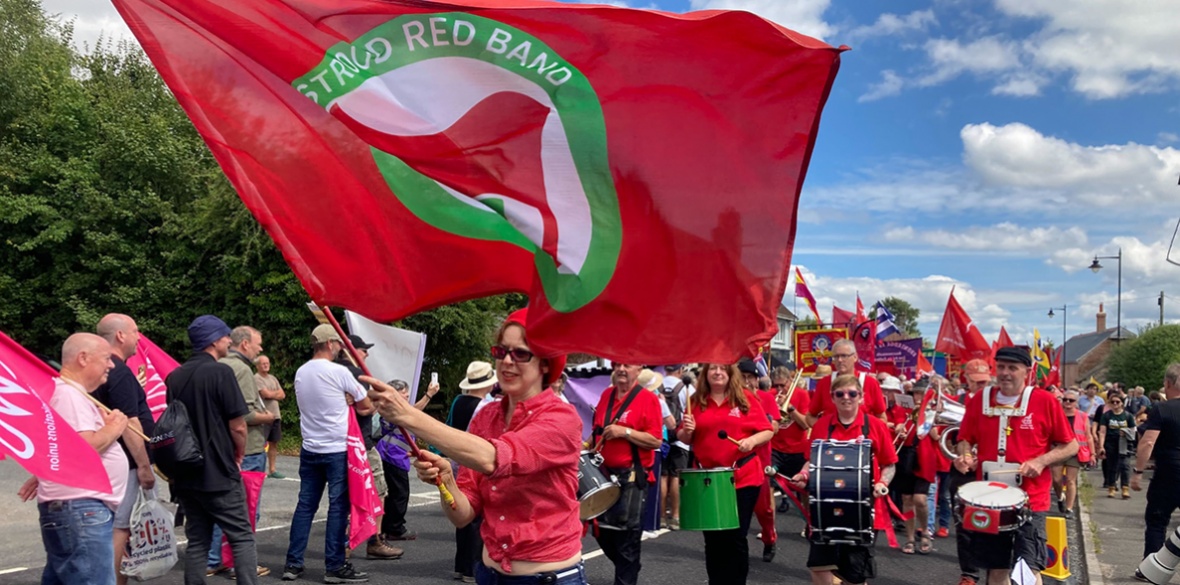
The Stroud Red Band take part in a march at the Tolpuddle Martyrs Festival in Dorset, July 21, 2024
Union leaders demand Labour deliver ‘deep and ambitious change’ as thousands attend the Tolpuddle Martyrs Festival in Dorset
UNION leaders issued a stark warning today, urging the new Labour government to deliver real change as thousands lined the streets at the Tolpuddle Martyrs Festival in Dorset.
Trade unionists taking part in the annual procession marched to brass bands and chanted “Oh Jeremy Corbyn” and “Keir Starmer you can’t hide, we charge you with genocide.”
They then cheered Bibby Stockholm refugees as they took centre-stage alongside general secretaries Matt Wrack (FBU), Paul Nowak (TUC) and Sharon Graham (Unite).
TUC president Matt Wrack said Prime Minister Sir Keir Starmer must raise expectation that Labour will use its overwhelming party majority to deliver the “significant change” the public wants to see.
“We want to see our rights restored, we want to see public services restored, we want to see homes rebuilt we want to see our wages rebuilt and restored after 14 years of attacks,” he said.
“I say this to the new Labour government as a Labour-affiliated union: this government needs to start to offer hope, because there are some stark warnings within that election.”
Noting the historically low vote share for Labour and high support for Reform in this month’s general election, he said: “What we cannot afford is further disillusionment within traditional Labour voters.
The new Labour government laid out its legislative plans in the King’s Speech and, whilst there are a few commitments to celebrate, there are far more glaring omissions that would go a long way to building a fairer society for all.
With that said, we wholeheartedly welcome plans to bring our railways back into public ownership and end no fault evictions for renters – policies that are key elements in our 5 Demands to build an alternative to the misery faced by millions. We also welcome the intention to introduce the Hillsborough Law and Martyn’s Law to ensure accountability and justice for the victims of gross systemic failings. As well as this, we are pleased to see the long-awaiting conversion therapy ban remain on the parliamentary agenda and hope that the introduction of this law will end the cruelty faced by far too many experiencing gender dysphoria and play a key role in a kinder and dignified level of healthcare needed by transgender and non-binary people.
However, the complete and utter moral failure to abolish the disgusting and punitive two-child benefit cap, which was implemented by the Tories and has pushed countless families into poverty. The pleas from numerous campaigners have fallen on deaf ears in the new government. We totally condemn the lack of political will from Keir Starmer’s Labour Party who, make no mistake, have made the conscious choice to keep millions of children in destitution and food insecurity.
Corbyn plans to host monthly “people’s forums”, which he describes as “a shared, democratic space” for local campaigns, and trade, tenants’ and debtors’ unions.
He believes these forums will form the basis of a new grassroots organising model that can be replicated across the country.
Most MPs hold regular surgeries for constituents to air their grievances or lobby the MP on a particular subject.
The Islington North MP called for people to “stand up for themselves and against those who have ignored their demands for peace and humanity”.
Green and independent candidates inflicted a series of blows against the Labour Party
Keir Starmer’s election victory has given Labour a firm grip on power – but a closer look at the results shows a party facing stiff opposition from the left. Many candidates standing on anti-austerity and pro-Palestine platforms have achieved impressive results, which could spark a wider political movement.
Across most of Great Britain, support for the Labour Party did not actually increase. It is thanks only to the UK’s First Past the Post electoral system that such a big landslide was possible.
With two seats still left to declare, Labour has won 9.6 million votes – around 33.7% of all votes cast. This is far less than the 12.8 million votes (40%) the party secured in 2017, when Jeremy Corbyn was leader.
Since the last election in 2019, Labour has increased its overall share of the vote by less than two points. Polling expert John Curtice says this was “entirely as a result of a 17-point increase in support in Scotland”, following a collapse in SNP support.
Starmer’s victory, Curtis explains, was not so much due to a rise in support for the party, but “largely on the back of a dramatic 20-point decline in Conservative support”.
The Labour leader’s allies will, no doubt, use the result to show that the party can win elections only from the centre ground – and will continue to push out any opposition from the left. But yesterday’s vote also represents a major shift in support for left-wing candidates.
At the last election, no independent candidates won a seat. This time around, independents secured an impressive share of the vote and inflicted a series of major blows to Labour, winning in five constituencies in England. Many such candidates had stood on pro-Palestine platforms, highlighting Starmer’s support for Israeli atrocities in Gaza.
Independent Shockat Adam defeated Labour shadow cabinet minister Jon Ashworth in Leicester South, which was meant to be a safe seat; Ashworth had won by more than 22,000 votes in 2019. After the result was announced, Adam said: “This is for the people of Gaza.”
Elsewhere, IT consultant Iqbal Mohamed, pulled off a landslide victory against Labour in the constituency of Dewsbury and Batley in West Yorkshire, winning by almost 7,000 votes.
A solicitor called Adnan Hussein, who stood as an independent candidate in Blackburn, secured a narrow win over Labour, in what the BBC described as a “stunning victory”.
And another pro-Palestine independent candidate, Ayoub Khan, beat Labour in the constituency of Birmingham Perry Barr.
Meanwhile, Corbyn – who also stood as an independent after being forced out of the party – won his seat in Islington North by more than 7,200 votes. This was despite Labour pouring significant support into the constituency, including visits from party grandees like Tony Blair’s former chief adviser, Peter Mandelson, and former deputy leader Tom Watson.
Corbyn, of course, benefited from being so well-known and having served the constituency for more than 40 years. But the scale of his victory was certainly not guaranteed. Shortly before the election, the constituency was described in the media as “marginal”.
Other independents came a close second or third. They include 23-year-old Liane Mohamed, who was within touching distance of kicking Labour’s shadow health secretary, Wes Streeting, out of his seat in Ilford North. She lost by just 528 votes.
In Chingford and Woodford Green, the Labour Party scored a spectacular own-goal by ditching its popular local candidate, Faiza Shaheen, in a last-minute deselection that split the left-wing vote and allowed former Conservative leader Iain Duncan Smith to retain the seat with 17,000 votes. Shaheen – whom Starmer previously campaigned with and described as “a fantastic candidate” – stood as an independent and won almost 12,500 votes – only 79 less than Labour.
Even in Starmer’s ultra-safe central London seat of Holborn and St Pancras, an independent candidate emerged out of nowhere to land a considerable blow. The Labour leader lost nearly 18,000 votes (more than 17%) from the last election, falling from 36,641 to 18,884. His rival, the anti-apartheid campaigner Andrew Feinstein, came second with 7,312.
All of these wins should worry Labour. Although its victory is clear, the party faces a significant electoral and political threat from left-wing and pro-Palestine opponents. If it wants to secure another victory at the next election, it must think very carefully about its stance on issues like Gaza, the NHS and the cost of living crisis.
There are reasons independent candidates often struggle to win seats at a general election. They receive little airtime from the media and lack the big financial donations that larger parties rely on.
The First Past the Post system also greatly benefited Labour in this election, when compared to the Green Party and others. This will reignite calls for proportional representation.
But despite these systemic obstacles, this time around, many independent candidates succeeded. Their message resonated with the public. So what would have happened if they had worked together on a left-wing platform of fighting injustices, both in the UK and further afield? The results today could well be very different in many areas.
If there was ever a good time for them to consider a new party, it’s now. Nigel Farage’s Reform UK has shown that a new party can burst onto the stage and win seats in Parliament. Given the success of many left-wing independent candidates, and the purge of left-wingers from the Labour Party, could the left learn something from this in time for the next election?
Zionist Keir Starmer is quoted “I support Zionism without qualification.” He’s asked whether that means that he supports Zionism under all circumstances, whatever Zionists do.