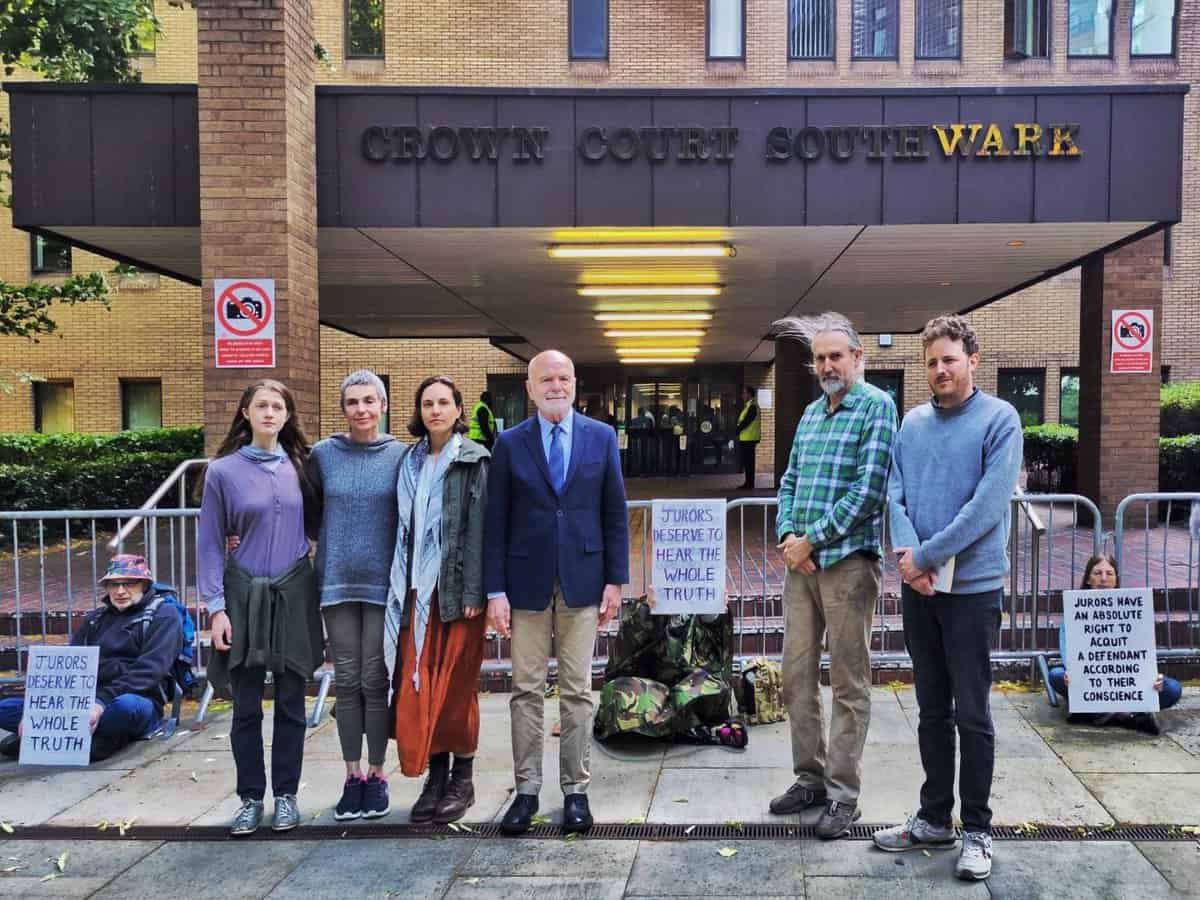
UN Special Rapporteur on Environmental Defenders under the Aarhus Convention Michel Forst attended the trial of five Just Stop Oil supporters at Southwark Crown Court. He attended as an observer because of his serious concerns.
The jury is now deliberating the verdict in a case involving Just Stop Oil supporters Daniel Shaw, Cressie Gethin, Lucia De-Abreu-Whittaker, Louise Lancaster, and Roger Hallam. The five are currently on trial at Southwark Crown Court. They are charged with conspiracy to cause a public nuisance in connection with the M25 gantry actions in November 2022.
They were first arrested in 2022 either pre-emptively in police raids at their homes after attending a Zoom call (in which a Sun journalist was present), or travelling near the M25. The Sun alleged it had ‘infiltrated’ the meeting, tipping off the police and enabling National Highways to secure a public injunction. Some of the five defendants were imprisoned for up to 113 days without trial. They were released subject to stringent conditions including a 10pm to 7am house curfew, stipulations not to be within a one-mile radius of the M25, no contact with other defendants, and not to participate in any climate change demonstration.
The trial began on 24th June, presided over by Crown Court Judge Hehir.
At the start of the trial, the office of the UN Special Rapporteur on Environmental Defenders released a statement expressing its views on the criminal prosecution of Daniel Shaw. Due to his “grave concerns” about the criminalisation of UK environmental defenders, Special Rapporteur Michel Forst attended the trial in person on 4th and 5th July. [1]
During the trial so far, Judge Hehir has ordered nine separate arrests from the courtroom: three times each for Roger Hallam and Daniel Shaw, twice for Louise Lancaster, and once for Cressie Gethin. Additionally, the defendants have collectively spent seven nights in remand since the trial began, with Daniel, Roger, and Louise each spending two nights, and Cressie spending one night.
On the 4th of July, the prosecution made a historic concession by admitting to the following, in the list of agreed facts to be presented for the jury’s consideration:
“1. On 17 December 2020, Her Majesty’s Treasury published the New Zero Interim Report which states, ‘Climate change is an existential threat to humanity. Without global action to limit greenhouse gas emissions, the climate will change catastrophically with almost unimaginable consequences for societies across the world.’ In recognition of the risks, the UK became, in 2019, the first major economy to implement a legally binding net zero target.
2. Scientific consensus is that beyond 1.5 degrees Celsius warming above pre-industrial levels risks catastrophic and irreversible consequences for humanity, which will be irreversible.
3. Over the past five years, the global average temperature rise since pre-industrial times has averaged just under 1.3 degrees Celsius. For the 12 months to June 2024, it averaged 1.63 degrees Celsius and is estimated to top 1.5 degrees Celsius permanently before 2030.
4. In October 2022, the UK Government opened the 33rd licensing round to allow oil and gas companies to explore for more fossil fuels in the North Sea.”
Despite the presence of these agreed facts and the explicit provision for the defence of ‘reasonable excuse’ under section 78 of the Police, Crime, Sentencing and Courts Act 2022, Judge Hehir ruled that the defendants would not be allowed any defence under law, repeating at various points in the trial as well as in his written directions to the jury that any facts pertaining to “man-made climate change” were “entirely irrelevant” to the defendants’ charges.
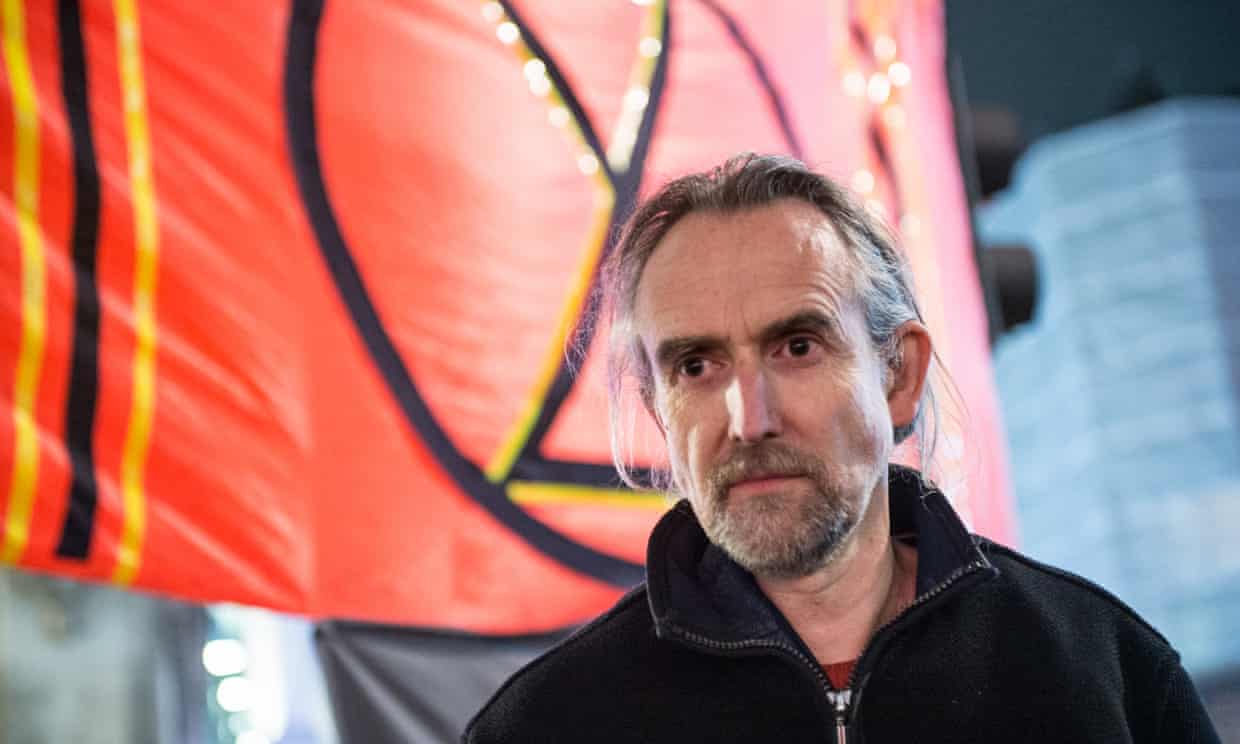
Roger Hallam, on trial for conspiring to block traffic on the M25 in 2022, said he wanted to ‘speak the whole truth’. Photograph: Ollie Millington/Getty
Accused speak out of turn about climate threat and challenge judge who orders jury to leave
There was chaos in the courtroom at a climate protest trial when two defendants stood and made statements defying the authority of the court.
At separate points during the trial on Thursday, Roger Hallam and Daniel Shaw, charged along with three others with conspiring to block traffic on the M25 in 2022, stood up in front of the jury and spoke out of turn.
Hallam, whose evidence was discontinued on Wednesday, stood up just as court got under way on Thursday and said: “I wish to communicate to the jury and the court that I was forcibly removed from the court yesterday for refusing to break my oath and speak the whole truth.”
Later on, while Louise Lancaster, a co-defendant, was in the witness box, Shaw, whose evidence was also discontinued on Wednesday, stood up from his place in the court and directly challenged the judge.
He said: “Climate change represents an existential threat to humanity. The court agrees with that. Why are you not trying the people causing this crisis?”
Each time the defendants continued speaking as the judge, Christopher Hehir, ordered the jury to leave the court.
Lancaster refused to submit to cross-examination by the prosecution, as Shaw and Hallam had done the previous day, prompting Hehir to discontinue her evidence.
Hehir told jurors: “Members of the jury, in your absence I had a discussion in open court with Miss Lancaster. In frank and straightforward terms she has told me she is not prepared to submit to cross-examination. In those circumstances her evidence is at an end.”
UN Special Rapporteur on Environmental Defenders under the Aarhus Convention and former UN Special Rapporteur on Human Rights Defenders Michel Forst is attending the ongoing trial of five Just Stop Oil supporters at Southwark Crown Court today. He is attending as an observer because of his serious concerns.
The special rapporteur’s office released a statement on 24th June detailing his views regarding the criminal prosecution of Daniel Shaw in this trial. The statement can be read here.
The Aarhus Convention, to which the UK is a signatory, aims to promote environmental democracy by ensuring public access to information, participation in decision-making, and access to justice in environmental matters. The Special Rapporteur monitors the implementation of the convention’s provisions by its parties, ensuring compliance with obligations related to access to justice. Additionally, the Special Rapporteur investigates complaints from individuals or groups alleging violations of their rights under the Aarhus Convention, assesses specific cases, and makes recommendations to ensure compliance.
Daniel Shaw, Cressie Gethin, Lucia De-Abreu-Whittaker, Louise Lancaster and Roger Hallam are currently on trial at Southwark Crown Court, charged with conspiracy to cause a public nuisance in connection with the M25 gantry actions in November 2022. They were arrested either pre-emptively in police raids at their homes after attending a Zoom call in which a Sun journalist was present, or arrested travelling near the M25 respectively. The Sun alleged it had ‘infiltrated’ the meeting and boasted of tipping off the police and enabling National Highways to secure a public injunction.
Some of these five were imprisoned for up to 113 days without trial. They were released subject to stringent conditions including a 10 pm to 7 am house curfew, not to be within a one-mile radius of the M25, no contact with other defendants and not to participate in any climate change demonstration.
In another trial involving Just Stop Oil supporters, which was the first under the new Public Order Act 2023 for a Section 7 offence, Judge Hehir who is overseeing the current proceedings barred all legal defences from the defendants and prohibited any mention of the climate crisis to the jury. This trial concluded with a conviction, and Judge Hehir is expected to sentence the defendants at a future date.
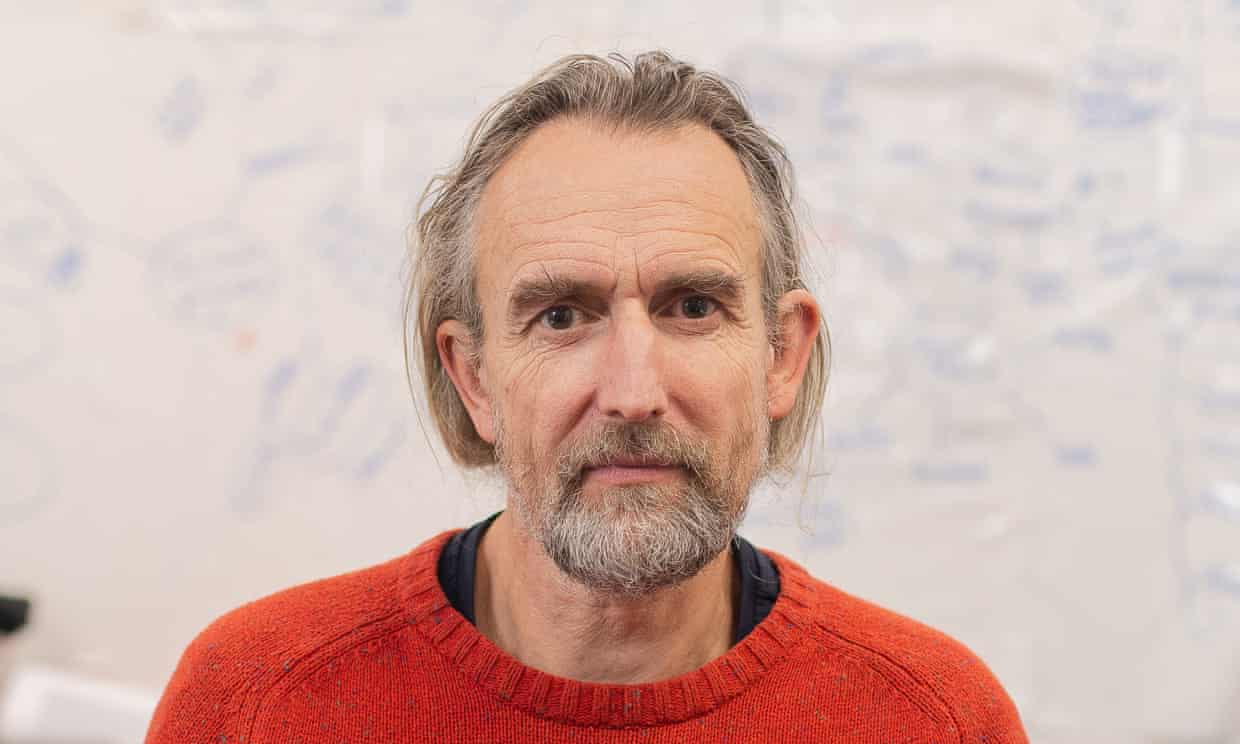
Roger Hallam is on trial with others accused of conspiracy to cause a public nuisance. Photograph: Alecsandra Raluca Drăgoi/The Guardian
A climate protester ignored a judge’s instructions and refused to leave the witness box, instead delivering an hours-long speech telling jurors that his alleged role in a conspiracy to block the M25 was justified by the risk of human extinction.
Roger Hallam, 58, spoke for more than two hours on why a judge was wrong to rule that he and co-defendants could not bring evidence in their defence on the impacts of climate breakdown, and why such evidence justified the sort of acts of which they are accused.
The judge Christopher Hehir sent out the jury three times during Hallam’s extended address, left the court himself once, and interrupted Hallam many times to make clear it was not his place to instruct jurors on points of law.
But Hehir eventually let Hallam continue, to the defendant’s apparent surprise. “I apologise to you if I’m a little bit incoherent,” Hallam told jurors towards the end of his address. “I didn’t actually expect that I was going to get this far.”
Hallam is on trial alongside Louise Lancaster, Daniel Shaw, Cressida Gethin and Lucia Whittaker-de-Abreu on a charge of conspiracy to cause a public nuisance for allegedly organising activists to climb gantries on the M25 over four days in November 2022.
…
Hehir repeatedly interrupted Hallam. “I’m not going to permit you to lecture the jury, wrongly or rightly, about the law,” he said.
Hehir had ruled that the defendants could not bring extensive evidence about the impacts of climate breakdown but that they could speak about their political or philosophical beliefs on the issue, to give context to actions.
Hallam’s speech led Hehir to send the jury out of the courtroom three times. Hehir told jurors they were to take instructions on the law only from him and that Hallam’s evidence about the impacts of climate change was not relevant.
Democracy is a precious, and essential part of our society. Our leadership must always be accountable to the people, and if they are not, we risk oppression. We are, without a doubt, lucky to live in a liberal representational democracy, and when the time comes to vote, we should. So why then, are people acting politically, with civil resistance, outside of this mechanism?
Over the last twelve months, thousands of people in the UK have engaged in peaceful resistance, and over a hundred (and counting) have been imprisoned. It’s not just in this country, in Canada ‘Save Old Growth’ are blocking motorways demanding no more felling of ancient trees. In France, Germany, Italy, Austria, Norway, the USA and Australia, ordinary people are resisting, disrupting transport and cultural activities – demanding that their states act to protect, not destroy, life.
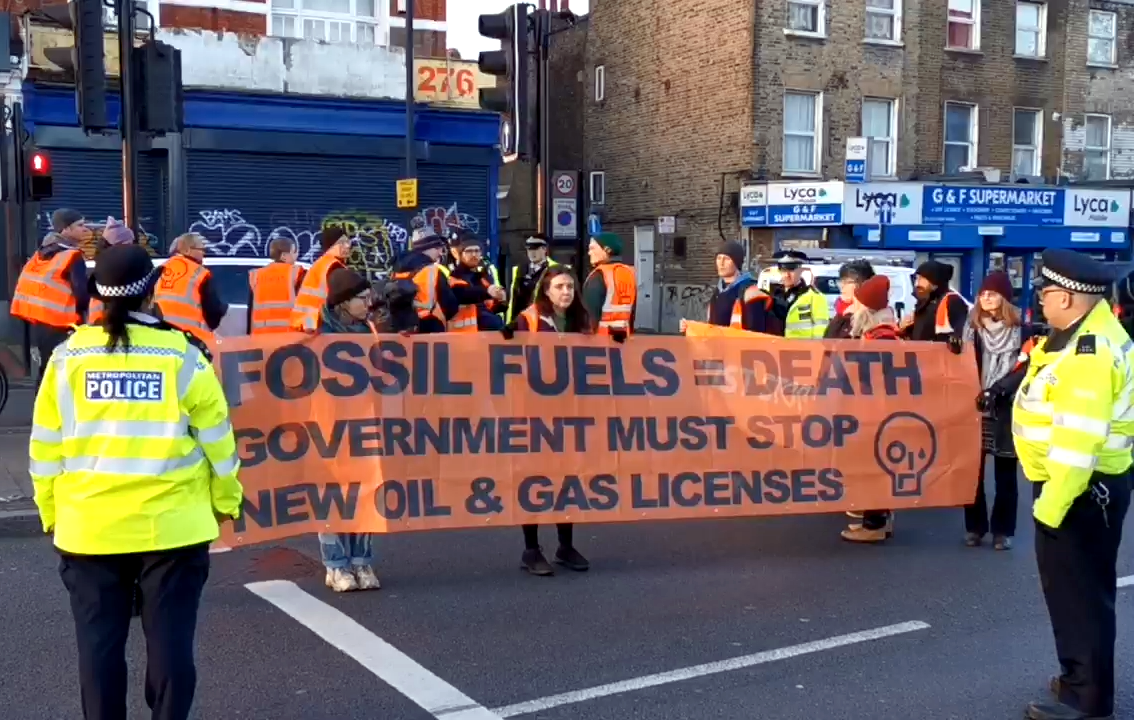
They are ordinary people – coming together and acting out of love as much as fear and grief. Engaging in civil resistance, and defying a state, that while democratically elected, has proved deeply harmful. There’s no denying this harm – while the International Energy Agency has made it clear we can have no more new oil and gas development, the UK Government is ready to approve new oil fields and issue new exploration licenses, a death sentence for millions.
Our politicians say they are ‘committed to reaching net zero’. What they are actually committed to is kicking the can down the road and round the corner. Gambling on unproven or non-existent technology to reverse our dumping of CO2 into the atmosphere.
Instead of taking action, they’re making the problem worse for another 30 years, literally pouring fuel on the fire. The UK is the home of BP and Shell who are making eye-watering profits, and enjoying tax breaks to destroy life – because “pensions”, because “jobs”, because “economic growth”.
A stable climate is not a competing policy demand to be set against pensions, transport, or public sector funding. One provides the basis for everything else, there simply isn’t a contest. Our predicament is almost comically simple – either we stop the destruction of the global systems that enable ordered civil society to work or we lose everything we value, our traditions, our cherished landscapes and, crucially, democracy. There are no free and fair elections on a burning earth.
In 2019 the MoD published a report outlining what is coming if we don’t immediately reduce carbon emissions – “increased conflict over diminishing natural resources”. That’s code for war. War over food and water – and we know what war looks like, flattened cities, dictator warlords, child traffickers waiting on borders, tortured grandfathers – it’s being documented once again in Europe.
So what has happened in the UK to protect against this future? Traffic on the M25 has been disrupted, London bridges closed, oil terminals have been blockaded and occupied, football matches interrupted. Inept radio hosts have sparked viral memes about growing concrete and inspired themed stag nights. Just Stop Oil, Insulate Britain, XR and Stop HS2 have been painted on both the Left and Right as an eco-mob, eco-fascists, as selfish, naive and childish. But perhaps the most damaging criticism is that they are anti-democratic.
It’s as if every right and freedom we enjoy has been handed to us by a benign government. As if the Suffragettes never smashed windows, as if the race riots never happened, as if Stonewall simply wrote letters, as if those demanding disability rights didn’t chain themselves to railings and buses, as if the poll tax was scrapped due to reasonable debate and discussion or waiting politely for a chance to vote. Change requires citizens to stand up and resist harmful governments, it is part of democracy.
Resistance has nothing to do with “protest”. Protest is when you express your disapproval. You do not express disapproval when murderous governments engage in an act condemning the world to go over 1.5C in the 2030s – a death sentence for small island states and millions in the global south. Pakistan today demonstrates what we face – 33 million people impacted by floods and agriculture decimated.
We know what to do. It’s what the Suffragettes did, it’s what the Civil Rights movements did, it’s what everyone does when the inalienable right to life and a livelihood are violated. We engage in non-violent civil resistance.
What we must do now is block and disable the cogs of the machine. This is not a “tactic” – it is an act of self respect, an act of solidarity, an act of love and necessity.
We must resist now or we will look back with longing at all we have lost. The last 250 years of sacrifice and tears expended by generations to create decent societies is about to be snuffed out in the blink of an eye. The word betrayal does not cover the reality of what is going on. All our traditions, all our values, all that we claim to stand for is about to be lost.
It’s not about winning. It’s about doing what has to be done. Those who fought fascism in the 20th century, those who are fighting the oil companies across the global south, those fighting the Russians in Ukraine, they act because they know someone has to stand up.
The next generations are watching us. Can you feel the weight of billions of children yet to take their first breath? They are saying “Are you mad? Get out there, and stop this – or you condemn us forever”.
dizzy: 1. I submit that we exist in a plutocracy rather than a democracy. 2. I couldn’t find the MoD article containing the quotation “increased conflict over diminishing natural resources”. I suspect that it existed but is no longer published openly. There are plenty of official reports making similar points and it is a reasonable statement. For example the WORLD DEVELOPMENT REPORT 2011, ‘Resource Scarcity, Climate Change and the Risk of Violent Conflict’ Alex Evans, Center on International Cooperation, New York University, September 9, 2010 makes similar claims. Edit: Despite that article being a very wooly academic paper, I think that it does make that claim
Although the conflict risk posed by climate change and resource scarcity will almost always be better understood as a ‘threat multiplier’ than as a sole cause of violent conflict, a range of potential linkages between climate, scarcity and conflict risk can nonetheless be identified, whether through intensifying existing problems, or through creating new environmental problems that lead to instability.
USAID (2009). Climate Change, Adaptation and Conflict: A preliminary review of the issues. CMD Discussion Paper no. 1, October 2009