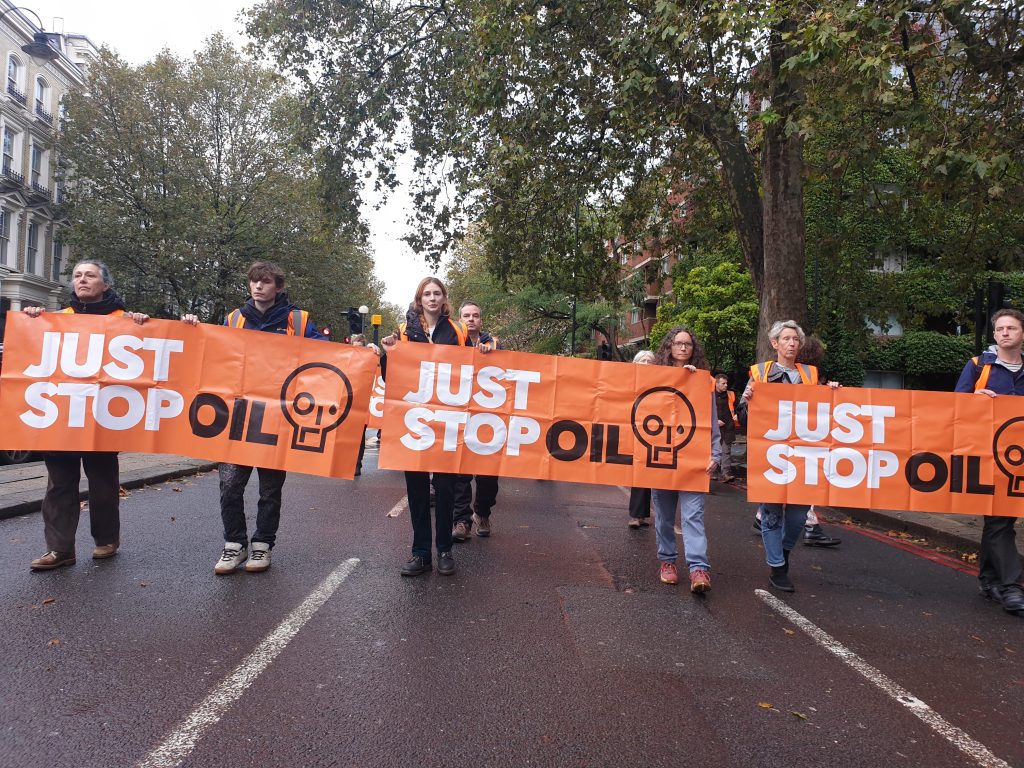
The paper is expected to reignite criticism of the UK’s Conservative government, which has promised hundreds of oil and gas exploration licenses to boost the North Sea industry. Photograph: Russ Bishop/Alamy
Researchers say world has enough fossil fuel projects planned to meet demand forecasts to 2050 if net zero is reached
The world has enough fossil fuel projects planned to meet global energy demand forecasts to 2050 and governments should stop issuing new oil, gas and coal licences, according to a large study aimed at political leaders.
If governments deliver the changes promised in order to keep the world from breaching its climate targets no new fossil fuel projects will be needed, researchers at University College London and the International Institute for Sustainable Development (IISD) said on Thursday.
The data offered what they said was “a rigorous scientific basis” for global governments to ban new fossil fuel projects and begin a managed decline of the fossil fuel industry, while encouraging investment in clean energy alternatives.
By establishing a “clear and immediate demand” political leaders would be able to set a new norm around the future of fossil fuels, against which the industry could be held “immediately accountable”, the researchers said.
Published in the journal Science, the paper analysed global energy demand forecasts for oil and gas, as well as coal- and gas-fired electricity, using a broad range of scenarios compiled for the UN Intergovernmental Panel on Climate Change that limited global heating to within 1.5C above pre-industrial levels.
It found that in addition to not needing new fossil fuel extraction, no new coal- and gas-fired power generation was needed in a net zero future.
The paper is expected to reignite criticism of the UK’s Conservative government, which has promised to offer hundreds of oil and gas exploration licenses to boost the North Sea industry, a policy that has emerged as a key dividing line with the opposition Labour party before the 4 July general election.
Labour has vowed to put an end to new North Sea licences if it comes to power, and also plans to increase taxes on the profits made by existing oil and gas fields to help fund investments in green energy projects through a new government-owned company, Great British Energy.
We’ve now had 11 record-breaking months of heat in a row and sea surface temperatures in the North Atlantic have soared to their highest in at least 40 years.
So you can see why forecasts have warned that the continent could be in for another unusually hot summer – possibly even the hottest on record.
…
Europe has been warming at twice the global average since 1991, according to recent data from the World Meteorological Organisation (WMO) and EU climate agency Copernicus (C3S). The continent is “no exception” when it comes to the consequences of climate change with both agencies warning that Europe needs to do more to cut its emissions and transition away from fossil fuels.
dizzy: Moving away from fossil fuels is the appropriate way to address the climate crisis. Anything else is not addressing the problem.In the UK that’s no more oil or gas licences and stopping Rosebank i.e no new fossil fuels.
Climate campaigners should be thinking about the likely headlines coming out of the important European Parliament elections taking place from June 6-9.
The Parliament passes EU legislation alongside the Council of Ministers (representing EU Member State governments) following formulation by the European Commission in the EU’s tripartite rule-making system.
The latest poll of polls by Politico, released May 24, predicts a hard-right shift by voters for Parliament representatives, followed by related attacks on EU climate policy, which is now one of the lead policy objectives of the right across Europe.
The polls show the hard-right Identity and Democracy Group, which includes Italy’s Lega (LSP) and France’s Rassemblement National (RN) rising to 66 seats from 59 in the 720-seat parliament. That may now be optimistic given the expulsion last week of Germany’s Alternative für Deutschland from the group.
The predicted rise would see it close in on Renew Europe, the pro-EU party that includes France’s Mouvement Democrate and the Dutch D66 and VVD parties, which is forecast to slip to 82 seats from 102.
A marginal rise in seats is also predicted for the right-wing European Conservatives and Reformists Group (ECR), from 72 to 74.
That will create serious climate headwinds in the European Parliament.
‘Anti-Woke’
Right-wing parties now regularly oppose votes on environmental issues and are increasingly formulating their own “Motions for Resolutions” (proposals put forward for vote) with an anti-regulatory stance.
The hard-right push won’t make the European policy weather though.
That’s made largely by the centre-right European People’s Party (EPP, Christian Democrats) – predicted to make a marginal rise to 176 from 174 seats – and the left-wing Progressive Alliance of Socialists and Democrats (S&D), also predicted to rise slightly to 144 from 140 seats.
The forecast is not cheery here either.
Sustainability campaigners say political support is waning for environmental, social and governance (ESG) – a moniker that started life in the push for policy and action in financial markets, but has become a broader catch-all term for sustainable economics.
The EPP’s backing of ESG votes has dropped by 40 percent between 2020 and 2023, according to data compiled for nongovernmental organisations and seen by DeSmog.
Even support from the left (S&D) has dropped by 10 percent, while Renew Europe backed 15 percent fewer ESG policy initiatives over the same period.
Why?
Campaigners say part of the answer lies in the transatlantic wave effect of the so-called “anti-woke”, anti-ESG campaign from the United States to Europe.
The U.S. anti-ESG movement has been driven largely by social wedge issues, such as LGBTQ+ rights and abortion, as well as diversity, equity, and inclusion (DEI) debates.
In Europe, cost-of-living and migration are the arguments being deployed to derail, delay, or water down ESG policies. National nuances include stoked-up controversy around the transition to greener heating systems in Germany and France, or farmers and groundwater nitrate pollution in the Netherlands and Belgium.
Political attacks, from both right and left, on legislation related to ecodesign for sustainable products to create a circular economy, nature restoration, and the phasing out of internal combustible engines, have prompted the European Commission to delay green policies for fear of sparking an even wider backlash. Progressive groups have been slow to respond, fearing electoral consequences.
Green Deal
The European Union’s framework for a green, responsible economy looks roughly like this: The Green Deal provides the top-down policy direction for reducing emissions and green incentives, which feeds into the Green Taxonomy to classify what kinds of investments can be considered green. The Corporate Sustainability Reporting Directive (CSRD) requires companies to report on sustainable activities, and the Sustainable Finance Disclosure Regime (SFDR) forms an equivalent rulebook for investors.
The EU’s regulatory activity between 2018-2024 has been a huge boost for sustainable finance.
Has policy always been good? No. There is work still to do to make the rules pragmatic and understandable in terms of output. But this is the nature of regulation in these days of intense lobbying, counter-lobbying and political expediency.
The end of the implementation phase for much of the EU’s regulatory advances comes next year. That will be a dangerous time. The cost of these policies will be fully visible for businesses, and ripe for pushback.
In an inflationary economy, right wing parliamentarians will frame the financial and social implications of ESG regulations as unnecessary; too much, too soon, too costly.
Anti-ESG actors are already weaponising the debate.
Investors in the sustainable finance field expect the anti-ESG movement to become increasingly structured after the European Parliament elections.
They believe populist parties will seek to co-opt concerns in the corporate and financial services sectors over the costs of ESG compliance, and seek to align with trade associations to increase opposition to new green rules.
Indeed, European investors are already watering down their voting against pro-ESG shareholder resolutions, which is the primary way they can influence corporate activity.
A report earlier this year titled Voting Matters by ShareAction, the responsible investment campaign group, found that in 2023 just three percent of resolutions proposed to encourage companies to take action on carbon dioxide emissions and related environmental concerns were passed, compared to 32 percent in 2021.
In the first instance, climate campaigners in Europe need to pay much more attention to the policy programmes of the parties and then get out the vote for the European Parliamentary elections.
Closer relationships will need to be built with the EPP on how to make green regulation work for voters in the longer term to head off the hard-right challenge.
Much more clarity is also required on how green regulation can be used to incentivise companies and investors to adopt changes that will improve the living standards and environment of citizens over realistic timeframes.
We should not shy away from the difficult debates and trade-offs that this will involve; indeed, we must be actively preparing for them.
Hugh Wheelan is co-founder of Response Global Media, publisher of Responsible Investor. He has written extensively on ESG, investment, corporate, and sustainability issues for international publications including Financial News, The Guardian, and The Financial Times.
I’m not concerned with the headline topic but Miliband makes claims that need to be fact checked:
“If every country in the world adopted Labour’s position [on deciding not to issue new oil and gas licences] it would have a transformative effect on the debate,” he said.
Is it Labour’s position not to issue new oil and gas licences? If it is, are they likely to abandon that position since the Labour Party seems to abandon every policy to be more Tory? Why position instead of policy? Because position can be abandoned easier?
Miliband said the party’s plans to ban new oil and gas licences are “the most progressive position of any major country in the world” but that the transition in the North Sea has to be properly managed to protect those working in existing fields.
So, it’s already qualified by Miliband in the very next paragraph? “… the transition in the North Sea has to be properly managed to protect those working in existing fields.” sounds like you and the Labour party are full of shit Ed.
later edit: What about Rosebank? Are the Labour party going to stop Rosebank? The Labour party are definately full of shit on climate if they’re going to let Rosebank continue.
Rishi Sunak on stopping Rosebank says that any chancellor can stop his huge 91% subsidy to build Rosebank, that Keir Starmer is as bad as him for sucking up to Murdoch and other plutocrats and that we (the plebs) need to get organised to elect MPs that will stop Rosebank.
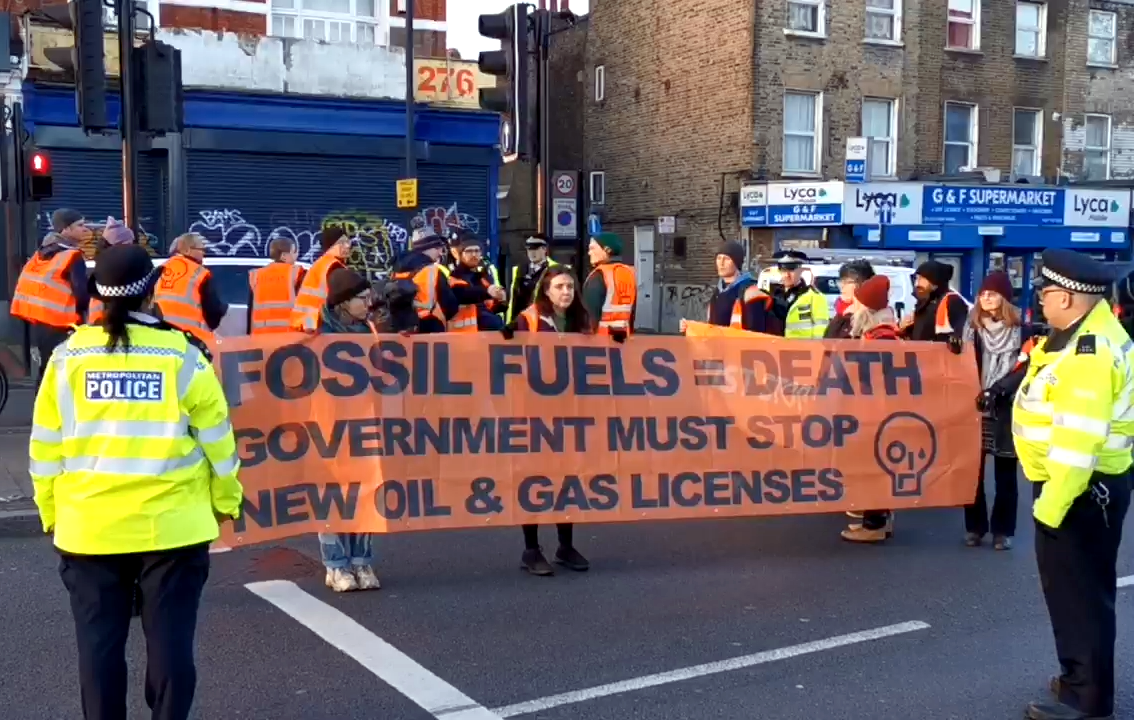
Just Stop Oil supporter Lora Johnson, 38, was acquitted of criminal damage by a Jury in front of Judge Grieve at Southwark Crown Court today. She was arrested on October 14, 2022, for spraying the iconic, triangular Metropolitan Police sign with orange paint in front of New Scotland Yard during Just Stop Oil’s month of action.
Lora was among the 637 people detained by police during a period of relentless civil resistance that month, demanding that the government halts all new oil and gas licences and consents. A video of Lora’s arrest from two years ago on Westminster Bridge, where she proclaimed that “inaction on climate change is a death sentence for all,”has been viewed more than 11 million times.
Johnson said today:
“I’ve just been found not guilty after six days at Southwark Crown Court by a jury of my peers. The action I took was painting the New Scotland Yard sign orange, in resistance to the government’s genocidal approval of new oil and gas licences.
“I would like to ask the MET police: who are they there to serve and protect? The good people of this country? Or the oil-corrupted government? I would like to ask them how they are planning to police the mass hysteria, the panic, the fear, the looting, the theft, the hoarding and the inevitable violence that will result when our shelves are empty and we can’t feed our children?”