Five Just Stop Oil supporters have disrupted a staging of the iconic musical ‘Les Misérables’ at the Sondheim Theatre in Westminster last night. Just like revolutionaries featured in the story, they are calling on everyone to take a stand against the government’s criminal plans to “max out our oil and gas reserves” and to join in civil resistance against new fossil fuels.
During the performance of ‘Do You Hear The People Sing?’, five Just Stop Oil supporters entered the stage carrying orange banners reading ‘Just Stop Oil’ and ‘The Show Can’t Go On’. They emerged during the song’s crescendo, amongst actors bearing revolutionary red flags. At around 8:50pm they locked themselves to the set using flexible bicycle locks, which theatre technicians were unable to remove. The performance was halted, and the theatre was evacuated by 9:10pm.
23 year old community worker Hannah Taylor is one of those who took action today. They said:
“The show starts with Jean Valjean stealing a loaf of bread to feed his sister’s starving child. How long before we are all forced to steal loaves of bread? How long before there are riots on the streets? The show cannot go on. We are facing catastrophe. New oil and gas means crop failure, starvation and death. It is an act of war on the global south and an utter betrayal of young people.”
“Rishi Sunak has just approved Rosebank, a new oil project in the north sea which will produce as much carbon as the annual emissions of the 28 lowest-income countries combined. It will lead to hundreds of thousands of deaths due to starvation as crops fail in the increasingly extreme weather conditions.”
“Am I not, like Jean Valjean, justified in breaking the law to oppose this criminal government and its murderous policies? Ask yourself, will you, like the citizens of Paris in the play, stand by and watch, or will you stand up against our governments’ criminal plans and call for an end to new oil and gas?”
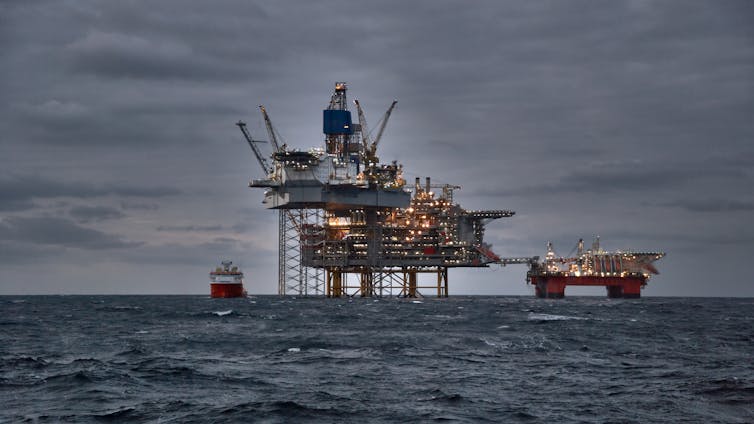
In a four-line statement announcing the approval of the new Rosebank oil field 80 miles west of Shetland, the UK’s offshore oil and gas regulator showed its mission no longer serves the public good.
The announcement by the North Sea Transition Authority (NSTA), which regulates oil and gas extraction in the waters off the British coast, asserted that net zero considerations had been taken into account – a technical definition that makes it appear long-term oil production is compatible with climate goals. This has outraged and dismayed climate scientists, campaigners, and the many other people concerned about the UK’s faltering climate leadership.
The approval greenlights a process that is expected to produce first oil by 2026, and around 300 million barrels of oil (and a smaller amount of gas) over the next two decades. The project’s developers are Equinor, an oil company owned for the most part by the Norwegian state, and Ithaca Energy, owned by the Delek Group listed on the Tel Aviv stock exchange.
The decision is out of step with demands for rapid action on climate change coming from a range of quarters. This includes shareholder activists demanding corporations accelerate decarbonisation, direct action groups such as Just Stop Oil, and financiers concerned about the risks of “asset stranding” as renewables become cheaper than fossil fuels.
Public protests and legal challenges to the NSTA spotlight the irrationality and recklessness in the government’s expressed support for issuing new licenses. Activists are not alone in making this point.
A welter of scientific studies and reports by international agencies confirm that new fossil fuel extraction is incompatible with keeping global temperature increases well below 2℃.
Rosebank has been a major focus for climate activism in the past couple of years, as science, international policy and campaigners turn their attention to stopping new extraction, rather than solely focusing on reducing emissions. Calls to end new licensing for oil and gas are in line with climate science.
But a climate politics focused on new licensing alone misses the point. The thing is, like other North Sea oil fields yet to be approved, Rosebank was licensed for oil and gas extraction years ago.
The NSTA approval process follows licensing, sometimes after considerable time has passed. And it is this approval process that locks the UK into hydrocarbon production for years to come.
End ‘maximising economic recovery’
The core objective of the NSTA is to maximise the economic recovery of UK petroleum – a principle shorthanded as MER – as set out in the 1998 Petroleum Act. In practice, this means the regulator’s primary mission is to facilitate the extraction of oil and gas.
A revised strategy in 2021 paired MER with an obligation to support the UK’s net zero commitments. And the former Oil and Gas Authority changed its name to include an explicit reference to the “transition” in 2022, underpinned by ambitions for emissions reduction and decarbonisation.
NSTA sees its job as effecting the industry’s alignment with these goals. It is now also in charge of licensing for carbon capture and storage and offshore hydrogen storage.
Rosebank’s approval therefore reveals a deeper truth: the regulator’s guiding objective fails the public good test. Regulation aims to avoid economic, environmental and social harms, and ensure the public good through delivering collective benefits and upholding socially-desirable ideals. The Rosebank decision arguably breaches this principle.
Supporters of Rosebank argue it will contribute to the UK’s energy security and deploy decarbonisation technologies that reduce CO₂ emissions overall. These arguments do not stand scrutiny, however: oil from Rosebank, like around 80% of North Sea oil production, will be sold directly into international markets and will not materially affect the price of petrol or diesel for UK motorists.
Much of the value of that oil will flow into the portfolios of Equinor and Ithaca. That value could be harnessed to speed up transition to renewables or ensure its benefits are widely distributed, but that’s largely down to Equinor and Ithaca – not the UK government.
A decade ago, a decision by NSTA would not have raised much attention. Now it highlights a significant problem in need of reform. Piecemeal adaptation has left MER and other core regulatory principles untouched, which is at odds with the climate emergency.
Existing licensed fields escape the weak scrutiny embodied in instruments such as the climate compatibility checkpoint, a series of tests to be applied in decisions about future licensing rounds. What’s more, as a litmus test for approval, Rosebank indicates other licensed projects may get the go-ahead, like Cambo.
Removing NSTA’s central objective to maximise economic recovery requires nothing less than a rewrite of the Petroleum Act. This would be an opportunity to fundamentally revise what the North Sea is for, and whether or how to exploit its resources in the future. A start would be to consider a reversal of direction – a “minimising” of economic recovery, for example – which redefines the “economic” in terms of what is socially necessary.
Such a move will inevitably entail reviewing licences already in place, and will likely generate challenges from the sector and other powerful incumbents. Rosebank exposes, however, how the new mission of the offshore regulator has to be about securing a new public good. This needs wider social debate, and should ultimately be decided through parliament.
Don’t have time to read about climate change as much as you’d like?
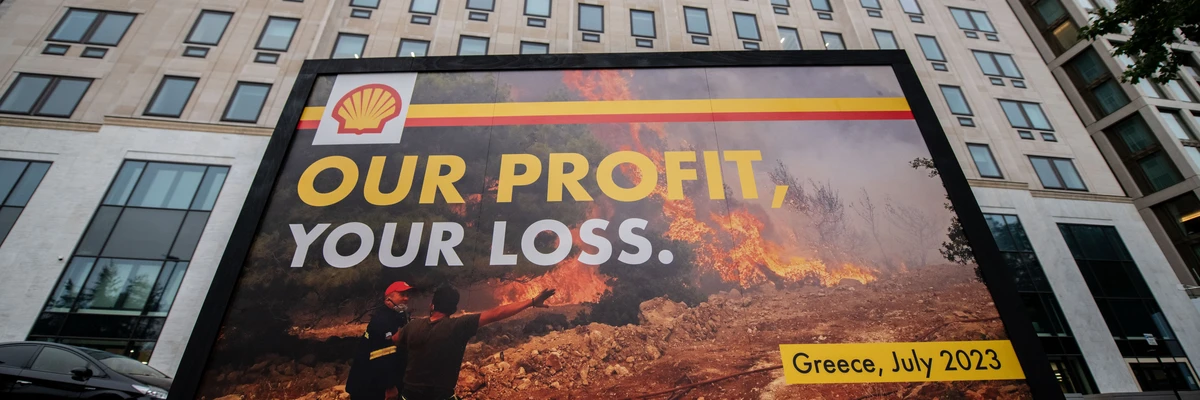
Greenpeace activists display a billboard during a protest outside Shell headquarters on July 27, 2023 in London. (Photo: Handout/Chris J. Ratcliffe for Greenpeace via Getty Images)
In February this year, the UK’s Climate Change Committee (CCC) wrote a letter to government in which it claimed that more domestic oil and gas extraction would have “at most, a marginal effect on prices”, recommending instead that the best way of reducing exposure to volatile energy markets is “cut[ting] fossil fuel consumption, improving energy efficiency, [and] shifting to a renewables-based power system”.
Meanwhile, research from campaign group Uplift reveals that gas from undeveloped UK oil and gas fields in the North Sea, including Rosebank, will deliver at most three weeks of energy to the UK per year, while oil would provide up to five years of oil demand, even if none of it were exported. In reality, most production from North Sea fields, along with Rosebank, which is joint-owned by Norwegian state oil major Equinor (40%), Canadian Suncor Energy (20%) and Israeli-owned Ithaca Energy (20%), is likely to be exported abroad, as is currently the case with 60% and 80% of North Sea gas and oil, respectively.
Further analysis of data from GlobalData reveals just how far burning oil and gas from Rosebank would threaten the UK’s climate targets. According to GlobalData, Rosebank contains the largest untapped oil and gas reserves of all proposed North Sea fields, with 370 million barrels of oil equivalent.
Using US Environmental Protection Agency (EPA) conversion figures – according to which one barrel of oil emits 0.43 tonnes (t) of CO₂ when burnt and 1,000 cubic feet of gas emit 0.0551t of CO₂ when burnt – Rosebank is likely to release 155 million tonnes of carbon dioxide (mtCO₂) into the atmosphere over its lifetime.
However, in a “balanced” net-zero pathway, as per the CCC’s sixth carbon budget, emissions from fossil fuels fall 75% by 2035 from 2018 levels. In total, emissions from “fuel supply” – predominantly made up of fossil fuels – amount to 298mtCO₂-equivalent (mtCO₂e) between 2023 and 2050, meaning lifetime emissions from Rosebank are equivalent to more than half of the UK’s remaining carbon budget for total fuel supply.
…
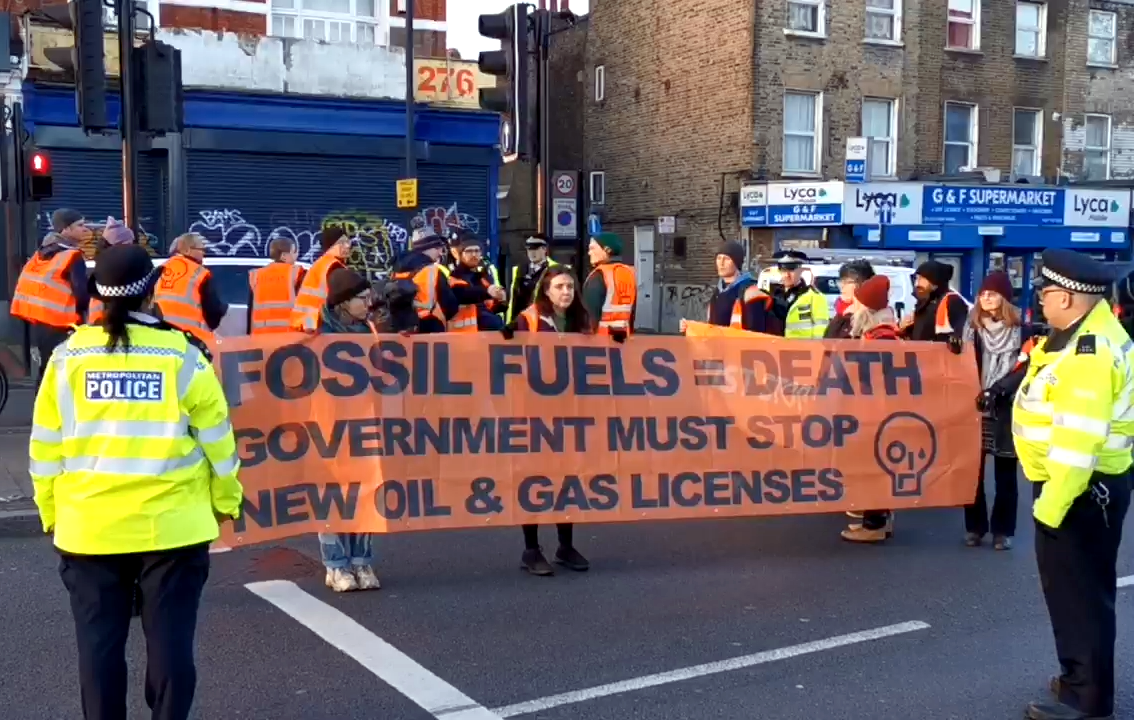
Just Stop Oil protesting in London 6 December 2022.
Decision by UK prime minister to water down key climate policies ‘really shocking to me’, says former US vice-president
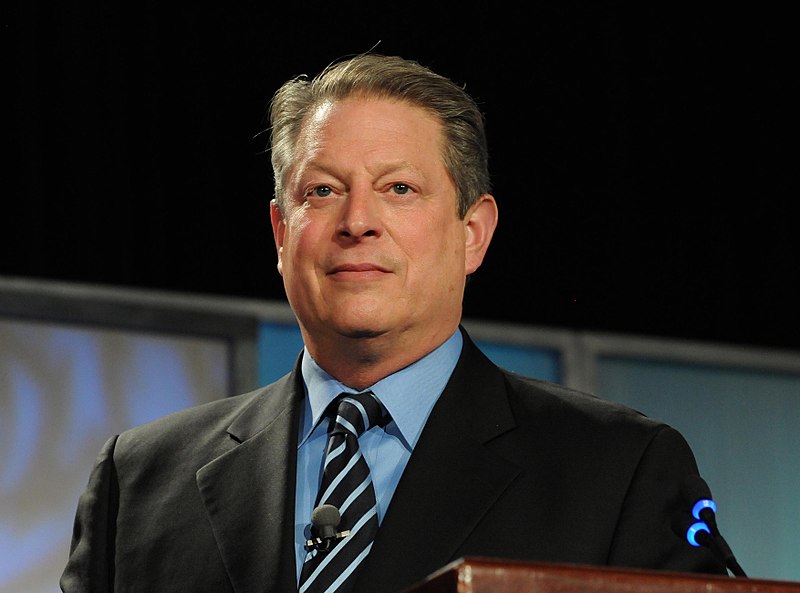
Image of Al Gore by JD Lasica Creative Commons Attribution 2.0 Generic license.
Al Gore, the former US vice-president, has described the decision by the UK prime minister, Rishi Sunak, to water down key climate policies as “shocking and disappointing” and “not what the world needs from the United Kingdom”.
Gore, now one of the world’s foremost advocates for swift action to avert the climate crisis, told CNN: “I find it shocking and really disappointing … I think he’s done the wrong thing. I’ve heard from many of my friends in the UK including a lot of Conservative party members who have used the phrase, ‘utter disgust’.
“And some of the young people there feel as if their generation has been stabbed in the back. It’s really shocking to me.”
UK not a serious player in global race for green growth, says Greenpeace, while Oxfam says move is ‘betrayal’
Just Stop Oil protesting in London 6 December 2022.
Jim Watson, professor of energy policy and director of UCL’s Institute for Sustainable Resources
“Rishi Sunak’s net zero speech is full of contradictions, and will make it harder to meet our medium- and long-term climate change targets. It also risks increasing the costs by delaying the shift away from fossil fuels and reducing the economic benefits to the UK.”
ProfSir Brian Hoskins, chair of the Grantham Institute at Imperial College London
“Our PM wants to have his cake and eat it when he says that the government wants to keep to the UK climate change targets but to weaken the policies to achieve them. These policies were already too weak according to the June report of its advisers, the Climate Change Committee.”
…
Rebecca Newsom, head of politics at Greenpeace UK
“The grim reality is that Britain is no longer seen as a serious player in the global race for green growth. Under the Conservative government, Britain has gone from leader to laggard on climate change and further planned U-turns leaked last night will only hasten our waning influence on the world stage.”
“Any further weakening of the government’s climate policies is a complete betrayal of people living in poverty – both in the UK and abroad – who are most vulnerable to climate change. The government needs to put long-term interests ahead of short-term politics and that means a fast and fair move towards renewable energy.”
One of the many occasions UK Prime Minister Rishi Sunak uses a private jet.
“Sunak’s U-turn today will be devastating for the people of the U.K. and for the planet we call home,” warned one Scottish Green. “It’s nothing short of evil.”
Critics across the political spectrum—from Conservative members of Parliament and corporations to Greens and climate campaigners—reacted with anger and resolve Wednesday following the announcement by U.K. Prime Minister Rishi Sunak that his Tory government would retreat from some of its key net-zero commitments.
Speaking Wednesday at the Downing Street Press Briefing Room in London, Sunak said his government is still committed to reaching net-zero by 2050, but in a “more proportionate way” that would bring a “greener planet and a more prosperous future.”
The rollback will reportedly include delaying a ban on the sale of petrol- and diesel-powered vehicles from 2030 to 2035, pushing back the phaseout of gas boilers, scrapping energy efficiency targets for some homes, dropping recycling plans, and canceling a planned air travel tax.
“This is a U-turn that will leave the Tories facing in the opposite direction of almost everyone, and finally end their hopes of reelection.”
“No one can deny climate change is happening,” Sunak said, adding that the county needs “sensible green leadership” instead of false choices that “never go beyond a slogan.”
However, Conservative peer Lord Zac Goldsmith — who resigned his ministerial post earlier this summer due to what he called Sunak’s climate “apathy” — called the prime minister’s reversal “a moment of shame.”
“His short stint as PM will be remembered as the moment the U.K. turned its back on the world and on future generations,” he added.
Rishi Sunak leads us down a path to societal collapse. A “greener planet and a more prosperous future” is impossible with our government’s issuing of 100 new oil and gas licences.
Renewables are the cheapest form of power today. They don’t cause mass death and destruction. pic.twitter.com/ujRArFQqjT
Shadow Climate Secretary Ed Miliband led Labour condemnation of the reversal, which he called “a complete farce from a Tory government that literally does not know what they are doing day to day.”
Brighton Pavilion Green MP Caroline Lucas slammed what she called Sunak’s “coordinated, calculated, and catastrophic rollback.”
“What this all reveals is that Sunak really doesn’t seem to care about the climate in the slightest—it’s little more than an afterthought,” Lucas wrote in a Guardian opinion piece published Wednesday.
Sunak must call a general election by January 2025, and his Tories are trailing the opposition Labour Party in opinion polls amid persistently high inflation, slow economic growth, and rising inequality.
“If Sunak mistakenly thinks the climate is merely a political device to draw dividing lines between his party and Labour, he will fail on his own terms,” wrote Lucas. “All it will do is draw an ever-greater divide between him and the people he seeks to govern.”
“The government needs to double down now, not U-turn,” Kennedy Walker, a U.K. organizer with the climate action group 350.org, said in a statement. “We have the opportunity to show what a transition to a greener economy that works for people and the planet can look like; we need to hold leadership to account to make sure it happens and they follow through on their own promises.”
Riffing on the government’s “long-term decisions for a brighter future” slogan, Extinction Rebellion U.K. wrote on the social media site X: “Short-term decisions for a shitter future. Remember, this government took £3.5 million in donations from Big Oil and other industries before licensing new gas and oil.”
Many companies including automaker Ford and energy giant E.ON joined in criticism of the rollback.
“Our business needs three things from the U.K. government: ambition, commitment, and consistency. A relaxation of 2030 would undermine all three,” Ford U.K. chair Lisa Brankin said Wednesday. “We need the policy focus trained on bolstering the EV market in the short term and supporting consumers while headwinds are strong: infrastructure remains immature, tariffs loom, and cost-of-living is high.”
We've signed an open letter alongside 400 other NGOs and businesses, expressing our concerns to @RishiSunak as he announces the UK government's weakening of net zero policies.
Some critics noted that Sunak’s announcement came on the same day the leaders of many nations—but not Britain or the world’s two top carbon polluters, China and the United States—gathered in New York for the United Nations Climate Ambition Summit.
“We’re in a climate emergency. The deadly impacts of climate change are here now and we have to act urgently,” Labour London Mayor Sadiq Khan—the only U.K. speaker at the summit — told The Guardian Wednesday. “We have seen record high temperatures in London earlier this month and the hottest ever July. Over the last two years, we have experienced unprecedented wildfires and flash floods, destroying homes and livelihoods.”
“This government’s response flies in the face of common sense and shows they are climate delayers,” Khan added. “It beggars belief that not only are they watering down vital commitments, but they are also passing up the opportunity to create green jobs, wealth, and lower energy bills—as well as failing to give investors the certainty they need to boost the green economy.”
It will be another shameful day if @GOVUK rows back on its Net Zero policies. Shortsighted, it will erode credibility at home & abroad. This isn’t the time to seek political advantage with games. Leadership and action are needed, not delay and procrastination.
Sunak’s reversal also infuriated many people in Scotland.
“Rishi Sunak has blood on his hands,” National Union of Students Scotland president and Scottish Young Greens co-convener Ellie Gomersall toldThe National. “His excuse? It’s too costly. Well then all the more kudos to the Scottish government who are still moving forward with net-zero policies like low-emission zones, phasing out gas boilers, cheaper public transport, all the while on a budget severely restrained by the confines of devolution.”
“And of course when the Scottish government does try to implement simple yet effective measures like a deposit return scheme, Westminster comes along and blocks it,” she added. “Sunak’s U-turn today will be devastating for the people of the U.K. and for the planet we call home. It’s nothing short of evil.”
Prof Dave Reay: “It’s not pragmatic, it’s pathetic. This rolling back on emissions cuts for short-term political gain will undermine the transition to net zero and with it the future opportunities, prosperity and safety of the entire country.”https://t.co/t9H64fBAZq
Alistair Heather, a Scottish writer and TV presenter, told The National that he was “almost pleased” by Sunak’s announcement.
“This is a U-turn that will leave the Tories facing in the opposite direction of almost everyone, and finally end their hopes of reelection,” he explained. “For mainstream voters, who understand that a clear, urgent movement of travel towards a green future is the best chance we have of mitigating the worst effects of the climate collapse, the Tories have made themselves completely unelectable. Good… Fuck the Tories. Mon the independence.”
“With the Left AWOL, our species is being quick-marched to extinction.”
The outrage was felt far beyond U.K. shores.
“At a time when the U.K. should be providing global leadership in transitioning off fossil fuels, especially in recognition of the impact its historical emissions have had in bringing about the climate crisis, the U.K. government is considering backtracking on already insufficient commitments,” 350.org Europe regional director Nicolò Wojewoda said in a statement.
Yanis Varoufakis, a former Greek finance minister who heads the left-wing MeRA25 party, wrote on X that “Sunak’s U-turn is a reflection of the total Europe-wide collapse of the market-based, neoliberal consensus on how to tackle the climate crisis. It marks the center‐right’s new path.”
“And with the Left AWOL,” he added, “our species is being quick-marched to extinction.”