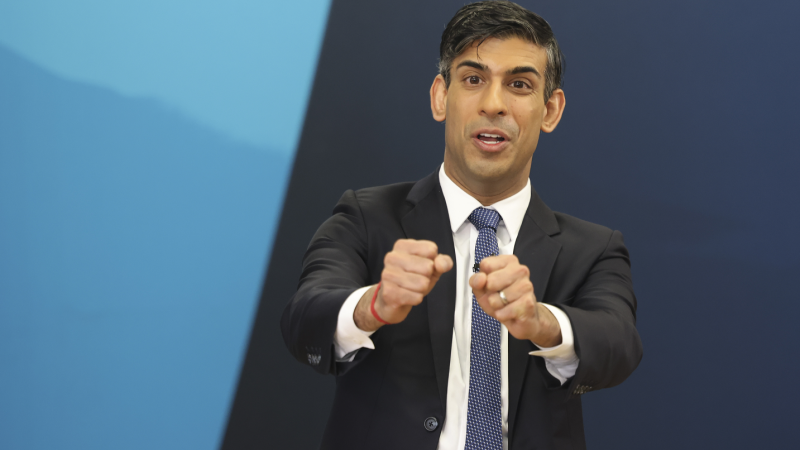
The Tory Party has spent an “unprecedentedly large figure” in the last month on advertising for Rishi Sunak’s Facebook page leading to a huge surge in followers, a transparency organisation has found.
Political transparency group Who Targets Me said Rishi Sunak’s spending on his own Facebook page in December was an “unprecedentedly large figure for a UK politician outside of an election period”.
Sunak appeared to buy more adverts in the last three months than Keir Starmer has in the three years and eight months he’s been Labour leader, which Who Targets Me stressed was a reminder of how digital campaigns are set to influence general elections in 2024.
Spending on Rishi Sunak’s Facebook page topped £42,000 in two weeks, with just over £9,000 spent on Meta adverts on 30th December alone and an additional £11,000 on New Year’s Eve.
According to Who Targets Me, the advertisements brought Sunak’s page a total of roughly 6 million impressions from December 25th to 31st. This has led to the page growing by nearly 100k in followers in the last month, making it now bigger than the main Conservative page, and Keir Starmers. However the official Labour Party page still has a fair hundred thousand followers more.
Palestinians inspect the damage following an Israeli airstrike on the El-Remal aera in Gaza City on October 9, 2023. Israel continued to battle Hamas fighters on October 10 and massed tens of thousands of troops and heavy armour around the Gaza Strip after vowing a massive blow over the Palestinian militants’ surprise attack. Photo by Naaman Omar apaimages. licensed under the Creative Commons Attribution-Share Alike 3.0 Unported license.
Expect the UK to intervene on Israel’s side in the South African case against Israel for Genocide at the International Court of Justice. If Israel loses, British ministers, civil servants and military personnal could end up in the dock for genocide – not only in the Hague, but in the UK.
…
What has the UK government done to aid and abet the genocide? It has:
1) Actively encouraged and incited genocide, including by the systematic obstruction of ceasefire resolutions at the UN Security Council; 2) Provided military equipment to Israel, with dozens of flights from RAF Akrotiri to Israel during the course of the genocide itself; 3) Provided communications intelligence to Israel to assist in genocide; 4) Provided aerial surveillance to Israel to assist in genocide.
These are for certain. It is also widely rumoured that UK Special Forces have participated directly in the genocide. That is something the prosecution will have to determine.
There has been a great sense of impunity among the zionist-controlled political classes: they have believed that they were in no danger of any personal retribution for their part in the brutal destruction of thousands and thousands of young children. In fact they felt able to turn the power of the state against anybody protesting that destruction.
There has been no legal jeopardy to anybody supplying, inciting or cheering on Israel’s monstrous atrocities. The jeopardy has all been felt by those opposing the atrocities.
That all changed with South Africa’s reference to the International Court of Justice. A determination of genocide by the International Court of Justice must be respected by the International Criminal Court and it will be impossible even for the odious Karim Khan to avoid bringing prosecutions against the perpetrators. Similarly in the UK, the fact of genocide being legally established, a police investigation will be obliged simply to focus on whether the UK aided and abetted it.
Quite simply, if you ask the police to investigate Sunak for aiding and abetting genocide today, they will laugh at you and say there is no genocide. After an ICJ judgment they can no longer do that
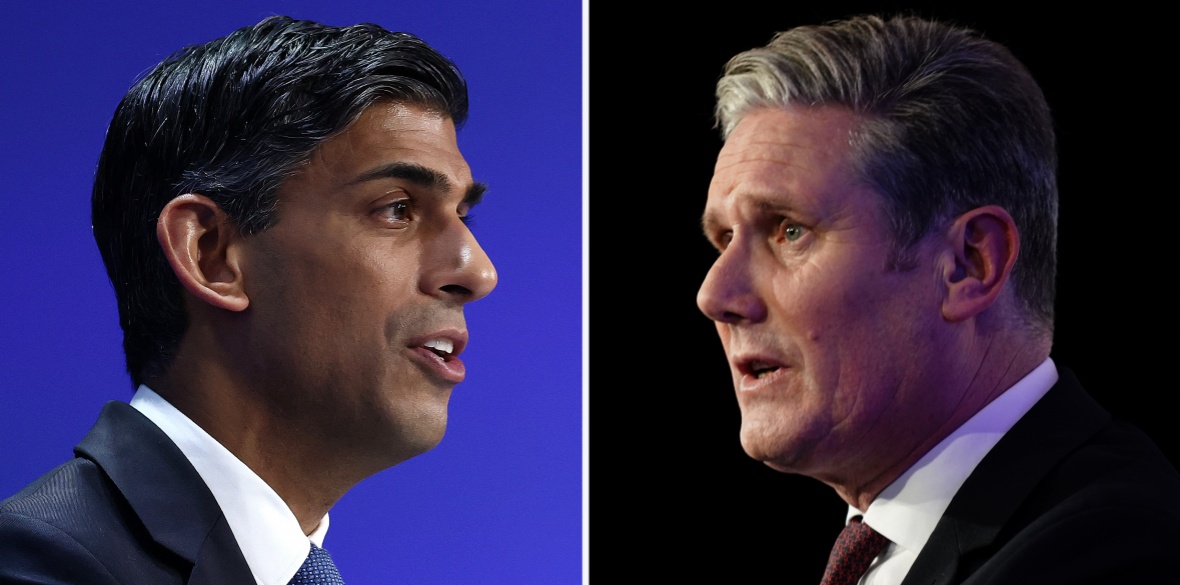
Prime Minister Rishi Sunak and Labour leader Sir Keir Stammer, December 27, 2023
2024 is almost certainly a general election year. Westminster rumours of a May poll are rife, but the autumn remains the more likely option for beleaguered premier Rishi Sunak.
An essential function of a democratic election is to offer the possibility of a change of government. The forthcoming contest, however, seems to offer little more than a shift in administrators of the same anti-popular policy.
The problem facing voters wanting significant change — the majority of the electorate one can assume — is the state of the Labour Party. On the most pressing international issues — Palestine and Ukraine — its policy is identical with the Tories: war and more war, as Washington directs.
Domestically its priority is sticking within the narrow parameters of Treasury orthodoxy. Anything involving spending public money is, even after 13 years of austerity, ruled out. So too tax rises on the rich.
The Green New Deal is diluted further by the day, and privatisation looks like extending its tentacles into the NHS.
Even more positive Labour policies, like extending trade union rights, are clouded by a scepticism as to Keir Starmer’s sincerity, given his well-earned reputation for dissimulation and double-dealing.
Victim of repeated smears and even a discredited prosecution is planning a bid at the next Ilford North parliamentary election, say locals
Syed Siddiqi, the former Labour member repeatedly abused, harassed and smeared by right-wing Labour figures in Ilford in north London, is planning to stand against right-winger Wes Streeting in the next Ilford North parliamentary election, according to local sources.
In 2018, Streeting also launched a ‘disgraceful’ and ‘disgusting’ tirade in the face of Diane Abbott, Britain’s first Black woman MP, leaving Abbott ‘shell-shocked’. If he stands, Syed Siddiqi can expect considerable support from outraged former Labour supporters around the country who would be delighted to see Streeting ejected.
We know think tanks can shape government policy. But we often have no idea who is paying them to do so
openDemocracy’s Who Funds You? report finds think tanks raking in millions ahead of general election | Getty
You don’t have to follow UK politics too closely to have spotted the names of a handful of think tanks cropping up again and again in the news.
There is little doubt these organisations exert significant influence. Just last year, the Institute for Economic Affairs (IEA) was reported to have shaped then-prime minister Liz Truss’s disastrous budget.
And sometimes it seems like only hours have passed between the publication of a Policy Exchange research paper and the adoption and implementation of its content as government policy. This is perhaps unsurprising given even Policy Exchange says its “status as the UK’s most influential think tank is widely recognised”.
The influence of high-profile think tanks is also apparent in the revolving door between them and the government. The former CEO of Taxpayers’ Alliance (TA), for example, took up a job in Priti Patel’s office when she was home secretary.
So we know think tanks can shape public policy. What is often far less obvious, though, is who is paying them to do so.
openDemocracy’s annual Who Funds You? report, published today, assesses how transparent think tanks’ financial disclosures were in the past year, grading them on a scale from A to E based on how much they publish about their funders.
I should mention, at this point, that I am the CEO of Unlock Democracy, a think tank awarded an A rating (the most transparent possible) in the report.
The report has revealed that UK think tanks have raised more than £101m to influence public policy in the run-up to the next general election – £25m of which came from ‘dark money’-funded think tanks, which are opaque about funders.
Policy Exchange and the IEA were both awarded D ratings, the second lowest.
There is nothing in either think tank’s mission that indicates any requirement for high levels of secrecy surrounding their funders. So why are they so shy about revealing their backers?
Is it because the public and ministers might view any advocacy of slower action on climate change or accusations of ‘nanny-statism’ over limits on sugar, salt and fat in processed foods differently if their accounts revealed they were partly funded by oil or gas companies, large food manufacturers or private individuals with an interest in promoting deregulation or privatisation? Of course, they might not be. But that’s the point – we don’t know.
Or is it because much of the media might stop describing them, rather generously, as ‘independent’ if the truth were known about from where and whom they received financial support?
Or is it because pressure would build for Parliament to force these think tanks to register as consultant lobbyists?
Given the IEA, Policy Exchange, the Taxpayers’ Alliance and other think tanks have declined to take voluntary action to reveal their sponsors, it is time for the government to step in and require them to declare funders contributing over £5,000 a year.
The media could help by refraining from describing think tanks whose funding remains as murky as the waters in our polluted rivers as ‘independent’.
We would all then be better equipped to establish whether the exhortations of the most influential think tanks will help deliver ‘a stronger society’ or something far less attractive.