Oil giant funds computer game that promotes fossil fuels to schoolchildren

Spread the love

Original article by Josephine Moulds republished from TBIJ  under a Creative Commons Attribution-NonCommercial-NoDerivs 3.0 Unported License.

The online game is targeted at pupils as young as seven

Equinor, the company looking to develop the Rosebank oil field in the North Sea, has funded a computer game aimed at UK school children, promoting the idea that fossil fuels are part of a green energy mix.

In an unusually frank admission of lobbying children, a web page promoting the game stated that it “aligns with our work to build future talent pipelines and secure permission to operate at a time of sensitivity around fossil fuels, particularly in light of . . . the Rosebank development”. The story was first revealed by the Norwegian news publication E24.

Rosebank – the UK’s largest untapped oilfield – was greenlit by the Conservative government in 2023, prompting condemnation from climate campaigners. That decision was ruled unlawful by the courts in January this year because it had not taken into account the carbon emissions created by burning any oil and gas produced. Equinor, Norway’s state energy company, continues preparation work on the site under its joint venture with Shell. [*1]

The game lets players choose between renewable energy or fossil fuels to power their city.

Marketing agency We Are Futures, which describes itself as “the go-to partner for building advocacy for brands amongst young people”, developed Equinor’s schools-based, curriculum-linked education programme, Wonderverse. It also received support from the Association for Science Education (ASE), a UK membership organisation for science teachers and technicians.

Read more: £4bn in UK public pensions funding North Sea oil giants drilling new wellsBP has been rowing back on renewables for years. So why was it helped by ‘net zero’ banks?Allianz’s board says it’s time to save the planet. They can start with their own investments

The game was promoted on ASE’s School Science website, which also stated: “With over two-thirds of teens believing the oil and gas industry causes more problems than it solves, Wonderverse helps lay misconceptions to rest by exploring some of the challenges involved in a just energy transition.”

The ASE web page, which has been taken down since the story first broke, said the programme, aimed at 7–14 year olds, is “designed to spark wonder for science and the future of energy”. It includes a game, in which players attempt to build a city that survives until the year 2050, and in-school education materials to “showcase how modern cities use energy resources and the ways the energy transition can be managed”.

While players are encouraged to invest in research into renewable energy, TBIJ successfully ran a city powered by oil and some renewables until 2050. Meanwhile, scientists say there must be huge declines in the use of coal, oil and gas to reach net zero emissions by 2050 and avoid further catastrophic climate change.

Screenshot from Game Over screen of Energy Town

Charlotte Howell, who leads the climate campaign group Parents for Future, was shocked that Equinor was behind an energy-themed game aimed at UK schoolchildren. She told E24: “We want to know how this can be allowed. I’m horrified that Equinor, as a partly state-owned company, is working against UK ambitions on climate. They are lobbying directly against our children.”

Tessa Khan, executive director at climate campaign group Uplift, said it was “morally indefensible” to pretend that the UK needed Rosebank for energy security when in reality it would accelerate the climate crisis.

Khan told TBIJ: “It’s one thing for Equinor to mislead the public about the benefits of new oil fields like Rosebank, but it is quite another to target children with blatant fossil fuel propaganda disguised as ‘education’. This so-called ‘computer game’ is not about learning – it’s about teaching the next generation to see oil and gas as inevitable, when the climate science could not be clearer that we need to leave new fossil fuels in the ground.”

Equinor told TBIJ it was not aware of the promotional material associated with the game until notified by media, and denied that rolling out the school game is part of a lobbying campaign to promote developing Rosebank.

A spokesperson said: “The overall intention and aim for Wonderverse and Energy Town is to provide schools and teachers with a suite of high-quality resources to help students learn more about where energy comes from, whilst building … the employability skills needed to successfully enter employment. The learning resources have been awarded a green tick by the Association for Science Education, assuring the programme’s quality for use in schools.” They also said the game was developed using data from the International Energy Agency.

ASE’s School Science website provides free online science resources for teachers and students. The site was sponsored by partners including ExxonMobil, which ASE describes as “the world’s leading nongovernmental energy company aiming to meet world energy demand in an economically, environmentally and socially responsible manner”. ExxonMobil is the world’s third most polluting company, according to Carbon Majors, a database of historical fossil fuel production data.

A spokesperson for ASE said the promotional text was provided via briefing materials from We Are Futures. They said the School Science website was no longer actively maintained and will be decommissioned, and that ExxonMobil is no longer a partner of ASE.

We Are Futures, which also works for the UK government and BP, did not respond to a request for comment.

After the court ruling in January, Equinor is set to reapply to the UK government for approval to develop Rosebank. This time it must include information about the emissions that will be produced by burning the oil extracted from Rosebank. According to Uplift, those emissions could be more than the combined annual CO2 emissions of all 28 lowest-income countries in the world, including Uganda, Ethiopia, and Mozambique. Equinor is reportedly “confident” that the project will go ahead and expects it to start up in 2026 or 2027.

Khan said: “If Equinor is serious about supporting the next generation, it should start by walking away from Rosebank and using its power and influence to focus solely on renewable energy. That’s the only way to really protect our children’s future.”

Reporter: Josephine Moulds
Environment editor: Rob Soutar
Deputy editor: Chrissie Giles
Editor: Franz Wild

Fact checker: Frankie Goodway
Production editor: Sasha Baker

TBIJ has a number of funders, a full list of which can be found here. None of our funders have any influence over editorial decisions or output.

Original article by Josephine Moulds republished from TBIJ  under a Creative Commons Attribution-NonCommercial-NoDerivs 3.0 Unported License.

*1 by dizzy. Equinor is attempting to develop the Rosebank oil field in partnership with Ithaca Energy, not Shell.

Campaigners take part in a Stop Rosebank emergency protest outside the U.K. Government building in Edinburgh, after the controversial Equinor Rosebank North Sea oil field was given the go-ahead Wednesday, September 27, 2023. (Photo: Jane Barlow/PA Images via Getty Images)
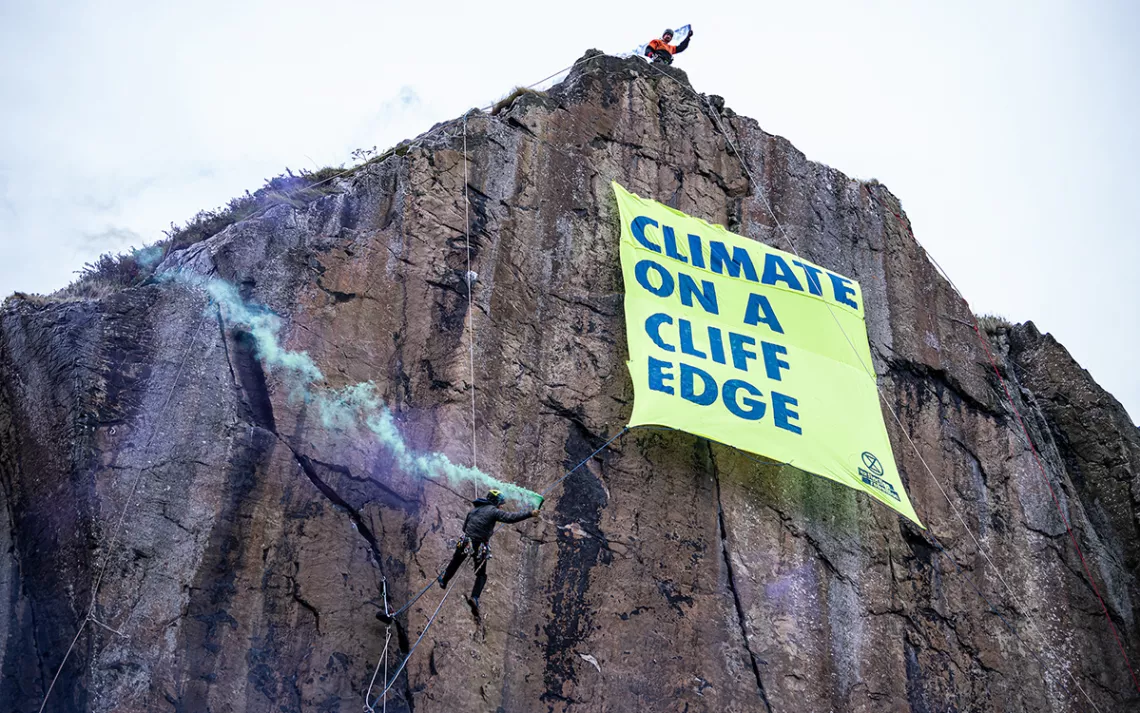
Experienced climbers scale a rock face near the historic Dumbarton castle in Glasgow, releasing a banner that reads “Climate on a Cliff Edge.” One activist, dressed as a globe, symbolically looms near the edge, while another plays the bagpipes on the shores below. | Photo courtesy of Extinction Rebellion and Mark Richards
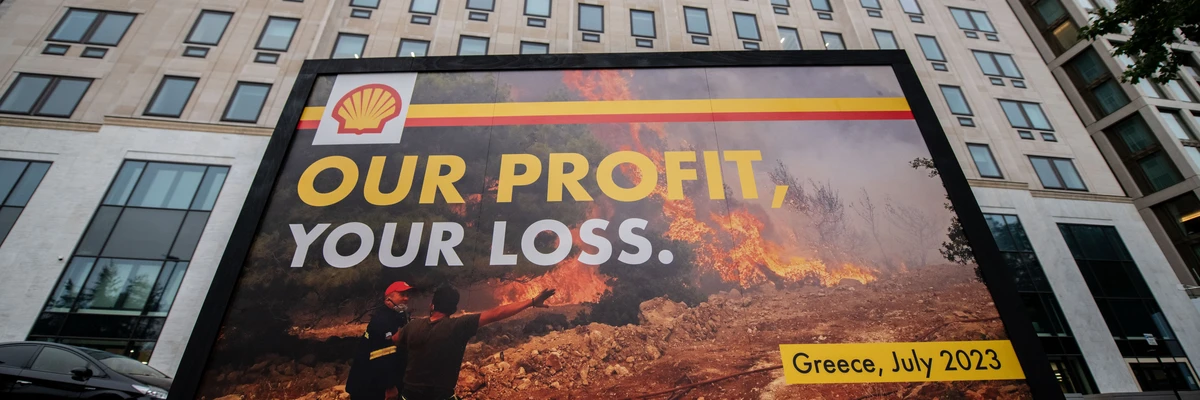
Greenpeace activists display a billboard during a protest outside Shell headquarters on July 27, 2023 in London.
Greenpeace activists display a billboard during a protest outside Shell headquarters on July 27, 2023 in London. (Photo: Handout/Chris J. Ratcliffe for Greenpeace via Getty Images)

Continue ReadingOil giant funds computer game that promotes fossil fuels to schoolchildren

The atmosphere is getting thirstier and it’s making droughts worse – new study

Spread the love
luchschenF/Shutterstock

Solomon Gebrechorkos, University of Oxford

Droughts are becoming more severe and widespread across the globe. But it’s not just changing rainfall patterns that are to blame. The atmosphere is also getting thirstier.

In a new study published in Nature, my colleagues and I show that this rising “atmospheric thirst” – also known as atmospheric evaporative demand (AED) – is responsible for about 40% of the increase in drought severity over the last four decades (1981-2022).

Imagine rainfall as income and AED as spending. Even if your income (rainfall) stays the same, your balance goes into deficit if your spending (AED) increases. That’s exactly what’s happening with drought: the atmosphere is demanding more water than the land can afford to lose.

As the planet warms, this demand grows – drawing more moisture from soils, rivers, lakes, and even plants. With this growing thirst, droughts are getting more severe even where rain hasn’t significantly declined.


Get your news from actual experts, straight to your inbox. Sign up to our daily newsletter to receive all The Conversation UK’s latest coverage of news and research, from politics and business to the arts and sciences.


The process of AED describes how much water the atmosphere wants from the surface. The hotter, sunnier, windier and drier the air is, the more water it requires – even if there isn’t less rain.

So even in places where rainfall hasn’t changed much, we’re still seeing worsening droughts. This thirstier atmosphere is drying things out faster and more intensely and introducing more stress when this water is not available.

Our new analysis reveals that AED doesn’t just make existing droughts worse – it expands the areas affected by drought. From 2018 to 2022, the global land area experiencing drought rose by 74%, and 58% of that expansion was due to increased AED.

Our study highlights that the year 2022 stood out as the most drought-stricken year in over four decades. More than 30% of the world’s land experienced moderate to extreme drought conditions. In both Europe and east Africa, the drought was especially severe in 2022 – this was driven largely by a sharp increase in AED, which intensified drying even where rainfall hadn’t dropped significantly.

drought ridden corn crop, bare field, grey sky
Crop yields are severely affected by water stress. Scott Book/Shutterstock

In Europe alone, widespread drying had major consequences: reduced river flows hindered hydropower generation, crop yields suffered due to water stress, plus many cities faced water shortages. This put unprecedented pressure on water supply, agriculture and energy sectors, threatening livelihoods and economic stability.

My team’s new research brings clarity to the dynamics of drought. We used high-quality global climate data, including temperature, wind speed, humidity and solar radiation – these are the key meteorological variables that influence how much water the atmosphere can draw from the land and vegetation. The team combined all these ingredients to measure AED – essentially, how “thirsty” the air is.

Then, using a widely recognised drought index that includes both rainfall and this atmospheric thirst, we could track when, where and why droughts are getting more severe. With this metric, we can calculate how much of that worsening is due to the atmosphere’s growing thirst.

The future implications of this increasing atmospheric thirst are huge, especially for regions already vulnerable to drought such as western and eastern Africa, western and south Australia, and the southwestern US where AED was responsible for more than 60% of drought severity over the past two decades.

Without factoring in AED during drought monitoring and planning, governments and communities may underestimate the true risk they face. With global temperatures expected to rise further, we can expect even more frequent and severe droughts. We need to prepare. That involves understanding and planning for this growing atmospheric thirst.

Driving drought

Knowing what is causing droughts in each specific location enables smarter climate adaptation. AED must be a central part of how we monitor, model and plan for drought.

Identifying the specific drivers of drought is essential for tailoring effective ways to cope with drought. If droughts are mainly due to declining rainfall, then the focus should be on water storage and conservation. But if AED is the main driver – as it is in many places now – then strategies must address evaporative loss (i.e. the amount of water lost from the surface and plants to the atmosphere) and plant water stress. This might involve planting drought-resistant crops, constructing irrigation systems that use water more efficiently, improving soil health or restoring habitats to keep moisture in the land.

As our research shows, rising AED – driven by global warming – is intensifying drought severity even where rainfall hasn’t declined. Ignoring it means underestimating risk.


Don’t have time to read about climate change as much as you’d like?
Get a weekly roundup in your inbox instead. Every Wednesday, The Conversation’s environment editor writes Imagine, a short email that goes a little deeper into just one climate issue. Join the 45,000+ readers who’ve subscribed so far.


Solomon Gebrechorkos, Reserach Fellow in Climate Change Attribution, University of Oxford

This article is republished from The Conversation under a Creative Commons license. Read the original article.

Continue ReadingThe atmosphere is getting thirstier and it’s making droughts worse – new study

UNRWA slams Israeli ban on international journalists reporting on Gaza, calls to allow it to work

Spread the love

This work by Middle East Monitor is licensed under a Creative Commons Attribution-NonCommercial-ShareAlike 4.0 International License.

UNRWA Commissioner General Philippe Lazzarini on April 30, 2024 [FABRICE COFFRINI/AFP via Getty Images]

Philippe Lazzarini, the commissioner-general of the UN agency for Palestinian refugees (UNRWA), on Saturday condemned Israel’s ongoing ban on international journalists entering Gaza, calling it an unprecedented act in modern conflict, Anadolu reports.

“This is unprecedented in any other conflict in modern history,” Lazzarini said in a statement.

“It is a ban on the truth. It is a ban on reporting the facts. It is the perfect recipe to fuel misinformation, deepening polarization and dehumanization.”

He stressed the importance of allowing independent reporting and supporting local journalists: “International journalists must independently report from Gaza and support their Palestinian colleagues who continue to do a heroic job at a heavy price.”

“Nearly 200 of them were reported killed since the war began,” said Lazzarini, stressing that “the ban on international media must be lifted.”

Separately, the UN agency for Palestinian refugees (UNRWA) on Saturday reiterated its call for cooperation from the Israeli government over allegations made against the agency, stating that no credible evidence has been provided despite repeated requests.

“UNRWA has repeatedly requested cooperation and evidence from Israel regarding the serious allegations made against the Agency,” the agency said in an official statement.

READ: At least 65 Palestinians killed, 100 more injured as Israel continues attacks on Gaza on 2nd day of Eid

“After 20 months, UNRWA has not received any response, nor has the Government of Israel shared any sufficient evidence.”

The agency emphasized its continued commitment to its humanitarian mandate, stating: “UNRWA remains committed to its mandate and is ready to deliver humanitarian assistance at scale in Gaza, together with other UN agencies.”

Israel, rejecting international calls for a ceasefire, has pursued a genocidal offensive in Gaza since October 2023, killing nearly 54,700 Palestinians, most of them women and children. Aid agencies have warned about the risk of famine among the enclave’s more than 2 million inhabitants.

Last November, the International Criminal Court issued arrest warrants for Israeli Prime Minister Benjamin Netanyahu and his former Defense Minister Yoav Gallant for war crimes and crimes against humanity in Gaza.

Israel also faces a genocide case at the International Court of Justice for its war crimes against civilians in the enclave.

READ: Israeli lawmaker shows off keys to locked UNRWA Headquarters in Jerusalem in Knesset session

This work by Middle East Monitor is licensed under a Creative Commons Attribution-NonCommercial-ShareAlike 4.0 International License.

UK Labour Party government ministers Keir Starmer, Angela Rayner and Rachel Reeves explain that they are partners complicit in Israel's Gaza genocide. The UK has provided Israel with arms, military and air force support. They explain that they don't do gas chambers but do do forced marches, starvation, destroy hospitals, mass-murders of journalists and healthcare workers.
UK Labour Party government ministers Keir Starmer, Angela Rayner and Rachel Reeves explain that they are partners complicit in Israel’s Gaza genocide. The UK has provided Israel with arms, military and air force support. They explain that they don’t do gas chambers but do do forced marches, starvation, destroy hospitals, mass-murders of journalists and healthcare workers.
Continue ReadingUNRWA slams Israeli ban on international journalists reporting on Gaza, calls to allow it to work

53% of Europe and Mediterranean Basin Impacted by Drought in Mid-May: Report

Spread the love

https://www.ecowatch.com/drought-europe-mediterranean-2025.html

From May 11 to 20, 42 percent of soils in Europe and the Mediterranean basin lacked moisture and were at a warning level, while five percent were at an alert level, indicating vegetation was not growing normally.

Countries in northern, central and eastern Europe were at high alert levels.

Roughly 19 percent of territory in Ukraine was on alert, with other countries in concerning circumstances, including nine percent of Hungary and Slovakia, 10 percent of Poland and 17 percent of lands in Belarus.

The alert level for some territories and countries was as high as 20 percent, including the Palestinian territories, Cyprus and Syria.

Several countries were experiencing drought conditions in mid-May without being at an alert level, including 98 percent of the United Kingdom. According to the UK’s Met Office, the country had its driest spring in over 50 years, as well as its warmest spring ever recorded.

Continues at https://www.ecowatch.com/drought-europe-mediterranean-2025.html

Continue Reading53% of Europe and Mediterranean Basin Impacted by Drought in Mid-May: Report

Thousands expected at anti-austerity demonstration

Spread the love

https://morningstaronline.co.uk/article/thousands-expected-anti-austerity-demonstration

 People take part in the People’s Assembly Britain is Broken national demonstration in central London, November 5, 2022

AHUGE demonstration is being held in central London tomorrow to “send a message” to the government over spending cuts and welfare reform.

The People’s Assembly said it expected thousands of trade unionists, campaigners and activists to attend the protest.

The campaign group accused the government of making spending cuts that target the poorest in society.

A spokesperson said: “The adherence to ‘fiscal rules’ traps us in a public service funding crisis, increasing poverty, worsening mental health and freezing public-sector pay.

“Scrapping winter fuel payments, keeping the Tory two-child benefit cap, abandoning Waspi women, cutting £5 billion of welfare by limiting PIP [personal independence payments] and universal credit eligibility and slashing UK foreign aid from 0.5 per cent to 0.3 per cent of GDP, while increasing defence spending to 2.5 per cent of GDP, are presented as ‘tough choices.’

“Real tough choices would be for a Labour government to tax the rich and their hidden wealth to fund public services, fair pay, investment in communities and the NHS.”

Article continues at https://morningstaronline.co.uk/article/thousands-expected-anti-austerity-demonstration

Keir Starmer says that the Labour Party under his leadership all feel a small part of Scunthorpe.
Keir Starmer confirms that he's proud to be a red Tory continuing austerity and targeting poor and disabled scum.
Keir Starmer confirms that he’s proud to be a red Tory continuing austerity and targeting poor and disabled scum.
Continue ReadingThousands expected at anti-austerity demonstration