Argentina’s far-right libertarian president warns in Davos, “the West is in danger”

Spread the love

[While a serious issue, there are some amusing parts to this article.]

Original article by ARG Medios at peoples dispatch republished under a Creative Commons Attribution-ShareAlike 4.0 (CC BY-SA) license.
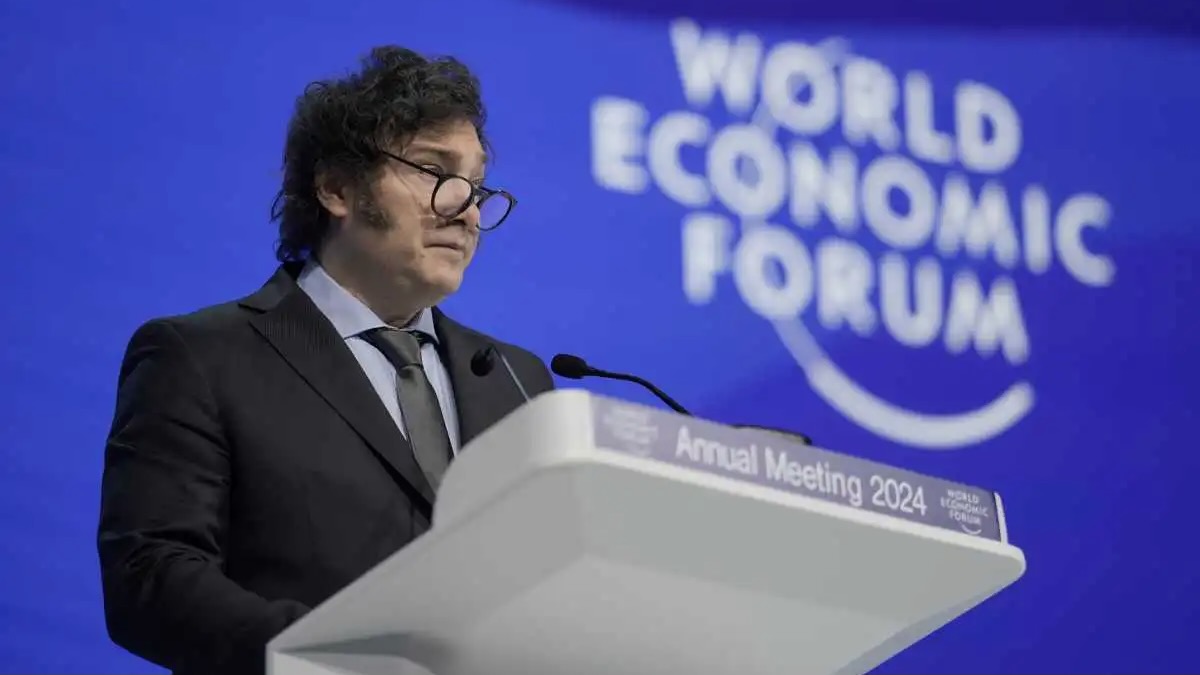
On the morning of January 17, Argentine President Javier Milei gave his first speech at the World Economic Forum in Davos, Switzerland. The far-right libertarian was sworn in on December 10, 2023 and since then has launched all-out attacks on the working class through presidential decrees and omnibus laws, all of which have been vehemently opposed on the streets.

Milei began his speech at Davos by telling those present: “I am here to tell you that the West is in danger. All over the world, leaders who must defend the values of capitalism assume a vision that leads to socialism and poverty. “The main leaders of the world have abandoned freedom for so-called collectivism, which is the cause of the problems.”

The strongest argument of his speech was going to be that capitalism is the only tool to end hunger and poverty in the world, although he added: “the leftist thinking attacks capitalism for being, according to them, unjust. They say it is bad because it is individualistic and they fight for social justice. This concept has become fashionable around the world, but social justice is an unfair, violent idea, because taxes are coercively collected. Nobody pays taxes voluntarily. The State is financed through coercion. If a company generates a good product it will do well, if the State punishes the capitalist for being successful it destroys their incentives, and the cake will be smaller. Collectivism ties the entrepreneur’s hands.”

He also spoke of enemies, who for him are those who use the State as a tool: “everyone. There are no substantive differences. Socialists, conservatives, communists, fascists, Nazis, social democrats, centrists. They are all the same.”

In this same sense, Milei attacked two of the most important agendas at the Davos Forum, gender inequality and climate change: “The first of these new battles was the ridiculous and unnatural fight between men and women. Libertarianism already establishes equality between the sexes. The founding stone of our creed says that all men are created equal, that we all have the same inalienable rights granted by the creator, among which are life, liberty and property,” he maintained.

He went further and said: “the only thing that became of this agenda of radical feminism is greater intervention by the state to hinder the economic process, giving work to bureaucrats who do not contribute anything to society, be it in the format of women’s ministries or international organizations dedicated to promoting this agenda.”

In the same sense, he denied human responsibility for climate change: “another one of the conflicts that socialists raise is that of man against nature. They maintain that human beings damage the planet and that it must be protected at all costs, even going so far as to advocate for population control mechanisms or the bloody agenda of abortion.”

Finally, the only praise in Javier Milei’s speech was for the businessmen, whom he treated as heroes and also told them: “do not let yourself be intimidated by the political caste that wants to remain in power. You are heroes, you are benefactors, let no one tell you that your ambition is immoral, do not give in to the advance of the State, The state is the problem itself, you are the protagonists of history. Long live fucking freedom!

The president returned to Argentina on Wednesday on a commercial flight, after a couple of meetings and a bold speech that was not very widely accepted in Davos. He will face a massive national strike on January 24, called for by all the major trade unions and confederations in Argentina in opposition to his pro-capitalist, pro-businessman policies.

This article was first published in Spanish on ARG Medios.

Original article by ARG Medios at peoples dispatch republished under a Creative Commons Attribution-ShareAlike 4.0 (CC BY-SA) license.
Continue ReadingArgentina’s far-right libertarian president warns in Davos, “the West is in danger”

Argentine courts grant union’s request and suspend Milei’s labor reform

Spread the love

Original article by Brasil de Fato republished from peoples dispatch under a Creative Commons Attribution-ShareAlike 4.0 (CC BY-SA) license.

The measures are part of a “decree” announced by the far-right president in December

Labor reform is one of the points of Milei’s decree (Photo: Mídia NINJA)

The Argentine judiciary has granted a request from the National Confederation of Labor (CGT), the country’s main trade union center, and suspended the effects of the labor reform provided for in the “decree” launched by the government of ultra-right Javier Milei last December. The court decision published on January 3 is a precautionary one, i.e. it suspends the measure.

The decision was taken by the National Chamber of Labor Appeals, the first instance in the Argentine judiciary for appeals on labor issues. The court argued that there was no proven need or urgency to make the decision without consulting the Argentine Congress, which is responsible for legislation.

The “decretazo” is formally called the Decree of Necessity and Urgency (DNU), and is provided for in the Argentine Constitution. However, the executive branch can only issue this type of decree when there are exceptional circumstances and it is not possible to wait for Congress to meet.

Among other measures, the Milei government’s labor reform extends the probationary period for new employees from three to eight months (thus increasing the period in which employers can fire new workers without paying severance pay).

It also authorized the dismissal of workers who take part in picket lines or occupy workplaces during stoppages or strikes, as well as changes to overtime compensation systems.

According to Argentine newspaper La Nación, Wednesday’s court decision came as a surprise to the government. Clarín, another daily in the country, said that the government will appeal to higher courts to overturn the injunction issued by the Labor Appeals Chamber.

This article was translated from an article originally published in Portuguese on Brasil De Fato.

Original article by Brasil de Fato republished from peoples dispatch under a Creative Commons Attribution-ShareAlike 4.0 (CC BY-SA) license.
Continue ReadingArgentine courts grant union’s request and suspend Milei’s labor reform

Skwawkbox exclusive: smeared ex-Lab member Siddiqi ‘planning to stand vs Streeting’

Spread the love

Original article republished from the Skwawkbox for non-commercial use.

Victim of repeated smears and even a discredited prosecution is planning a bid at the next Ilford North parliamentary election, say locals

Syed Siddiqi, the former Labour member repeatedly abused, harassed and smeared by right-wing Labour figures in Ilford in north London, is planning to stand against right-winger Wes Streeting in the next Ilford North parliamentary election, according to local sources.

Siddiqi has faced constant harassment by the party right, including a failed attempt to prosecute him that ended in all charges being dropped – reminiscent of the disgraced hatchet job against neighbouring left-wing Muslim MP Apsana Begum.

The party’s hounding of Siddiqi even went as low as suspending him for more than three years after he was the victim of a foul, late-night Islamophobic tirade by a local right-winger, despite the whole incident being recorded. His abuser was quickly reinstated so that he could stand for Labour in local elections.

Siddiqi was revealed to have been targeted by Streeting’s office and others, by the leaked party report into abuse by the party right:

Labour has a long and appalling record of Islamophobia and of protecting abusive right-wingers. Local council leader Jas Athwal was selected as the party’s candidate in Ilford South, after complaints of ‘serious sexual assault’ were dismissed by a committee of Labour national executive members – against the advice of the party’s barrister. He won the selection vote when six hundred postal votes ‘turned up’ late in proceedings, while supporters of his opponent, incumbent MP Sam Tarry, were denied entry to the selection meeting. Labour general secretary David Evans dismissed the evidence as ‘irrelevant to the result.

The party has reason to fear the challenge. Last year, Lutfur Rahman ousted Labour to win the executive mayor’s position in nearby Tower Hamlets last year and voters there kicked out Labour at the last local elections in a landslide for Rahman’s new Aspire party. In neighbouring East End borough Newham, Newham Independents leader Mehmood Mirza hammered an imposed Labour candidate in May – and his colleague Sophia Naqvi then trounced Labour in November’s by-election in Newham Plaistow North.

With discontent spreading in the area and Black councillor Shanell Johnson quitting Labour in Redbridge, which covers both Ilford seats, in disgust at the local and national party’s conduct, few would be surprised to see similar developments threatening Labour’s complacency there too; particularly with an incumbent MP as dislikeable as Streeting, Starmer’s pro-privatisation health spokesman who has accepted donations from private health interests and who triggered protests outside his office – and a boycott by students – for his part in Starmer’s support for Israeli war crimes.

In 2018, Streeting also launched a ‘disgraceful’ and ‘disgusting’ tirade in the face of Diane Abbott, Britain’s first Black woman MP, leaving Abbott ‘shell-shocked’. If he stands, Syed Siddiqi can expect considerable support from outraged former Labour supporters around the country who would be delighted to see Streeting ejected.

Original article republished from the Skwawkbox for non-commercial use.

Continue ReadingSkwawkbox exclusive: smeared ex-Lab member Siddiqi ‘planning to stand vs Streeting’

Why it is essential that the UK’s shady think tanks reveal their funders

Spread the love

Original article by Tom Brake republished from Open Democracy under a Creative Commons Attribution-NonCommercial 4.0 International licence.

We know think tanks can shape government policy. But we often have no idea who is paying them to do so

openDemocracy’s Who Funds You? report finds think tanks raking in millions ahead of general election  | Getty

You don’t have to follow UK politics too closely to have spotted the names of a handful of think tanks cropping up again and again in the news.

There is little doubt these organisations exert significant influence. Just last year, the Institute for Economic Affairs (IEA) was reported to have shaped then-prime minister Liz Truss’s disastrous budget.

And sometimes it seems like only hours have passed between the publication of a Policy Exchange research paper and the adoption and implementation of its content as government policy. This is perhaps unsurprising given even Policy Exchange says its “status as the UK’s most influential think tank is widely recognised”.

The influence of high-profile think tanks is also apparent in the revolving door between them and the government. The former CEO of Taxpayers’ Alliance (TA), for example, took up a job in Priti Patel’s office when she was home secretary.

So we know think tanks can shape public policy. What is often far less obvious, though, is who is paying them to do so.

openDemocracy’s annual Who Funds You? report, published today, assesses how transparent think tanks’ financial disclosures were in the past year, grading them on a scale from A to E based on how much they publish about their funders.

I should mention, at this point, that I am the CEO of Unlock Democracy, a think tank awarded an A rating (the most transparent possible) in the report.

The report has revealed that UK think tanks have raised more than £101m to influence public policy in the run-up to the next general election – £25m of which came from ‘dark money’-funded think tanks, which are opaque about funders.

Policy Exchange and the IEA were both awarded D ratings, the second lowest.

There is nothing in either think tank’s mission that indicates any requirement for high levels of secrecy surrounding their funders. So why are they so shy about revealing their backers?

Is it because the public and ministers might view any advocacy of slower action on climate change or accusations of ‘nanny-statism’ over limits on sugar, salt and fat in processed foods differently if their accounts revealed they were partly funded by oil or gas companies, large food manufacturers or private individuals with an interest in promoting deregulation or privatisation? Of course, they might not be. But that’s the point – we don’t know.

Or is it because much of the media might stop describing them, rather generously, as ‘independent’ if the truth were known about from where and whom they received financial support?

Or is it because pressure would build for Parliament to force these think tanks to register as consultant lobbyists?

Given the IEA, Policy Exchange, the Taxpayers’ Alliance and other think tanks have declined to take voluntary action to reveal their sponsors, it is time for the government to step in and require them to declare funders contributing over £5,000 a year.

The media could help by refraining from describing think tanks whose funding remains as murky as the waters in our polluted rivers as ‘independent’.

We would all then be better equipped to establish whether the exhortations of the most influential think tanks will help deliver ‘a stronger society’ or something far less attractive.

The full report is available at opendemocracy.net/who-funds-you/

Original article by Tom Brake republished from Open Democracy under a Creative Commons Attribution-NonCommercial 4.0 International licence.  

Continue ReadingWhy it is essential that the UK’s shady think tanks reveal their funders

China cancels line of credit, pulling the plug on Argentina’s ‘anarcho-capitalist’ president

Spread the love

Original article by JAMES MEADWAY republished from People’s World under http://creativecommons.org/licenses/by-nc-nd/3.0/us/.

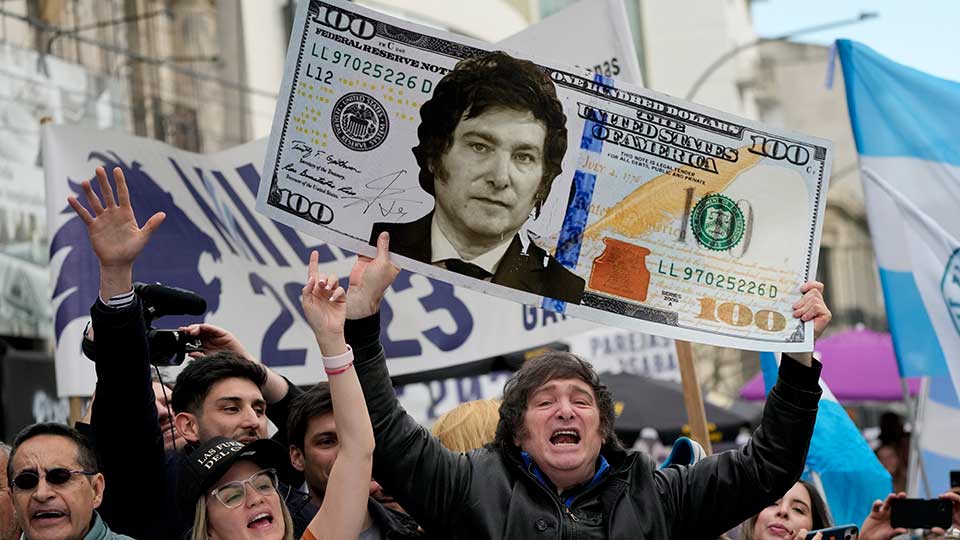
Dollarization: Javier Milei holds up a giant cardboard sign depicting a U.S. $100 banknote emblazoned with an image of his face during a rally in La Plata, Sept. 12, 2023. Milei wants to replace the peso with the U.S. dollar as Argentina’s currency and says that the country’s Central Bank should be abolished. He’s got a new financial challenge, though: China just cut his line of credit. | Natacha Pisarenko / AP

The Chinese government may have pulled the plug on far-right “anarcho-capitalist” President of Argentina Javier Milei, just weeks after his shock election win.

In a spectacular demonstration of how the lines of geopolitical power are shifting, the People’s Bank of China has withdrawn its “swapline” to the Argentinian central bank, depriving it of a vital source of cheap funding.

This leaves debt-ridden Argentina without ready access to funding to meet its promises to pay creditors. These international creditors include the IMF, to whom Argentina owes a world-record $43 billion. China provided the Argentinian government with funds for its $2.7 billion IMF repayment over the summer, lending it ultra-cheap foreign currency through its swapline arrangement.

Milei, a fanatical free marketeer, was elected with 55% of the vote in November from a population desperate for a break with the failed political Establishment. Developing his public profile through TV appearances and his 1.4 million followers on TikTok, Milei was able to present his program of ferocious spending cuts and the abolition of the Argentinian currency, the peso, as the bitter medicine the country needed to end its economic crisis. Younger voters, in particular, flocked to him in droves.

This was a product of desperation. Two-fifths of Argentinians live below the poverty line, and close to 60% of children. Inflation was over 140% when the election campaign ended, meaning prices doubling roughly every six months.

Since the government defaulted—halted payments—on its debts at the end of 2001, the two decades since have seen governments both pro and anti-neoliberal attempts to negotiate agreements with Argentina’s creditors and break the cycle of crises.

The latest round of these was a colossal 2018 loan from the IMF, attached to conditions on cutting government spending over the following three years.

But what tipped the country over the edge into its latest round of crisis has been the catastrophic drought that began in 2019. This ongoing drought is the worst for over 60 years, hammering farmers and severely cutting harvests—soybean production fell to its lowest level for a century.

For a country dependent on agricultural exports for foreign exchange earnings, it has been a disaster. Its trade deficit ballooned, taxes fell and government spending mushroomed. Government borrowing swelled and the Argentina central bank resorted to issuing more money to cover spending costs. Climate change almost certainly worsened the drought.

Milei’s program offered nothing on this—he is a climate change denier, claiming that those who “blame the human race” for climate change are “fake…only looking to raise funds for socialist bums who write for fourth-rate newspapers.”

The colorful language is very much part of his appeal, along with waving a chainsaw at his public appearances, to symbolize what he planned for government spending, and smashing a piñata of the central bank on live TV.

But cartoonish posing shouldn’t kid us: Milei’s program is neoliberalism on steroids. He campaigned on a promise to cut government spending by 15% of Argentina’s GDP.

His plan to abolish the peso and “dollarize” the economy was arguably even more radical, claiming this would prevent Argentinian bureaucrats and politicians from printing money. Although two other Latin American countries, Ecuador and Panama, use the dollar as their official currency, neither is the size of Argentina, the continent’s second-largest economy.

And while many Argentinians already use the dollar, with $246 billion in dollar savings, the government has no dollars to hand, and would have to either buy them to replace pesos, or perhaps seize them from those mostly middle-class savings.

The plan is a non-starter. Confronted with the economic realities, Milei has rapidly defaulted to conservative type, appointing a former president of the central bank, Luis Caputo, as his economy minister, and appointing a close associate of Caputo as the new central bank head. So much for “burning it down.”

The ferocious spending cuts are still planned, along with a 54% devaluation of the peso as part of a program approved by the IMF.

Far from a radical break, Milei is a stooge for the maintenance of Argentina’s failed elite—including even the rehabilitation of the dictatorship, with his running mate for Vice President, Victoria Villaruel, claiming the figure of 30,000 “disappearances” under the regime is a “myth.”

This is a familiar pattern. Across the world, supposed populists from the radical right have taken power, often with the promise of taking on corrupt local elites. They don’t follow through.

Italy’s radical right government, for example, in August threatened a windfall tax on banks that were profiteering from interest rate rises. But they rapidly backed down after howls of protests from the banks themselves.

Milei has almost certainly bitten off more than he can chew. Expecting protests, harsh new guidelines for police and military, including the criminalization of the parents of younger protests have been rushed through—“prison or bullet,” as one pro-government MP described them. Inflation has accelerated, to 3,678% a year, which the government are now using to justify their “shock therapy.”

However, it is anti-China posturing that could prove his undoing. China is Argentina’s second-biggest market for exports, and loans from China make up over 42 per cent of Argentina’s foreign exchange reserves.

Yet Milei called China an “assassin” during his election campaign, promising to sever ties and instead reorienting Argentina towards full-throated support for Israel and the U.S. Argentina’s foreign minister has confirmed that the country would not be joining the China-led BRICS coalition, as pledged by the last government.

This was treated as a “slap in the face” by China: Cutting loan support to Argentina is the inevitable response. As Milei himself might put it: Fuck around and find out.

Morning Star

Original article by JAMES MEADWAY republished from People’s World under http://creativecommons.org/licenses/by-nc-nd/3.0/us/.

Continue ReadingChina cancels line of credit, pulling the plug on Argentina’s ‘anarcho-capitalist’ president