MetropolitanRepublic staff celebrating at the Silverback Awards, November 2023. (Credit: MetropolitanRepublic Uganda)
MetropolitanRepublic enlisted social media influencers to promote giant oil project as climate campaigners suffered beatings and arrests.
Last November, a beaming group of staff from MetropolitanRepublic collected their gorilla-shaped trophy at the Silverback Awards, Uganda’s top advertising and public relations gala.
The South African PR agency had won its prize for promoting the “sustainable development” of Uganda’s untapped oil reserves by French oil company TotalEnergies.
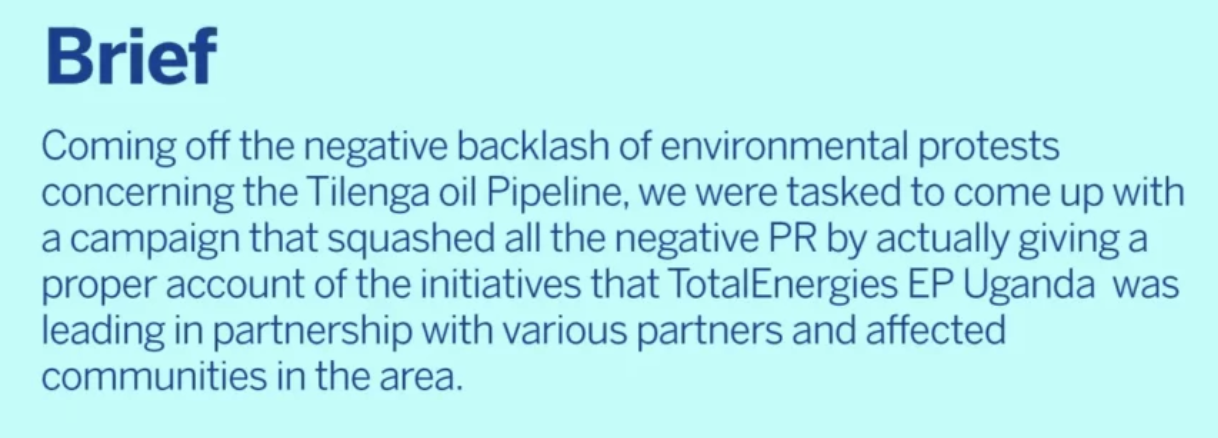
MetropolitanRepublic — which is part-owned by British communications giant WPP — described the brief for the award-winning “Action for Sustainability” campaign in its entry to the Silverback Awards: to devise an approach that “squashed all the negative PR” from protests against TotalEnergies’ plans for a 1,443-kilometre pipeline to export oil from Uganda’s Lake Albert via neighbouring Tanzania.
An accompanying video featured photographs of Ugandan anti-pipeline campaigners to illustrate this “backlash” and described them as “haters”.
“How do you launch a successful project off the back of this?” asks the narrator in the video. “Well, you develop a 360 PR campaign that retells your story the way it should be told.”
A screenshot from the award submission published on the Silverback Awards’ website. The Tilenga pipeline is a feeder pipeline under construction to carry oil from the Tilenga oilfields to the start of EACOP. (Credit: Silverback Awards)
Now, DeSmog can reveal that Ugandan police or military personnel have arrested, beaten, threatened, or harassed at least eight of the 15 campaigners pictured in MetropolitanRepublic’s award submission video.
These incidents — documented via video taken at protests, interviews with the campaigners, and police records — took place both before and after the video was published on the Silverback website in March.
There is no indication that MetropolitanRepublic’s campaign or the award submission led directly to any specific incidents affecting the activists. Nevertheless, DeSmog found that the agency engaged a network of social media influencers to post hundreds of times in support of TotalEnergies’ plans to mitigate the impact of the pipeline — even as protestors were being beaten and harassed.
“These PR firms are sponsoring our oppression,” said Hillary Innocent Taylor Seguya, one of the campaigners pictured in MetropolitanRepublic’s award submission video. “The more you push misinformation to the rest of the world, the more it means that you don’t care about our rights.”
Protestors from student human rights group Justice Movement Uganda opposing the East Africa Crude Oil Pipeline. (Credit: Bruce Nahabwe)
Since the pipeline project was first announced in 2017, advocacy groups have highlighted concerns over the displacement of communities in Uganda and Tanzania, damage to ecosystems and wildlife, and the climate impact of burning Uganda’s oil. The outcry has prompted some banks, insurers, and the PR company Edelman — which has represented oil companies for decades — to shun the project, known as the East Africa Crude Oil Pipeline, or EACOP.
In June this year, UN Secretary-General Antonio Guterres urged communications agencies to stop working for fossil fuel companies, saying PR campaigns run by “Mad Men fuelling the madness” were making the climate crisis harder to address.
MetropolitanRepublic, however, defended its role in promoting the pipeline — a joint venture between TotalEnergies and state oil companies from Uganda, Tanzania, and China.
Zionist Keir Starmer is quoted “I support Zionism without qualification.” He’s asked whether that means that he supports Zionism under all circumstances, whatever Zionists do.
UK forces were involved in supporting Israel in the conflict in the Middle East after Iran launched a missile attack on the country.
Defence Secretary John Healey said British forces had “this evening played their part in attempts to prevent further escalation”, without giving more details.
The BBC understands UK fighter jets were involved, as they were in April when Iran last attacked Israel with missiles.
Responding on Tuesday to Iran’s attack, which the Israeli military said involved 180 missiles being fired with most intercepted, Prime Minister Sir Keir Starmer said the UK “stands with Israel” and recognises its right to self-defence.
A man documents the damaged buildings at the site of an Israeli airstrike in Beirut’s southern suburb, Lebanon, October 1, 2024
ISRAEL’S invasion of Lebanon looked close to having ignited all-out war in the Middle East last night as Iran launched multiple missiles at Israeli targets in response.
It was unclear how Israel or the US, which has stationed huge forces in the region to back Israel up as it continues its Gaza genocide, would react as the Morning Star went to press.
The Israeli military followed up its violation of Lebanese territory by warning residents of nearly two dozen border communities to evacuate, hours after announcing the start of “limited” ground operations against the Hezbollah resistance movement.
…
British peace activists condemned Israel’s invasion and its attempts to portray it as a “limited” operation.
Independent MP Jeremy Corbyn told the Morning Star: “Israel’s decision to send troops into Lebanon, a sovereign nation, is no ‘limited ground operation,’ it is an invasion.”
Mr Corbyn also blasted British policy in the Middle East, saying: “Our government’s hypocrisy is on full display. Its failure to defend international law and stand up to Israel is a moral disgrace.”
Ken Klippenstein, an independent reporter operating on Substack and an investigative alum of the Intercept, announced (Substack, 9/26/24) that he had been kicked off Twitter (now rebranded as X). His crime, he explained, stemmed from posting the 271-page official dossier of Republican vice presidential candidate’s J.D. Vance’s campaign vulnerabilities; the US government alleges that the information was leaked through Iranian hacking. In other words, the dossier is a part of the “foreign meddling campaign” of “enemy states.”
Klippenstein is not the first reporter to gain access to these papers (Popular Information, 9/9/24), but most of the reporting about this dossier has been on the intrigue revolving around Iranian hacking rather than the content itself (Daily Beast, 8/10/24; Politico, 8/10/24; Forbes, 8/11/24). Klippenstein decided it was time for the whole enchilada to see the light of day:
As far as I can tell, it hasn’t been altered, but even if it was, its contents are publicly verifiable. I’ll let it speak for itself.
“The terror regime in Iran loves the weakness and stupidity of Kamala Harris, and is terrified of the strength and resolve of President Donald J. Trump,” Steven Cheung, communications director for the Trump campaign, responded when I asked him about the hack.
If the document had been hacked by some “anonymous”-like hacker group, the news media would be all over it. I’m just not a believer of the news media as an arm of the government, doing its work combating foreign influence. Nor should it be a gatekeeper of what the public should know.
The US Office of the Director of National Intelligence said in a statement that alleged Iranian hacking (9/18/24) was “malicious cyber activity” and “the latest example of Iran’s multi-pronged approach…to stoke discord and undermine confidence in our electoral process.”
Where’s the beef?
Ken Klippenstein (Substack, 9/26/24) argued that the Vance dossier ” is clearly newsworthy, providing Republican Party and conservative doctrine insight into what the Trump campaign perceives to be Vance’s liabilities and weaknesses.”
The Vance report isn’t as salacious as Vance’s false and bizarre comments about Haitians eating pets (NPR, 9/15/24), but it does show that he has taken positions that have fractured the right, such as aid for Ukraine; the report calls him one of the “chief obstructionists” to providing assistance to the country against Russia. It dedicates several pages to Vance’s history of criticizing Trump and the MAGA movement, suggesting that his place on the ticket could divide Trump’s voting base.
On the other hand, it outlines many of his extreme right-wing stances that could alienate him with putative moderates. It says Vance “appears to have once called for slashing Social Security and Medicare,” and “is opposed to providing childcare assistance to low-income Americans.” He “supports placing restrictions on abortion access,” and states that “he does not support abortion exceptions in the case of rape.”
And for any voter who values 7-day-a-week service, Vance “appears to support laws requiring businesses to close on Sundays.” It quotes him saying: “Close the Damn Businesses on Sunday. Commercial Freedom Will Suffer. Moral Behavior Will Not, and Our Society Will Be Much the Better for It.” That might not go over well with small business owners, and any worker who depends on their Sunday shifts.
‘Took a deep breath’
The Washington Post (8/13/24) suggested that Vance dossier was different from Hillary Clinton’s hacked emails in 2016 because of “foreign state actors increasingly getting involved” in US elections.
Are the findings in the Vance dossier the story of the century? Probably not, but it’s not nothing that the Trump campaign is aware its vice presidential candidate is loaded with liabilities. There are at least a few people who find that useful information.
And the Washington Post (9/27/24) happily reported on private messages Vance sent to an anonymous individual who shared them with the newspaper that explained Vance’s flip-flopping from a Trump critic to a Trump lover. Are the private messages really more newsworthy than the dossier—or is the issue that the messages aren’t tainted by allegedly foreign fingerprints? Had that intercept of material involved an Iranian, would it have seen the light of day?
In fact, the paper (8/13/24) explained that news organizations, including the Post, were reflecting on the foreign nature of the leak when deciding how deep they should report on the content they received:
“This episode probably reflects that news organizations aren’t going to snap at any hack that comes in and is marked as ‘exclusive’ or ‘inside dope’ and publish it for the sake of publishing,” said Matt Murray, executive editor of the Post. Instead, “all of the news organizations in this case took a deep breath and paused, and thought about who was likely to be leaking the documents, what the motives of the hacker might have been, and whether this was truly newsworthy or not.”
Double standards for leaks
Politico (10/7/16) quoted a Clinton spokesperson: “Striking how quickly concern about Russia’s masterminding of illegal hacks gave way to digging through fruits of hack.” This was immediately followed by: “Indeed, here are eight more e-mail exchanges that shed light on the methods and mindset of Clinton’s allies in Brooklyn and Washington.”
There seems to be a disconnect, however, between ill-gotten information that impacts a Republican ticket and information that tarnishes a Democrat.
Think back to 2016. When “WikiLeaks released a trove of emails apparently hacked from Hillary Clinton’s campaign chairman email account, unleashing thousands of messages,” as Politico (10/7/16) reported, the outlet didn’t just merely report on the hack, it reported on the embarrassing substance of the documents. In 2024, by contrast, when Politico was given the Vance dossier, it wrote nothing about its contents, declaring that “questions surrounding the origins of the documents and how they came to our attention were more newsworthy than the material that was in those documents” (CNN, 8/13/24).
The New York Times and Washington Post similarly found the Clinton leaks—which were believed at the time to have been given to WikiLeaks by Russia—far more newsworthy than the Vance dossier. The Times “published at least 199 articles about the stolen DNC and Clinton campaign emails between the first leak in June 2016 and Election Day,” Popular Information (9/9/24) noted.
FAIR editor Jim Naureckas (11/24/09) has written about double standards in media, noting that information that comes to light through unethical or illegal means is played up if that information helps powerful politicians and corporations. Meanwhile, if such information obtained questionably is damaging, the media focus tends to be less on the substance, and more on whether the public should be hearing about such matters.
For example, when a private citizen accidentally overheard a cell phone conversation between House Speaker John Boehner, former Speaker Newt Gingrich and other Republican congressmembers, and made a tape that showed Gingrich violating the terms of a ethics sanction against him, news coverage focused on the illegality of taping the conversation, not on the ethics violation the tape revealed (Washington Post, 1/14/97; New York Times, 1/15/97).
But when climate change deniers hacked climate scientists’ email, that produced a front-page story in the New York Times (11/20/09) scrutinizing the correspondence for any inconsistencies that could be used to bolster the deniers’ arguments.
When Cincinnati Enquirer reporter Michael Gallagher wrote a series of stories about the Chiquita fruit corporation, based in part on listening without authorization to company voicemails, the rest of the media were far more interested in Gallagher’s ethical and legal dilemmas (he was eventually sentenced to five years’ probation) rather than the bribery, fraud and worker abuse his reporting exposed.
Meet the new boss
Musk personally ordered the suspension of the account of antifascist activist Curt Loder, the Independent (1/29/23) revealed, noting that “numerous other accounts of left-leaning activists and commentators have been suspended without warning.”
There’s a certain degree of comedy in the hypocrisy of Klippenstein’s suspension. Since right-wing billionaire Elon Musk bought Twitter, he has claimed that his administration would end corporate censorship, but instead he’s implemented his own censorship agenda (Guardian, 1/15/24; Al Jazeera, 8/14/24).
The Independent (1/29/23) reported that Musk “oversaw a campaign of suppression that targeted his critics upon his assumption of power at Twitter.” He
personally directed the suspension of a left-leaning activist, Chad Loder, who became known across the platform for his work helping to identify participants in the January 6 attack.
Al Jazeera (2/28/23) noted that “digital rights groups say social media giants,” including X, “have restricted [and] suspended the accounts of Palestinian journalists and activists.” Musk has likewise fulfilled censorship requests by the governments of Turkey (Ars Technica, 5/15/23) and India (Intercept, 1/24/23, 3/28/23) officials, and is generally more open to official requests to suppress speech than Twitter‘s previous owners (El Pais, 5/24/23; Washington Post, 9/25/24).
Meanwhile, Musk’s critics contend, he’s allowed the social network to be a force multiplier for the right. “Elon Musk has increasingly used the social media platform as a megaphone to amplify his political views and, lately, those of right-wing figures he’s aligned with,” AP (8/13/24) reported. (Musk is vocal about his support for former President Donald Trump’s candidacy—New York Times, 7/18/24.)
“Twitter Antisemitism ‘Skyrocketed’ Since Elon Musk Takeover—Jewish Groups,” blasted a Newsweek headline (4/25/23). Earlier this year, Mother Jones (3/13/24) reported that Musk “has been retweeting prominent race scientist adherents…spreading misinformation about racial minorities’ intelligence and physiology to his audience of 176.3 million followers.”
‘Chilling effect on speech’
The message Ken Klippenstein got from X announcing he had been kicked off the platform.
Now Musk’s Twitter is keeping certain information out of the public view—information that just happens to damage the presidential ticket he supports. With Klippenstein having been silenced on the network, anyone claiming X is a bastion of free speech at this point is either mendacious or simply deluded.
Klippenstein (Substack, 9/26/24) explained that “X says that I’ve been suspended for ‘violating our rules against posting private information,’ citing a tweet linking to my story about the JD Vance dossier.” He added, though, that “I never published any private information on X.” Rather, “I linked to an article I wrote here, linking to a document of controversial provenance, one that I didn’t want to alter for that very reason.”
The journalist (Substack, 9/27/24) claims that his account suspension, which he reports to be permanent, is political because he did not violate the network’s code about disclosing personal information, and even if he did, he should have been given the opportunity to correct his post to become unsuspended. “So it’s not about a violation of X’s policies,” he said. “What else would you call this but politically motivated?”
Klippenstein is understandably concerned that he is now without a major social media promotional tool. “I no longer have access to the primary channel by which I disseminate primarily news (and shitposts of course) to the general public,” he said. “This chilling effect on speech is exactly why we published the Vance Dossier in its entirety.”
UPDATE: Klippenstein (Substack, 9/29/24) reports that his publication of the Vance dossier is being censored not only by X, but by Meta (Facebook and Instagram) and Google as well: “The platforms said that the alleged Iranian origin of the dossier — which no one is calling fake or altered — necessitated removing any links to the document.”
FAIR’s work is sustained by our generous contributors, who allow us to remain independent. Donate today to be a part of this important mission.
More than $120 million from a few ultra-wealthy families has powered the Heritage Foundation and other groups that created the plan to remake American government.
Since 2020, donor networks linked to just six family fortunes have funneled more than $120 million into Project 2025 advisory groups, a DeSmog analysis has found.
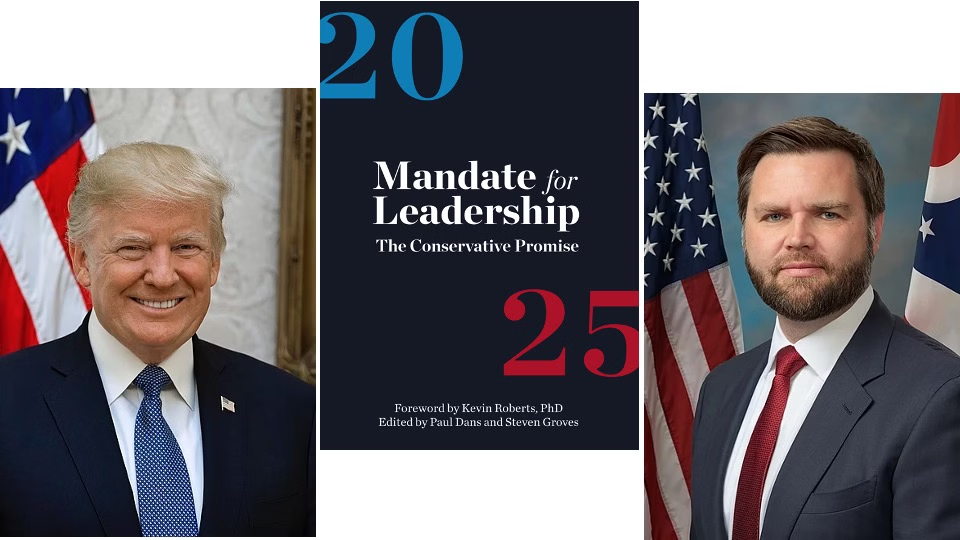
More than 100 nonprofits led by the Heritage Foundation, a right-wing think tank that has engaged in climate change denial and obstruction for decades, have signed on as advisors to the Project 2025’s 900-page “Mandate for Leadership” document — a plan to rapidly “reform,” or radically alter, the U.S. government by shuttering bureaus and offices, overturning regulations, and replacing thousands of public sector employees with hand-picked political allies.
In its official Project 2025 materials, Heritage Foundation leadership repeatedly draws attention to the size and diversity of its advisory board, suggesting that its numerous “coalition partners” are part of a broad, “movement-wide effort” representing a variety of independent viewpoints.
“Project 2025 is unparalleled in the history of the conservative movement—both in its size and scope but also for organizing [so many] different groups under a single banner,” the organization wrote in an October 2023 press release.
But an analysis of financial disclosure forms shows the same small group of donors supporting Project 2025’s advisors again and again — hardly a sign of ideological diversity. Of the 110 nonprofits formally supporting Project 2025, almost 50 received major donations from the same six sources of wealth since 2020.
Many of the organizations the six families funded also have close ties to Donald Trump and his running mate, Ohio Senator JD Vance, DeSmog found. Trump has repeatedly denied involvement in or knowledge of Project 2025, though that position conflicts with a growing number of news reports — a disavowal made more awkward by the fact that Vance wrote the foreword to Dawn’s Early Light, a forthcoming book by Heritage Foundation president Kevin D. Roberts that describes his Project 2025 vision. DeSmog’s review of Project 2025’s financial backers found additional links to Trump, Vance, and key figures in their orbit that had not been previously known.
These six donor networks, linked to the family fortunes of a handful of wealthy industrialists, have spent years working to loosen environmental regulations and promote climate change denial. Though Heritage describes Project 2025 as a mainstream effort to “return government to the people,” its funding sources suggest something far less populist: a vehicle for the obsessions of ultra-rich donors on the far-right fringe, pushing an agenda to reshape American democracy and overturn regulations needed to maintain a livable climate.
Representatives from the six donor networks did not respond to DeSmog’s outreach on this story. The Heritage Foundation did not reply to a request for comment.
The Coors Family At least $2.7 million to Project 2025 groups since 2020
In 1972, Joseph Coors, grandson of Coors Brewing Company founder Adolph Coors, kick-started the Heritage Foundation with an initial gift of $250,000. For years, he supported the conservative think tank’s growth, ultimately funneling his funds through the Adolph Coors Foundation, the nonprofit he started with his brother Bill in 1976.
“There wouldn’t be a Heritage Foundation without Joe Coors,” former Heritage president Edwin J. Feulner wrote in a 2003 tribute.
Joseph Coors meets with Ronald Reagan in 1981. Credit: Wikipedia
The tradition continues today, with billionaire Peter H. Coors — retired beer magnate and Adolph’s great-grandson — at the helm. The Adolph Coors Foundation funded 22 Project 2025 advisory groups between 2020 and 2023, including $300,000 to the Heritage Foundation. Vance has been connected to Heritage since at least 2017, when he wrote the forward to that organization’s “Index of Culture and Opportunity” and gave a keynote address at a Heritage event promoting the report.
Of the Project 2025 groups, Coors funded Hillsdale College, which The New Yorker called “the Christian liberal-arts college at the heart of the culture wars,” most heavily, with nearly $900,000 in donations since 2020. Former Heritage staffer James Braid, today Vance’s deputy chief of staff and legislative director, spent 10 months as a James Madison fellow at Hillsdale College in 2021. Braid appeared on camera in a Project 2025 training video recently obtained by ProPublica and Documented. Braid was also an advisor at American Moment, another Project 2025 group.
The Coors Foundation gave an additional $5.9 million to DonorsTrust, a not-for-profit that describes itself as a philanthropic partner for conservative and libertarian donors — and that gives hundreds of millions of dollars to conservative causes annually, including to numerous Project 2025 advisors, as well as other organizations that downplay or deny the science and urgency of climate change.
Charles G. Koch At least $9.6 million to Project 2025 groups since 2020
In terms of raw numbers, Charles Koch — the CEO and chairman of Koch Industries, a sprawling conglomerate with an oil refinery focus — isn’t the biggest donor to Project 2025 groups in the past few years. But his support for the vast fundraising apparatus that powers conservative charities, including dozens of the initiative’s coalition partners, goes back decades, and his influence can’t be underestimated. A review of public financial disclosures by Greenpeace found that the network of charitable foundations linked to Koch and his late brother, David Koch, donated more than $165 million to climate-change-denying groups between 1986 and 2018. That includes more than $23 million to 16 nonprofits that Project 2025 lists among its advisors.
Throughout the 1990s, Koch Industries was also a “vital supporter” of the American Legislative Exchange Council (ALEC), a Project 2025 advisor. A membership group that connects more than 2,000 state legislators to over 300 corporations and private foundations, ALEC calls itself “a forum for stakeholders to exchange ideas”; New Yorker investigative journalist Jane Mayer, in her book Dark Money, describes it as an enormously successful effort “aimed at waging conservative fights in every state legislature in the country.” Foundations linked to Charles G. Koch donated more than $1.2 million to ALEC since 2020, Desmog’s review found, mostly through his Stand Together Trust.
Koch’s largest donations to Project 2025 groups since 2020 included $3.8 million to the Texas Public Policy Foundation (TPPF), a climate-change-denying nonprofit with close links to both the Heritage Foundation and the Trump administration. In 2018, Trump tapped Brooke Rollins, TPPF’s CEO since 2003, for a post at the Office of American Innovation; in 2020, he named her to lead his administration’s domestic policy strategy. By 2019, there were so many connection points between TPPF and the Trump administration that Politico’s E & E News wrote a story about it.
Rollins was succeeded at TPPF by Kevin Roberts, who had been promoted to CEO by 2021, when he left to become president of The Heritage Foundation. Koch-linked nonprofits also donated $845,000 to Heritage since 2020.
Richard and Elizabeth Uihlein At least $13 million to Project 2025 groups since 2020
The Uihleins are co-founders of Uline, a company that sells shipping and packing supplies — including its ubiquitous brand of cardboard boxes — and other bulk business goods. They donate heavily to conservative causes through the Ed Uihlein Foundation, named after Richard’s father, a packaging company entrepreneur whose grandfather was an original founder of the Schlitz beer company.
Among its donations to 13 different Project 2025 groups since 2020, Uihlein’s largest grants went to the Foundation for Government Accountability ($6.6 million), a limited-government think tank that has railed against “the Biden administration’s radical climate agenda,” and the American Cornerstone Institute ($2.5 million), founded by neurosurgeon and former Trump cabinet member Dr. Ben Carson. Carson has called climate change “irrelevant” as recently as 2015.
Outside the nonprofit sphere, the Uihleins are major donors to the Trump campaign. An analysis of Federal Election Commission data showed that the couple donated $10 million to Make America Great Again, Inc., a pro-Trump super PAC, in May 2024.
The Scaife Family At least $21.5 million to Project 2025 groups since 2020
Richard Mellon Scaife died in 2014, but his contribution to conservative causes is still felt today. A billionaire heir to the vast Mellon fortune, which was created thanks to his progenitors’ exploits in oil and aluminum production, banking, and other industries, Scaife provided years of critical financial support to the Heritage Foundation, starting in 1973. A 1999 article in the Washington Post called him the “funding father of the Right.”
Today, two foundations Scaife once controlled — the Sarah Scaife Foundation and the Allegheny Foundation — continue to give heavily to conservative causes, including to numerous organizations involved in climate change denial. DeSmog’s review found that Scaife family foundations gave $4.1 million to the Heritage Foundation since 2022, while also contributing to 22 other Project 2025 advisory groups.
Scaife foundations also donated an additional $1.2 million to the State Policy Network, an ALEC-linked group that supports conservative nonprofits that oppose government regulation, including 25 members of Project 2025’s coalition.
Barre Seid At least $22.4 million to Project 2025 groups since 2020
The enigmatic industrialist Barre Seid primarily built his fortune through his company Tripp Lite, an electronics manufacturer specializing in surge protectors. He is reportedly a major benefactor supporting the Heartland Institute, a Project 2025 advisor organization that The Economist called “the world’s most prominent think tank supporting skepticism about man-made climate change” — a description Heartland approvingly quotes on its website.
In late 2020, Barre donated 100 percent of Tripp Lite’s shares to Marble Freedom Trust, a nonprofit controlled by Federalist Society co-chairman Leonard A. Leo. In early 2021, Leo sold the shares, netting $1.65 billion. The amount is said to be “among the largest — if not the largest — single contributions ever made to a politically focused nonprofit,” according to The New York Times.
Since May 2020, Marble Freedom Trust has donated $100 million to Concord Fund, also known as the Judicial Crisis Network, a Leo-linked nonprofit. In that time, Concord has donated $22.4 million to eight Project 2025 groups, giving most heavily ($11.9 million) to Susan B. Anthony Pro-Life America.
Seid also gave $2 million to Independent Women’s Voice, the sister organization of Independent Women’s Forum, a Project 2025 advisor. During her time as director for the Independent Women’s Forum’s Center for Energy and Conservation, Mandy Gunasekara, a former Trump administration Environmental Protection Agency official, authored Project 2025’s chapter on restructuring the EPA — with recommendations that include “cutting its size and scope” dramatically.
The Bradley Family At least $52.9 million to Project 2025 groups since 2020
The Lynde and Harry Bradley Foundation was originally established in 1942 by brothers Lynde and Harry Bradley, founders of the Allen-Bradley company, which made its fortune manufacturing a wide range of electronic products. Their descendants have continued to financially support the foundation for years to come, including with a reported $200 million gift in 2015.
But it was Michael W. Grebe, who served as CEO of the foundation between 2002 and 2016, who cemented its reputation as a conservative powerhouse, steering donations to a network of activist organizations like The Heritage Foundation, the Mackinac Center for Public Policy, and the Heartland Institute (all Project 2025 coalition partners). The current chairman is James Arthur “Art” Pope, CEO of the North Carolina grocery chain Variety Wholesalers, a longtime Koch ally.
The Bradley Foundation and a second philanthropic vehicle it supports, the Bradley Impact Fund, donated over $50 million to 29 different Project 2025 advisors since 2020. That’s not including an additional $56 million to DonorsTrust, which a 2013 Mother Jones investigation dubbed, along with its affiliate group Donors Capital Fund, the “dark money ATM” of the U.S. conservative movement. The Bradley Foundation’s Project 2025-linked donations include more than $7.7 million to Turning Point USA, a “powerful ally” of the Trump presidential campaign, which promotes conservative causes on university campuses and is funded in part by the fossil fuel industry. Its single largest donation was $27.1 million in 2022 to Project 2025 advisor Turning Point Legal, founded by former Trump advisor, and past president of a coal lobby group, Stephen Miller.