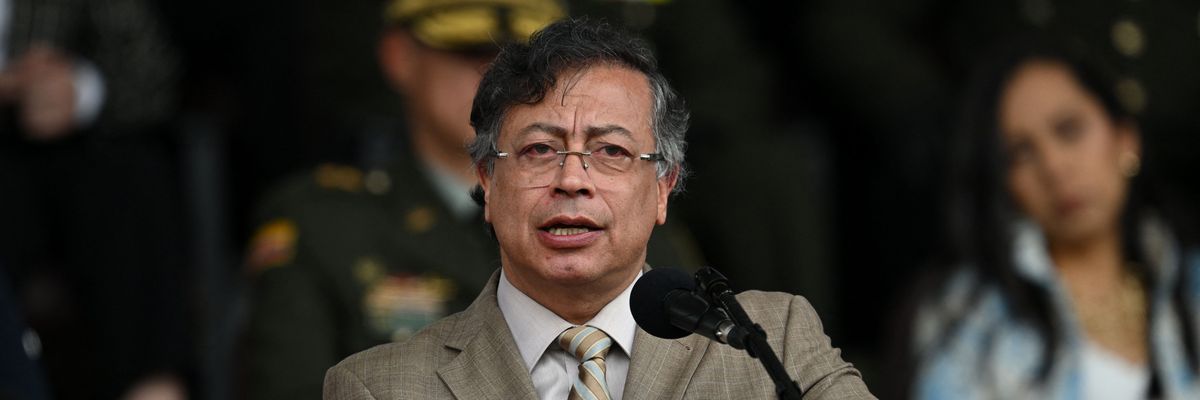
Colombia’s President Gustavo Petro delivers a speech during the commemoration of the 134th anniversary of the National Police and the promotion of officers at the General Santander Police Academy in Bogotá on November 13, 2025. (Photo by Raul Arboleda/AFP via Getty Images)
Rep. Gregory Meeks, who introduced a war powers resolution, said Trump’s actions combine the “worst excesses of the war on drugs and the war on terror.”
As Democrats in the US House of Representatives introduced their latest measure to stop President Donald Trump from continuing his attacks against alleged drug cartels without approval from Congress, the president said he wouldn’t “rule out” deploying US ground troops in Venezuela—and warned he could escalate attacks across Latin America, with possible strikes in Mexico and Colombia as well.
Shortly after the Department of Defense, called the Department of War by the Trump administration, announced its 21st illegal airstrike on what they’ve claimed, without evidence, to be “narco-terrorist” vessels mostly in the Caribbean—attacks that have killed at least 83 people—Trump told reporters in the Oval Office on Monday that he may soon begin similar operations against drug cartels in mainland Mexico.
“Would I launch strikes in Mexico to stop drugs? It’s OK with me. I’ve been speaking to Mexico. They know how I stand,” he said. “We’re losing hundreds of thousands of people to drugs. So now we’ve stopped the waterways, but we know every route.”
Earlier this month, following reports from US officials that the Trump administration had started “detailed planning” to send US troops to Mexico, the nation’s president, Claudia Sheinbaum, retorted that “it’s not going to happen.”
In his comments Monday, Trump threatened to carry out strikes in Colombia as well, saying: “Colombia has cocaine factories where they make cocaine. Would I knock out those factories? I would be proud to do it personally.”
Colombian President Gustavo Petro has been one of Latin America’s fiercest critics of Trump’s extrajudicial boat bombings, last week referring to the US president as a “barbarian.” Trump, meanwhile, has baselessly accused Petro of being “an illegal drug leader,” slapping him and his family with sanctions and cutting off aid to the country.
In response to Trump’s threats on Monday, Petro touted the number of cocaine factories that have been “destroyed” under his tenure. According to figures from the Colombian Ministry of Defense, around 18,000 of them have been taken out of commission since Petro took office in 2022, a 21% increase from Colombia’s previous president.
Immediately after Trump issued his threat against Colombia, he backpedaled, saying: “I didn’t say I’m doing it, I would be proud to do it.”
However, reporting from Drop Site News earlier this month has suggested that Sen. Lindsey Graham (R-SC) “was briefed by Secretary of War Pete Hegseth on the new list of hard targets inside Venezuela, Colombia, and Mexico in early October, and lobbied fellow senators on expanding the war to include drug-related sites in Colombia.”
The senator had alluded to the plans on CBS News’ “Face the Nation,” saying: “We’re not gonna sit on the sidelines and watch boats full of drugs come into our country. We’re gonna blow them up and kill the people who want to poison America. And we’re now gonna expand our operations, I think, to the land. So please be clear about what I’m saying today. President Donald Trump sees Venezuela and Colombia as direct threats to our country, because they house narco-terrorist organizations.”
On Tuesday, a group of Democrats in the US House of Representativesintroduced another measure that would stop Trump from continuing his attacks against alleged drug cartel members without approval from Congress.
The measure would require the removal of “United States Armed Forces from hostilities with any presidentially designated terrorist organization in the Western Hemisphere,” unless Congress authorizes the use of military force or issues a declaration of war. Previous measures to stall Trump’s extrajudicial attacks have been narrowly stymied, despite receiving some support from the Republican majority.
“There is no evidence that the people being killed are an imminent threat to the United States of America,” said Rep. Gregory Meeks (NY), the top Democrat on the House Foreign Affairs Committee, who introduced the resolution.
Meeks added that Trump’s campaign of assassinations in Latin America combines “the worst excesses of the war on drugs and the war on terror.”
Trump’s threats of military action come after Hegseth announced what he called “Operation Southern Spear” last week, which he said would be aimed at “remov[ing] narco-terrorists from our hemisphere.” In a description that evoked the 19th-century Monroe Doctrine, Hegseth wrote on social media that “the Western Hemisphere is America’s neighborhood—and we will protect it.”
In the Oval Office, Trump declared, without evidence, that with each strike his administration carries out against Venezuelan boats, “we save 25,000 American lives,” which experts say is obviously false since Venezuela plays a very minor role in global drug trafficking.
Several international legal experts have said Trump’s strikes constitute a war crime. Earlier this month, Oona A. Hathaway, a professor of international law at Yale Law School, said that members of the Trump administration “know what they are doing is wrong.”
“If they do it, they are violating international law and domestic law,” Hathaway said. “Dropping bombs on people when you do not know who they are is a breach of law.”
The Trump administration has argued that its actions are consistent with Article 51 of the UN’s founding charter, which requires the UN Security Council to be informed immediately of actions taken in self-defense against an armed attack.
The administration has not provided evidence that its attacks constitute a necessary form of self-defense. But last month, a panel of independent UN experts said that “even if such allegations were substantiated, the use of lethal force in international waters without proper legal basis violates the international law of the sea and amounts to extrajudicial executions.”
Donald Fuhrump says that Amerikkka doesn’t bother with crimes or charges anymore, not being 100% Amerikkkan and opposing his real estate intentions is enough.
British political commentator Sami Hamdi speaks to the media in London, Thursday, Nov. 13, 2025, on his return to the U.K. after he was arrested by Immigration and Customs Enforcement on Oct. 26 while on a speaking tour in the U.S
A BRITISH journalist and vocal advocate for Palestinian rights touched down at Heathrow airport today after being detained for more than two weeks by US immigration authorities.
Sami Hamdi was held by Immigration and Customs Enforcement (ICE) officers at San Francisco International Airport on October 26.
He had been in the middle of a speaking tour discussing Israel’s genocide in Gaza when the government revoked his visa.
The State Department did not specify what triggered the revocation. But the California chapter of the Council on American-Islamic Relations (CAIR-CA), whose lawyers challenged Mr Hamdi’s detention in federal court, said he was detained over his support for Palestine and “punished for criticising Israel.”
After arriving back in Britain today, Mr Samdi told the press: “This wasn’t just an attack on me, it was an attack on the freedoms of ordinary Americans and citizens worldwide.
“ It was an attack on their freedom to speak the truth in the face of hatred.
Donald Fuhrump says that Amerikkka doesn’t bother with crimes or charges anymore, not being 100% Amerikkkan and opposing his real estate intentions is enough.
Widespread bullying and violence reported at the army training college | James Battershill
An 11-month investigation reveals culture of violence, criminality and sexual abuse at army training centre for teens
The British Army is the only military in Europe that still recruits 16-year-olds.
That’s how old Hamish* was when he joined last year. As is required of all 16- and 17-year-old sign-ups, who are legally still children but are given the titles of ‘junior soldiers’, he moved into the residential Army Foundation College Harrogate in the north of England to begin his military training.
“In the first couple of weeks, it’s brilliant,” he said of his early days in the army, explaining that most teenage recruits “see it as a brilliant way of earning money”, particularly “if you haven’t really got any GCSEs”.
“But then things start to break down,” he said. Hamish soon witnessed boys being repeatedly punched in the head during fights with their peers or whipped with belts during initiation rituals, as well as other physical violence, including extreme bullying. Junior members of staff, he said, told the teenage recruits they did not need to know about such incidents, even encouraging them to physically “fight it out”.
Hamish is far from alone in his experiences at AFC Harrogate. An exclusive investigation by openDemocracy and the Children Rights International Network (CRIN) has revealed the shocking extent of the bullying, harassment, self-harm, sexual offences and safeguarding failures that teenagers who join the British Army are subject to.
Over the past 11 months, we have submitted dozens of Freedom of Information requests, worked with peers in the House of Lords to ask parliamentary questions, reviewed publicly available documents and data, as well as video footage of instances of violence at AFC Harrogate, and spoken to sources and experts to uncover the reality of life at the college. Our investigation found that between 1 January 2018 and September 2025:
The Ministry of Defence recorded 474 complaints of physical violence against junior soldiers at AFC Harrogate – an average of 62 a year
Staff members were the alleged perpetrators in 41 of these incidents
There were 176 complaints of “sexual allegations”, more than 30 of which were against college staff
The MoD recorded 214 complaints of bullying at the college
The college recorded an average of 20 incidents of self-harm every year
North Yorkshire Police recorded 24 crimes at the college in the first six months of 2025 alone, including five sexual offences
openDemocracy shared the number of allegations of physical violence with a teacher who spent more than a decade working in a mainstream school with a sixth form in England, where the pupils are the same age as those at AFC Harrogate, to ask if this was a normal rate. A school receiving such a high number of complaints in any given year, she said, “would be fucking nuts”.
Teachers from English state schools also told us that the 176 allegations of sexual abuse at AFC Harrogate “seems phenomenally high”. One said that in more than a decade of teaching at a sixth form college, she could only think of one such complaint.
Our findings raise serious concerns about the welfare of teenagers at AFC Harrogate.
Like many other Western militaries, the British Army is finding it increasingly difficult to bring in new recruits. In 2010, the army boasted nearly 110,000 troops; now, it struggles to meet its target of 73,000. The Ministry of Defence plans to spend £18m on attracting new personnel to the army this financial year, twice as much as The Daily Express reported it spent in 2023/24. It is likely that much of this spend will target 16- and 17-year-olds, whom CRIN has previously found make up around third of the army’s annual intake – but our investigation has thrown into doubt the care that the British Army will provide to those who sign up.
The failures we have uncovered at AFC Harrogate are not without tragic real-world consequences. CRIN previously found that more than half the British soldiers who have killed themselves while in active service over the past two decades had signed up to the military before they turned 18, with those who joined aged 16 or 17 more than twice as likely to take their own lives than those who joined as adults.
“These recruits,” CRIN’s Jim Wyke warned, “coming from the most deprived backgrounds, join wanting to serve their country, to better themselves, to build something of themselves – and what do they get? An education that would be illegal anywhere else in the UK. A significant risk of being bullied or physically and sexually abused, including by their instructors. And worst of all, a welfare system that prioritises the reputation of the army above the children under their command.
“The truth is simple: the army is exposing children to abuse, and when confronted with this is refusing to act. This is a scandal. Those who’ve signed up so young deserve better.”
Life at AFC Harrogate
As the UK’s only initial army training unit for child recruits, the Army Foundation College in Harrogate receives all 16- and 17-year-olds who join the British Army each year. On average, this is around 2,370 teenagers annually, according to data obtained through FOI.
Many of these junior soldier recruits have specific vulnerabilities.
The majority come from disadvantaged backgrounds: recruitment to the army is 57% higher in deprived areas than the wealthiest parts of the country. Last year’s AFC Harrogate intake also included 39 registered care leavers – twice as many as you might expect based on the proportion of children in care in the UK – according to a parliamentary question submitted on our behalf by Labour peer Baroness Lister. And 182 junior soldiers had an initial assessment at the MoD’s department of community mental health between 1 January 2019 and 31 December 2024, an FOI revealed.
Upon arriving at AFC Harrogate, these teenagers are placed in the care of around 500 members of staff at the college, the vast majority of whom are themselves members of the army who have undertaken a two-week course at the army instructor training school at Pirbright, before receiving on-the-job training.
The new junior soldiers join one of two ‘Phase 1’ courses: a 49-week programme for recruits who intend to join combat roles, and a shorter 23-week course for those who plan to go on to roles such as military engineers, field doctors, or logistics specialists. Both courses, the army website says, teach aspects of military life including fieldcraft, skill at arms, fitness training, qualities of a soldier and battlefield casualty drills.
Trainees also receive some, albeit limited, education from civilian staff. The Ministry of Defence (MoD) is not bound to the Education and Skills Act 2008, which requires 16- and 17-year-olds to be in education or training. As such, the college offers short ‘Functional Skills’ courses in English and Maths, which are below the level of GCSEs and do not offer an easy route to further qualifications.
AFC Harrogate’s promotional material often boasts that it has repeatedly been rated ‘outstanding’, the highest grade, by England’s education watchdog, Ofsted. Not mentioned is that the MoD has a bespoke commercial contract with Ofsted, with the government covering the costs of the inspections of AFC and other Initial Army Training Establishments. Under this memoriam of understanding, Ofsted inspects AFC on different criteria than it would a mainstream college.
In a glossy video on the army’s website, teenage recruits at AFC Harrogate extol the benefits of signing up to the military. One talks of the college’s “really good” facilities that include “pool tables and even a cinema, so you can always go down there and watch some films with your friends”. Another says the “wage here is mint”, boasting that “you’re 17 and earning like a grand a month”, and says it’s true that “the army is like a massive family” because she’s made “the strongest friends she’s ever had” in just five months.
But headlines from recent years reveal a darker side to the college.
Last year, former AFC Harrogate instructor Kerry-Anne Knight won her employment tribunal against the MoD over sexist and racist behaviour by her colleagues. And in February this year, an inquest into the suicide of 19-year-old royal artillery gunner Jaysley Beck heard that she had previously been in a relationship with an adult instructor at AFC Harrogate, which she attended from the age of 16 – an abuse of power that the military has since banned. The relationship officially started after she left the college. Another former Army sergeant major last month pleaded guilty to sexually assaulting Beck at Larkhill military base, which she went to after leaving Harrogate and where she took her own life.
For over a year, openDemocracy has worked to reveal how military enables abuse then closes ranks around perpetrators
Our investigation proves that these cases were not one-offs. We found widespread incidents of physical violence and bullying among junior soldiers and staff, as well as reports of criminal behaviour and sexual abuse.
Responding to our findings, Harrogate MP Tom Gordon said: “Cultures of harassment, abuse and misogyny have no place in our society, least of all within our Armed Forces. The Armed Forces are already suffering from significant recruitment and retention challenges, and statistics like these only serve to discourage young people from joining. It is crucial that the Armed Forces take direct and decisive action to address these issues.” Gordon also confirmed he has arranged a meeting with AFC Harrogate, saying “I look forward to hearing directly from the College about the steps they are taking.”
Describing our findings as “worrying,” army veteran, campaigner and author Diane Allen told openDemocracy: “The MoD stated recently that their values were laid out clearly in written doctrine. But my response was that ‘paper values’ are useless, unless young recruits see their instructors and the wider leadership demonstrate those values day to day. We hear the MoD press trot out the same, standard message – that the issues in our recruit training establishments are historic and resolved. This investigation shows up the lie.”
Physical and criminal violence
The Ministry of Defence recorded 433 complaints of physical violence between junior soldiers at AFC Harrogate between January 2018 and September 2025, an average of 62 a year. There were a further 41 complaints of staff being violent towards young recruits.
To put this into perspective, openDemocracy asked three randomly chosen mainstream colleges across England that had also been rated ‘outstanding’ by Ofsted how many complaints of violence they received during this same seven-and-a-half-year period. Two had not received any such complaints, while the third college had received just one.
Hamish, who left the British Army last year after six months, has since become a whistleblower over the extreme violence he witnessed and himself suffered at AFC Harrogate. He told CRIN there were “many fights, beatings in the bathrooms” at the college. These include one fight in which he was punched in the face, and another in which he saw a recruit “get scratched on the neck and then kicked in the stomach” by fellow junior soldiers.
These fights were often encouraged by AFC Harrogate’s lower-ranking staff, Hamish said, explaining that rather than attempting to stop physical violence, infantry corporals would encourage junior soldiers who were arguing to put on boxing gloves and fight it out in a ‘sanctioned fight’. Their attitude was “more or less, fuck it, fight it out. I’m not bothered [if you] do it behind closed doors, and I won’t need to know about it,” Hamish said.
openDemocracy has reviewed footage of one sanctioned fight, which Hamish filmed in 2024 and shared with the CRIN. The fight ends with one boy being repeatedly punched in the head after the instructor leaves the room. Hamish also shared a video of an initiation ceremony, known as a “hazing”, in which a boy doing press-ups is repeatedly whipped with a belt by a fellow junior soldier.
These altercations can spill into criminal behaviour. The Royal Military Police opened 105 investigations into physically violent crimes by soldiers at AFC Harrogate between 2018 and 2025, including 58 reports of battery and 22 reports of actual bodily harm, which carries a maximum prison sentence of five years, or seven where an attack was racially or religiously motivated. The outcomes of these investigations are not known.
While a soldier making a complaint against another member of the armed forces would likely be directed by their superiors to the military police in the first instance, any person alleging a soldier has done something that would be a crime in the civilian courts can instead choose to report it to civilian police force. AFC’s local force, North Yorkshire Police, recorded 13 incidents of “violence against the person” – a broad category of crimes that could range from common assault to more serious crimes such as grievous bodily harm – at the barracks in the first six months of 2025.
Bullying is also a serious problem at AFC, with the Ministry of Defence receiving 214 bullying complaints about the college between 2018 and 2025. The data, which was obtained under FOI, does not show whether the complaints relate to peer-on-peer bullying or staff-on-student bullying.
Hamish said that while senior staff would likely take action to stop bullying if they became aware of it, junior staff members’ attitude would again be, “if you’ve got a problem with somebody, fight it out, sort it out.” That approach might be okay for adults, he added, but “it shouldn’t come down like that at AFC.”
David* saw first-hand the impact that bullying at AFC had on his son, John*, who signed up to the British Army in September 2024, when he was 16. John had wanted a fresh start away from a group of friends who were getting into trouble, and David described his son’s first six weeks as “brilliant”, but said things soon took a darker turn.
“One of the corporals – an instructor – had it in for him,” said David. “He was singled out, made to do essays until early morning. It was just him.”
John’s parents turned to social media for advice. They contacted the college and the corporal was moved on from Harrogate, but worse was to come. “When he started phase one of training, the other boys in his room were bullying him,” David said. “He got hit, he got assaulted. When my wife FaceTimed him, he had a mark on his face.”
David and his wife complained to the Officer Commanding, the most senior position at AFC Harrogate – a difficult decision as they were worried it could lead to further bullying. The OC told the pair that it was being dealt with, but ultimately John chose to leave the army.
“My son has totally changed since he came back,” said David. “He’s a totally different boy than when he went away and not in a good way. He’s now got a referral to see a mental health nurse. It’s affected our family as my wife and I have been worried sick.
Bullying can leave recruits suicidal. In 2023, a teenager at AFC Harrogate attempted to take his own life with a gun, after experiencing severe bullying. A whistleblower told The Times that the man’s injuries were so severe he had to be air-lifted to help on a stretcher.
AFC Harrogate recorded 103 incidents of self harm between in the five years to 31 March 2024, an average of 20 a year, according to data that the MoD disclosed to Labour Peer Lord Coaker, the minister of state for defence, following a parliamentary question. openDemocracy and CRIN asked the MOD how many suicide attempts there had been, but was told it does not record this data.
We also asked the Yorkshire Ambulance Service how many call-outs it had received to AFC Harrogate since 2020. The total number was 86, of which 11 were category one, which are deemed to be the most urgent, life-threatening emergencies. Fifty were category two – “not life-threatening but require rapid response” – while the remainder were category three and four, the lowest two tiers of call-outs.
In contrast, three randomly selected Ofsted-rated ‘outstanding’ colleges received a total of 34 ambulance call outs in the same time period.
We put these figures to Rachel De Souza, the Children’s Commissioner for England, whose website says she has a legal duty to promote and protect the rights of children, especially “children who are living away from home”. Her office said it was aware of the issues at AFC Harrogate but did not respond to repeated requests for comment before our publication deadline.
Sexual abuse
The MoD has been dogged by repeated sexual abuse scandals in recent years, and AFC Harrogate is no exception.
In 2023, CRIN revealed that North Yorkshire Police had recorded nine rapes at the college between July 2022 and August 2023, as well as four lesser sexual offences.
Updated data shows the situation has not improved. The force told us it had recorded ten sexual offences at the college in the 18 months to July 2025, including rape of a male aged 16 and over, sexual assault on a female aged 13 and over, and sexual assault on a male aged 13 and over. There were also reports of harassment, stalking and assaults with and without injury. The data does not show how many of each of these assaults were recorded.
These figures do not include cases dealt with by the military justice system, such as a court martial last year, where a junior soldier received a suspended sentence after being found guilty of assault by penetration committed against a 17-year-old colleague who was in the medical wing.
Exclusive: Pervasive misogyny means 77% of troops accused of rape are found not guilty in military courts
The Royal Military Police recorded 122 sexual crimes against under-18s in uniform from 2021 to 2024. The data does not show how many of the victims and perpetrators were at AFC Harrogate, as some could have been in the equivalent training colleges for the Royal Navy or Royal Air Force.
We submitted multiple FOI requests to the MoD to determine the extent of sexual complaints, abuse and violence at the training barracks. While most were refused, a question asked to Parliament on our behalf by Baroness Lister revealed there were 176 “sexual allegations” at AFC Harrogate between 1 January 2018 and 30 June 2025, of which 32 were made against staff – an average of five a year.
Court martial records also gave some insight into sexual violence committed by staff at AFC. In 2024, instructor Corporal Irwin was found to have had sex with a child while acting in a position of trust, and instructor Corporal Conway was convicted of raping an adult colleague in her room. In January 2023, instructor Corporal Bartram was convicted for the serial sexual exploitation of six female under-18 recruits over ten months from July 2021.
“Sexual trauma can cause setbacks and life-long disadvantages for young people, impacting their emotional, mental, and physical health,” said Mags Godderidge, CEO of Survive North Yorkshire, which supports survivors of sexual violence in the region. “Many survivors face PTSD symptoms and psychological distress, including panic attacks, anxiety, and depression.
“Given the long-term and sometimes lifelong impact, organisations and institutions should be doing all they can to protect children from sexual harm – whether that harm is caused by peers or people in positions of trust.”
A college or a military base?
Despite the clear safeguarding concerns raised in this investigation, Ofsted continues to rate AFC Harrogate as “outstanding” for welfare – including in its 2023/24 report, the inspection for which came three months after the bullied recruit tried to take his own life using a gun and nine months after Cpl Bartram was convicted of sex offences against recruits under his care.
“If you’re an Ofsted inspector, you look at the fact that they have a welfare [officer], they have the chaplain, they have the games room and everything,” said whistleblower and former junior soldier Hamish. “So that ticks boxes. But I think if they went round the college and asked some of the recruits: do you feel that the support that is there? Do you feel like you can go to it? I feel like they would get quite a couple of noes.”
We approached Ofsted for comment but it told us it does not comment on individual units. It referred us to its handbook which states: “The aim of inspection is to evaluate the effectiveness and efficiency of arrangements to provide for the welfare of and care for trainees.” Inspections look at “quality of training and support; professional and personal development of trainees; quality of facilities, infrastructure and resources; and effectiveness of leadership and management.”
An Army spokesperson said that “unacceptable and criminal behaviour has absolutely no place in our Armed Forces”, but stood by the Ofsted report, saying it “highlighted that high standards of care, welfare, and safeguarding are deeply embedded in the Army Foundation College (Harrogate) training programmes”.
They added: “Robust procedures are in place to address any allegations, and we work hard to create an environment where personnel know any report will be met with action. This includes the Violence against Women and Girls Taskforce and our Victim and Witness Care Unit, which provides independent support to victims. The Defence Serious Crime Command assures all serving personnel that any reporting of a serious crime will be investigated independently from their chain of command.”
As well as Ofsted, wellbeing at AFC Harrogate is supported by a body known as the Independent Advisory Panel (IAP), set up in response to the Deepcut scandal in the 1990s, when four young soldiers at the barracks were found dead from gunshot wounds over a seven-year period.
In its terms of reference – obtained by openDemocracy and CRIN through FOI laws – the IAP described itself as “an independent, non-statutory source of advice, challenge, encouragement, and support.” But the document also states that “the IAP has no responsibility for and will not attempt to override the fundamental army principle of self-regulation vested in the Commanding Officer and the higher chain of command” and that it will “observe and record what they see without judgement.”
These terms raise questions over the panel’s effectiveness. As with Ofsted, the IAP has repeatedly failed to sanction AFC Harrogate during periods when our investigation has found distressing levels of sexual, physical and emotional violence within its ranks.
As for David, whose son John was so badly bullied at the college, his views on their failings are clear. “The college did not do enough to protect my son,” he said. “They’re 16-17-year-old boys, they are dumped in a room at night, they are left to their own devices, the corporals are not watching what’s happening. I’ve got twin boys aged 13 and I wouldn’t want them to go to Harrogate at all.”
Indigenous demonstrators shout slogans during a demonstration at Parque Central Cayambe, Ecuador, as part of the national strike on October 1, 2025 | Felipe Stanley/Agencia Press South/Getty Images
Taking from Trump’s playbook and reviving colonial trope, President Noboa labelled Indigenous protesters ‘terrorists’
Recent years have seen Western governments extoll their democratic values while leading increasingly harsh crackdowns on dissent, with activists arrested and accused of terrorism.
Now, Ecuador has gone even further. President Daniel Noboa’s far-right government met recent nationwide anti-austerity protests with a brutality that has left two protesters dead, 473 injured, 12 missing, and 206 detained, according to the Alliance of Human Rights Organisations of Ecuador.
A 31-day national strike erupted on 22 September, nine days after Noboa removed fuel subsidies, raising the price of diesel by 55% from $1.80 to $2.80 per gallon. The demonstrations, which disrupted the movement of goods and people across the country as protesters blocked main roads, were led by Ecuador’s largest Indigenous organisation, the Confederation of Indigenous Nationalities, which represents many of the people who will be the hardest hit by the price hikes.
The government responded by imposing a state of emergency and deploying troops to break up protesters, leading to state-inflicted violence that drew criticism from civil rights groups in Ecuador and across the world.
Human Rights Watch reported it had “verified 15 videos” of “soldiers or police officers forcibly dispersing peaceful demonstrations and using tear gas and other ‘less lethal’ weapons recklessly and indiscriminately”, while Amnesty International warned of “excessive use of force against protesters by the security forces, possible arbitrary arrests, as well as the opening of abusive criminal proceedings and freezing of bank accounts belonging to social leaders and protesters”.
The unrest came as Ecuadorian voters prepare to vote on a series of referendums on 16 November. Perhaps the most controversial question they will answer is over whether to accept foreign military bases on Ecuador’s territory.
The ballot does not explicitly refer to the United States, but it may as well do; this week, US homeland security secretary Kristi Noem made her second visit to the Latin American country in four months to scout out locations for new US military bases.
Noboa’s government has long pushed for greater alignment with the US. While Ecuadorian opposition leaders warn that US military bases would threaten Ecuador’s sovereignty, both Noboa and Donald Trump’s administrations argue that they would help to stop transnational crime gangs from using the country to smuggle drugs from South America into the US.
Although polls suggest a slight majority of voters are against the bases, many are still undecided. Regardless of how they vote, Trump’s influence over Noboa’s government is already clear from the reaction to the recent Indigenous-led demonstrations. Taking from the US president’s playbook, ministers accused protesters of carrying out “terrorist acts” – directly echoing language used against activists in the US – and at least 13 people have been charged with terrorism after allegedly attacking the offices of police in Otavalo, a city in northern Ecuador.
This decision to cry terrorism is part of a strategy to turn social discontent into a security threat. Rather than answering the demands of protesters – the majority of whom were the poor people, transport workers and Indigenous peoples who will be hardest hit by fuel price increases – the government has chosen to criminalise dissent and militarise social conflict to protect its austerity measures from popular resistance.
But protest is not terrorism. It is the democratic voice of those who suffer most from inequality.
Unequal sacrifices
In Ecuador, an oil-producing country, the dispute over fuel subsidies is a recurring issue.
The subsidies have kept prices for petrol and diesel artificially low since the 1970s, but consecutive governments have argued they put too much strain on the national budget, costing the state billions, while international financial institutions have criticised them for “distorting” the economy. In 2022, the subsidies were equivalent to around 2% of Ecuador’s GDP, according to a report by the Ministry of Economy and Finance.
But for farmers, truck drivers and informal workers, the subsidies provide indispensable respite from low incomes and rising living costs. Therein lies the clash: what governments see as an easy way to make savings on their balance sheet will mean hunger for many ordinary people.
One key measure of the cost of living in Ecuador is the monthly price of the ‘basic family basket’, a government-defined set of goods needed to sustain a family of four, including food, clothing, medicine, household items and transport costs. In May this year, the price of that basic family basket reached $812, while the monthly minimum wage remained at $470. This disparity will only worsen with the removal of the diesel subsidy, which will make transport, food and the production of goods more expensive.
Previous attempts to scrap the fuel subsidies have caused the social unrest that has marked Ecuadorian politics in recent years. Two previous governments tried to do so in 2019 and 2022. Both instances sparked huge demonstrations that forced ministers into U-turns.
This time, Noboa’s government, which was elected in 2023, does not appear to be backing down. The Confederation of Indigenous Nationalities eventually called off their strike on 23 October in the wake of the state’s brutal repression, having been unable to secure any concessions.
If the government does succeed in removing the subsidies, it will lead to rising costs that will not be borne equally across Ecuador, a plurinational and multi-ethnic country where wealth is concentrated in certain areas and among certain racial groups.
The most recent data finds that 72% of the population self-identifies as mestizo, a term that refers to a person of mixed European and Indigenous American ancestry. The next largest demographic group is the Montubio people (7.4%), a rural ethnic group from coastal Ecuador; followed by Afro-Ecuadorians (7.2%), who also primarily live in the coastal provinces; then Indigenous people (7%) who largely live in the highlands and Amazon; and white people (6.1%), who have historically been based in larger cities.
The Afro-Ecuadorians and Indigenous populations in the country’s Amazon and rural coastal provinces will suffer most from the increases in transport and labour costs. Many of the families who will be affected are already impoverished, with a 40% poverty rate in these areas, far above the national rate of 28%.
Ecuador’s coast is dominated by export-oriented agribusiness and ports; the Andean highlands by public administration, services and manufacturing; while the oil extraction in the Amazonian east accounts for a large part of the country’s national income, without translating into local well-being.
The paradox is evident: the territories that produce wealth also face the greatest inequalities and deficits in health, education and basic services.
Women will also be hit harder by the removal of the fuel subsidies than men. The country’s 3.6% unemployment rate masks key gender inequalities; among women the rate is 4.6%, compared to 2.8% among men. Similarly, only 27% of women have access to adequate employment, with sufficient income and stability, compared to 41% of men, according to official figures.
The greater job insecurity created by rising food and household goods prices will disproportionately affect women. They will be forced to work longer hours to survive, particularly where they are responsible for the care of children or elderly relatives – another burden that disproportionately falls on women.
There is no neutrality in austerity: there is a regressive redistribution that privileges fiscal balance at the expense of the country’s most impoverished.
‘Terrorism’ and state coercion
While protests started in the immediate aftermath of the announcement on 13 September that the subsidies would be scrapped, the coordinated national strike began on 22 September.
Over the following 31 days, news broadcasts were full of images of this resistance across Ecuador: closed roads in Cuenca, pots and pans banging in Quito, women and children fleeing tear gas in San Rafael de la Laguna.
President Noboa imposed a state of emergency in many provinces, a measure that suspends constitutional guarantees such as the freedom of assembly, the inviolability of the home and correspondence, and the freedom of movement due to curfews. Last year, the Constitutional Court issued a warning to the president over the repeated use of this tool, which it said should be applied only in “extraordinary” circumstances.
By also condemning the protesters as “terrorists”, the government aims to delegitimise collective action, depoliticise the dispute over income and enable repression. Labelling Indigenous people as ‘offenders’ revives an old colonial trope of ‘internal enemies’, where racialised bodies are seen as a threat to order.
Noboa’s discourse is also part of a well-known Latin American genealogy: during the years of counterinsurgency, the labels of ‘subversion’ and ‘terrorism’ justified massacres, states of siege and arbitrary detentions. Today, that same language is being revived to shield a neoliberal model that is based not on consensus but on coercion.
For now, the question is not whether Ecuador can sustain fuel subsidies in the long term, but who gets to decide this. Removing subsidies without dialogue or progressive compensation mechanisms is governing against the majority.
A truly democratic policy would require real dialogue with Indigenous, Afro-Ecuadorian and peasant organisations, and including their voices in defining policies on the prices of utilities, including fuel, water and energy.
Wage and labour reform is also needed to link the minimum wage to the cost of the basic basket of goods and reduce gender and ethnic gaps, as well as territorial investment in the Amazon and rural areas to provide health, education and basic services. Finally, the demilitarisation of social conflict and the repeal of laws that criminalise protest.
The Noboa government seems to be choosing another path: shielding austerity with repression. But labelling those who defend life and bread for their families as terrorists does not resolve the conflict: it deepens it.
Protest is the language of those who refuse to be expelled from history by a model that promises order in exchange for inequality and silence.
*Rose Barboza is a Brazilian researcher and doctoral candidate in Social Sciences at the Centre for Social Studies, University of Coimbra, Portugal. She specialises in transitional justice, feminist epistemologies and critical race theory. Her current work explores comparative cases of state repression and social movements across Latin America.
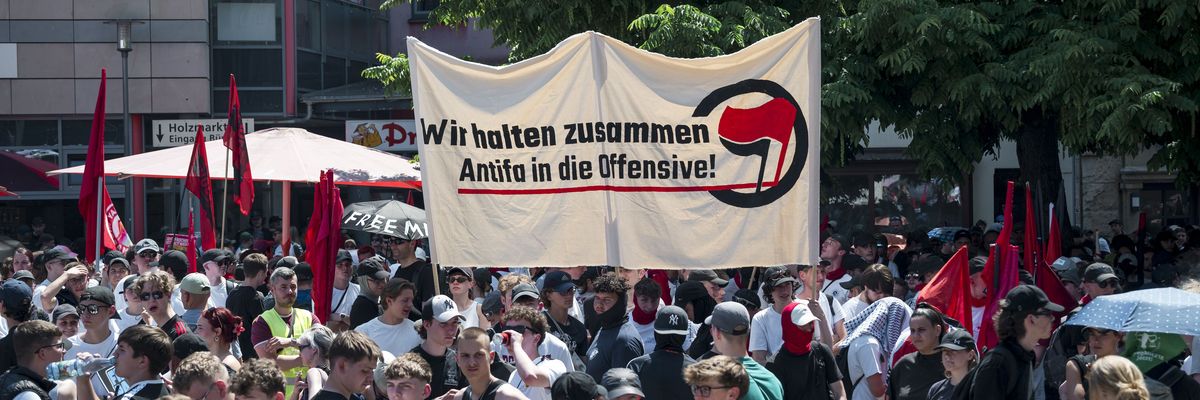
“We stick together – Antifa on the offensive!” reads a banner at a demonstration on June 14, 2025, in Jena, Thuringia, Germany, called by a broad alliance of anti-fascist groups under the slogan “Now more than ever! Anti-fascism is necessary!”. (Photo by Daniel Vogl/Picture Alliance via Getty Images)
Investigative journalist Ken Klippenstein warns that the designation opens up US citizens to government surveillance, asset seizure, and material support charges.
President Donald Trump’s State Department on Thursday broadened his efforts to use “terrorism” to crush his enemies on the left, designating four European groups as “foreign terrorist organizations” based on their alleged connections to the vaguely defined network of leftist agitators known as “antifa,” short for “anti-fascist.”
Following the assassination of right-wing activist Charlie Kirk in September, Trump turned his attention toward waging a war on left-wing protest groups and liberal nonprofits, describing them as part of a vast, interconnected web that was fomenting “terrorism,” primarily through First Amendment-protected speech.
As part of that effort, Trump formally designated “antifa” as a “domestic terrorist organization,” even though it is not a formal group with any structure, but rather, a loose confederation of individuals all expressing an amorphous political belief. Civil rights advocates warned that the vague nature of the designation could be extended to bring terrorism charges against anyone who describes the Trump administration’s actions as fascist or authoritarian.
Shortly after, Trump also signed a little-reported national security order, known as National Security Presidential Memorandum 7 (NSPM-7), which mandated a “national strategy to investigate and disrupt networks, entities, and organizations that foment political violence so that law enforcement can intervene in criminal conspiracies before they result in violent political acts.”
Some of the indicators of potential violence, the memo said, were “anti-Americanism, anti-capitalism, and anti-Christianity,” “extremism on migration, race, and gender,” and “hostility towards those who hold traditional American views on family, religion, and morality.”
Referencing NSPM-7 explicitly, the State Department on Thursday spread that crusade against the left overseas, slapping four German, Greek, and Italian anarchist groups with the label of “foreign terrorist organization” (FTO). The same designation has been given to groups like al-Qaeda, ISIS, and al-Shabaab.
Trump slaps Antifa with its first-ever foreign terror label, in move that explicitly cites NSPM-7. https://t.co/NIeWFNv1PZ
— Ken Klippenstein (NSPM-7 Compliant) (@kenklippenstein) November 13, 2025
The groups targeted were Antifa Ost in Germany; the Informal Anarchist Federation/International Revolutionary Front (FAI/FRI) in Italy; Armed Proletarian Justice in Greece; and Revolutionary Class Self-Defense, also in Greece.
The designation of Antifa Ost and other violent Antifa groups supports President Trump’s National Security Presidential Memorandum-7, an initiative to disrupt self-described ‘anti-fascism’ networks, entities, and organizations that use political violence and terroristic acts to undermine democratic institutions, constitutional rights, and fundamental liberties.
Groups affiliated with this movement ascribe to revolutionary anarchist or Marxist ideologies, including anti-Americanism, ‘anti-capitalism,’ and anti-Christianity, using these to incite and justify violent assaults domestically and overseas.
Each of the accused groups has had members charged with or convicted of violence, often against Neo-Nazis or adjacent far-right causes. But while they are more organized than America’s anti-fascist movement, they are still broad-based and diffuse.
Mirroring what studies have shown in the US, the far-right is responsible for the overwhelming bulk of political violence in the European Union. A 2024 study by Armed Conflict Location and Event Data (ACLED) found that across Europe, the far-right was responsible for 85% of the violent targeted incidents they tracked.
Though Greece was one exception, where far-left violence was more prevalent than far-right violence, Mary Bossis, an emeritus professor of international security at Piraeus University in Athens, told The Guardianthat Greece’s anti-fascist movement has little to do with it.
“It is highly exaggerated to say that the antifa movement in Greece employs terror tactics,” she said. “They even run in elections and have never shown any sign of violence.”
While most social movements have some violent adherents, Bossis said, “that does not mean, as in the case of antifa, that the whole movement is either violent or supportive of terrorism. In fact, it is very much not the case… Standing against fascism does not make someone a terrorist.”
As Mark Bray, a Rutgers University professor who teaches a course on the history of antifascism, pointed out in The Guardian, Antifa Ost is the only one of the four groups designated by Trump that self-identifies as anti-fascist.
“The others are revolutionary groups,” he said. “This shows how the Trump administration is trying to lump all revolutionary and radical groups together under the label ‘antifa’. By establishing the (alleged) existence of foreign antifa groups, the Trump administration seems to be setting the stage for declaring American antifa groups (and all that they deem to be ‘antifa’) to be affiliated with these supposed foreign terrorist groups.”
Ken Klippenstein, an independent investigative journalist who has warned about NSPM-7 since its release, noted that this marks the first time that an entity in any of these three European countries has ever been slapped with the label of an FTO.
“The move seems an attempt to make people accustomed to white Westerners being treated as terrorists,” he wrote Thursday. “That, after all, is the goal of Trump’s national security directive NSPM-7.”
While there is no law on the books to back Trump’s designation of antifa as a domestic terrorist organization, there is such a designation for foreign terrorist groups.
Being designated as a member of a foreign terrorist organization can subject one to significant sanctions, including having assets in American banks frozen, being unable to enter the country, or being prosecuted for “material support.”
The government has used accusations of terrorism to go much farther, including carrying out extrajudicial assassinations of targets. Over the past two months, the Trump administration has bombed over a dozen boats in the Caribbean using the unsubstantiated justification that their passengers are “narco-terrorists” shipping drugs for cartels, which the administration has also designated as FTOs. The attacks have killed at least 76 people.
Attorney General Pam Bondi suggested last month that the Trump administration planned to use the “same approach” to antifa as it has with cartels, leading many to fear that might include assassinations.
Mehdi Hasan, the founder of the media outlet Zeteo, said the designation of these groups as terrorist organizations was “super bad for US citizens, especially on the left of the spectrum,” because it “gives this authoritarian administration potentially the power to surveil and go after US citizens on spurious ‘funding of FTO’ grounds.”
The State Department noted in a fact sheet on the designations that it is also seeking to target those in the US accused of supporting these groups.
“US persons are generally prohibited from conducting business with sanctioned persons. It is also a crime to knowingly provide material support or resources to those designated, or to attempt or conspire to do so,” the memo said. “Persons that engage in certain transactions or activities with those designated today may expose themselves to sanctions risk. Notably, engaging in certain transactions with them entails risk of secondary sanctions pursuant to counterterrorism authorities.”
Klippenstein said that while Trump’s “domestic terrorist” designation was limited, “with an FTO designation, the gloves come off,” opening Americans up to “FISA surveillance, seizure of financial assets, [and] material support charges.”
Donald Fuhrump says that Amerikkka doesn’t bother with crimes or charges anymore, not being 100% Amerikkkan and opposing his real estate intentions is enough.Donald Trump warns against following the Onaquietday.org blog, says that he’s heard that she’s a witch with a black cat and a dangerous kitchen.Orcas discuss how Trump was re-elected and him being an obviously insane, xenophobic Fascist.


 British political commentator Sami Hamdi speaks to the media in London, Thursday, Nov. 13, 2025, on his return to the U.K. after he was arrested by Immigration and Customs Enforcement on Oct. 26 while on a speaking tour in the U.S