Category: new authoritarianism

  • Venezuela and the journey from Monroe’s Doctrine to Trump’s Jungle Law

    Spread the love

    Original article by Diana Cariboni republished from OpenDemocracy under a Creative Commons Attribution-NonCommercial 4.0 International licence. 

    Donald Trump holds a press conference after US forces captured Venezuelan leader Nicolas Maduro and launched a ‘large-scale strike’ on the Latin American country | Jim Watson / AFP via Getty Images)

    The US has a long history of military intervention in Latin America, but never before has it been so brazen

    As the days pass, shock subsides over the kidnapping of Venezuelan president Nicolás Maduro and his wife, Cilia Flores, which was ordered by Donald Trump and carried out by the US military. That the victim is a dictator has helped to justify the illegal use of brute force.

    There is a long history of US military intervention in Latin America. It’s been the expression of the most enduring principle that has governed relations in the American continent.

    Everything Trump did in the first year of his second presidential term was old news: tariff wars, interventions in the internal affairs of other countries, threats, extortion and the revival of the old Monroe Doctrine.

    What is new is the brazenness, the absence of even the slightest legal justification, or even the effort to frame actions within some interpretation of international law, however twisted it may be. There is no talk of democracy, freedom or human rights for millions of Venezuelans.

    This is an unexplained and uncontested exercise of power. “What’s next, Mr President, Colombia?” journalists asked Trump like subjects asking their emperor. “It sounds good to me,” he replied. Mexico, Colombia, Cuba, Greenland… “American dominance in the Western Hemisphere will never be questioned again.”

    The threat is material – Maduro in handcuffs, the naval deployment in the Caribbean, the boats bombed for months – and at the same time diffuse. No one knows what the logic or the alleged motive for the next action will be.

    The effect of Trump’s actions, already tested with the so-called “peace deal” for Palestine in the aftermath of the Israeli genocide in Gaza, is to sow confusion and division, and paralysis. The era of this new power has begun with little to oppose it, and with international laws useless like broken toys. And we are all warned.

    Maduro was extracted from his bunker in eight minutes, which was enough time to kill 32 Cuban guards who were protecting him. The rest of the regime remains intact, now as the executive arm of Trump’s designs, which have articulated only one priority: oil.

    When asked about elections, democracy or the release of some 800 political prisoners, Trump and his secretary of state, Marco Rubio, reply that all this “is premature”. The nature of the events indicates the coup was orchestrated with a part of the regime whose head was Maduro.

    Nothing remains of Venezuela’s Bolivarian revolution, not even dignity. Delcy Rodríguez, Maduro’s vice-president and one of the most vocal figures in his administration, has been appointed interim president, with Trump’s acquiescence. She and her brother Jorge, the president of the National Assembly, Diosdado Cabello, the minister of the interior, and Vladimir Padrino López, the head of the armed forces, have become administrators of a Trump protectorate – a new, perhaps provisional, status quo that sets Venezuela and all of Latin America sailing into uncharted waters.

    The eternal misunderstanding

    In a speech to the US Congress 202 years ago, US president James Monroe laid the foundations for his new country’s relationship with the other republics emerging across the American continent amid struggles against the European colonial powers.

    That relationship would be one of US dominance and Latin American subordination, although the Monroe Doctrine was presented as a warning against new European colonial adventures in America.

    “America for Americans” – Monroe’s phrase that coined the eternal misunderstanding – postulated that America, the continent, was for them, who called themselves “Americans”. In that single remark, the rest of the American peoples were left in an inferior category, confined to their nationalities or to a subordinate belonging to the same single continent (Latin Americans, South Americans, Central Americans or Caribbeans). Never simply Americans.

    Other US presidents followed Monroe’s lead. More than five decades after his doctrine came Rutherford Hayes’s corollary of 1880, on the need for the US to have exclusive control in Central America and the Caribbean, and therefore of any interoceanic canal, followed by Theodore Roosevelt’s corollary of 1904, which postulated the freedom of the US to intervene by force in any country on the continent if it considered that its interests were affected.

    Just a few weeks ago, on the anniversary of the Monroe Doctrine, Trump published his own corollary, which contains nothing new, though the foreign power to keep away now is no longer Europe but China. The novelty lies in what began in Venezuela.

    The question of democracy

    In December, the UN reported that Venezuela’s human rights situation was continuing to deteriorate. In 2021, the International Criminal Court’s prosecutor opened a formal investigation into crimes against humanity, such as torture, disappearances and executions at the hands of the state.

    Like Delcy Rodríguez now, Maduro became interim president in 2013 after the death of leader Hugo Chávez. Shortly afterwards, he won the elections by a narrow margin and, from 2015 onwards, took an openly authoritarian turn when he refused to recognise the result of parliamentary elections that left him without a majority in the National Assembly.

    Opponents of the regime tried different approaches to overthrow it. To name just a few: peaceful demonstrations, violent actions, calls for a military uprising, attempts to get neighbouring governments to blockade the country, support for economic sanctions by the US and the European Union, complaints to international organisations, boycotts of elections they considered rigged, negotiations with the regime mediated by third countries, and massive participation in elections. None of this moved the needle.

    Despite the opposition’s victory in the 2024 presidential elections, Maduro was once again proclaimed president, through fraud.

    Then Trump reappeared, with a military deployment unseen in decades, indiscriminate bombing of ships in the Caribbean and the Pacific, and persecution and stigmatisation of Venezuelan migrants as terrible criminals and mentally ill people ravaging US cities.

    The main opposition leader, María Corina Machado, who recently won the Nobel Peace Prize, clung to this strategy like a lifeline in the storm. She argued that the military siege, the accusations of narco-terrorism against Maduro and his circle, and the imminent military action by Washington would bring down the regime and open the door to a transition. Shortly after Maduro’s kidnapping, Machado proclaimed: “Today we are prepared to assert our mandate and take power.”

    Trump’s response could not have been colder. He removed her from the scene, claiming she lacked the necessary “respect” and “support” for the moment.

    In an interview with Fox News on Monday, Machado tried again to court Trump and said she wanted to give him her Nobel Peace Prize, which the US president has long coveted and considers himself deserving of. Days later, Trump indicated to Fox News that he might meet with her in Washington, saying: “I understand she’s coming in next week sometime, and I look forward to saying hello to her.” The Norwegian Nobel Institute was forced to clarify that its peace prizes cannot be transferred to third parties.

    There were celebrations by Venezuelans in exile in cities across the western hemisphere when Maduro’s overthrow was announced, but not within Venezuela. Maduro no longer governs there, but the same regime does, under Trump’s shadow.

    Original article by Diana Cariboni republished from OpenDemocracy under a Creative Commons Attribution-NonCommercial 4.0 International licence. 

    15 Jan 2026 Realized that I’ve featured this twice … Oh well.
  • The kidnapping of Venezuela’s sovereignty

    Spread the love

    Original article by Atul Chandra, Tings Chak republished from peoples dispatch under a Creative Commons Attribution-ShareAlike 4.0 (CC BY-SA) license.

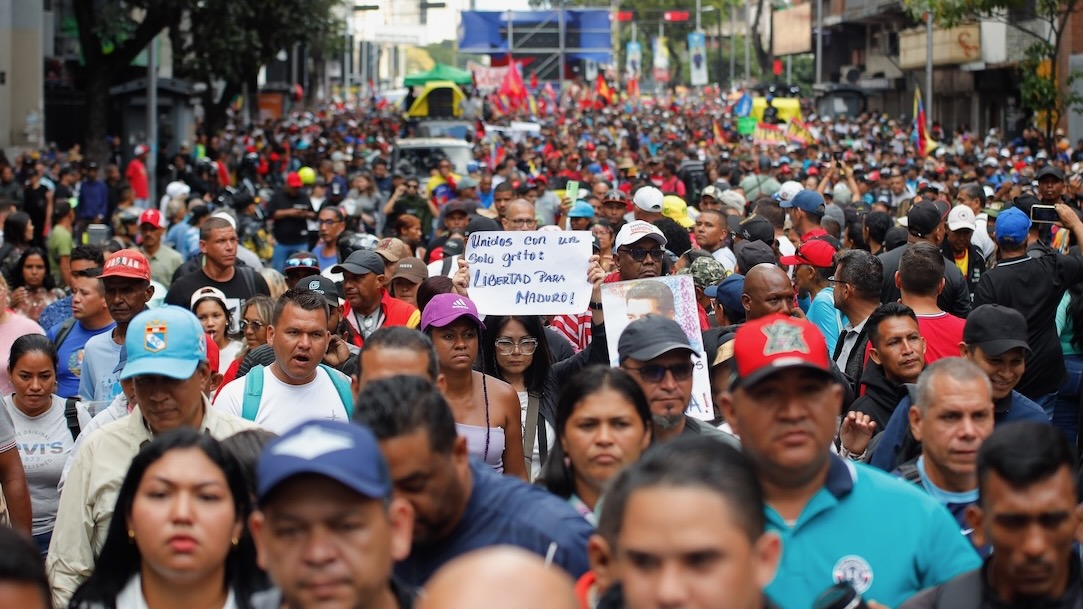
    Mobilization in Venezuela for the return of President Nicolás Maduro from US captivity. Photo: Francisco Trias

    The US has essentially declared that sovereignty itself for any nation that refuses subordination to US imperialism, holds no weight.

    On January 3, 2026, the United States did not merely bomb a sovereign country and capture its president. It displayed, in the most unambiguous terms, a total defiance of the post-War international order that it helped create. When US special forces captured Venezuelan President Nicolás Maduro and his wife and National Assembly deputy Cilia Flores from Caracas and transported them to a Brooklyn jail, they did not simply violate Venezuelan sovereignty. They declared that sovereignty itself, for any nation that refuses subordination to US imperialism, holds no weight.

    As Nicolás Maduro Guerra, the president’s son, stated before Venezuela’s National Assembly: “If we normalize the kidnapping of a head of state, no country is safe. Today it’s Venezuela. Tomorrow, it could be any nation that refuses to submit.”

    The response to this act, regardless of one’s political orientation or views on the Maduro government, will determine whether the concepts of international law, multilateralism, and the self-determination of peoples retain any meaning in the twenty-first century. This is not a question for the left alone. It is a question for every nation, every government, and every citizen who believes that the world should not be governed by the principle that might makes right.

    The logic of hyper-imperialism unveiled

    What distinguishes the current phase of US foreign policy from earlier periods of intervention is its brazenness. When the CIA orchestrated the overthrow of Guatemalan President Jacobo Árbenz in 1954, Washington maintained the pretense of responding to communist subversion. When American forces invaded Panama in 1989 to capture Manuel Noriega, the justification was framed within a discourse of law enforcement. The history of US intervention in Latin America spans over forty successful regime changes in slightly less than a century, according to Harvard scholar John Coatsworth.

    But Trump’s announcement that the United States would “run” Venezuela represents something qualitatively different. Here there is no pretense. When asked about the operation, Trump invoked the Monroe Doctrine and said that these are called “Donroe Doctrine”, signaling that the Western Hemisphere remains a zone of US dominion – an assertion clearly made in the National Security Strategy launched in November 2025. Secretary of State Marco Rubio’s subsequent clarification that the US would merely extract policy changes and oil access did nothing to soften the nakedness of the imperial project.

    This represents what we at the Tricontinental: Institute for Social Research have identified as “hyper-imperialism”, a dangerous and decadent stage of imperialism. Facing the erosion of its economic and political dominance and the rise of alternative centers of power (mainly in Asia) US imperialism increasingly relies on its uncontested military strength. The Chatham House analysis is unequivocal: this constitutes a significant violation of Venezuelan sovereignty and the UN Charter. There was no Security Council mandate, nor any claims to self-defense.

    The post-1945 international order established the formal principle that states possess sovereign equality and that force against another state’s territorial integrity is prohibited. Article 2(4) of the UN Charter was designed precisely to prevent the powerful from treating the world as their domain, which the US has now blatantly ignored.

    The test for Global South solidarity

    The kidnapping of President Maduro poses an existential question to the discourse of “multipolarity”. While the seeds of a multipolar world order may exist (China’s economic rise, the increasing political assertiveness of Global South countries, BRICS and its expansion, the increasing trade in local currencies) they have proven to be extremely limited in the face of the US unilateral use of force. This is an uncomfortable truth.

    The initial responses from governments suggest the difficulty of moving from rhetorical condemnation to material constraint. Brazilian President Lula correctly identified the stakes when he condemned the capture as crossing “an unacceptable line” and warned that “attacking countries, in flagrant violation of international law, is the first step toward a world of violence, chaos, and instability”. Colombian President Petro rejected “the aggression against the sovereignty of Venezuela and of Latin America.” Mexico’s President Sheinbaum declared that “the Americas do not belong to any doctrine or any power.” China’s Foreign Minister Wang Yi condemned US military intervention and called for the release of President Maduro, saying that, “We don’t believe that any country can act as the world’s police.”

    The groundswell of opposition confronts a structural problem: the institutions designed to prevent such actions are incapable of constraining the permanent members of the Security Council. The United States can veto any resolution condemning its behavior. The emergency Security Council meeting convened at the request of Venezuela and Colombia produced denunciations but no enforcement mechanism.

    Read more: Cubans and Venezuelans killed by the US honored in Caracas

    Every government that has sought to develop independently, that has attempted to control its own natural resources, that has resisted subordination to Washington, must recognize that what has happened in Venezuela could happen to them. Trump’s threats against Cuba and Colombia underscore this point.

    Sovereignty, resources, and the right to self-determination

    The pattern is well established with the successive overthrowing of heads of states when they tried to implement land reform like Árbenz in Guatemala, nationalize national resources under Allende in Chile and Mosaddegh in Iran. The thread continues to the present situation in Venezuela.

    Venezuela possesses the world’s largest proven oil reserves, estimated at 303 billion barrels. Trump made no effort to disguise the centrality of oil, announcing that American companies would rebuild Venezuela’s oil industry and the US would be “selling oil, probably in much larger doses”. The maritime blockade preceding the military operation served the explicit purpose of strangling the country economically.

    Yet the entire trajectory of the US Venezuela policy since 2001, from funding opposition groups to the 2002 coup attempt, to Operation Gideon in 2020, to the “maximum pressure” sanctions, has been designed to prevent Venezuela from making free choices. The assault accelerated after Venezuela enacted its 2001 Hydrocarbons Law asserting sovereign control over oil resources.

    Conclusion

    The kidnapping of Nicolás Maduro and National Assembly deputy Cilia Flores should compel a fundamental reassessment of the state of the international order. The formal institutions and legal frameworks that were supposed to prevent great power aggression have failed to constrain Washington’s imperialist aggressions. This places an enormous responsibility on the governments and peoples of the Global South. The debates around multipolarity, BRICS, South-South cooperation, and de-dollarization are rendered academic if they do not translate into the practical capacity to impose costs on actions like the invasion of Venezuela. Ultimately, the imperialist aggression against Venezuela has repercussions for governments and peoples around the world, regardless of their ideological orientation or views on the Maduro government. While the real limits of “multipolarity” in this stage of US hyper-imperialism have been laid bare, we must continue building our collective capacity to resist. The defense of Venezuelan people’s sovereignty, after all, is a defense of the sovereignty of all our nations.

    Atul Chandra & Tings Chak are the Coordinators of the Asia Desk at the Tricontinental: Institute for Social Research Tricontinental: Institute for Social Research.

    This article was produced by Globetrotter.

    Original article by Atul Chandra, Tings Chak republished from peoples dispatch under a Creative Commons Attribution-ShareAlike 4.0 (CC BY-SA) license.

    Elon Musk urges you to be a Fascist like him, says that you can ignore facts and reality then.
    Elon Musk urges you to be a Fascist like him, says that you can ignore facts and reality then.
    Donald Fuhrump says that Amerikkka doesn't bother with crimes or charges anymore, not being 100% Amerikkkan and opposing his real estate intentions is enough.
    Donald Fuhrump says that Amerikkka doesn’t bother with crimes or charges anymore, not being 100% Amerikkkan and opposing his real estate intentions is enough.
    Orcas discuss how Trump was re-elected and him being an obviously insane, xenophobic Fascist.
    Orcas discuss how Trump was re-elected and him being an obviously insane, xenophobic Fascist.

  • Protests take place across Italy to show solidarity with Venezuela

    Spread the love

    Original article by Ana Vračar republished from peoples dispatch under a Creative Commons Attribution-ShareAlike 4.0 (CC BY-SA) license.

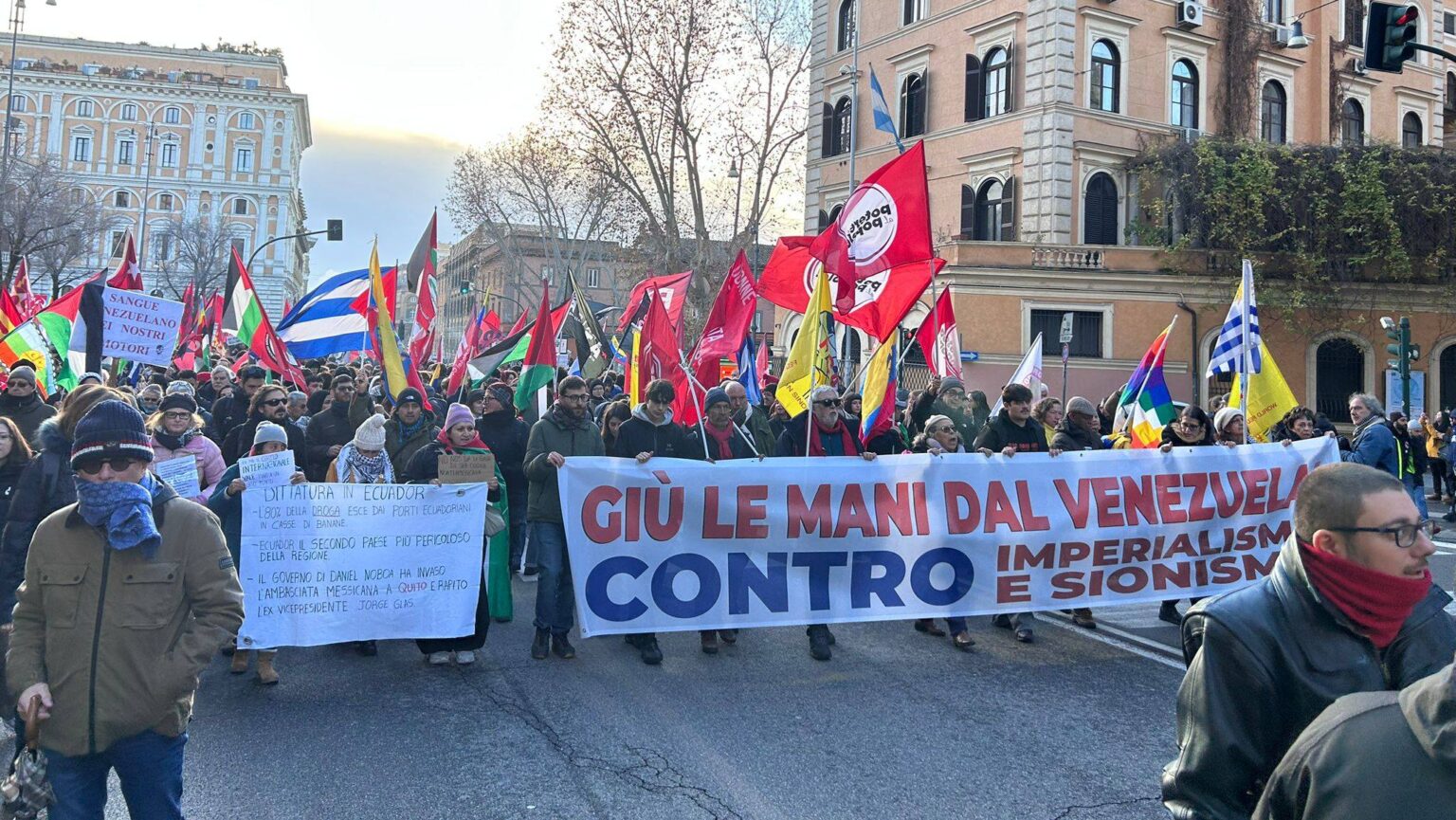
    Source: Potere al Popolo – Roma/Facebook

    Thousands mobilized across Italy to stand in solidarity with Venezuela and oppose US imperialism.

    Thousands of people mobilized in 30 Italian cities on Saturday, January 10, to express solidarity with Venezuela and demand the immediate release of President Nicolás Maduro and Cilia Flores. “While in Caracas and across Venezuela, following the bombings and the kidnapping of Maduro by the [US] administration, the Bolivarian people have been taking to the streets for days in defense of national sovereignty and the Chavista revolutionary process, internationalist support for Venezuela’s struggle against US imperialist terrorism is also being voiced in Italy,” the youth association Cambiare Rotta stated.

    The demonstrations were launched by grassroots trade unions, youth organizations, student collectives, and left political formations. Together, they denounced US aggression against Venezuela and imperialist threats targeting other territories, including Cuba, Mexico, Colombia, and Greenland. “The United States is once again showing its warmongering, imperialist, and violent face – the same one we have seen in the genocide in Palestine and which has recently struck Venezuela, bombing neighborhoods, killing civilians, and taking the lives of 32 Cuban heroes who were in Caracas defending the people and the revolution,” Potere al Popolo Rome wrote.

    Read more: Cubans and Venezuelans killed by the US honored in Caracas

    Rejecting the portrayal of Venezuela as an authoritarian state – a narrative promoted by the US and enthusiastically endorsed by much of the European political establishment, including Giorgia Meloni’s government – demonstrators voiced support for Venezuelan sovereignty and for the socialist project pursued since the leadership of Hugo Chávez. “It is clear that imperialism fears the possibility that people might rebel and demand something different from the barbarism they want to impose on us,” said Marta Collot of Potere al Popolo on Saturday. She added that the struggle of the Bolivarian Revolution in Venezuela, and of all those who stand in solidarity with it, is ultimately a struggle for a world centered on the interests of the working class rather than on the profits of oligarchies promoting policies of war and armament.

    While participants recognized the latest US attacks and threats as a dangerous escalation of imperialist aggression, many stressed that this trajectory began well before the recent assault on Venezuela. “In reality, the qualitative shift happened some time ago, when the entire West, including the European Union, allowed Israel to carry out the systematic annihilation of the Palestinian people without obstruction,” warned the grassroots trade union Unione Sindacale di Base (USB). “Unfortunately, Europe is not defending us from this imperialist assault on humanity as a whole, quite the opposite,” the union added. “EU leaders are increasingly focused on convincing us of the need to rearm, fully subordinated to Trump’s arrogance and unwilling to accept any solution in Ukraine that, if implemented, would undermine their plans to revive the military industry, which now seems to be their only answer to a crisis of credibility and the ongoing deindustrialization of our continent.”

    Read more: Africa voices outrage against US invasion of Venezuela and kidnapping of President Maduro

    In contrast to what protesters outlined as European governments’ complicity in US-led aggression worldwide, the people in the streets affirmed their support for the Venezuelan people and the political vision they are pursuing. “We express our full solidarity with and support for the Bolivarian Republic of Venezuela, recognizing that the Chavista and Bolivarian revolutionary process represents a viable and necessary alternative to Western barbarism,” Potere al Popolo Rome concluded.

    Original article by Ana Vračar republished from peoples dispatch under a Creative Commons Attribution-ShareAlike 4.0 (CC BY-SA) license.

    Elon Musk urges you to be a Fascist like him, says that you can ignore facts and reality then.
    Elon Musk urges you to be a Fascist like him, says that you can ignore facts and reality then.
    Donald Fuhrump says that Amerikkka doesn't bother with crimes or charges anymore, not being 100% Amerikkkan and opposing his real estate intentions is enough.
    Donald Fuhrump says that Amerikkka doesn’t bother with crimes or charges anymore, not being 100% Amerikkkan and opposing his real estate intentions is enough.
    Orcas discuss how Trump was re-elected and him being an obviously insane, xenophobic Fascist.
    Orcas discuss how Trump was re-elected and him being an obviously insane, xenophobic Fascist.


  • Trump’s blatant oil grab lays bare the violence of a fossil fuel economy

    Spread the love

    Original article by Rob Soutar republished from TBIJ under a Creative Commons Attribution-NonCommercial-NoDerivs 3.0 Unported License.

    The abduction of Maduro came with no pretence of spreading democracy – it’s the new US national security plan in action

    The writer Eduardo Galeano said in 1971 that “as lungs need air, so the US economy needs Latin American minerals”.

    Half a century later, after the shocking abduction of Venezuelan president Nicolás Maduro last week, it now seems like the US has stopped pretending otherwise.

    On the face of it, Maduro was taken in connection with alleged drugs and weapons offences. But in the aftermath of the raid, Trump said the US will “run the country” until an orderly transition had taken place – and this will include US companies pumping Venezuela’s vast reserves of crude oil. The country’s reserves are reportedly the largest in the world but have remained largely untapped due to old infrastructure and low investment.

    Recommended Articles

    Let’s be clear: this is not a conventional invasion or a political coup. There has been barely any of the usual talk of spreading liberty and democracy. There are no US boots on the ground. And with senior government figures still in place for now, there appears to be little appetite for any regime change. Nor was there any serious attention paid to the Venezuelan people – both those inside the country and the millions of migrants – who’ve endured political oppression and painful economic hardship.

    To Venezuelans, the motive is obvious. It’s all about the oil. As one man in a viral clip put it in relation to US, Russian and Chinese interest in the country: “What do you think they want, our recipe for arepa?”

    And for Trump, this involves settling scores on behalf of the US companies whose assets were nationalised by Maduro’s predecessor, Hugo Chávez.

    This was Trump’s new national security strategy in action: aggressively anti-drugs and just as aggressively pro-fossil fuels.

    Trump’s sudden willingness to pursue these ends using military aggression could mark the start of a worrying new era for security, sovereignty and the climate. Uncertainty reigns for Venezuelans – and the implications go way beyond that country’s borders.

    Fighting for the phase-out

    After Maduro’s abduction – which some legal experts have called a kidnapping – Trump warned Colombia’s president Gustavo Petro that “he’s next”.

    And Mexico, another country that has struggled with insecurity linked to drug production and trafficking, has also come into Trump’s crosshairs. In a joint-statement, Brazil, Chile, Spain, Uruguay, Mexico and Colombia condemned the Venezuela raid as a violation of international law and setting a “dangerous precedent for peace and security in the Americas”.

    Aside from Brazil and Uruguay, all of these countries supported a declaration at recent global climate talks to end fossil fuel expansion. And in April, Colombia will co-host an inaugural global summit to transition away from fossil fuels. This further puts these countries at odds with a US government that sees the “ideologies” of climate change as a threat to the country.

    This year, the US also assumes the presidency of the G20, a grouping of the world’s wealthiest nations. Its State Department will use the opportunity to promote fossil fuels. Trump’s “drill baby drill” mantra is going global – with little respect for international norms or conventions.

    Market bounce

    As the US built up a naval presence in the Caribbean over recent months and blocked oil tankers, international investors also waited in the wings for the re-opening of the Venezuelan oil market. The news of Maduro’s ousting prompted shares in US oil companies Chevron, Exxonmobil and ConocoPhillips to spike.

    Chevron has operated in Venezuela for years and since 2022 has had a special exemption from US sanctions on the country. ConocoPhillips has been locked in a long legal battle with the Venezuelan government, seeking compensation for Chávez’s expropriations. Both are expected to cash in on Trump’s actions.

    Executives from UK oil companies will also be lobbying the government to allow their involvement, according to former BP chief Lord Browne. Among them could be Shell, which is reportedly eyeing a return to gas fields near the maritime border with Trinidad and Tobago.

    Clearly, there’s money to be made. And restoring American dominance in oil, gas, coal and nuclear is a central pillar of Trump’s strategy. He also wants to bring key commodities – like Venezuelan oil – to American shores for his country to process, use and sell.

    But with so much uncertainty around the US’s long-term plans for Venezuela, and the prospect of wider regional instability, the country remains a risky bet for international investors. Whatever uncertainty they feel, it can’t compare to that felt by Venezuelans.

    Venezuela has long been dependent on oil for foreign income – and its leaders have long warned of the risks of a foreign invasion. An economy so dependent on fossil fuels is a vulnerable one.

    Put simply, clean energy is the safer bet. Last year, investments in solar, wind, nuclear and other greener sources were twice those made in fossil fuels, according to the International Energy Agency. It cited energy security concerns as a factor.

    As the veteran US climate campaigner Bill McKibben put it recently: “If you’re for peace and democracy, then a solar panel is a useful tool.”

    Lead image: A protest in Madrid on Sunday 4 January. Photo by Thomas Coex / AFP via Getty

    Reporter: Robert Soutar
    Deputy editor: Chrissie Giles
    Editor: Franz Wild
    Production editor: Alex Hess

    TBIJ has a number of funders, a full list of which can be found here. None of our funders have any influence over editorial decisions or output.

    Original article by Rob Soutar republished from TBIJ under a Creative Commons Attribution-NonCommercial-NoDerivs 3.0 Unported License.

    Elon Musk urges you to be a Fascist like him, says that you can ignore facts and reality then.
    Elon Musk urges you to be a Fascist like him, says that you can ignore facts and reality then.
    Donald Fuhrump says that Amerikkka doesn't bother with crimes or charges anymore, not being 100% Amerikkkan and opposing his real estate intentions is enough.
    Donald Fuhrump says that Amerikkka doesn’t bother with crimes or charges anymore, not being 100% Amerikkkan and opposing his real estate intentions is enough.
    Orcas discuss how Trump was re-elected and him being an obviously insane, xenophobic Fascist.
    Orcas discuss how Trump was re-elected and him being an obviously insane, xenophobic Fascist.

  • The use of military force in Iran could backfire for Washington

    Spread the love
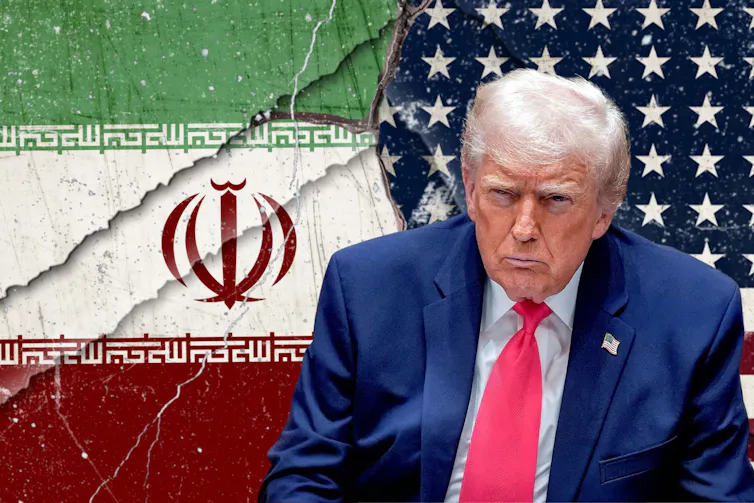
    Tehran has said it is ‘ready for war’ after Trump’s threats of US military action. Lucas Parker / Mr Changezi / Shutterstock / Canva

    Bamo Nouri, City St George’s, University of London

    Donald Trump is weighing military action in Iran over the state’s crackdown on protesters. Reports suggest that more than 600 people have been killed since the protests began in late December, with the US president saying the US military is now “looking at some very strong options”.

    Trump has not yet elaborated on what these options are and has said that Iranian officials, keen to avoid a war with the US, had called him “to negotiate”. But he added that the US “may have to act before a meeting” if the deadly crackdown continues.

    There is a wide spectrum of measures available to Washington should it decide to intervene in Iran. These range from diplomatic condemnation and an expanded sanctions regime, to cyber operations and military strikes. However, history weighs heavily against every move the US government may be considering.

    Targeted sanctions and diplomatic pressure, which includes the 25% tariff rate recently introduced by Trump on any country that does business with Iran, remain the least escalatory tools. They allow the US to coordinate with its allies and signal moral support for protesters in Iran without triggering direct confrontation. Yet decades of experience show the limits of this approach.

    Iran’s leadership has mastered how to absorb economic pressure, shift costs on to society and frame longstanding western sanctions as collective punishment imposed by hostile outsiders. The government in Tehran has adapted over time by developing alternative markets and expanding informal and non-dollar trade.

    It has also boosted its economic resilience through regional networks, particularly in Iraq where political, financial and security ties help sustain revenue flows and cushion the impact of sanctions on the state.

    There are other, more covert tools at Washington’s disposal, including cyber disruption and efforts to assist independent media or help protesters bypass internet shutdowns. These measures can help protesters stay visible internationally and complicate the state’s capacity to ramp up repression.

    However, even here expectations should be modest. These tools may create friction within the Iranian elite by raising the costs of, and imposing technical difficulties on, surveillance and repression. But they do not change the core calculus of a regime that prioritises survival above all else.

    At the most extreme end of the spectrum are military strikes. The rationale behind strikes would be to undermine the regime’s repression efforts. But in reality, they risk doing the opposite. Iran’s ruling system, and particularly the powerful Islamic Revolutionary Guard Corps branch of the armed forces, has historically relied on external threats to consolidate power domestically.

    A preemptive US strike would almost certainly hand Iran’s security apparatus the very narrative it seeks: an existential battle for national survival. This framing is already explicit in the discourse of the Iranian elite.

    Mohammad Bagher Ghalibaf, the hardline speaker of the Iranian parliament, warned in a recent speech that any attack on Iran would make Israel and all US military bases and assets in the region “legitimate targets”. Iranian state media then showed large crowds of regime supporters rallying in Tehran and other cities, chanting “Death to America” and “Death to Israel.”

    Military escalation is especially dangerous given the character of the current protest movement. Women have been at the forefront, challenging the ideological foundations of the state, while regions populated largely by ethnic Kurds have endured disproportionate levels of violence at the hands of the authorities.

    These protests are civic, decentralised and rooted in social grievances. US military strikes would allow the Iranian state to overwrite that reality, recasting a diverse domestic movement as a foreign-backed security threat. In doing so, it would legitimise a far harsher crackdown than anything seen so far.

    Shadow of 1953

    Many ordinary Iranians are also cautious of direct US interference. This stems from a CIA-backed coup in 1953 that ousted Iran’s elected prime minister, Mohammad Mosaddeq, and restored the monarchy under Shah Mohammad Reza Pahlavi. The coup was followed by nearly two decades of repression, political policing and authoritarian rule closely aligned with western interests.

    This experience is not distant history; it is a foundational trauma that continues to shape Iranian political consciousness. As a result, recent suggestions by Trump that the collapse of Iran’s theocratic system would naturally make way for a democratic transition cannot be disentangled from the memory of an external intervention that produced dictatorship rather than self-rule.

    It also explains why many people inside Iran are sceptical of figures such as Reza Pahlavi, the son of country’s last shah who has often been promoted in the west as a possible future leader of Iran. Pahlavi remains symbolically tied to a system associated with oppression and foreign backing. This leaves him without the broad domestic legitimacy required for any credible democratic transition, regardless of his messaging.

    The scepticism of Iranians is reinforced by recent regional experiences. In Iraq, foreign intervention hollowed out the state, leaving a weak system that has been co-opted by external powers and militias.

    And in Syria, the collapse of central authority paved the way for a former al-Qaeda leader, Ahmed al-Sharaa, to take power. He has been rebranded by western powers, including Trump, into a credible political figure despite his jihadist past.

    These cases reinforce a belief across the Middle East that western intervention tends not to empower democratic forces. It instead appears to elevate the most organised and militarised parties to power, producing long-term instability rather than renewal.

    Without a credible, homegrown transition, Iran risks fragmenting and sliding into chaos. For Washington, the most difficult reality may be that the wisest path is not bold intervention, but restraint combined with sustained support for Iranian society.

    Genuine change in Iran cannot be engineered from the outside, especially at the point of a missile.

    Bamo Nouri, Honorary Research Fellow, Department of International Politics, City St George’s, University of London

    This article is republished from The Conversation under a Creative Commons license. Read the original article.

    Elon Musk urges you to be a Fascist like him, says that you can ignore facts and reality then.
    Elon Musk urges you to be a Fascist like him, says that you can ignore facts and reality then.
    Donald Fuhrump says that Amerikkka doesn't bother with crimes or charges anymore, not being 100% Amerikkkan and opposing his real estate intentions is enough.
    Donald Fuhrump says that Amerikkka doesn’t bother with crimes or charges anymore, not being 100% Amerikkkan and opposing his real estate intentions is enough.
    Orcas discuss how Trump was re-elected and him being an obviously insane, xenophobic Fascist.
    Orcas discuss how Trump was re-elected and him being an obviously insane, xenophobic Fascist.