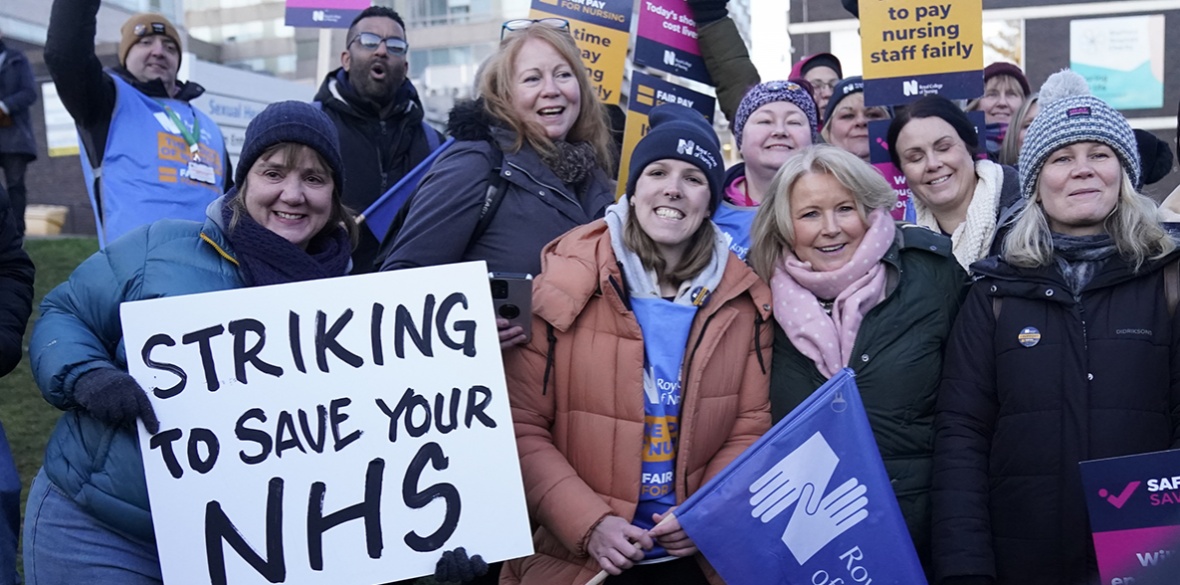
Campaigners in the UK say get Palantir out of the NHS

Spread the love

Original article by Ana Vračar republished from peoples dispatch under a Creative Commons Attribution-ShareAlike 4.0 (CC BY-SA) license.

Source: Talia Woodin/Medact

Health workers and activists ramp up their campaign to oppose surveillance company Palantir’s role in managing NHS data

Health workers and activists in Britain are intensifying their campaign against US-based surveillance and data company Palantir, as Keir Starmer’s government accelerates its push to involve the notorious firm in managing National Health Service (NHS) data.

Palantir first gained a foothold in the NHS during the COVID-19 pandemic, securing contracts outside standard procurement processes and enjoying popularity among high-ranking health officials. The company, infamous for its involvement in operations such as the US-led invasions of Afghanistan and Iraq and migrant persecution under the US Immigration and Customs Enforcement (ICE), soon expanded its role in Britain. By last year, it had won a £330 million (USD 417 million) contract to implement the Federated Data Platform (FDP), intended to modernize medical data management across England.

Not all NHS institutions are currently able to share data because of differing systems. Both Conservative and Labour governments have identified this as the main reason for bottlenecks in the health system and claimed that resolving the problem would lead to improvements to care. However, organizations like Medact, Just Treatment, and Corporate Watch warn that entrusting this task to Palantir could deepen issues rather than solve them.

Similarly, many health experts have highlighted how the FDP would effectively lock the NHS into dependency on Palantir. The company’s systems are designed in a way to make data extraction difficult and integration with industry-standard analytics costly and complicated, so users are compelled to keep using them. “Palantir’s system pushes people to its own proprietary systems; and switching costs [for the NHS] will be very high,” Doctors’ Association and Foxglove warned in a 2023 report.

The current government is pushing forward with this form of private sector expansion in the NHS despite warnings from trusts and experts that the results will fall far short of expectations. In fact, some NHS organizations being forced to adopt the FDP under Labour’s administration have said that the new platform could result in a loss of functionality compared to the systems they currently rely on.

Read more: Labour considers expanding private sector role in NHS, undermining the already fragile public health system

While there is general agreement among analysts that data sharing and usage within the NHS could be significantly improved, they argue that these improvements can and should be achieved through local and regional initiatives. In contrast to the top-down model ushered in by the FDP, these initiatives would build on existing systems and expertise, avoiding handing over control to a private company with a track record of human rights abuses.

Concerns that the FDP could make the NHS entirely dependent on Palantir are sharpened by fears over how patient data might be used. As one of the world’s largest public healthcare systems, the NHS holds an unique health dataset. While such data has immense potential to strengthen public services, entrusting it to corporate partners poses great risks. For instance, it could be exploited for purposes such as tracking and criminalizing migrants—a practice that has been systematically pursued under Britain’s hostile environment policies.

Read more: Should health workers work with counter terrorism agencies?

Palantir takes pride in finding new applications for data, specifically to reinforce Western dominance. Given that the full scope of the FDP remains unclear, there is significant concern that NHS data could also be exploited to boost Palantir’s surveillance tools. These tools are already being deployed in Israel’s ongoing genocide against Palestinians in the Gaza Strip.

Palantir’s leadership has been outspoken in its support for Israel, openly aligning with Benjamin Netanyahu’s government even as it proceeded to kill tens of thousands of Palestinians. The company is actively testing—or rather, showcasing—its artificial intelligence (AI) models through Israel’s attacks in Palestine and Lebanon. This indicates a clear intent to monetize these tools further by marketing them to other states preparing to go on killing sprees.

Handing over NHS medical data to Palantir would deepen the Starmer administration’s complicity in Israel’s war crimes, health justice organizations warn. Such a move risks staining the NHS’s reputation, turning its dataset into a tool for oppression internationally while undermining public trust in the healthcare system at home.

Many had hoped that a change in government in July would mean an end to the FDP. However, “instead of hitting reset, Labour hit accelerate,” Just Treatment remarked during a No Palantir in the NHS meeting in November. This response reflects Labour’s priorities when it comes to the public healthcare provider. “If the government were setting out to implement reforms in the way that our data is held to improve health outcomes and improve the NHS, they would be going about it in a way that maximizes public trust, maximizes public and health service and health worker support for those initiatives,” the organization remarked during the meeting.

Instead, the government appears more interested in using national health data for economic gain. This approach aligns closely with recommendations from neoliberal policy advisors, such as those at the Tony Blair Institute for Global Change, who have recently called for the use of NHS data as a means to boost Britain’s economic standing.

Although the implementation of the FDP is progressing, activists argue that it is not too late to stop it—especially if local groups escalate their efforts. They emphasize that by increasing pressure, health workers and activists could not only push for the cancellation of Palantir’s FDP contract but also demand the termination of all agreements with companies complicit in Israel’s occupation. While Palantir is currently a key focus, the organizations highlighted that this campaign is just the beginning, serving as a starting point for broader action.

Original article by Ana Vračar republished from peoples dispatch under a Creative Commons Attribution-ShareAlike 4.0 (CC BY-SA) license.

Continue ReadingCampaigners in the UK say get Palantir out of the NHS

What the budget got wrong about the NHS and prevention

Spread the love

Lindsay Jaacks, University of Edinburgh

A healthy NHS and strong economy depend on healthy people, not just strong public finances. Chancellor Rachel Reeves’ budget was a missed opportunity for the government to get serious about public health by protecting citizens from the leading risk factor for death in the UK: unhealthy food.

If a multinational corporation was dumping a chemical into our water that was costing the NHS £19 billion a year (the cost of obesity), that company would be asked to pay the bills. This is the “polluter pays” principle.

The same principle should apply to food. Instead, multinational food companies are profiting from sales of unhealthy food. For example, PepsiCo, which includes brands such as Pepsi MAX, Walkers and Doritos, generated more than £70 billion net revenue in 2023, globally.

Reeves’ budget states that the soft drinks industry levy will rise in line with inflation. From April 1 2025, the lower rate of the levy will increase from 18 pence per litre to 19.4 pence per litre. And the higher rate will increase from 24 pence per litre to 25.9 per litre. (The lower rate applies to added-sugar drinks with a total sugar content of 5 to 7.9 grams per 100 millilitres, and the higher rate applies to drinks with 8 grams or more per 100 millilitres.)

Levies like this result in an increase in the price of food and drink if companies pass the levy on to citizens; which is exactly what they typically do.

Evidence suggests that the levy has been effective at reducing consumption of sugar in the UK, but it could do much more.

According to the World Health Organization, as of July 2022, 108 countries have sugary drinks taxes, many of them substantially higher than the rate in the UK. For example, in the United Arab Emirates (UAE), there is a 50% excise tax on carbonated drinks and 100% tax on energy drinks.

By comparison, in the UK, the changes to the soft drinks levy in the new budget are estimated to increase the price of a 330ml can of a “higher band” soft drink by just three pence by 2029 to 2030.

Many countries have gone beyond sugary drinks to tax other foods, such as those high in fat, salt or sugar. Again, in the example of the UAE, a 50% excise tax is applied to any product with added sugar or other sweeteners. Indeed, 18 countries have taxes on high fat, salt and sugar foods.

Mexico was among the first countries to adopt such a policy, applying an 8% tax on discretionary foods such as confectionary, chocolate, sugary breakfast cereals, crisps and other salty snacks. Following implementation, there was a significant reduction in sales of these unhealthy foods.

Corner shop in Mexico, featuring a Coca-Cola advert.
Mexico was the first country to introduce a tax on sugary drinks. JRomero04/Shutterstock

Make the polluter pay

The new budget in the UK could have gone much further in terms of raising funds and rebuilding the NHS by expanding the soft drinks levy to a levy on high fat, salt and sugar foods.

The government’s ten-year plan for the NHS is due to be published in spring 2025. Many have advocated for the plan to focus on prevention. But the idea that the NHS should be responsible for prevention perpetuates the idea that individuals are responsible for unhealthy diets and obesity. It moves the blame from companies that process, promote and profit from high fat, salt and sugar foods to individuals and the NHS. Instead, why not demand that the polluters pay?

A healthy population underlies economic growth. If the government wants a healthy NHS and a strong economy, make multinational corporations, not citizens, pay for the harms of their unhealthy products that are marketed to us and our children every day.

Lindsay Jaacks, Personal Chair of Global Health and Nutrition, University of Edinburgh

This article is republished from The Conversation under a Creative Commons license. Read the original article.

Continue ReadingWhat the budget got wrong about the NHS and prevention

Labour considers expanding private sector role in NHS, undermining the already fragile public health system

Spread the love

Original article by Peoples Health Dispatch republished from peoples dispatch under a Creative Commons Attribution-ShareAlike 4.0 (CC BY-SA) license.

Protest against privatization of the NHS in the UK, February 25, 2023. (Photo: We Own It) 

The UK Labour government is considering increasing the role of private healthcare providers, weakening NHS capacities

The Labour Party is considering a major expansion of the private sector’s involvement in the National Health Service (NHS) as it attempts to reduce waiting lists in the United Kingdom. Recently, the Independent Healthcare Providers Network (IHPN) wrote to Keir Starmer’s government, stating that private providers are ready to spend £1 billion to accommodate more NHS patients—if the government guarantees them long-term work.

While the offer has been welcomed by officials from the Department of Health, health activists have raised alarms over the plan. The We Own It campaign warned that a resurgence of the Private Finance Initiative (PFI) policy, as essentially proposed by the private sector, would lead to higher debt, staffing shortages, and diminished NHS training capacities.

Read more: The NHS at 75 years: A sharp turn needed to fight health inequities

This wouldn’t be the first time private capital has been welcomed by a Labour administration. When Tony Blair was Prime Minister, PFI entrusted the private sector with financing the construction of hospitals to fill gaps in the NHS network. The NHS would then pay back the costs of building such infrastructure—with interest—over the course of 25 years or more, eventually becoming the owner.

However, earlier reports indicated that while the NHS gained £13 billion in assets through PFI, it also ended up with £80 billion in debt. This meant that until at least 2022, some NHS trusts spent more on servicing debt to the private sector than on medical supplies.

There is no indication that the current government would introduce stronger safeguards when implementing a new phase of the initiative, dubbed PFI 2.0. If anything, the situation might worsen. While the previous round of PFI left some infrastructure for the public sector, PFI 2.0 foresees nothing of the sort. The additional capacities would be entirely private, with the only public involvement being the money paid to them.

“PFI 2.0 would not only drastically expand private provision in the health service, it will also dramatically increase how much is sucked out of the NHS in profits,” We Own It suggested in its analysis. Currently, private companies siphon £10 million weekly from the NHS. Guaranteeing even more private contracts would add to that burden, leaving fewer funds to invest in the NHS’s own capacities.

Labour fails to grasp importance of publicly-owned NHS

According to a recent inquiry, these capacities are in dire need of strengthening, as health activists have claimed for decades. The inquiry indicated that years of austerity have left a deep mark on the NHS, and it was this—not staff inefficiency—that led to the crisis. Unfortunately, the inquiry failed to underline the importance of breaking ties with the private sector and keeping the NHS publicly-owned, according to the group Keep Our NHS Public.

Even if it did, it is highly likely that Health Secretary Wes Streeting would not understand the importance of such a strategy. Speaking at a party conference in September, Streeting expressed enthusiasm about “reform,” a code word used by governments for “anything but public investment in public capacities.”

“Reform or die. We choose reform,” the Health Secretary said. His approach has left activists understandably worried that the government is sticking to a vague health reform agenda instead of making material commitments to protect the NHS.

Rather than pursuing a shift from “analog to digital,” Keep Our NHS Public argued, the government should pledge to move away from underfunding, fragmentation, and outsourcing. As health workers and their trade unions have raised multiple times, a true strategy to protect the NHS must also include a commitment to improving working conditions and ensuring fair salaries.

If the private sector’s role is expanded, this would not be a realistic option. “The private sector does not have its own staff,” We Own It warned. “They steal staff, trained at huge public expense, from the NHS.”

Further involvement of the private sector would also reduce the NHS’s capacity to train new staff, the group stated. The procedures usually handled by the private sector are often critical for the hands-on experience needed by medical trainees. With fewer procedures of this kind being performed in NHS hospitals, these learning opportunities would disappear, condemning new generations of health workers to lower-quality education and undermine patient care.

“If PFI 1.0 was one of the nails in the coffin of the NHS as we know it, PFI 2.0 is the true end of our NHS as a public service that works for patients, not profit,” We Own It warned.

People’s Health Dispatch is a fortnightly bulletin published by the People’s Health Movement and Peoples Dispatch. For more articles and to subscribe to People’s Health Dispatch, click here.

Original article by Peoples Health Dispatch republished from peoples dispatch under a Creative Commons Attribution-ShareAlike 4.0 (CC BY-SA) license.

Continue ReadingLabour considers expanding private sector role in NHS, undermining the already fragile public health system

Removing caps on benefits could save the government billions of pounds, study finds

Spread the love
Image of Keir Starmer and a poor child.
Zionist Keir ‘Kid Starver’ Starmer. Image thanks to The Skwawkbox.

https://morningstaronline.co.uk/article/removing-caps-benefits-could-save-government-billions-pounds-study-finds

REMOVING caps on benefits could save the government billions of pounds rather than cost money, a progressive economic think tank says.

The New Economics Foundation (NEF) report, published today, says that the cost of benefit caps could be outweighed by the gains to be made from abolishing them.

Gains include easing extra pressure on the NHS and other services resulting from the poverty caused by the caps, according to the experts.

The benefit cap was introduced in 2013 by the Conservative and Liberal Democrat coalition government and limits the amount of benefits a household can receive.

The two-child limit was introduced by the Tory government in 2017. It restricts the application of child tax credit and universal credit to the first two children in households.

The NEF estimates that axing the caps could save £1.5 billion a year over the next five years alone through lower demand on public services.

In the longer term — in 20 or 25 years — children lifted from poverty could have estimated future net earnings of £920 million a year higher, with an extra £490m returned to government through taxation and reduced spending on social security.

“In reducing child poverty rates, pressures on the NHS, schools and social services will reduce, enabling the reallocation of resources to other areas of high demand,” the report states.

https://morningstaronline.co.uk/article/removing-caps-benefits-could-save-government-billions-pounds-study-finds

Keir Starmer says pensioners can freeze to death and poor children can starve and be condemned to failure and misery all their lives.
Continue ReadingRemoving caps on benefits could save the government billions of pounds, study finds