Category: NHS

  • Starmer’s hints about the budget suggest UK is set for bleak four years

    Spread the love

    Original article by Paul Rogers republished from Open Democracy.

    https://cdn2.opendemocracy.net/media/images/GettyImages-2159569411.max-760×504.jpg

    Introducing a wealth tax would indicate this is a progressive government. But that seems unlikely

    Taking as his theme the need to “fix the foundations” after “14 years of rot” under Tory rule, new Labour prime minister Keir Starmer this week delivered a message that should bring discomfort to everyone in the months and perhaps years to come.

    Those “14 years of rot” are of no surprise to voters; indeed, they helped ensure a landslide Labour victory in the election in July. But Starmer’s plans to resolve them appear likely to be far harsher than many voters expected.

    The chancellor of the Exchequer, Rachel Reeve, has made numerous hints that hard times are ahead. Her October budget will be uncompromising in its commitment to raising revenue to help fill a fiscal hole reckoned to be around £20bn – but much of this money seems likely to be taken from the poorer sections of society, not the rich.

    Labour will retain unpopular policies introduced by the Conservatives – the ‘bedroom tax’ and limiting child benefit allowances to the first two children, for example – while introducing its own cost-cutting measures, such as reducing the winter fuel allowances for many pensioners.

    These actions contribute to a growing sense that the Starmer government will prove to be decidedly right-of-centre in a country beset with deep divisions of wealth and poverty. Some areas may see an improvement, such as labour rights, but even there, it is a matter of the devil in the detail.

    One area where the government does apparently have cash to spash, though, is military spending, which is set to be substantially increased despite the manifest failures in Afghanistan, Iraq and Libya, and the deeply unpopular Israeli wars on Gaza and the West Bank.

    Labour’s attitude to Israel is certainly unlikely to change, with the Department for Business and Trade reporting on efforts to strike a new trade deal with the country, saying: “Our teams will be entering negotiating rooms as soon as possible, laser-focused on creating new opportunities for UK firms.” An official from the British Embassy in Israel also recently wrote of the “tremendous opportunity for collaboration between Israeli and British companies”.

    A full-scale Strategic Defence Review is also underway, and there are few if any indications that it will start by addressing the grievous failures of the past two decades. If previous experience is anything to go by, it will likely also omit the main challenge to international security: climate breakdown. Without that, the review will not be worth the paper it is written on. Net zero secretary Ed Miliband may be doing his best to maintain the idea of a green transition but the issue would be sidelined by any major increase in government spending.

    On the domestic front, less than two months into the new Labour government the contrast between Food Bank Britain and the ludicrous levels of runaway wealth is apparent. It was coincidentally yet powerfully illustrated just four days before Starmer’s pre-budget speech, by a full-page property advertisement from Sotheby’s in the Financial Times.

    Of the seven properties on sale, one was a relatively modest three-bedroom apartment in Chelsea, on sale for a mere £5m, while the others included a six-bedroom house in Belgravia offered at £18m and a nine-bedroom/five-bathroom place near Regent’s Park for £20m. Another Regent’s Park number was on sale for £25m million, which at least had 7 bathrooms for the 6 bedrooms. Trumping all was a triplex number in Knightsbridge – £50m with exclusive access to Hans Place Gardens.

    While we have to wait for the October budget announcements, we can be reasonably sure that there will be some attempts to raise modest amounts from the wealthier sectors of society, possibly involving changes in capital gains and inheritance taxes. But the best indicator of a changed government would be one willing to bring in wealth taxes, especially those directed at the super-rich.

    Onee of Britain’s largest trade unions, Unite, recently proposed a 1% per annum tax on those with net assets of over £4m, which would include property, shares and bank holdings but not mortgaged property. That is estimated to yield £25bn a year but would be bitterly opposed, with the Daily Mail informing us that: “Millionaires are looking to flee the UK in their droves to escape Labour’s tax raids – with a record number of wealthy Britons tipped to leave the country this year.”

    As things stand, the budget is expected to include substantial cuts in public spending that could be at least partly avoided by such a wealth tax, and it is worth noting that some European countries such as Switzerland and Spain have already introduced them. At least Britain’s wealthy won’t be fleeing “in their droves” to those countries.

    If adopted in October, in even a modest form, a wealth tax would be a reasonable marker for a progressive government. If not, then an opportunity will be missed for placing Labour in a more progressive place in the political spectrum than currently seems at all likely.

    Original article by Paul Rogers republished from Open Democracy.
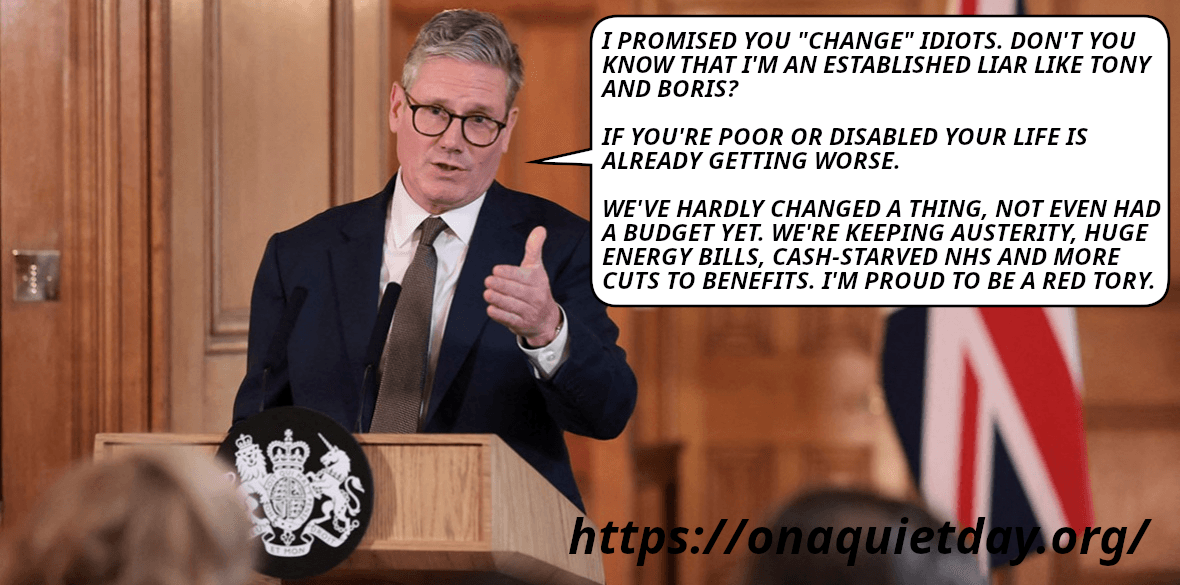
    Keir Starmer confirms that he is continuing Tory policies and that he's proud to be a red Tory.
    Keir Starmer confirms that he is continuing Tory policies and that he’s proud to be a red Tory.
    Keir Starmer says pensioners can freeze to death and poor children can starve and be condemned to failure and misery all their lives.
    Keir Starmer says pensioners can freeze to death and poor children can starve and be condemned to failure and misery all their lives.
  • Starmer accused of insulting workers by warning of tough times ahead

    Spread the love
    Keir Starmer confirms that he is continuing Tory policies and that he's proud to be a red Tory.
    Keir Starmer confirms that he is continuing Tory policies and that he’s proud to be a red Tory.

    https://morningstaronline.co.uk/article/starmer-accused-insulting-workers-warning-tough-times-ahead

    …

    Downing Street has billed the speech tomorrow as “a direct message to the working people across Britain.”

    In it, Sir Keir is expected to develop the line of attack that Chancellor Rachel Reeves began when she accused the Tories before the summer recess of leaving a £22 billion black hole in this year’s budget.

    Sir Keir will claim government has to take “unpopular decisions” to rebuild the country from “rubble and ruin” left by the Tories, saying: “We have inherited not just an economic black hole but a societal black hole.

    “And that is why we have to take action and do things differently.

    …

    https://morningstaronline.co.uk/article/starmer-accused-insulting-workers-warning-tough-times-ahead

  • Welsh Government backs use of ‘unqualified doctors’ despite safety concerns

    Spread the love
    NHS emblem
    NHS emblem

    https://nation.cymru/news/welsh-government-backs-use-of-unqualified-doctors-despite-safety-concerns/

    The Welsh Government has defended the employment by NHS Wales of partially trained medics known as “physician associates”, despite concerns that they can pose a danger to patients.

    PAs, as they are referred to, receive some medical training, but it falls far short of the level required for qualification as a doctor.

    Critics argue they are a cost-cutting measure and fear safety standards are being compromised.

    An assessment carried out by Health Education England (HEE) , and considered by all four of the UK’s health departments, concluded that patients were at high risk of harm from PAs. The health departments have therefore recommended the introduction of statutory regulation for the profession.

    …

    https://nation.cymru/news/welsh-government-backs-use-of-unqualified-doctors-despite-safety-concerns/

  • Contaminated blood victims confused and angered over changes to compensation plan

    Spread the love

    https://morningstaronline.co.uk/article/contaminated-blood-victims-confused-and-angered-over-changes-to-compensation-plan

    Campaigners, including many who are personally infected and affected by infected blood, gather in Westminster, London, July 26, 2024

    CONTAMINATED blood victims expressed confusion and anger after the government announced changes to a multibillion-pound compensation plan today.

    Paymaster General and Cabinet Office Minister Nick Thomas-Symonds said survivors of the biggest treatment disaster in NHS history will get life-long support with up to £15,000 extra for those subjected to “unethical” research.

    Payouts under the scheme will start by the end of the year for survivors and by next year for affected people such as family members under a second set of regulations.

    Mr Thomas-Symonds said the total estimate of the cost of scandal compensation will be set out in the Budget red book, with more than £1 billion had already been paid out.

    “We know no amount of compensation can fully address the damage to people who suffered as a result of this scandal,” he said.

    The £15,000 payout was, however, branded as “derisory and insulting” and a “kick in the teeth” by a victim who was infected with HIV and other viruses while subjected to unethical medical testing at a specialist school.

    …

    https://morningstaronline.co.uk/article/contaminated-blood-victims-confused-and-angered-over-changes-to-compensation-plan

  • Should health workers work with counter terrorism agencies?

    Spread the love

    Original article by Peoples Health Dispatch republished from peoples dispatch under a Creative Commons Attribution-ShareAlike 4.0 (CC BY-SA) license.

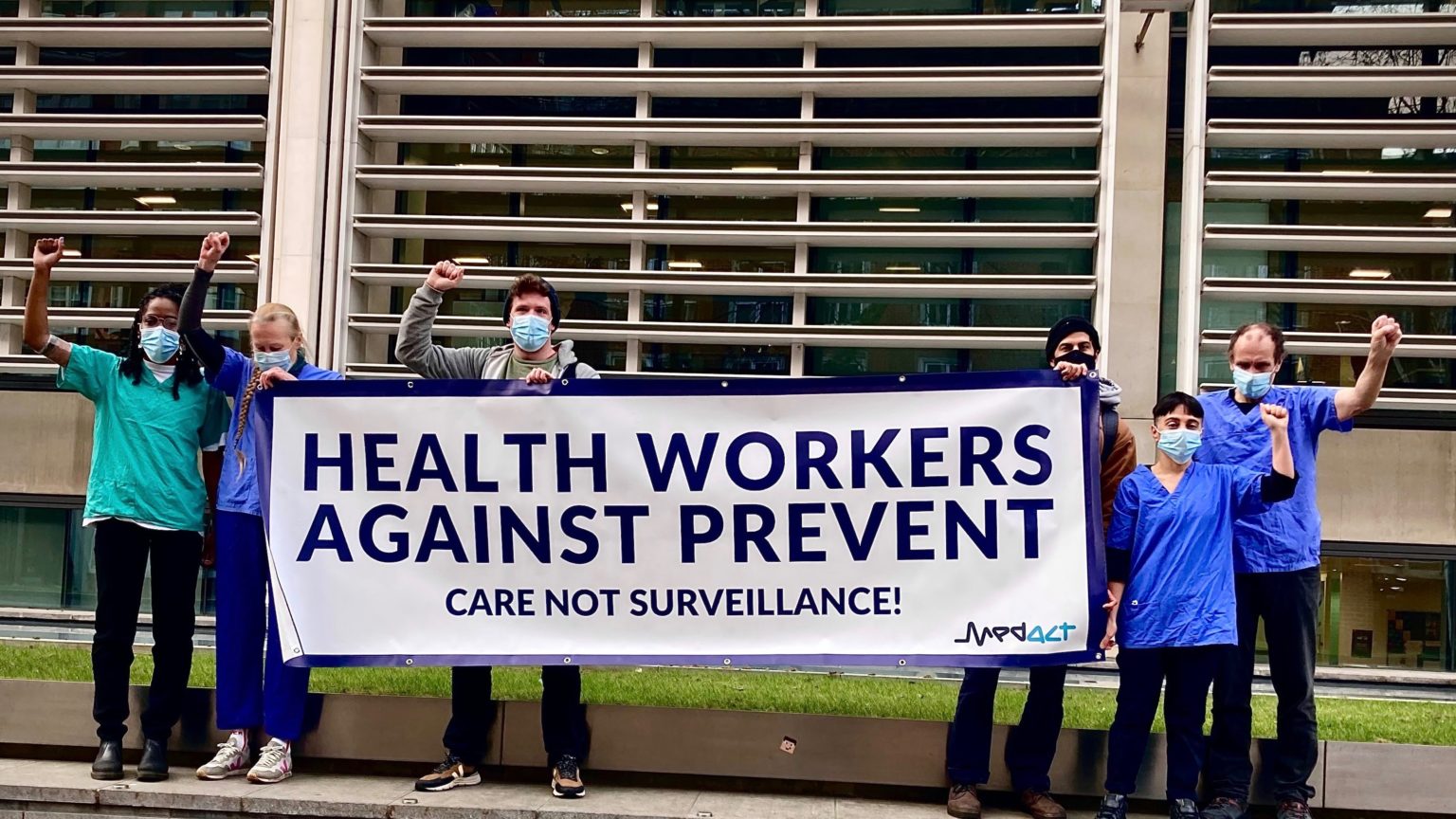
    (Action against Prevent by members of Medact’s Securitization of Health group outside the UK Home Office on February 15, 2023. (Photo: Medact/Twitter)

    NHS staff pulled into counter-terrorism programs, raising alarms over patient care and professional ethics

    Mental health workers in the United Kingdom are being drawn into joint ventures with police and intelligence institutions as part of the national counter-terrorism agenda.

    A new report by Medact, an association of health workers advocating for peace and social justice, highlights how the Counter Terrorism Clinical Consultancy Service (CT CCS) integrates National Health Service (NHS) staff with counter-terrorism agents. This service effectively turns health workers into interpreters for the police, who use the information provided to decide on tactics for individuals identified as potential terrorist threats.

    Read more: Prevent: Health workers resist UK’s ‘counter terrorism’ strategy that weaponizes public services

    In 2024, approximately £17 million was awarded to NHS Trusts to collaborate with security services involved in counter-terrorism. At the report’s launch in London, author Charlotte Heath-Kelly explained that these funds support interdisciplinary teams tasked with analyzing information about selected subjects.

    The teams comprise mental health professionals, including nurses, psychiatrists, psychologists, and police officers. Health workers receive basic information on individuals identified as threats, which they then process and explain to their police counterparts. If the decision is made to continue monitoring a person, health workers interpret new information collected and may reach out to the person’s GP practice to encourage them to report on their patients in case they, for example, discontinue therapy or experience a stressful situation.

    “This creates an indirect surveillance relationship between health workers and patients and may compromise a patient’s right to discontinue medical treatment since police-led interventions may follow non-compliance,” Heath-Kelly writes.

    Unseen patients

    CT CCS health professionals contextualize and explain how potential mental health issues could affect an individual’s behavior. This process, referred to as “formulating,” is commonly used in mental health care to better understand a person’s mental health status in the context of their everyday life and offering them support. However, unlike in healthcare settings where formulating is done collaboratively with the patient, CT CCS professionals have no direct contact with the people they are assessing, nor do they have their consent for the process to take place. This puts the teams at odds with professional ethics.

    The involvement of health workers means that counter-terrorism teams do not only profile individuals but are guided in using available medical information contextually. Despite these “improvements,” it is likely that those most affected by this new line of intelligence will be racialized. Previous analyses by Medact have shown that Muslims were about 23 times more likely to be referred to a mental health hub for ‘Islamism’ than white British people were for ‘Far Right extremism.’

    CT CCS work: legal but controversial

    Alarmingly, there is no public accountability or oversight over the implementation of this program. If allowed to continue unchecked, it will persist as a “bubble of trust” between select health professionals and police officers, as described by a high-ranking officer interviewed by Heath-Kelly. This could easily erode the relationship between health workers and their patients and undermine the overall role of the NHS.

    The work of CT CCS teams, while controversial, is entirely legal. They operate within regulations such as the GDPR, relying on provisions that allow information sharing when a person is flagged as a risk to themselves or others. However, they apply these rules even at very low levels of perceived risk, including many cases involving young people and children. This potential for misuse in the field of health information and data, which is particularly sensitive, suggests that similar practices could occur in other areas.

    There must be a better way to utilize the millions of pounds allocated to the intersection of health and policing services, Heath-Kelly appealed at the launch. Considering the soaring needs in mental health services and the shortage of health workers in the field, the new government might want to divert the budget to address these critical areas instead.

    Original article by Peoples Health Dispatch republished from peoples dispatch under a Creative Commons Attribution-ShareAlike 4.0 (CC BY-SA) license.