This work by Middle East Monitor is licensed under a Creative Commons Attribution-NonCommercial-ShareAlike 4.0 International License.
The groundbreaking ceremony of Bushehr Nuclear Power Plant, held in Bushehr, Iran on November 10, 2019 [Fatemeh Bahrami/Anadolu Agency]
Russia started a large wave of evacuation on Saturday from Iran’s Bushehr nuclear power plant following US-Israeli attacks that killed one of the plant’s security personnel, Russian media reported.
Citing Alexey Likhachev, the head of Russian state nuclear corporation Rosatom, state news agency Tass said 198 employees are expected to return to Russia within two or three days. Russia helped build the plant and, as of last year, had some 700 personnel working there.
Likhachev underlined that developments around the plant are unfolding according to an “undesirable scenario.”
“As they say, our bad premonitions were not wrong. Overall, the escalation of the conflict around the Persian Gulf is leading to corresponding consequences near the plant,” he said.
One member of the plant’s security personnel was killed when it was hit on Saturday, Iran’s semi-official Fars News Agency reported.
The outlet said that one of the plant’s auxiliary buildings was damaged by the blast and shrapnel.
The region has been on alert since the US and Israel launched a joint offensive on Iran on Feb. 28, killing more than 1,340 people to date, including then-Supreme Leader Ali Khamenei.
Tehran has retaliated with drone and missile strikes targeting Israel, as well as Jordan, Iraq, and Gulf countries hosting US military assets.
This work by Middle East Monitor is licensed under a Creative Commons Attribution-NonCommercial-ShareAlike 4.0 International License.
Donald Trump calls for help from NATO allies in securing the Straight of Hormuz despite saying on 7 March 2026 that they don’t need people to join wars after they’ve already won. He’s challenged with the claim that he lies as much as the IDF.Keir Starmer explains that UK is actively supporting Israel’s genocidal expansion and repeats his previous quotation that he supports Zionism “without qualification”. Keir Starmer said “I said it loud and clear – and meant it – that I support Zionism without qualification.” here: https://www.jewishnews.co.uk/keir-starmer-interview-i-will-work-to-eradicate-antisemitism-from-day-one/
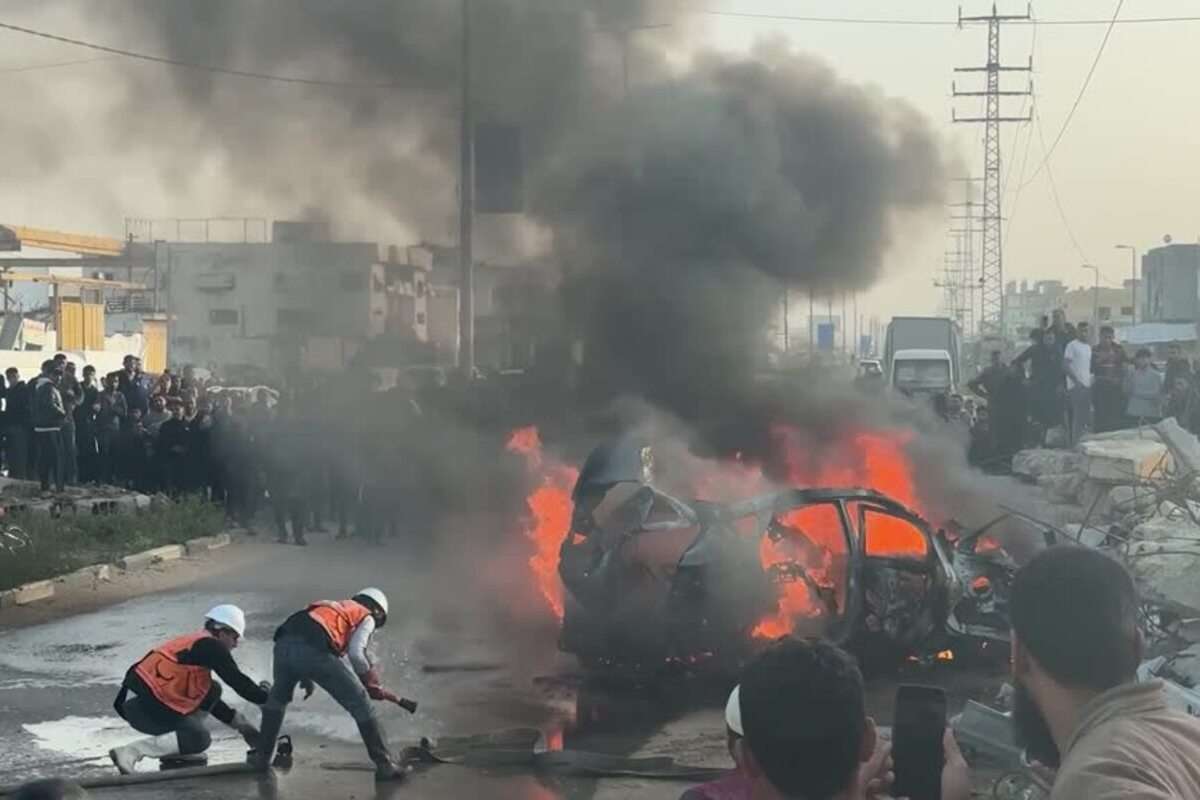
A view of a civilian vehicle caught fire as people gather around it after the Israeli army, violating the ceasefire, targeted it on Salah al-Din Street in central Gaza Strip, Palestine, on April 04, 2026. [Screengrab – Anadolu Agency]
Around 20 boats preparing to join the Global Sumud Flotilla’s “Spring Mission 2026” are set to depart from the southern port city of Marseille, France, as part of an initiative aimed at delivering humanitarian aid to Gaza and challenging the ongoing Israeli policy, with vessels readied for weeks at L’Estaque Port by the France Campaign coalition, including the Thousand Madleens to Gaza movement and the Freedom Flotilla Coalition, on April 03, 2026. [Esra Taşkın – Anadolu Agency]
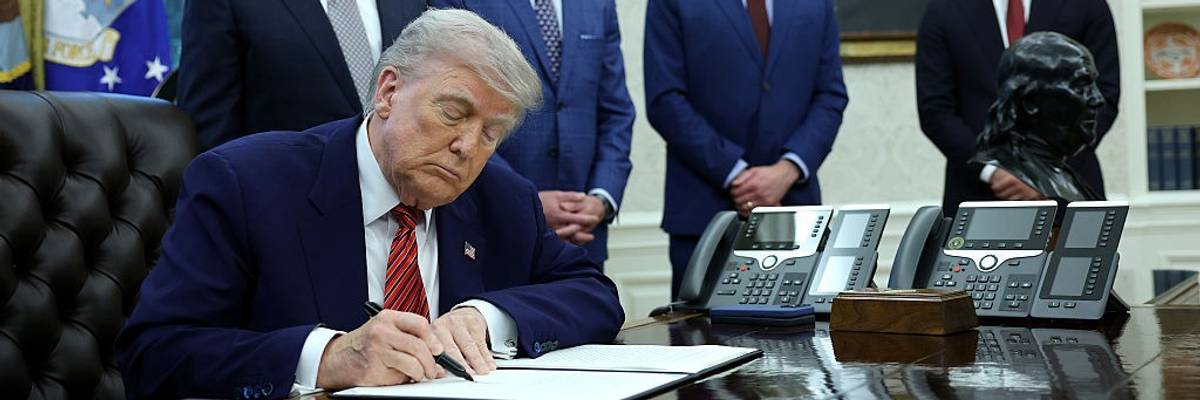
U.S. President Donald Trump signs an executive order related to nuclear power in the Oval Office of the White House in Washington, DC on May 23, 2025 (Photo by Win McNamee/Getty Images)
“I think the DOE’s attempts to cut corners on safety, security, and environmental protections are posing a grave risk to public health, safety, and our natural environment,” said one expert.
Less than a week after NPRrevealed that “the Trump administration has overhauled a set of nuclear safety directives and shared them with the companies it is charged with regulating, without making the new rules available to the public,” the US Department of Energy announced Monday that it is allowing firms building experimental nuclear reactors to seek exemptions from legally required environmental reviews.
Citing executive orders signed by President Donald Trump in May, a notice published in the Federal Register states that the DOE “is establishing a categorical exclusion for authorization, siting, construction, operation, reauthorization, and decommissioning of advanced nuclear reactors for inclusion in its National Environmental Policy Act (NEPA) implementing procedures.”
NEPA has long been a target of energy industries and Republican elected officials, including Trump. The exemption policy has been expected since Trump’s May orders—which also launched a DOE pilot program to rapidly build the experimental reactors—and the department said in a statement that even the exempted reactors will face some reviews.
“The US Department of Energy is establishing the potential option to obtain a streamlined approach for advanced nuclear reactors as part of the environmental review performed under NEPA,” the DOE said. “The analysis on each reactor being considered will be informed by previously completed environmental reviews for similar advanced nuclear technologies.”
“The fact is that any nuclear reactor, no matter how small, no matter how safe it looks on paper, is potentially subject to severe accidents.”
However, the DOE announcement alarmed various experts, including Daniel P. Aldrich, director of the Resilience Studies Program at Northeastern University, who wrote on social media: “Making America unsafe again: Trump created an exclusion for new experimental reactors from disclosing how their construction and operation might harm the environment, and from a written, public assessment of the possible consequences of a nuclear accident.”
Foreign policy reporter Laura Rozen described the policy as “terrifying,” while Paul Dorfman, chair of the Nuclear Consulting Group and a scholar at the University of Sussex’s Bennett Institute for Innovation and Policy Acceleration, called it “truly crazy.”
Until now, the test reactor designs currently under construction have primarily existed on paper, according to Edwin Lyman, director of nuclear power safety at the Union of Concerned Scientists, a nonprofit environmental advocacy group. He believes the lack of real-world experience with the reactors means that they should be subject to more rigorous safety and environmental reviews before they’re built.
“The fact is that any nuclear reactor, no matter how small, no matter how safe it looks on paper, is potentially subject to severe accidents,” Lyman said.
“I think the DOE’s attempts to cut corners on safety, security, and environmental protections are posing a grave risk to public health, safety, and our natural environment here in the United States,” he added.
Lyman was also among the experts who criticized changes that NPR exposed last week, after senior editor and correspondent Geoff Brumfiel obtained documents detailing updates to “departmental orders, which dictate requirements for almost every aspect of the reactors’ operations—including safety systems, environmental protections, site security, and accident investigations.”
While the DOE said that it shared early versions of the rules with companies, “the reduction of unnecessary regulations will increase innovation in the industry without jeopardizing safety,” and “the department anticipates publicly posting the directives later this year,” Brumfiel noted that the orders he saw weren’t labeled as drafts and had the word “approved” on their cover pages.
Secretly rewriting regulations is unfortunately becoming a pattern for this Admin. These changes in safety regulations are concerning, but what's even more troubling is that these decisions were made behind closed doors. Science Dems will be investigating. https://t.co/2MYazWquPk
In a lengthy statement about last week’s reporting, Lyman said on the Union of Concerned Scientists website that “this deeply troubling development confirms my worst fears about the dire state of nuclear power safety and security oversight under the Trump administration. Such a brazen rewriting of hundreds of crucial safeguards for the public underscores why preservation of the Nuclear Regulatory Commission (NRC) as an independent, transparent nuclear regulator is so critical.”
“The Energy Department has not only taken a sledgehammer to the basic principles that underlie effective nuclear regulation, but it has also done so in the shadows, keeping the public in the dark,” he continued. “These long-standing principles were developed over the course of many decades and consider lessons learned from painful events such as the Chernobyl and Fukushima disasters. This is a massive experiment in the deregulation of novel, untested nuclear facilities that could pose grave threats to public health and safety.”
“These drastic changes may extend beyond the Reactor Pilot Program, which was created by President Trump last year to circumvent the more rigorous licensing rules employed by the NRC,” Lyman warned. “While the DOE created a legally dubious framework to designate these reactors as ‘test’ reactors to bypass the NRC’s statutory authority, these dramatic alterations may further weaken standards used in the broader DOE authorization process and propagate across the entire fleet of commercial nuclear facilities, severely degrading nuclear safety throughout the United States.”
Orcas discuss Donald Trump and the killer apes’ concept of democracy. Front Orca warns that Trump is crashing his country’s economy and that everything he does he does for the fantastically wealthy.Donald Fuhrump says that Amerikkka doesn’t bother with crimes or charges anymore, not being 100% Amerikkkan and opposing his real estate intentions is enough.Elon Musk urges you to be a Fascist like him, says that you can ignore facts and reality then.
A household energy bill displayed on a mobile phone held next to a gas hob
MILLIONS face a shock New Year’s Day hike in energy bills — to pay for nuclear expansion projects even while wholesale prices fall.
Industry “regulator” Ofgem announced today a surprise increase in gas and electricity costs from January.
Campaigners urged Chancellor Rachel Reeves to act in her Budget to help struggling families as freezing winter temperatures bite.
The government’s cap on energy prices is to go up by 0.2 per cent in the three months to March.
End Fuel Poverty Coalition co-ordinator Simon Francis said: “Energy bills remain stubbornly high as households face a fifth winter of the energy costs crisis. Today’s announcement sees standing charges rise yet again, highlighting the structural problems in how energy is paid for.
“The addition of a new levy on bills which pays for nuclear power stations is unwelcome and could have been delayed until closer to when these plants actually start to generate electricity.”
The government this summer announced that taxpayers will effectively underwrite a private investment deal worth more than £38 billion to build Britain’s biggest nuclear project in a generation at the Sizewell C site on the Suffolk coast.
Billpayers face paying £1 a month for the costs from this winter until the project is complete under a funding mechanism that shields Sizewell’s investors from the impact of any delays — even if the total cost spirals to as much as £47bn.
dizzy: Nuclear power is too expensive, we can’t afford it. There’s also the problem that it produces waste that remains dangerously radioactive essentially for ever.
Green Party leader Zack Polanski said money would be better spent on renewable energy
Green Party leader Zack Polanski has criticised government plans to build a new generation of nuclear reactors, calling it old technology that is like “creating a fax machine”.
Centrica and US firm X-energy aim to create up to 2,500 jobs in Hartlepool by building 12 new advanced modular nuclear reactors.
Polanski said it was technology “from a long time ago” and that money would be better spent on wind and solar power, which could deliver thousands of jobs.
Labour MP for Hartlepool Jonathan Brash said the technology was being pioneered in the United States and that the companies were also working with schools and colleges to recruit a local workforce.
The nuclear site will be developed next to the town’s existing nuclear power station, which is set to be decommissioned in 2028.
The government previously said that the deal could secure the next 50 years of clean, homegrown energy and that it “marks the dawn of a new golden age for British nuclear”.







 A household energy bill displayed on a mobile phone held next to a gas hob