Argentina’s President Javier Milei delivers his speech at the Annual Meeting of World Economic Forum. Photograph: Markus Schreiber/AP
The wild politics and chainsaw made Argentina’s president an economic hero for the right. And now, with his nation’s finances in chaos: silence
So you really want to know how Prime Minister Farage would pan out? Well, speculate no longer. An excellent test case is unfolding right now, in a country that just so happens to be run by one of Nigel’s heroes. Javier Milei is “amazing”, said the CEO of the private company he calls Reform. “Cutting and slashing … doing all the things he’s done … that’s leadership.”
You may know some of this story, about how a political outsider took power in Argentina. You’ve seen photos of El Loco, the self-styled madman, in a black leather jacket, with sideburns like hedges and wielding a giant red chainsaw – all the better to slash the public sector with.
Taking over Latin America’s second-largest country made Milei the poster boy of the international hard right. Elon Musk: “I love Javier Milei.” Kemi Badenoch: “Javier Milei is the template.” Donald Trump: “My favourite president.” In office, he was lionised by Wall Street and the international commentariat. Milei’s economy was declared by no lesser sage than Niall Ferguson as a “man-made miracle”.
Donald Trump with Javier Milei at the UN general assembly in New York last month. Photograph: Evan Vucci/AP
Yet over the past few weeks, Argentina has gone into freefall. Investors have yanked billions out of the country, and the peso has dropped like a stone. A few days ago Trump was forced to pledge $20bn (£15bn) to prop up his friend, in addition to a rescue loan from the IMF. Later this month, Milei faces midterm elections that will serve as a referendum on his presidency and the results are expected to be bad. “We are seeing in real time how a government can melt in front of our eyes,” Alejandro Bercovich, a leading Argentine TV and radio journalist told me this week. “I never thought they would collapse this quickly.”
Hamas said it had approved parts of Donald Trump’s Gaza plan, including a hostage exchange. Photograph: Rodrigo Abd/AP
Palestinian militant group accepts part of US president’s plan but seeks further negotiations on many terms
Donald Trump ordered Israel to “immediately” stop bombing Gaza as he welcomed Hamas’s partial acceptance of his ultimatum to end the nearly two-year war.
Hamas has agreed to release all hostages in return for Palestinian prisoners held in Israeli jails, as well as surrender governing power in the Gaza Strip, in accordance with Trump’s plan.
In a statement on Friday evening, the Palestinian militant group asked for further negotiations on other parts of the plan, and did not say whether it would lay down its arms – a key part of Trump’s proposal unveiled on Monday.
Despite the qualified response by Hamas, Trump said in a post on Truth Social: “Based on the Statement just issued by Hamas, I believe they are ready for a lasting PEACE.
“Israel must immediately stop the bombing of Gaza, so that we can get the Hostages out safely and quickly! Right now, it’s far too dangerous to do that.
“We are already in discussions on details to be worked out. This is not about Gaza alone, this is about long sought PEACE in the Middle East.”
In a brief video message posted separately Trump said it was a “very special day” and added that “Everybody will be treated fairly.”
Conservative influencer Robby Starbuck’s hiring at Meta was apparently part of a legal settlement. Credit: CNBC
Right-wing influencer Robby Starbuck has a new job advising on political bias in Meta’s AI tools. His record on climate is concerning, say advocates.
A conservative political activist recently appointed to be Meta’s new artificial intelligence anti-bias advisor is a well-known climate change denier, DeSmog has learned.
Robby Starbuck — best known for opposing corporate diversity, equity and inclusion (DEI) initiatives, particularly among brands popular with conservatives — has a track record of denying the science of climate change. These views could seriously compromise the climate content accessed by Instagram and Facebook users, climate advocates warn.
In August 2024, Starbuck told CNN that “corporate policies to slow down the effects of human-caused climate change do nothing positive for society,” that “the climate has always changed” and that “human beings have very little control over it.”
In his new advisory role, Starbuck will be responsible for removing alleged political bias from Meta’s artificial intelligence tools. This may result in a surge of climate change denialism and climate science disinformation on Meta’s social media platforms, like Facebook and Instagram, say climate advocates.
Starbuck’s appointment appears to be at odds with Meta’s stated goals of reaching “net zero emissions across our value chain in 2030” by way of a “science-aligned emissions reduction target in line with the Paris Climate agreement.”
But his appointment comes at a time when major tech companies like Meta and Google are walking back their sustainability initiatives, a process likely motivated by a broad conservative-led anti-ESG political campaign, according to a 2024 Harvard Business Review analysis.
“Putting Starbuck in charge of Meta’s AI policies is the latest reason to believe that Facebook and Instagram are billboards for disinformation,” said Phil Newell, communications co-chair of Climate Action Against Disinformation (CAAD), a global coalition of over 50 climate and anti-disinformation organizations.
Why Meta appointed Starbuck
Starbuck — who produced music videos prior to becoming a conservative activist and MAGA influencer — has no scientific background or experience in climate science.
Yet that hasn’t stopped him from promoting a conspiracy that record 2024 floods in Dubai were the result of “weather modification,” or that the U.S. should “LEAVE and DEFUND the UN!” in response to its positions on climate change.
It is the general consensus of the scientific community and most of the world’s governments that climate change is real and caused by human activity.
He was apparently appointed to the role as part of a legal settlement. The conservative influencer had sued Meta after the company’s AI chatbot incorrectly linked Starbuck to the January 6th insurrection.
Starbuck’s appointment appears to contrast with Meta’s previous climate statements, including a July 2023 document entitled “Our Path to Net Zero” which stated that “operating sustainably and addressing climate change through bold, meaningful action are paramount to our mission.”
Yet in recent years Meta and other tech companies have appeared to walk back such commitments as they build data centers that have largely been powered by fossil fuels.
They’ve also cultivated closer relationships with Trump. Amazon, Apple, Meta, and Microsoft all made $1 million donations to Trump’s second inauguration fund.
Meta’s ties to Trump
Newell argues that Meta’s retreat on climate action coincides with new leadership that takes the crisis less seriously. He pointed to the 2025 appointment of chief global affairs officer Joel Kaplan, who is credited with developing Meta’s Washington lobbying effort, as well as bringing CEO Mark Zuckerberg into Donald Trump’s orbit.
About a week after Kaplan’s appointment, Meta announced that it would eliminate fact checkers from moderating content on its platforms. Zuckerberg said that the company would henceforth rely on users to counter climate change denialism and misinformation.
Newell told DeSmog that the prevalence of right-wing propaganda and disinformation on platforms such as Facebook is profitable, and likely why such content isn’t being banned.
Meta’s hiring of Starbuck comes as the Trump administration is leading a coordinated attack on mainstream climate science. In July, the Department of Energy released a report on climate change that actual climate scientists condemned as “biased, full of errors, and not fit to inform policymaking.” The report — authored by five well-known climate science deniers — aimed to undermine the scientific consensus that human activity underlies climate change.
According to CNN, Starbuck may be involved in efforts to reduce or eliminate “AI hallucinations” – false or nonsensical information provided in response to queries. As such, an exceptionally high-profile conservative activist will have a say in one of the world’s most widely used AI systems.
Even prior to hiring Starbuck, Meta’s AI has already been criticized for leaning heavily on carbon capture as a potential climate change solution, despite the considerable expert analysis that has largely concluded the technology is an ineffective smokescreen to permit continued fossil fuel production.
AI climate denial
Researchers with CAAD have identified bigger, more systemic climate problems with AI.
CAAD estimates that even if tech companies improved AI data centers’ energy efficiency by 10 percent, but also doubled the number of data centers, it would increase carbon dioxide emissions by 80 percent.
“There’s definitely a significant harm happening that’s already greater than the promises of pro-AI boosters,” said Newell.
Starbuck’s appointment — only the most recent example of the right-wing’s takeover of Big Tech — signals that the problem will likely get worse, especially if Meta’s AI is programmed to consider actual climate science politically or ideologically biased, he argued.
DeSmog reached out to Meta and Starbuck for comment, but did not receive a reply.
dizzy: I suggest that AI should be regarded as certainly not impartial and instead anti-Democratic and supportive of Fascism. For example Musk’s chatbot Grok is censored after confirming that Israel and the United States is committing genocide in Gaza and Google’s AI getting censored so that it fails to confirm that Trump is demented. It follows that AI should be opposed since it’s supportive of Fascism and anti-Democratic.
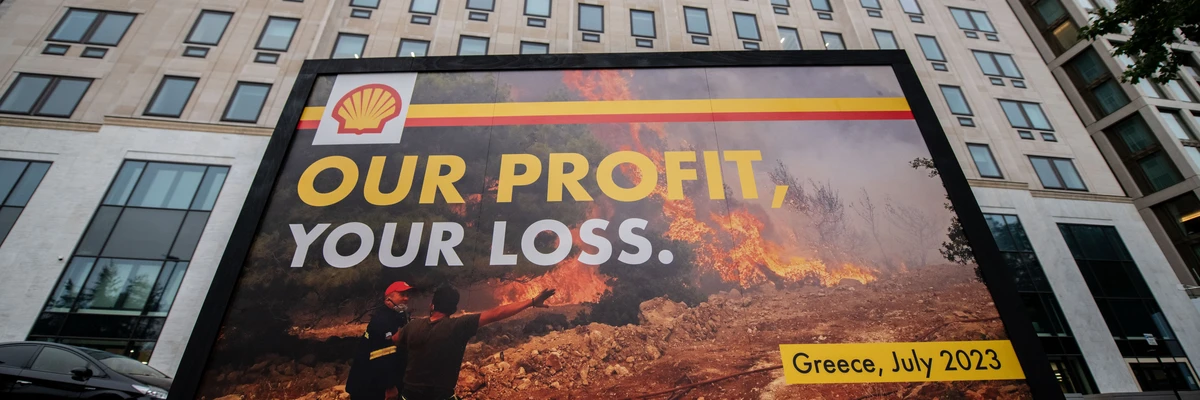
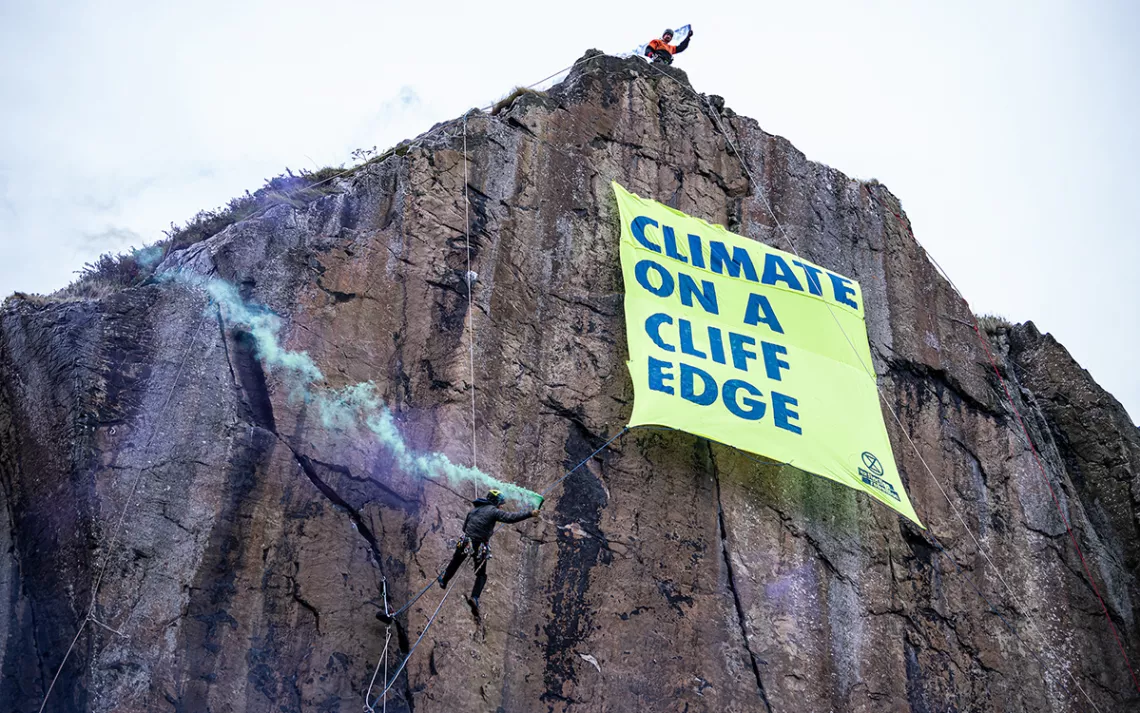
Greenpeace activists display a billboard during a protest outside Shell headquarters on July 27, 2023 in London. (Photo: Handout/Chris J. Ratcliffe for Greenpeace via Getty Images)Experienced climbers scale a rock face near the historic Dumbarton castle in Glasgow, releasing a banner that reads “Climate on a Cliff Edge.” One activist, dressed as a globe, symbolically looms near the edge, while another plays the bagpipes on the shores below. | Photo courtesy of Extinction Rebellion and Mark RichardsElon Musk urges you to be a Fascist like him, says that you can ignore facts and reality then.
Antarctic sea ice winter peak in 2025 is third smallest on record
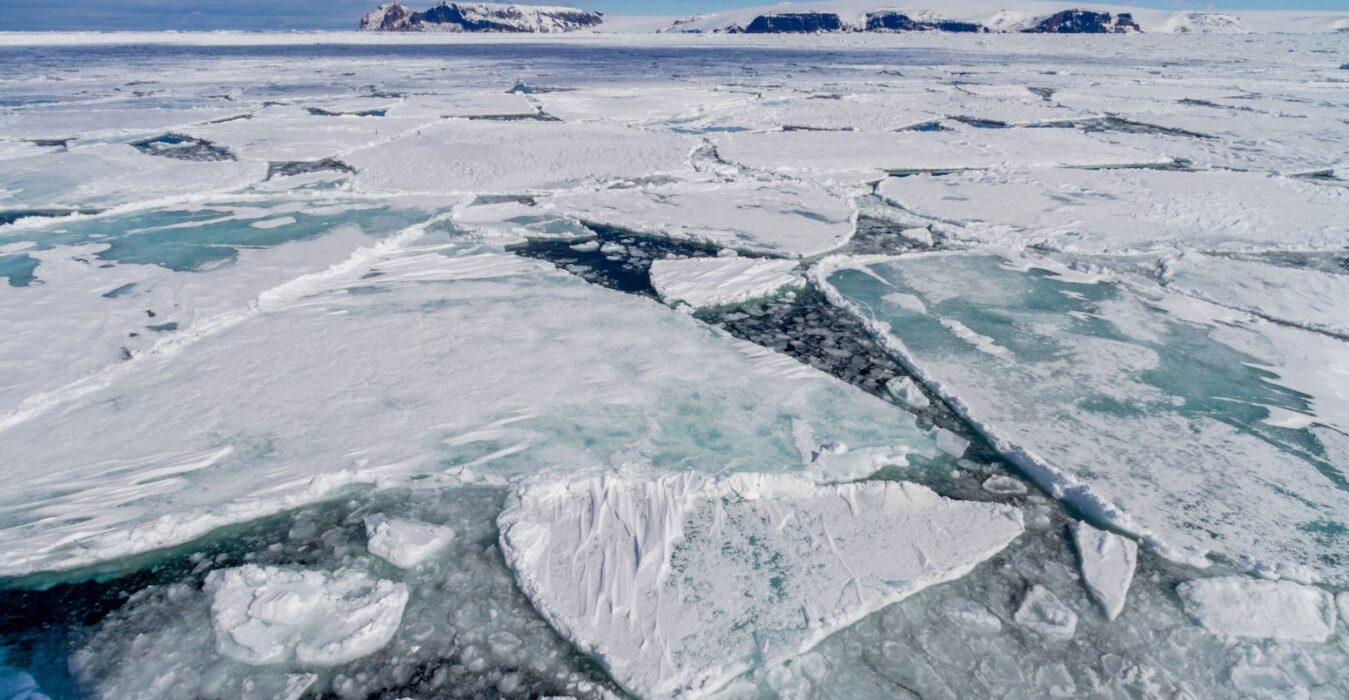
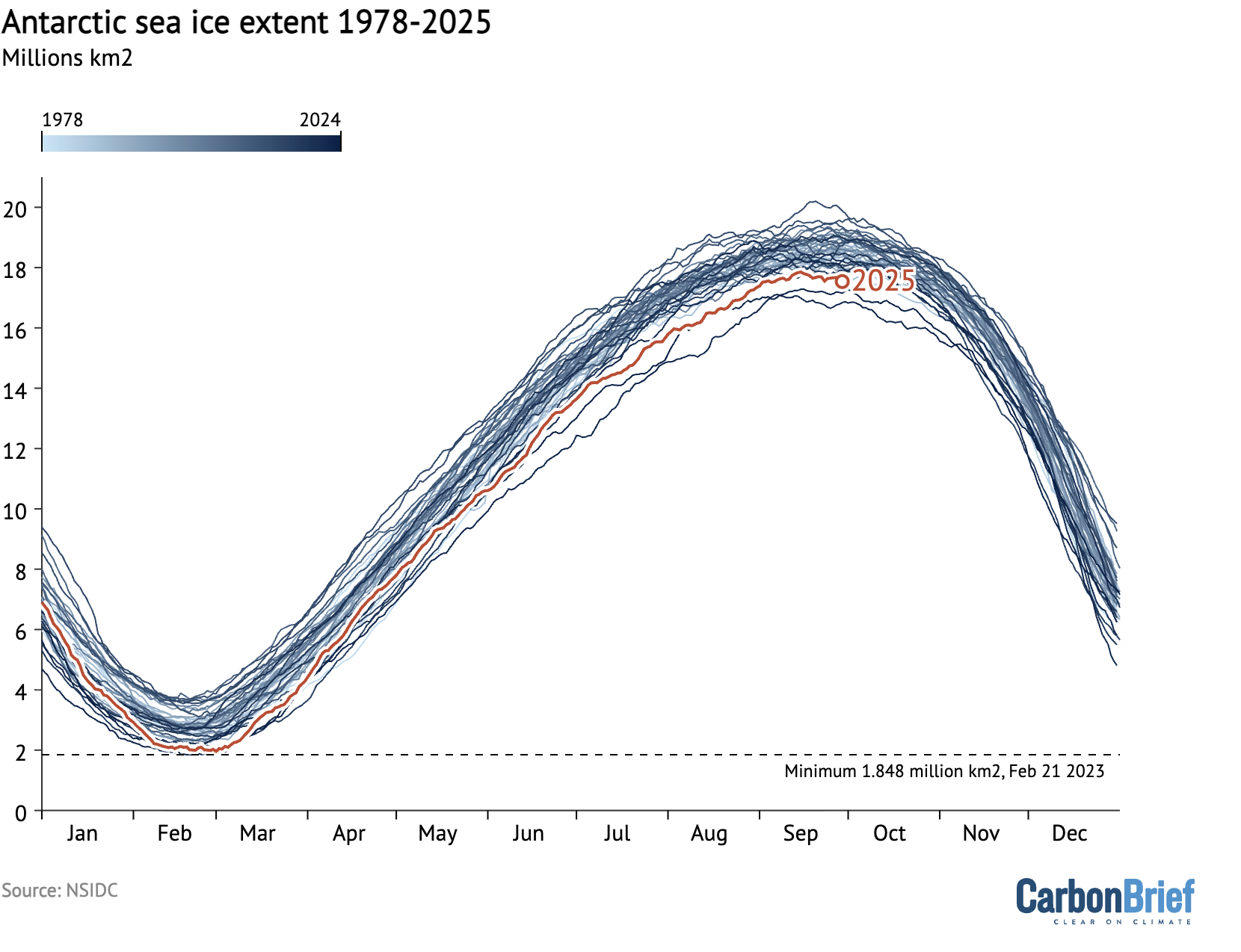
Antarctic sea ice has recorded its third-smallest winter peak extent since satellite records began 47 years ago, new data reveals.
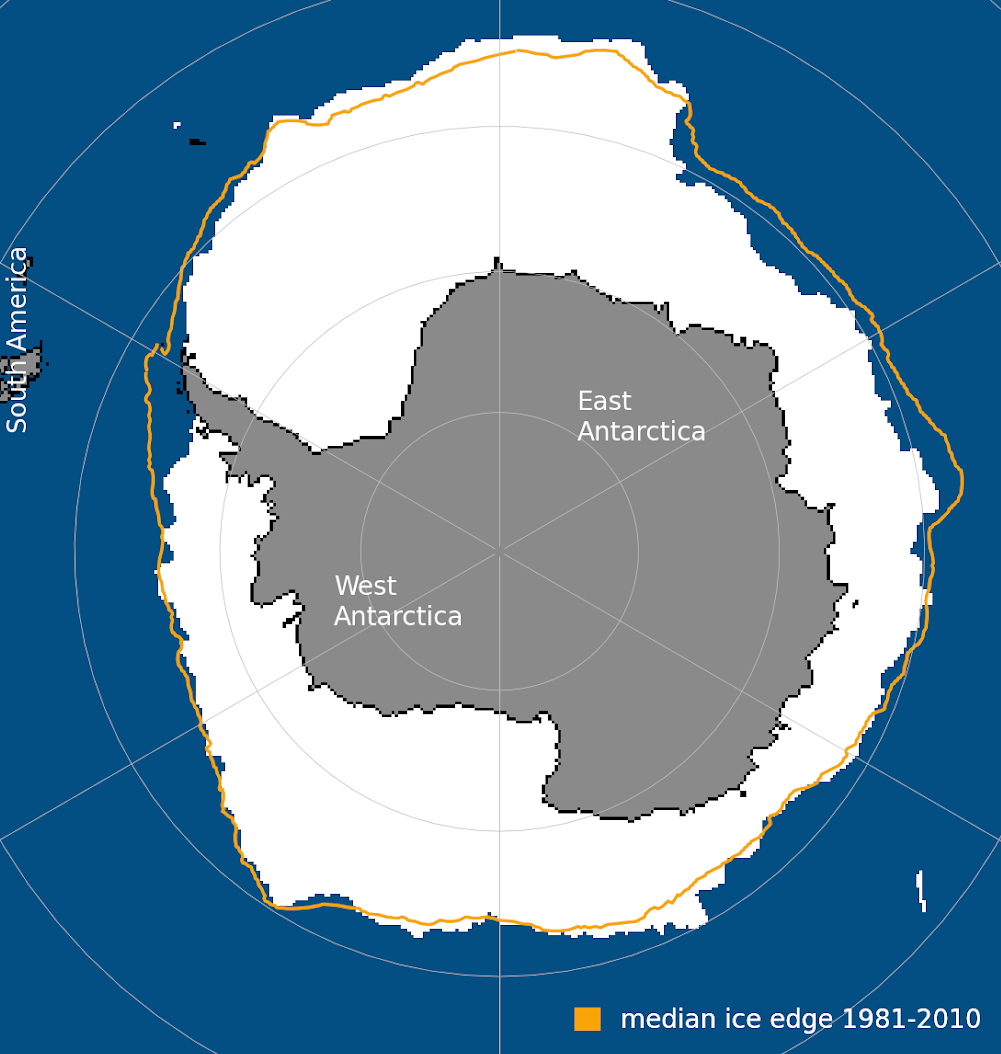
Provisional data from the US National Snow and Ice Data Center (NSIDC) shows that Antarctic sea ice reached a winter maximum of 17.81m square kilometres (km2) on 17 September.
This is 900,000km2 below the 1981-2010 average maximum extent – the historical baseline against which more recent sea ice extent is typically compared.
According to one expert, the “lengthening trend of lower Antarctic sea ice poses real concerns regarding stability and melting of the ice sheet”.
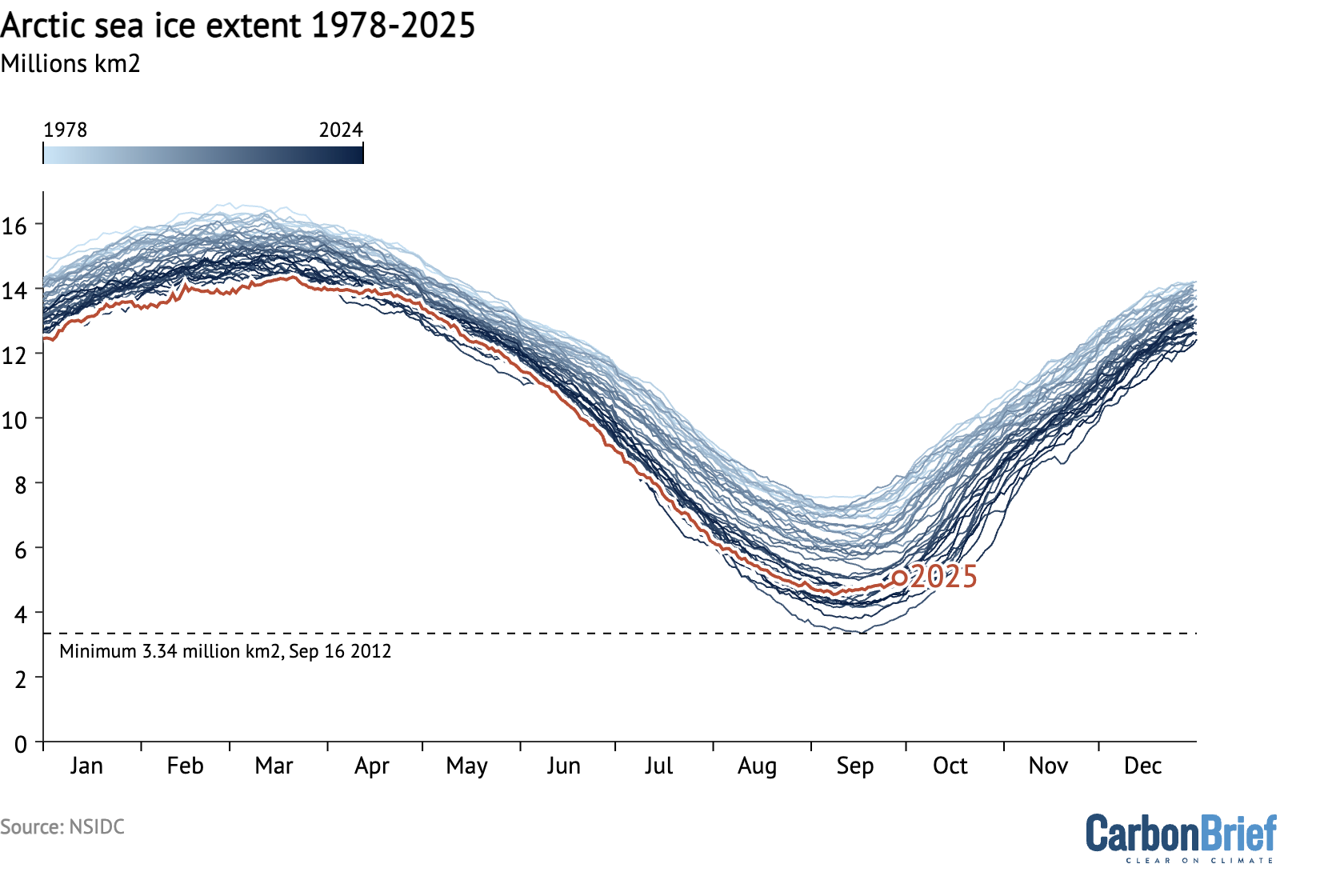
Meanwhile, at the Earth’s other pole, Arctic sea ice reached its annual minimum on 10 September, ranking as the joint-10th lowest in the satellite record.
At 1.6m km2, the 2025 minimum shares the spot with 2008 and 2010. The NSIDC notes that all 19 of the lowest sea ice extents in the record have occurred in the past 19 years.
Antarctic peak
For decades, scientists have been using satellite data to track the annual cycle of sea ice growth and melt at the world’s poles. This is a key way to monitor the “health” of sea ice in both the Arctic and Antarctic.
The map below shows Antarctic sea ice on the day of its maximum extent for the year on 17 September 2025, where the yellow line shows the 1981-2010 average.
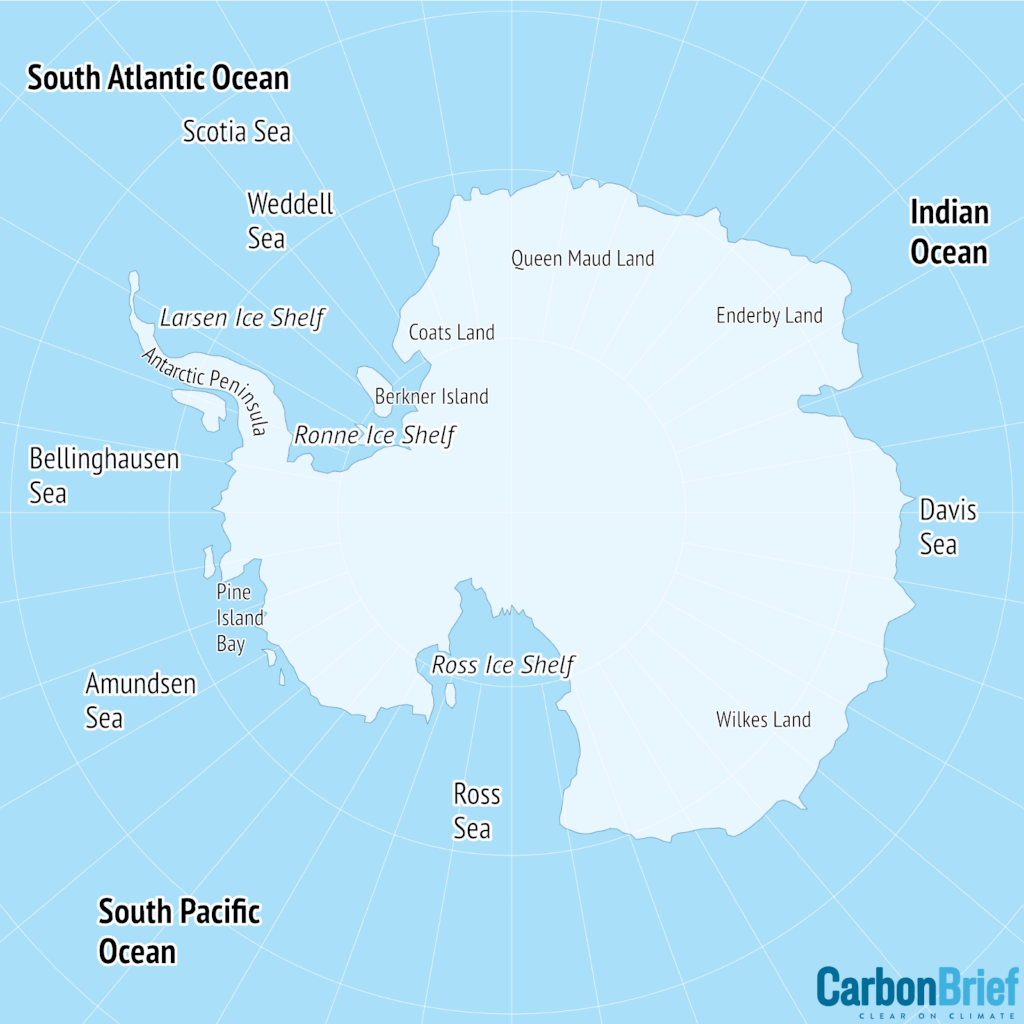
The NSIDC says that sea ice extent was “markedly below average” in the Indian Ocean and the Bellingshausen Sea, but “slightly above average” over the Ross Sea.
Antarctic sea ice extent on 17 September. Median sea ice edge for 1981-2010 is shown in yellow. Source: NSIDC.
“The lengthening trend of lower Antarctic sea ice poses real concerns regarding stability and melting of the ice sheet. However, it may also be leading to greater snowfall over the continent, which would slow the progression of sea level rise.”
Antarctic sea ice growth
In its typical annual cycle, Antarctic sea ice grows during winter towards its annual maximum extent in September or October. It then melts throughout the spring and summer towards its March minimum.
At 1.98m m2, this was the fourth consecutive year that Antarctic sea ice had fallen below 2m km2, the NSIDC noted.
In its monthly sea ice updates, the NSIDC reported that sea ice then grew at a “near-average pace”. During this period, sea ice “expanded rapidly” in the last areas to lose ice, including the Ross Sea and eastern Weddell Sea, it said.
Map showing the main regions of the Antarctic. Credit: Carbon Brief
The NSIDC explained that sea ice rebounded quickly in the Ross Sea area because ice extent had retreated “slowly” there the month before – meaning that the upper ocean layer did not have time to accumulate heat which would slow the winter freeze.
In April, “the situation in the Antarctic remained fickle”, the NSIDC said. At the beginning of the month, sea ice extent neared “record-low” daily extents, but as the month progressed ice cover expanded “fairly quickly”, it said.
May had “below average growth” in Antarctic sea ice and saw the fifth lowest record for Antarctic sea extent.
As June began, the the Bellingshausen Sea and eastern Queen Maud Lord regions were “far behind” in ice re-growth, it said, adding that the Bellingshausen Sea was almost entirely ice-free as temperatures were 6-8C above average.
In June, Antarctic sea ice was 1.28m km2 below the 1981-2010 baseline, with “particularly low” sea ice extent in the Bellingshausen Sea and the Indian Ocean sector, according to the NSIDC. This was the third-lowest sea ice extent ever recorded for the month of June, it said.
Throughout July, Antarctic sea ice extent grew at a “slower-than-average” rate, according to the NSIDC. By the end of the month, Antarctic sea ice extent was 1.3m km2 below the baseline, it noted.
Arctic melt season
In the Arctic, sea ice cover typically reaches its high point in March, before dropping to its September minimum at the end of the northern-hemisphere summer.
The 2025 Arctic sea ice winter peak was the smallest since satellite records began. The peak, recorded on 22 March, was 1.31m km2 below the average maximum for the 1981-2010 historical baseline.
In March, Arctic sea ice extent averaged 14.14m km2 – the lowest in the satellite record, according to the NSIDC. It noted that, at the time, average air temperature was above the historical baseline across much of the Arctic region.
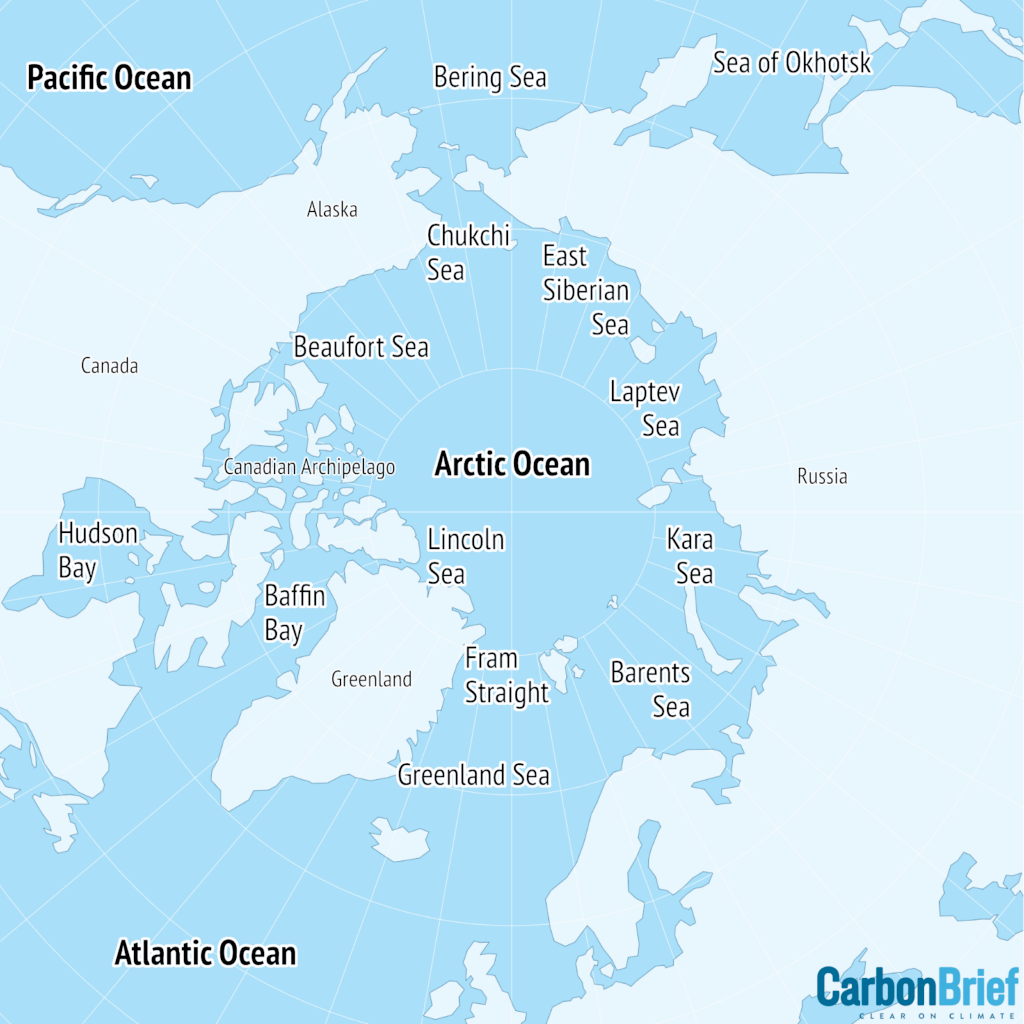
Map showing main regions of the Arctic. Credit: Carbon Brief
Arctic sea ice extent then “changed very little” throughout April, remaining “nearly constant” until the final days of the month, the NSIDC reported.
It added that the final days of April saw Arctic sea ice extent drop due to ice retreat along the coast of the Barents Sea.
According to data, the main reason why the April total extent remained largely flat was due to an increase of sea ice in the northeastern Barents Seas that “offset” losses elsewhere.
Below-average air temperatures over the northern Norwegian and Barents Seas was the most “notable feature” of April 2025, the NSIDC said.
May was marked by a decline in Arctic sea ice extent at a faster-than-average pace, the NSIDC noted, resulting in the seventh-lowest May extent on record.
It added that ice loss in May was “primarily” in the Barents Sea, Bering Sea and the Sea of Okhotsk.
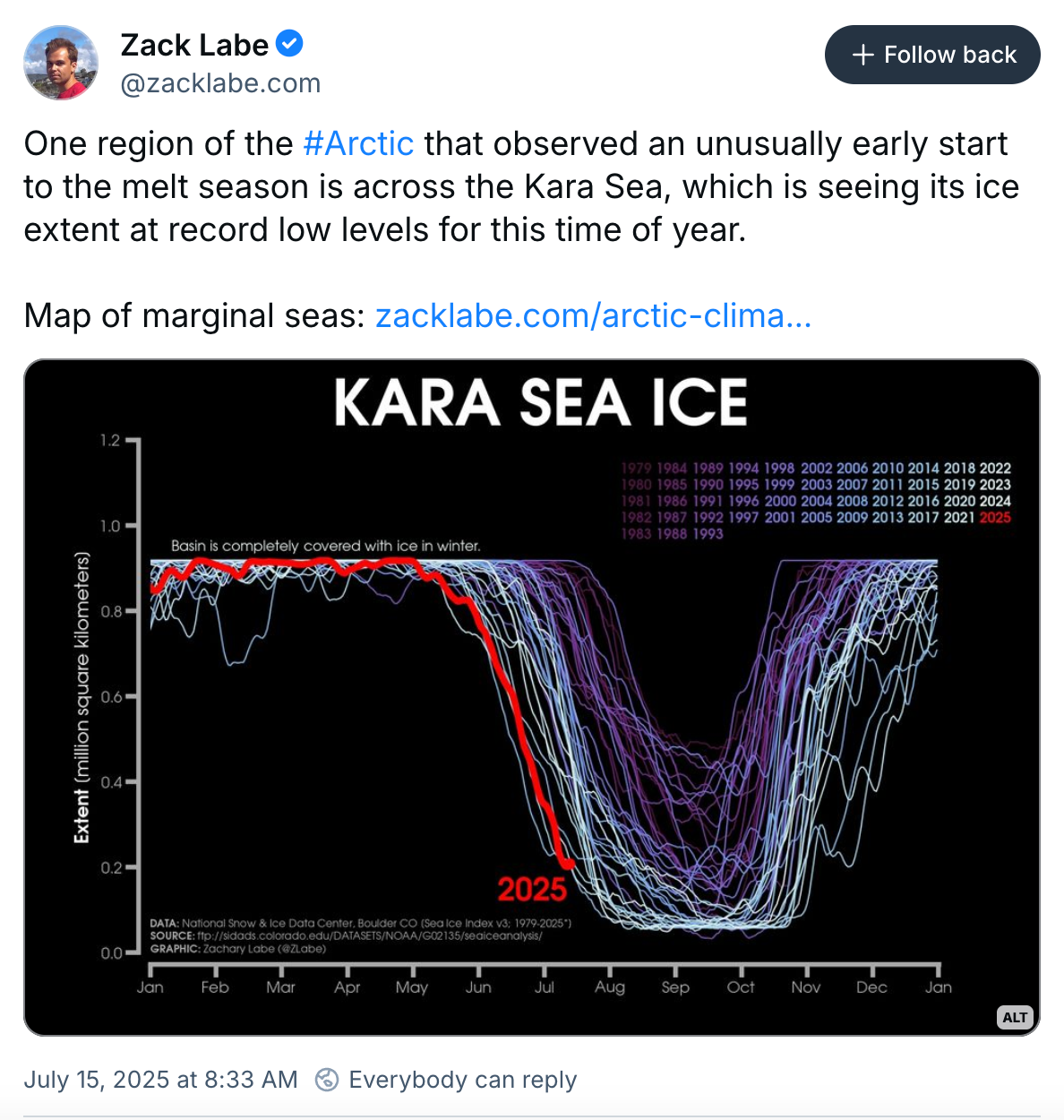
In June, Arctic sea ice extent averaged 10.48m km2 – the second-lowest average on record for the month, the NSIDC said. It noted that sea ice hit record-low levels over 20 June and 26 June and tracked at “near-record” low levels through the month. The Barents and Kara Seas were both “nearly ice-free” by the end June.
Hudson Bay ice extent was also “considerably below average” throughout June and northern parts of Baffin Bay were nearly ice-free, it said.
By the end of July, daily sea ice extent in the Arctic had fallen to 7.66m km2 – the third lowest in the satellite record, the NSIDC reported. It noted that, for most of the month, Arctic sea ice extent tracked close to levels recorded for 2012 – the year in which Arctic sea ice extent reached its lowest-ever September minimum.
Throughout August, the NSIDC reported that sea ice “rapidly melted and compacted” north of Alaska in the Beaufort Sea, with sea ice extent averaging at 5.41m km2 – the seventh lowest on record.
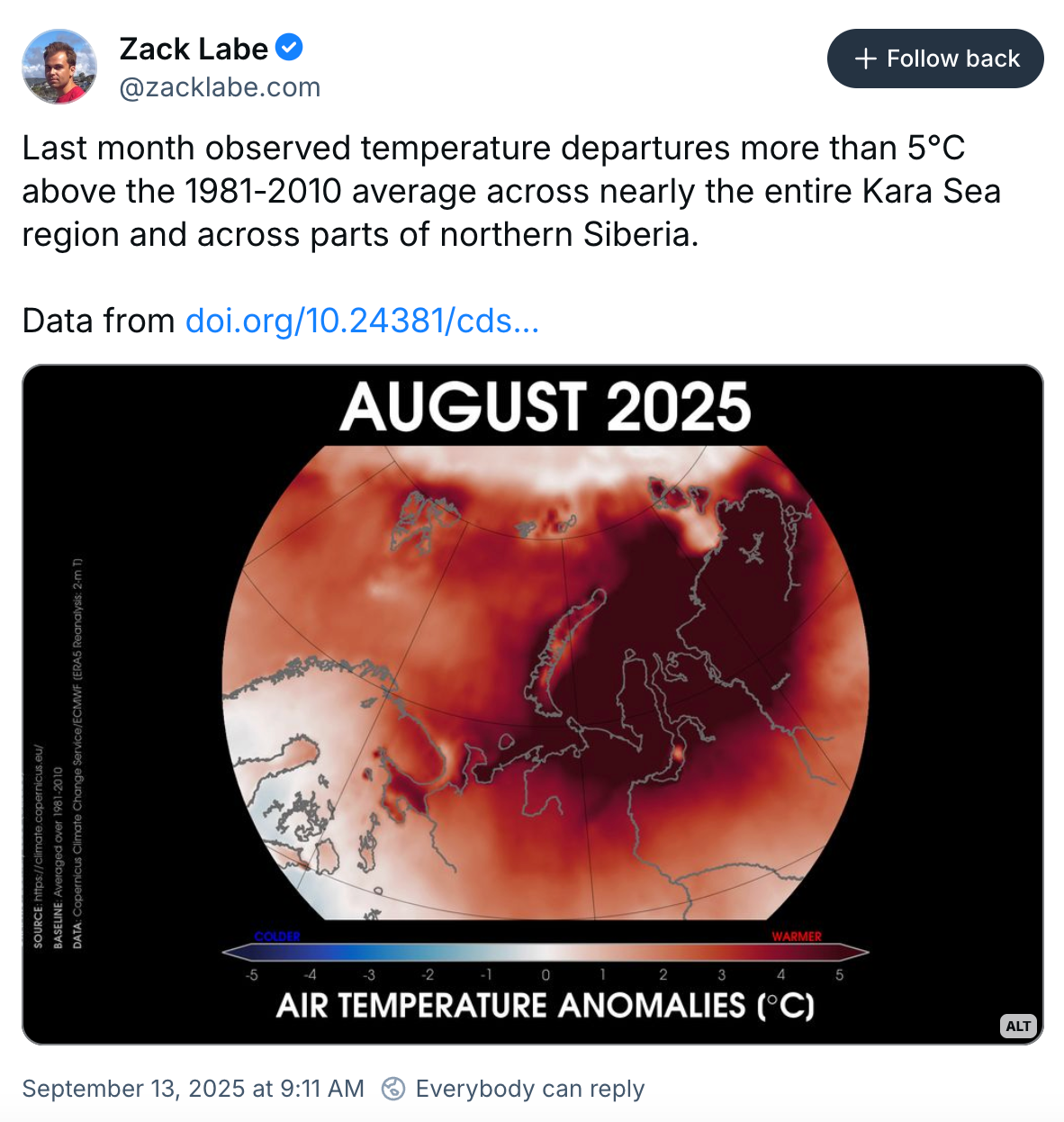
Dr Zack Labe – a climate scientist at Climate Central – tells Carbon Brief that northern Siberia saw August air temperatures more than 5C above the 1981-2010 average, resulting in “a striking amount of open water along the Atlantic side of the Arctic that would normally be ice-covered”.
At an annual minimum of 1.6m km2, this year’s Arctic minimum is “pretty unremarkable”, Labe tells Carbon Brief, and “adds to the evidence of a clear slowdown in the rate of summer Arctic sea ice loss”.
However, Labe stresses that this is “not surprising” – referencing a recent study which “clearly shows how internal variability can temporarily drive periods of slower melt in a warming climate, as well as periods of rapid melt, such as in the early 2000s”. (For more on this research, read Carbon Brief’s guest post).
He adds:
“It is only a matter of time before summertime melt accelerates again. This is not a good news story, especially since in many other months we still see a clear downward trend…
“While the past decade of summers may give the appearance of a slowdown, regional extremes such as in the Kara Sea this year underscore that the Arctic is already radically different from past decades. The driver is clear – human-caused climate change.”
Satellite switch
For decades, NSIDC has tracked sea ice using data from weather satellites run by the US Navy. However, earlier this year, Mongabay reported that NSIDC scientists “noticed holes in the data they were receiving”.
The article explains:
“When scientists inquired with the Department of Defense (DoD), they were told not all data were being downloaded and access to the data had been deprioritised. Soon after, the DoD said it would stop sharing…data altogether, citing military cybersecurity risks in the old systems.”
NSIDC scientist Walt Meier told Science that while the US satellites “are up there and functioning…we’re not getting all the data anymore, at least regularly”.
The DoD then set a cut-off date to “cease distribution data from the Defense Meteorological Satellite Programme” on 31 July.
In June, the NSIDC announced that it would “explore switching to a different sensor” aboard a Japanese satellite that was launched in 2012.
The only other option available to NSIDC was a “series of Chinese weather satellites, which the country is already using to produce its own record of sea ice”, Science noted. It added that a new US DoD weather satellite, launched last year, is “also capable of collecting similar data, but its data have not yet been made public”.
The switch was completed by the July cut-off date and NSIDC reprocessed all data for 2025 to use the new data source to ensure “consistency through the year”.
Donald Trump urges you to be a Climate Science denier like him. He says that he makes millions and millions for destroying the planet, Burn, Baby, Burn and Flood, Baby, Flood.Greenpeace activists display a billboard during a protest outside Shell headquarters on July 27, 2023 in London. (Photo: Handout/Chris J. Ratcliffe for Greenpeace via Getty Images)Experienced climbers scale a rock face near the historic Dumbarton castle in Glasgow, releasing a banner that reads “Climate on a Cliff Edge.” One activist, dressed as a globe, symbolically looms near the edge, while another plays the bagpipes on the shores below. | Photo courtesy of Extinction Rebellion and Mark Richards
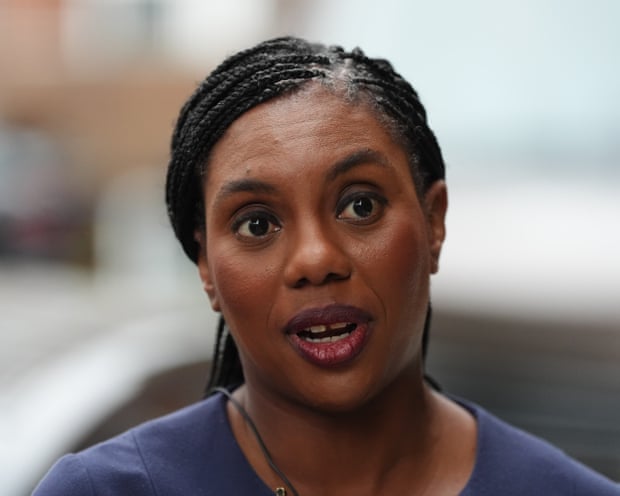
Kemi Badenoch, the Conservative leader, announced the policy before her party’s conference coming up this weekend. Photograph: Jonathan Brady/PA
Tory leader says she would replace it with ‘cheap energy’ strategy, ending decades-long consensus on climate
Kemi Badenoch has vowed to repeal the Climate Change Act if the Conservatives win the next election, doing away with controls on greenhouse gas emissions and dismantling what has been the cornerstone of green and energy policy for successive governments.
Badenoch said: “Under my leadership we will scrap those failed targets. Our priority now is growth, cheaper energy, and protecting the natural landscapes we all love.”
Under the landmark legislation, which was passed with the almost unanimous support of the Conservative party under David Cameron in 2008, carbon budgets are set for many years beyond the current government’s remit. This in effect binds future governments to adhering to climate policies, though it does not specify what those policies should be.
UK Conservative Party leader Kemi ‘not a genocide’ Badenoch explains her reality that the Earth is flat, the Moon is made of cheese and that she was born from
Unicorn horn dustElon Musk urges you to be a Fascist like him, says that you can ignore facts and reality then.Experienced climbers scale a rock face near the historic Dumbarton castle in Glasgow, releasing a banner that reads “Climate on a Cliff Edge.” One activist, dressed as a globe, symbolically looms near the edge, while another plays the bagpipes on the shores below. | Photo courtesy of Extinction Rebellion and Mark Richards