Arctic sea ice decline seemed to be slowing – until two record‑breaking low‑ice winters
Duo Chan, University of Southampton and Alessandro Silvano, University of Southampton
Arctic sea ice appeared to be entering a new phase. In the early 2020s, the rapid decline seen over previous decades seemed to ease, leading scientists to ask whether winter sea ice loss had slowed.
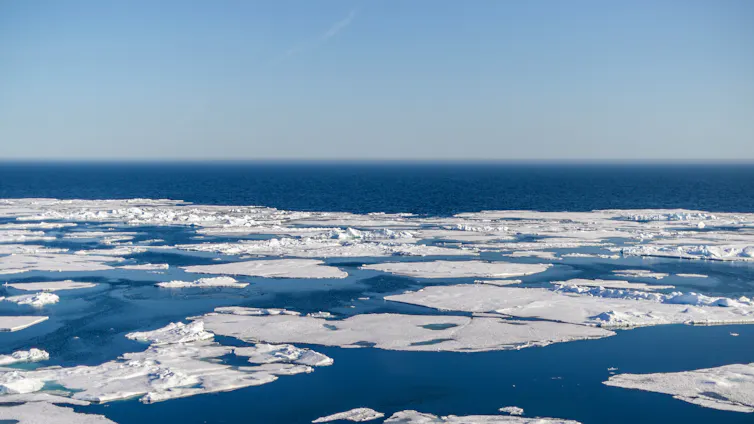
Our new study suggests that conclusion was premature. After two exceptionally low-ice winters in 2025 and 2026, the recent slowdown disappears. The almost 6% drop between 2024 and 2025 was the largest single-year decline on record. The latest observations restore a statistically significant downward trend, showing how a few unusual years can quickly change the overall picture.
Sea ice is a crucial indicator of climate change in the Arctic. As the planet warms, the Arctic is warming even faster, and satellite observations have shown that sea ice has declined in every month of the year since the late 1970s. The loss is largest at the end of summer, when the Arctic reaches its annual minimum ice cover, but winter sea ice has also been shrinking.

However, this decline has not been smooth. In the early 2020s, Arctic sea ice loss appeared to slow across much of the year. This did not mean the ice had recovered to what it was before modern global warming. But compared with the rapid losses seen in earlier decades, the trends seemed weaker, raising an important question: had Arctic sea ice decline begun to slow?
Exceptional winters
Our study examines why these two winters changed things. Until 2024, the recent 20-year decline in winter sea ice extent was not statistically significant – meaning the data is consistent with no decline over the past 20 years.
The record low of ice in 2025, followed by another near-record low in 2026, should rewrite the overall narrative. Using the February–March average, which we use to represent winter sea ice extent, 2025 recorded the largest single-year decline in the satellite record.
Including these latest observations changes the picture of a weakened decline. Once the 2025 and 2026 winters are included, the 20-year trend in Arctic winter sea ice extent returns to a statistically significant decline. We can now be much more confident that the trend is real, and the decline is still ongoing.
How Arctic winter sea ice extent has changed since 1980:
A fall of nearly 6% in one year also raises an obvious question: can Arctic winter sea ice really drop this quickly under current climate conditions? To answer this question, we examined climate model simulations of Arctic climates warmed by a similar amount to today, and asked whether they ever produce a one-year winter sea ice drop as large as the one seen in 2025.
They do, although only rarely.
In simulations where the Arctic has warmed by a similar amount to today, about 3°C since 1980, a one-year winter sea ice drop of this size occurs in roughly one out of every 100 simulated years. This suggests that the 2025 drop was unusual, but still physically plausible. It does not require a new explanation. Instead, it is consistent with a warming Arctic in which year-to-year variability can produce abrupt changes. From one winter to the next, the extent of sea ice can decline sharply, remain stable, or even increase.
So what should we expect in the coming years?
If warming continues, the same model simulations suggest that winter sea ice is unlikely to rebound to the higher levels seen in the early 2020s. This does not mean every coming winter will set a new record low. Arctic sea ice will continue to fluctuate from year to year. But under continued warming, these recent low-ice winters may mark a shift towards winter ice fluctuating around a lower average level.
The lesson, at least for winter, is that Arctic sea ice loss has not stopped. The apparent slowdown of the early 2020s looked real at the time, but now looks more like a pause than a lasting change. Short-term variability can temporarily mask decline, but it does not remove the underlying pressure from Arctic warming.
The open question is whether the same pattern will emerge in summer, which has also shown a recent slowdown in sea ice retreat. So far, the renewed winter decline has not yet translated into an equally clear renewed decline in summer.
Winter and summer sea ice are connected. Low winter ice may help precondition the ice cover for stronger spring and summer melt. But the connection is not automatic: Arctic sea ice does not simply move in the same direction, in every season, at the same time. Spring weather, clouds, snow cover, winds, ocean heat and ice thickness all affect how much ice survives to the summer minimum.
Understanding how these factors evolve in a changing climate will be crucial for answering whether, and when, summer sea ice decline re-emerges from its recent slowdown.
Duo Chan, Lecturer in Climate Sciences, University of Southampton and Alessandro Silvano, NERC Independent Research Fellow in Oceanography, University of Southampton
This article is republished from The Conversation under a Creative Commons license. Read the original article.

 Prime Minister Andy Burnham hosts his first Cabinet meeting at 10 Downing Street, London, July 21, 2026