‘We need to be a cost-of-living government’
https://morningstaronline.co.uk/article/we-need-be-cost-living-government
New PM slashes fuel bills and culls Starmer deadwood, but peace activists warn that placing John Healey as new Chancellor shows ‘beyond doubt that the military industrial complex is in charge of Burnham’s economic policy’
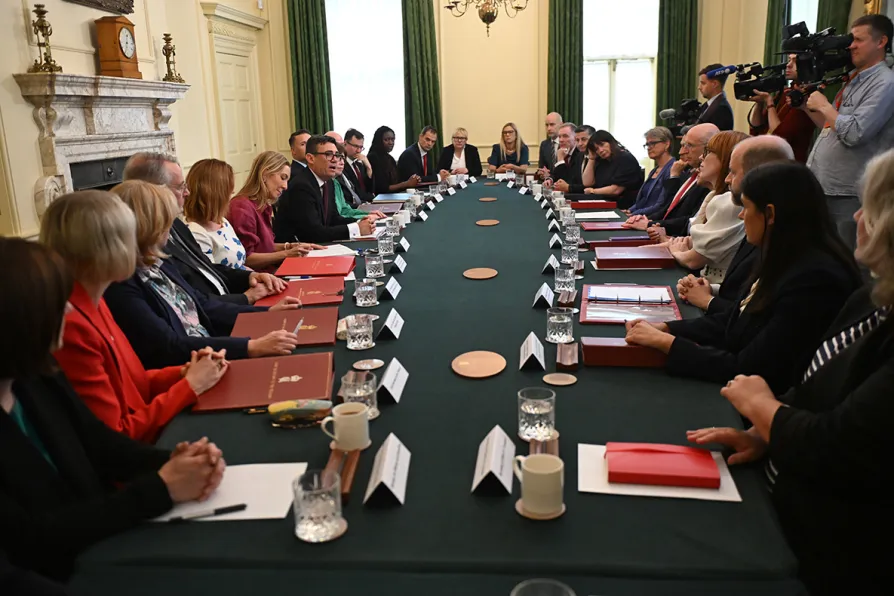
 Prime Minister Andy Burnham hosts his first Cabinet meeting at 10 Downing Street, London, July 21, 2026
WE ARE a cost-of-living government, Prime Minister Andy Burnham told his new Cabinet today after slashing energy bills for millions.
Mr Burnham acted to cut VAT on energy bills at a cost of £850 million as his first major move in Downing Street after naming a new team purged of deadwood from Sir Keir Starmer’s government.
However, anti-war campaigners warned that his choice of inveterate warmonger John Healey as new Chancellor presaged a further attack on welfare, health and education.
In a joint statement, Stop the War Coalition and the Campaign for Nuclear Disarmament said: “To hand the Treasury purse strings to a man who demanded a £197 billion increase in arms and nuclear weapons spending demonstrates beyond doubt that the military industrial complex is in charge of Burnham’s economic policy.
“The arms dealers and generals are undoubtedly now in the cabinet. John Healey’s appointment as chancellor will inevitably mean huge fights over welfare, health and housing to come.
“None of the social and economic ambitions — tackling the cost-of-living crisis in particular — that Burnham claims to aspire to will be possible if an ever-growing portion of the economy is devoted to war and destruction,” the two campaigns stated.
…
https://morningstaronline.co.uk/article/we-need-be-cost-living-government
Morning Star Exclusive: Campaigners jubilant at Welsh government decision over deep space radar application
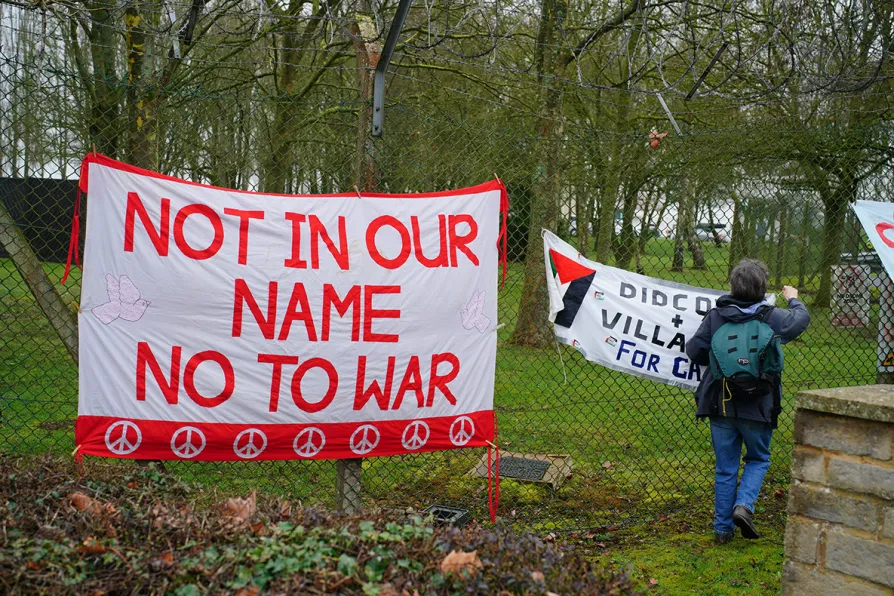 Protesters hang banners outside RAF Fairford in Gloucestershire during a demonstration to oppose any use of the base by US bombers, March 7, 2026
CAMPAIGNERS against a US deep space radar being built in Pembrokeshire celebrated yesterday after the Welsh government agreed to call in the planning decision.
The Pembrokeshire Against Radar Campaign (Parc) said their lobbying work with Plaid Cymru ahead of the Senedd election had paid off, after Planning Minister Sian Gwenllian intervened before Pembrokeshire County Council’s planning committee was due to decide on the scheme next Tuesday.
The campaigners described the move as a “seismic and significant positive step” for the new Plaid Cymru government.
A Parc spokesperson said: “[The Deep Space Advanced Radar Capability] Darc is a proposal for a huge 27-dish radar array overlooking the St Davids Peninsula of the Pembrokeshire Coast national park.
…
“… the development is of more than local importance and the application should be determined by the Welsh ministers.”
The Welsh government also said that the decision to call in the planning decision was not an indication of the eventual decision.
But as this was a Ministry of Defence application to build the radar installation, it may put further strain on the relationship with Prime Minister Andy Burnham and his new Defence Secretary Wes Streeting.
The Welsh government also said that the decision to call in the planning decision was not an indication of the eventual decision.
But as this was a Ministry of Defence application to build the radar installation, it may put further strain on the relationship with Prime Minister Andy Burnham and his new Defence Secretary Wes Streeting.
dizzy: climate should instead be recognised and addressed as an overwhelming and immediate threat. For example recent and current weather experienced in UK is causing huge issues UK agriculture.
The UK has a new prime minister, now it must act on Palestine
This work by Middle East Monitor is licensed under a Creative Commons Attribution-NonCommercial-ShareAlike 4.0 International License.

Britain has a new Prime Minister at a moment when history is demanding more than carefully worded statements.
As Andy Burnham enters Downing Street, he inherits a foreign policy crisis that has exposed deep divisions over Britain’s commitment to human rights, international law and the protection of civilian life: Israel’s devastating assault on Gaza.
For Palestinians, this is not an abstract diplomatic dispute. It is a humanitarian catastrophe that has claimed tens of thousands of lives, displaced entire communities and reduced much of Gaza’s civilian infrastructure to ruins.
Many human rights experts, legal scholars and international organisations have warned that Israel’s actions may amount to genocide, with the International Court of Justice currently examining allegations brought by South Africa under the Genocide Convention. The debate over the legal determination continues, but the scale of suffering is undeniable.
The question now facing Britain’s new Prime Minister is whether the UK will continue responding with statements of concern or whether it will finally use its influence to demand meaningful action.
Thousands of people recently marched through London calling on Britain’s new leadership to take stronger action for Gaza, demanding an end to civilian suffering and greater accountability for those responsible. Their message was clear: Palestinians cannot survive on expressions of sympathy alone.
For decades, Britain has presented itself as a defender of international law and human rights.
British governments have condemned abuses committed by states around the world and called for accountability when civilian populations are harmed.
READ: Pro-Palestinian protest in London call on Andy Burnham to impose sanctions on Israel
But principles lose their meaning when they are applied selectively.
The suffering of Palestinian civilians should not be treated as a diplomatic inconvenience or reduced to carefully balanced language. International law exists precisely to protect vulnerable populations, especially during moments of war and political pressure.
If Britain genuinely believes in a rules-based international order, then Gaza is a defining test.
The UK cannot demand accountability from some governments while shielding allies from meaningful scrutiny. Human rights cannot depend on political relationships.
Palestinians Need More Than Words
Humanitarian organisations have repeatedly warned of the devastating conditions facing civilians in Gaza.
Aid agencies have highlighted widespread hunger, displacement, the destruction of medical facilities and the collapse of essential services. ActionAid has called on Britain’s new Prime Minister to take urgent action to protect Palestinians, ensure humanitarian access and uphold international humanitarian law.
Medical Aid for Palestinians (MAP), which provides healthcare support to Palestinians living under occupation and conflict, has called on Britain’s new government to move beyond rhetoric and take concrete steps to protect Palestinian lives.
But humanitarian aid alone cannot address the root causes of this crisis.
The UK must use its diplomatic influence to demand an immediate end to actions that continue to devastate Palestinian civilian life.
This means supporting accountability mechanisms, ensuring British foreign policy does not contribute to violations of international law, and recognising that Palestinians have the same fundamental rights to freedom, safety and dignity as any other people.
Britain’s historical role in the Middle East gives it a particular responsibility.
The consequences of Britain’s decisions in the region continue to shape realities today, including the legacy of the British Mandate for Palestine and the events surrounding the creation of Israel in 1948.
That history does not mean Britain alone can solve the conflict. But it does mean Britain cannot claim neutrality while Palestinians continue to endure immense suffering.
A meaningful foreign policy requires more than managing diplomatic relationships. It requires moral courage.
The UK has significant influence through its diplomatic relationships, its position at the United Nations and its international standing.
That influence should be used to protect civilian lives—not simply preserve political alliances.
For many Palestinians, Muslims and human rights advocates in Britain, trust in Westminster has been severely damaged.
Many feel that Palestinian lives have been treated as less valuable and that the language of human rights has been applied inconsistently.
This is the challenge facing Andy Burnham’s government.
The new Prime Minister has an opportunity to demonstrate that Britain’s commitment to human rights is not selective, and that Palestinian suffering will not be ignored because confronting it is politically difficult.
History often judges governments not only by the crises they inherit, but by how they respond when confronted with injustice.
Gaza represents such a moment.
The question is whether Britain’s new leadership will look away, offer cautious statements, or take the steps necessary to protect Palestinian lives and uphold international law.
Palestinians do not need another government expressing concern while the destruction continues.
They need action.
Britain has a new Prime Minister. Now it must act on Palestine.
The views expressed in this article belong to the author and do not necessarily reflect the editorial policy of Middle East Monitor.
This work by Middle East Monitor is licensed under a Creative Commons Attribution-NonCommercial-ShareAlike 4.0 International License.

- Oscar-winning Javier Bardem says Gaza war has changed global views on Palestine
- El-Sisi pushes ahead with Egypt’s militarisation
- Mamdani says ICC warrant against Netanyahu should be ‘taken seriously’
- Air France extends Beirut flight suspension, halts service to Saudi capital Riyadh, Dubai
- Pilot zone operations begin in 3 southern Lebanon villages: US State Department
- France calls for ‘end to EU imports of products from illegal settlements’
- UN warns over ‘escalating’ Israeli occupier attacks against Palestinians in West Bank
- Israel killed 8 Palestinian journalists, committed 467 media violations in 1st half of 2026: Press union
- US to boost military aircraft presence in Mideast amid tensions with Iran: Report
- ‘Couldn’t find a hotel to stay’: Roger Waters says pro-Israel pressure campaign seeks to silence Israel’s critics
- West Bank killings show Israel’s encouragement of ‘ethnic cleansing’ against Palestinians, Israeli rights group says
- Bulgaria to seek parliamentary approval for deployment of US refueling aircraft at air base
- Iran’s IRGC says it attacked US military facilities in Bahrain, Kuwait
- Israeli minister calls for settlement building in Gaza, claims enclave ‘part of Israel’
- Yemen’s Houthis declare ‘maritime blockade’ on Saudi Arabia
- Trump warns Iran it will pay ‘many times over’ for any US troops killed
- Hamas names Khalil al-Hayya as head of its political bureau
- Iran’s president calls for ‘unity, collective decision-making’ amid escalation with US
- ‘Jewish terrorism’ in West Bank ‘threatens everyone’s security,’ Israeli commander warns
- UK Consulate in Jerusalem X account suspended after highlighting Israel’s abuse of Palestinian detainees
- The UK has a new prime minister, now it must act on Palestine
- Eleven children are dead in Algeria, where is the outrage?
- The Normandy logic behind Trump’s escalation against Iran
- Indonesia’s decision to deport a Palestinian activist is a moral failure
- Zero hour in Baghdad
- The rise of energy finance diplomacy
- Islamic resistance in Iraq threatens to target US interests if conflict with Iran escalates
- Displaced civilians gather west of Gaza as Israeli forces control 70% of the territory
- US strikes target military, civilian, and nuclear sites in Iran as Tehran expands attacks across the region
- Israel floods US phones with AI messages in campaign to manipulate public opinion
- Lebanese source: Aoun and Rubio agree on complete Israeli withdrawal from Southern Lebanon
- Al-Jawahiri… and a statue that does not recognise him
- Clashes resume between Yemeni Government forces and Houthis in Hudaydah
- Chickenpox infections climb among displaced children in Gaza, UN says
- Israeli Prosecution seeks up to 50-month prison sentence for Sheikh Kamal Khatib
- 2 Palestinians killed, another injured in attack by Israeli occupiers on West Bank village
- Araghchi says security breach behind Khamenei assassination remains and affects decision-making
- Palestinian UN envoy urges continued European support for UNRWA
- Israeli military carries out operations in Syria’s Quneitra countryside under air cover
- US soldier killed in northern Iraq during controlled detonation of downed Iranian drone
- 14 diplomatic missions urge Israel to allow Red Cross access to Palestinian prisoners
- Palestinian scholars warn against extraditing Sheikh Miqdad to Israel
- Israel threatens retaliation if Iran attacks
- US energy chief says Gulf oil flows nearing 14M barrels per day despite Iran tensions
- Israeli strike on tents for displaced Palestinians kills 1, injures 10 in southern Gaza
- Israel releases 16 Palestinian detainees through Karem Abu Salem crossing
- Lebanese president meets top US diplomat at start of Washington visit
- Turkish foreign minister urges return to US-Iran agreement, says Ankara coordinating with Qatar
- Egypt urges EU, international community to ban products from illegal Israeli settlements
- 14 US refueling aircraft arrive in Israel amid Iran escalation: Report