This work by Middle East Monitor is licensed under a Creative Commons Attribution-NonCommercial-ShareAlike 4.0 International License.
Activists staged a protest outside the office of German arms manufacturer Rheinmetall near the historic Brandenburg Gate in Berlin on Monday
Activists staged a protest outside the office of German arms manufacturer Rheinmetall near the historic Brandenburg Gate in Berlin on Monday, Anadolu reports.
The blockade was organized to protest arms production that activists said was linked to attacks on Palestine and Lebanon.
Swedish climate activist Greta Thunberg joined the demonstration and said: “We are doing this because it is our duty to protest against injustice and to stand up against genocide.”
“Stop Rheinmetall new factory and stop shipping weapons to Israel. Stop the genocide,” Thunberg added.
Berlin police intervened during the protest and detained Thunberg, the footage showed.
Climate science denier Donald Trump confirms that he knows nothing about democracy and that more liquid gold is being secured according to his policy of global privateering.Orcas discuss how Trump was re-elected and him being an obviously insane, xenophobic Fascist.
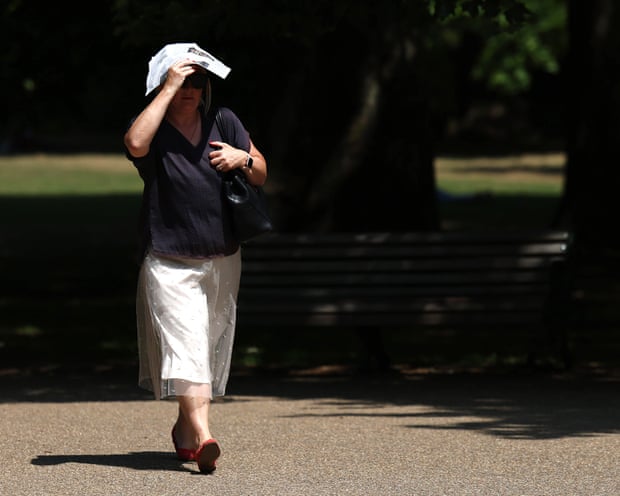
A woman in London uses a newspaper to shelter from the sun during the peak of June’s heatwave in England and Wales. Friends of the Earth said it was a ‘national scandal’ the UK was so dangerously unprepared. Photograph: Andy Rain/EPA
Extreme heat led to 440 deaths a day during June peak, say scientists, with climate crisis ramping up temperatures
The heatwave that affected England and Wales in June killed about 440 people a day during its three-day peak, scientists have estimated. Across the whole of the June heatwave, plus the one in May, about 2,700 people lost their lives prematurely.
The data starkly illustrates the danger of extreme heat, which is being supercharged by the climate crisis. More than 40% of the people affected would not have died without the 1.4C of human-caused global heating to date, according to the analysis. For comparison, about four people die each day as a result of road traffic collisions and about 35 a day because of alcohol and drug use, according to government statistics.
Extreme temperatures will worsen as continued fossil fuel burning pumps pollution into the atmosphere, making cuts in emissions and measures to protect people from global heating urgent, say experts.
“These are big numbers and we don’t want to see this many people dying,” said Dr Clair Barnes, at Imperial College London, who led the analysis. “We’ve reached the point where the heat is so extreme that we can’t help but acknowledge the impacts it has.”
Nigel Farage urges you to ignore facts and reality and be a climate science denier like him and his Deputy Richard Tice. He says that Reform UK has received £Millions and £Millions from the fossil fuel industry to promote climate denial and destroy the planet.Neo-Fascist Climate Science Denier Donald Trump says Burn, Baby, Burn.Elon Musk urges you to be a Fascist like him, says that you can ignore facts and reality then.
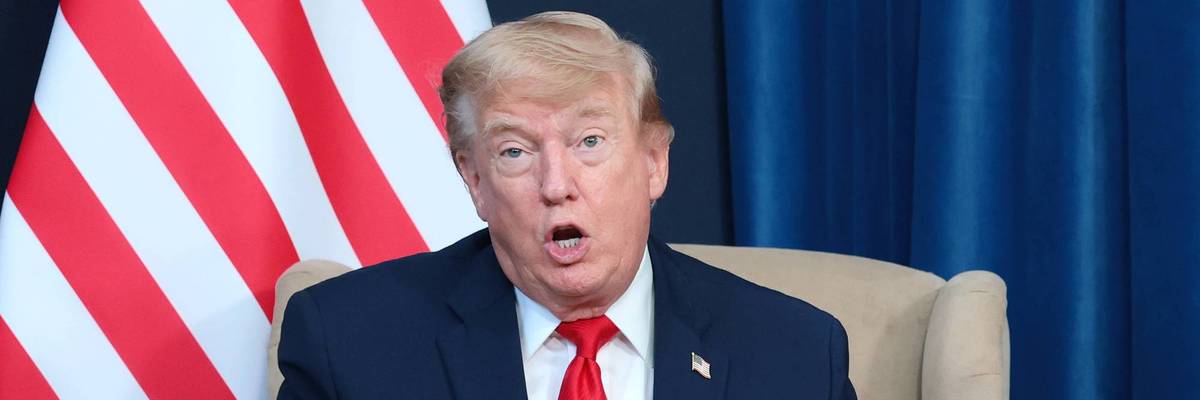
President Donald Trump speaks during a bilateral meeting with the Emir of Qatar, Sheikh Tamim bin Hamad Al Thani on the sidelines of the G7 summit, on June 16, 2026 in Evian-les-Bains, France. (Photo by Anna Moneymaker/Getty Images)
Despite the strait’s closure, Trump insisted it was “open as far as we’re concerned.”
US President Donald Trump on Sunday twice told journalists to stop asking him about the status of the Strait of Hormuz, which Iran once again closed after the president declared an end to the ceasefire deal between the two countries.
The first instance came during an interview with NBC News’ Kristen Welker, who pointed to conflicting statements from the Iranian government and US Central Command about the status of the strait, which is an essential shipping lane for global petroleum supplies.
Trump replied that “it’s open, and I don’t want to talk about it because I want to honor the life” of the late Sen. Lindsey Graham (R-SC), who died on Saturday from what his office described as “a brief and sudden illness.”
“So I don’t want to talk about it,” Trump continued. “I told you that before the call.”
WELKER: Iran says the Strait of Hormuz is closed. CENTCOM says it's open. Which is it?
TRUMP: It's open, and I don't want to talk about because I want to honor the life of Lindsey Graham, so I don't want to talk about it. I told you that before the call. pic.twitter.com/3ed7dN1bhK
Iran shut down shipping traffic in the strait after Trump launched an illegal war against the country in late February. The strait’s closure resulted in spiking oil and gasoline prices, which coincided with further erosion in Trump’s approval ratings.
Although traffic through the strait initially picked up in the wake of a June memorandum of understanding signed by the US and Iran, it has since slumped as the ceasefire between the two nations has fallen apart.
Ana Marie Cox, contributing editor at The New Republic, bashed both Welker and Tapper for heeding the president’s requests and not pushing him to answer questions about the war he unlawfully started.
“Frankly astonished that supposed news sources agreed to terms to interview Trump and appeared to be deferential to them,” Cox wrote in a social media post, “enough that they were apologetic in brining up other topics.”
Cox’s sentiment was echoed by Kai Ryssdal, host of NPR’s Marketplace, who remarked that “the guy being interviewed doesn’t get to pick the questions.”
Journalist Helen Kennedy challenged Trump’s assertion that asking about the status of the Iran war was irrelevant when talking about Lindsey Graham.
“Making war with Iran was Lindsey Graham’s favorite thing,” Kennedy observed. “It’s not like it’s unrelated.”
Elon Musk urges you to be a Fascist like him, says that you can ignore facts and reality then.Donald Trump calls for help from NATO allies in securing the Strait of Hormuz despite saying on 7 March 2026 that they don’t need people to join wars after they’ve already won. He’s challenged with the claim that he lies as much as the IDF.Orcas discuss how Trump was re-elected and him being an obviously insane, xenophobic Fascist.
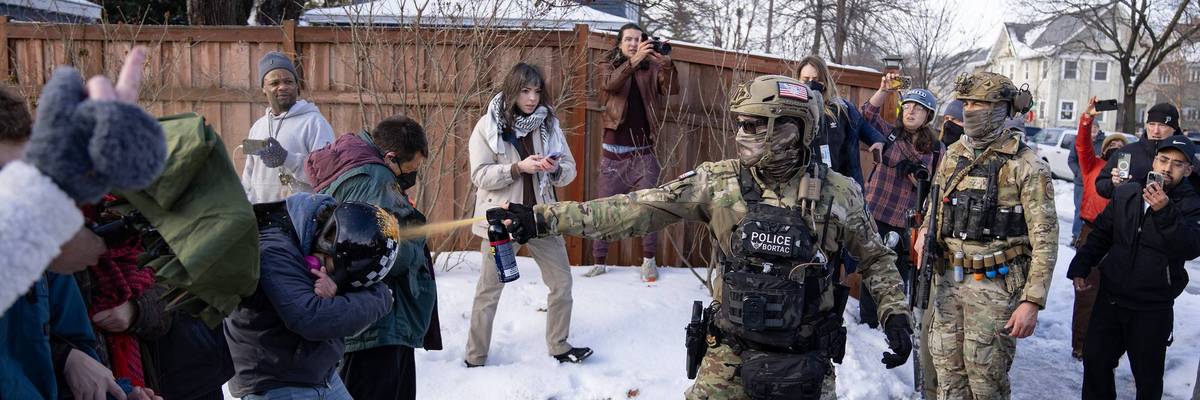
A Border Patrol Tactical Unit agent sprays pepper spray into the face of a protester attempting to block an immigration officer vehicle from leaving the scene where a woman was shot and killed by a federal agent earlier, in Minneapolis, Minnesota on Wednesday, January 7, 2026. (Photo by Alex Kormann/The Minnesota Star Tribune via Getty Images)
The unaccountable killings, the show trials, the informant bounties, the door knocks over emails, the leader’s praetorian guard, the captured press, the rewritten history, and now the reach for the ballots themselves: Every component is now built, tested, and humming.
Tuesday morning in Houston, Lorenzo Salgado Araujo did what he’d done nearly every morning for 35 years. He woke at 5:00 am, kissed his wife goodbye, loaded his van, and drove off to pick up his construction crew in Magnolia Park, the neighborhood that’s anchored Houston’s Mexican American community for a century.
He’d raised three sons in that city; they became a teacher and two engineers. He had no criminal record, and he was partway through the legal process of getting a work permit, biometrics and fingerprints already done.
By 7:00 am he was lying face down on Canal Street with a bullet in his abdomen, crying out for help in Spanish while a federal agent knelt over him talking on the phone. He died at Ben Taub Hospital, the same hospital where two of his sons were born. The Harris County medical examiner has ruled the manner of his death a “homicide.”
Immigration and Customs Enforcement (ICE) says he rammed their vehicle and “weaponized” his van to run down an officer, who fired in self-defense. His family says he almost certainly thought the unmarked cars tailing him were thieves after his work tools, because the men following him wore no insignia identifying them as law enforcement.
What we still have, and what the DDR and the Third Reich did not, is one more election in which the machine’s operators can be stripped of their power by the people they’re trying to frighten.
The League of United Latin American Citizens says photographs of the vehicles show little visible damage, which is a strange thing for a van that supposedly rammed a law enforcement vehicle hard enough to justify lethal force. David Bier of the libertarian Cato Institute reviewed newly surfaced footage and concluded it appears to show ICE initiating contact with Salgado Araujo’s vehicle, not the other way around; Norm Ornstein looked at the same evidence and called it “cold-blooded murder.”
The federal government has released no body camera footage, no dash camera video, and no photos of the damage it claims exists. The three eyewitnesses who were in the van, including Salgado Araujo’s own brother, are in ICE custody and can’t speak out. The Harris County District Attorney is trying to investigate, but her office says access to key evidence “remains under federal control.”
The president of Mexico announced this week that her government will pursue legal action against the United States over the killing. The historical inversion packed into that sentence is complete: Mexico is now appealing to international bodies to protect its citizens from American police violence.
Which brings us to the question people keep asking me on my radio show and on social media: “Are we in a police state yet?” And the question underneath it, the one that really matters: “How would we know?”
I lived in Germany for years, working with Salem International, some of that time in the little village of Höchheim hard up against the East German border, where the guard towers and the death strip were part of the landscape you saw on your way to buy bread.
I crossed through Checkpoint Charlie into East Berlin in 1986 and felt what a mature police state does to ordinary people: the lowered voices indoors, the glance over the shoulder before anybody said anything real. (If you’ve never experienced that world, watch the brilliant film The Lives of Others; it captures the East German surveillance state better than anything else on film.)
My spiritual mentor and employer in Germany, Gottfried Müller, had been an intelligence officer in Adolf Hitler’s army who renounced Nazism, was captured by the British in Iran, and spent most of the war in prison; he devoted the rest of his life to peace work.
And my dear old friend Armin Lehmann, who was the teenage Hitler Youth courier in the Führerbunker who delivered the news to Hitler that the war was lost (I still have a picture of him with Hitler, that’s on the cover of his book), spent his last decades in America as a peace activist.
Both men told me essentially the same story about how it began. It started getting scary, they noted, when the regime began to explicitly come after verbotener Gedanke, “forbidden thought.” For example, the radio stations, they said, used to encourage ordinary Germans to call in—to the shows and to the police—and “out” their neighbors who weren’t sufficiently loyal to the regime. Informing became one of the highest expressions of patriotism.
The Germans even have a word for the process by which their entire society was brought into line during 1933 and 1934: as Timothy Snyder notes, it’s Gleichschaltung, a coordination, a synchronization.
Germany didn’t become a police state in a day, and there was never an announcement.
There was just a series of Fridays, each one slightly worse than the last, until one day the question, “Are we in a police state?” had become dangerous to ask out loud.
So instead of waiting for an announcement that’s never coming, let’s do what Herr Müller would have done and run through the inventory necessary to create a fascist police state:
1. A police state is a nation where the police answer to the leader rather than to the law, and where nobody outside the leader’s circle is permitted to hold them accountable. It’s a nation where they can arrest, beat, torture, imprison, and even kill with both anonymity and impunity.
In January, ICE officer Jonathan Ross reportedly shot Renee Good, a 37-year-old mother of three, through the window of her car in Minneapolis, and Border Patrol agents killed Alex Pretti, an ICU nurse, on a public street days later. Within hours, then-Homeland Security Secretary Kristi Noem was calling both dead Americans “domestic terrorists,” a slander she refused six times under oath to retract.
Murder is a state crime, and in America state investigators have always worked police shootings alongside the feds. Not this time. The FBI agreed to a joint investigation with Minnesota’s Bureau of Criminal Apprehension the morning Good was killed, then reversed itself the same day after President Donald Trump declared Minnesota officials “crooked.”
Hennepin County Attorney Mary Moriarty called the categorical withholding of all evidence “unprecedented in American history.” Now the same machinery has closed around the killing of Lorenzo Salgado Araujo in Houston. It won’t be the last time.
2. A police state imprisons its dissidents, and it makes the sentences spectacular so everyone else gets the message.
On June 23, federal judges in Fort Worth sentenced eight members of a local book club who held a July 4, 2025 protest outside the Prairieland ICE detention center to a combined 450 years in prison, a figure the Justice Department bragged about in its own press release. Benjamin Song, who fired at an officer after the officer drew his weapon on the crowd, got 100 years.
Maricela Rueda, a doula and mother who was acquitted by the jury of every violent count against her, got 70 years in prison. Five others who were likewise acquitted of the attempted murder and firearms charges got 50 years apiece, because prosecutors persuaded the jury that wearing black and using the Signal messaging app constituted “material support for terrorism.”
And Daniel Sanchez Estrada, a Denton teacher and poet who wasn’t even at the protest, got 30 years for moving a box of anti-fascist political zines at his wife’s request, literature the prosecutors admitted was protected by the First Amendment.
For comparison, Proud Boy leader Enrique Tarrio was sentenced to 22 years for orchestrating the seditious conspiracy of January 6, and Trump pardoned him anyway. In this America, leading an armed attempt to overthrow the government earns you a pardon, while a book club that protests ICE earns its members what amounts to life without parole.
3. A police state criminalizes thought itself, as well as any expression of or action on that thought, no matter how “otherwise legal” it may be.
Last September, Trump signed NSPM-7, a national security directive that names “anti-Americanism, anti-capitalism, and anti-Christianity” as “indicators of domestic terrorism” and calls anti-fascism the “organizing rallying cry” of domestic terrorists. Consider how many of the roughly 75 million Americans who voted against Trump it could plausibly cover.
In December, then-AG Pam Bondi ordered every federal law enforcement agency to mine five years of data for anything “Antifa-related” by average Americans and hand it to the FBI, and directed the bureau to publicize its domestic terrorism call-in tip line and establish a cash reward system for informants.
When Herr Müller and Armin told me about German radio hosts urging listeners to inform on their neighbors, I thought I was hearing history, but it turns out I was hearing a forecast, and the American version pays cash.
4. A police state knocks on your door in reaction to your opinions, should you dare to express them out loud or in print.
In January, a Rochester software professional named David Streever sent a three-paragraph email to then-ICE Director Todd Lyons after watching the videos of ICE killings in Minneapolis.
“You are a monstrous human being and will go down in history as America’s Reinhard Heydrich, the butcher,” he wrote. “You will torment yourself until your last day on Earth.”
The email contains no threat of any kind, just a prophecy about a man’s conscience, the kind of furious letter Americans have been writing to powerful officials since before there was a Constitution to protect the practice.
Five months later, two federal agents rang his doorbell while he was in Finland with his 7-year-old daughter and handed his wife a document headed “WARNING NOTICE” and “YOU MAY BE IN VIOLATION OF FEDERAL LAW.” When he flew home, an agent showed up at his New York City hotel, a hotel whose location his wife had never disclosed, meaning Homeland Security found him anyway.
He’s now suing with the help of FIRE, the Foundation for Individual Rights and Expression, which could, like the Southern Poverty Law Center and multiple DC law firms, cause the Trump regime to put FIRE in their crosshairs next.
That same week, federal agents confronted Paigelynne Gonyea while she was working the polls during New York’s primaries, over an Instagram post about the already-publicly-identified officer who killed Renee Good. Federal agents questioned this poll worker, at her polling place, during an election, about her opinion of a federal agent who killed an American citizen on live video for the world to see.
5. A police state builds a security force loyal to the leader and his oligarch cronies rather than the nation.
Pentagon documents reviewed by The Washington Post describe a new National Guard “quick reaction force” of roughly 23,500 troops across all 50 states, trained for domestic riot control, with the first units ordered ready by last January 1 and the rest by April, timed neatly to the midterms.
Trump has claimed “unfettered authority” to deploy troops into American cities, boasting, “I could send the Army, Navy, Air Force, Marines, I can send anybody I wanted,” while governors are cut out of the chain of command and Pete Hegseth has barred military personnel from even talking to Congress without approval.
Vladimir Putin built exactly this in 2016; he called it Rosgvardiya, and its job was never national defense but regime preservation. Hitler built his version too, and it started small, as a “protection detail,” which in German is Schutsstaffel. History remembers it as the SS.
6. A police state needs a compliant press, and you don’t have to nationalize the networks when you can simply arrange for a friendly morbidly rich oligarch to buy them.
7. A police state rewrites the past, because people who remember accurate history make poor subjects.As George Orwell wrote of fascism, “Who controls the past controls the future: who controls the present controls the past.”
In March of last year Trump signed an executive order called “Restoring Truth and Sanity to American History,” and the sanitizing began: The National Park Service was ordered to strip signs and exhibits about slavery from national parks, including “The Scourged Back,” the famous photograph of the whip-scarred back of a man named Peter who escaped enslavement in Louisiana, and materials about John Brown’s raid at Harpers Ferry.
Trump himself complained that the Smithsonian was “OUT OF CONTROL” because its museums discussed “how bad Slavery was,” and this past weekend, on the Fourth of July no less, the White House released a report declaring that the National Museum of American History “cannot be trusted” to tell America’s story, faulting its director for, among other sins, wanting to move the museum away from an “America First mentality.”
Herr Müller and Armin lived through the original version of this, too: Within months of taking power the Nazis had burned the books, purged the universities and museums of “un-German” scholarship, and rewritten the textbooks so that German children would grow up inside a glorious past that never existed. Control what people remember and you control what they’ll accept.
8. And finally, a police state controls the vote.
In January, FBI agents raided Fulton County’s election warehouse and seized more than 650 boxes of 2020 ballots and voter rolls on an affidavit that omitted the state findings debunking its own claims, with then-Director of National Intelligence Tulsi Gabbard on scene and Trump personally on the phone with the agents.
On Tuesday, the same day Lorenzo Salgado Araujo was killed, the Justice Department sent letters to the election chiefs of all 50 states threatening each of them individually with criminal prosecution if noncitizens are found on their rolls, giving them five days to respond, this after the department lost 11 straight court cases trying to seize those very rolls.
On Thursday, citing last week’s Supreme Court decision giving him essentially unlimited firing power, Trump removed from officeall of the members of the Federal Election Assistance Commission, an independent, bipartisan agency that, along with the now-paralyzed Federal Election Commission, have the power to call out election fraud; illegal campaign tactics and spending; and vote-rigging when it’s committed by candidates, parties, or state or local officials. Both are now effectively shut down.
And when senators asked, under oath, whether ICE agents would be kept away from polling places this November, both Kristi Noem and her successor and former plumber Markwayne Mullin refused to rule it out, while the White House press secretary said she “can’t guarantee” it and Steve Bannon openly muses that ICE at the airports was a “test run” for ICE at the polls.
So, are we in a police state yet?
Armin and Herr Müller taught me that we’re asking the wrong question—or at least at the wrong moment—because nobody ever wakes up one morning and notices, “Gee, I guess I’m inside a police state…”
Instead, a police state gets assembled around you, one component at a time, while officials assure you that each component is perfectly normal and even necessary to “maintain order” or, more insidiously, to “preserve freedom.”
Milton Mayer, in his 1955 book They Thought They Were Free, described how good, decent Germans came to accept fascism. He was a Chicago reporter who, following World War II, went to Germany to interview 10 “average Germans” to try to learn how such a terrible thing could have happened and, hopefully, thus prevent it from ever happening here.
The stories he heard are so familiar to me, as I heard the same things over and over when living in Germany in the 1980s while talking with people who’d kept their heads down through the 1930s and early 1940s just to survive day-to-day:
“What happened here was the gradual habituation of the people,” a German college professor told Mayer, “little by little, to being governed by surprise; to receiving decisions deliberated in secret; to believing that the situation was so complicated that the government had to act on information which the people could not understand, or so dangerous that, even if the people could understand it, it could not be released because of national security….”
As Mayer’s professor friend noted, and Mayer recorded in his book:
This separation of government from people, this widening of the gap, took place so gradually and so insensibly, each step disguised (perhaps not even intentionally) as a temporary emergency measure or associated with true patriotic allegiance or with real social purposes. And all the crises and reforms (real reforms, too) so occupied the people that they did not see the slow motion underneath, of the whole process of government growing remoter and remoter…
To live in this process is absolutely not to be able to notice it—please try to believe me—unless one has a much greater degree of political awareness, acuity, than most of us had ever had occasion to develop… [O]ne no more saw it developing from day to day than a farmer in his field sees the corn growing. One day it is over his head.
In this conversation, Mayer’s friend suggests that he wasn’t making an excuse for not resisting the rise of the fascists but was simply pointing out what happens when you keep your head down and just assume that ultimately the good guys will win:
“You see,” Mayer’s friend continued, “One doesn’t see exactly where or how to move. Believe me, this is true. Each act, each occasion, is worse than the last, but only a little worse. You wait for the next and the next…”
“But of course this isn’t the way it happens. In between come all the hundreds of little steps, some of them imperceptible, each of them preparing you not to be shocked by the next. Step C is not so much worse than Step B, and, if you did not make a stand at Step B, why should you at Step C? And so on to Step D.”
“And one day, too late, your principles, if you were ever sensible of them, all rush in upon you. The burden of self-deception has grown too heavy, and some minor incident, in my case my little boy, hardly more than a baby, saying ‘Jew swine,’ collapses it all at once, and you see that everything, everything, has changed and changed completely under your nose.”
In a police state, everything seems the same, Mayer’s friend told him. You still go to work, cash your paycheck, have friends over, go to the movies, enjoy a meal out. The regime even backs down from time to time, making things seem ever more normal. Little victories, you tell yourself.
Except, as the German professor told Mayer, they’re not. One day, he said, you inevitably realize that:
The world you live in—your nation, your people—is not the world you were in at all. The forms are all there, all untouched, all reassuring, the houses, the shops, the jobs, the mealtimes, the visits, the concerts, the cinema, the holidays.
But the spirit, which you never noticed because you made the lifelong mistake of identifying it with the forms, is changed. Now you live in a world of hate and fear, and the people who hate and fear do not even know it themselves; when everyone is transformed, no one is transformed. Now you live in a system which rules without responsibility even to God.
So, here we are. The unaccountable killings, the show trials, the informant bounties, the door knocks over emails, the leader’s praetorian guard, the captured press, the rewritten history, and now the reach for the ballots themselves: Every component is now built, tested, and humming.
But what we still have, and what the DDR and the Third Reich did not, is one more election in which the machine’s operators can be stripped of their power by the people they’re trying to frighten.
That’s precisely why they’re working so hard on the machinery of that election, and precisely why the single most subversive act available to a free American this year is to vote, and to help everyone you know do the same.
So call the Capitol switchboard at 202-224-3121 and tell your senators and representative to defend state authority over elections; demand independent investigations of the killings of Renee Good, Alex Pretti, and Lorenzo Salgado Araujo; and put a statutory ban on federal agents at the polls.
Check your registration right now at vote.org, because voter roll purges are already happening in red states.
Sign up to be a poll worker in your county; they want poll workers intimidated, and the answer to that is more of us, not fewer.
Program the Election Protection hotline into your phone, 866-OUR-VOTE, and share it.
Support the people fighting this in court, from FIRE to the Blue state attorneys general.
And if this piece helped you see the machinery used to construct a police state more clearly, please share it and support independent media like my Hartmann Report, because a free press that can’t be bought by billionaires is one component of democracy they haven’t figured out how to seize.
Donald Trump sings and dances, says that it’s fun to kill everyone … unless he gets distracted or falls asleep.Orcas discuss how Trump was re-elected and him being an obviously insane, xenophobic Fascist.
Several different factors likely explain this trend, including reductions in planet-cooling aerosols as nations have cleaned up their air pollution, as well as changes in atmospheric circulation patterns, which models struggle to represent.
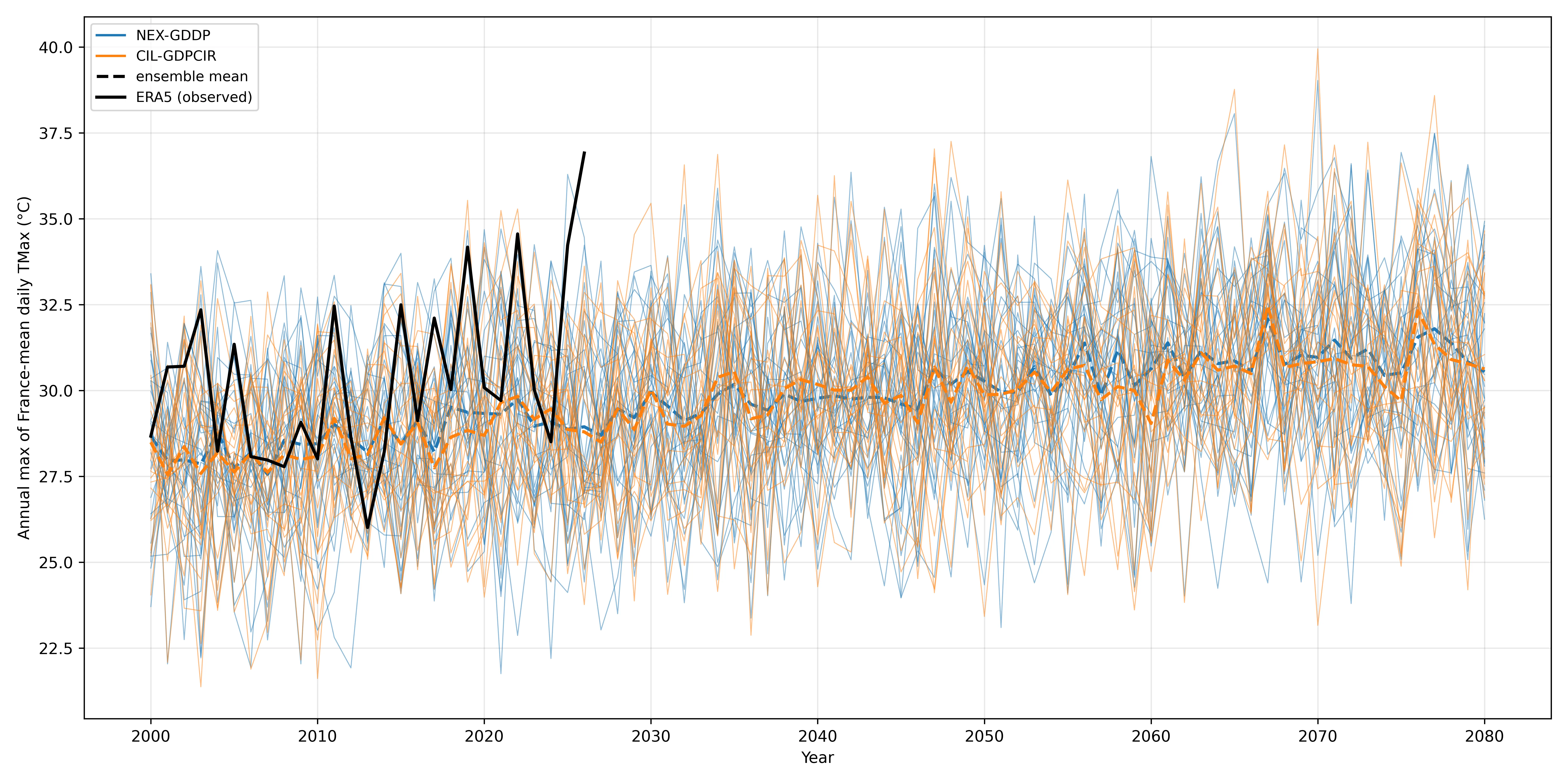
In June 2026, daily high temperatures averaged across France reached 36.9C, shattering the previous June record set in 2022 by 2.4C.
[For more on the impacts and coverage of Europe’s June heatwave, see Carbon Brief’s explainer.]
The rise in observed temperatures in France has outpaced projections made by climate models, with June maximum temperatures more in line with what was expected for the 2070s.
This is illustrated in the figure below, which shows how France’s average maximum daily high temperature for June recorded in 2026 (black line) compares to climate model projections (blue and orange lines).
Comparison of observed (ERA5, black) and modelled (blue and orange) temperatures across France from 2000 to 2080. Plot shows the maximum daily high temperature recorded in June for each year, after averaging temperatures across France. The model ensembles are bias-corrected CMIP6 model ensembles from the NEX-GDDP (blue) and CIL-GDPCIR (orange) projects. The dashed blue and orange lines are the ensemble averages. Credit: Prof Andrew Dessler.
Counting the death toll of climate change
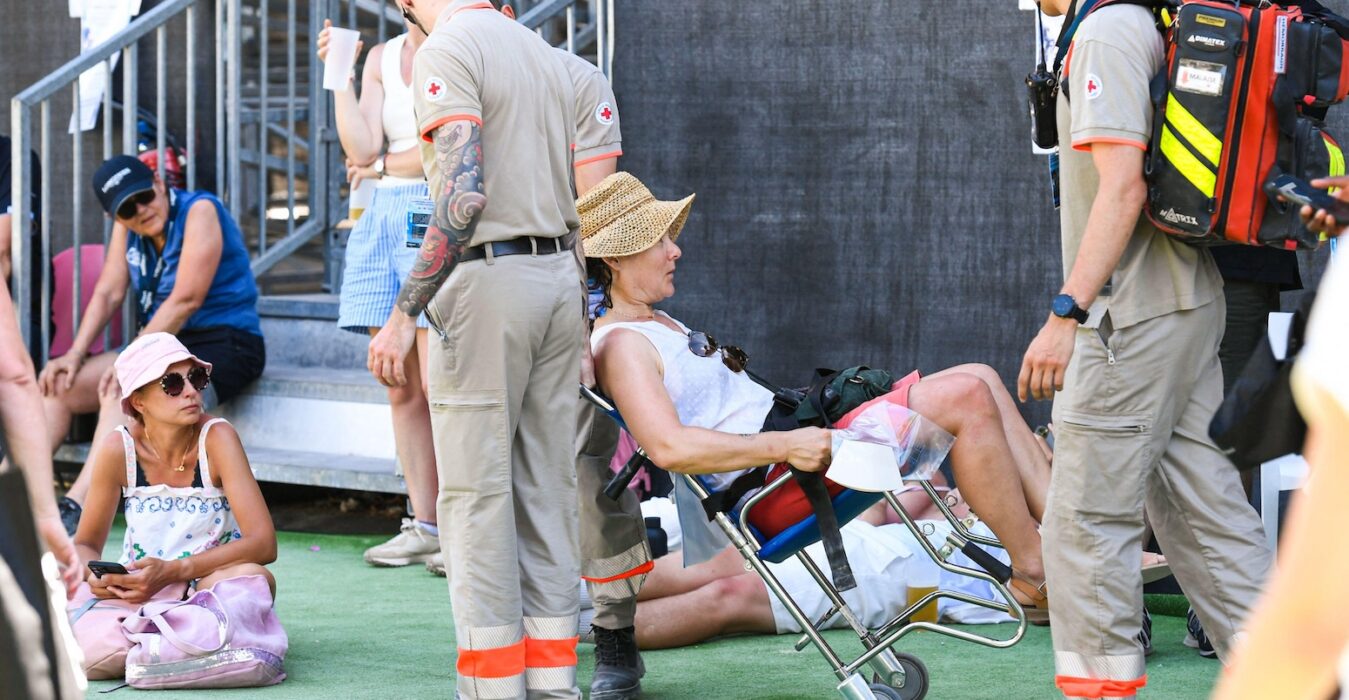
The downstream impacts of these extreme temperatures are lethal.
Scientists are able to estimate the death toll of high temperatures in many locations, depending on the availability of mortality and climate data.
One option is to examine death certificates to see which deaths have been directly recorded by physicians as related to heat. However, there is strong evidence that this method significantly undercounts heat-related deaths, as most death certificates do not consider environmental factors such as heat when diagnosing the cause of death.
Alternatively, it is possible to calculate the rate of total (“all-cause”) mortality in a given time period relative to previous time periods – for example, by comparing the total number of deaths in June 2026 compared to the average of previous Junes. This “excess deaths” figure can be used as an estimate of the deaths from a heat wave.
Using this approach, Public Health France attributed around 2,000 deaths in France to the extreme heat in the week of 22-28 June.
Finally, scientists can use long-term data on overall mortality and correlate changes in mortality with changes in temperature to understand the statistical relationship between the two.
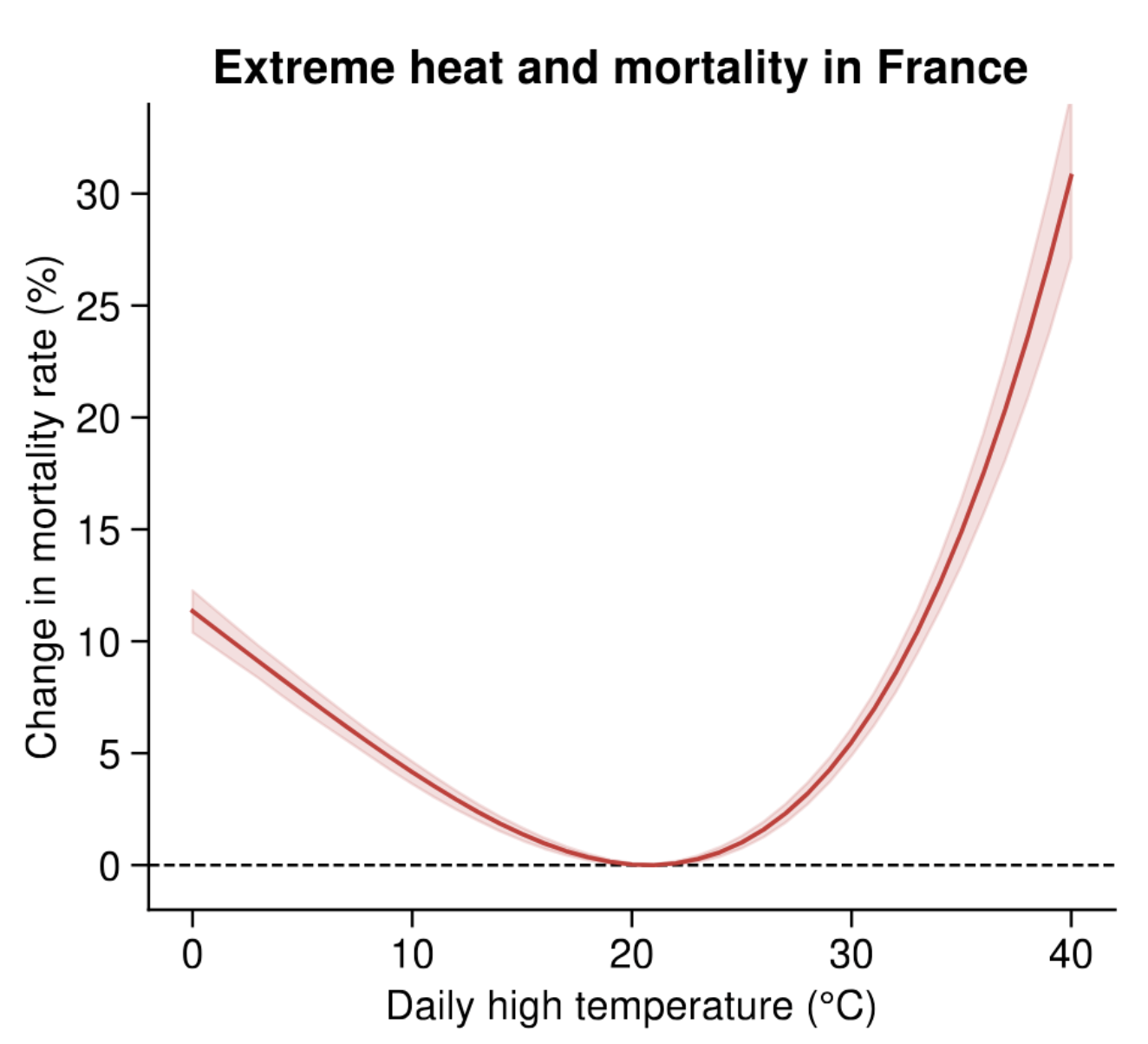
Research published in Proceedings of the National Academy of Sciences in 2025 that used this third approach found that mortality rates in France increase rapidly in cold or hot conditions as daily maximum temperatures depart further from approximately 20C.
This pattern of a U-shaped response of mortality to temperature – shown in the figure below – is veryconsistent across time periods and regions around the world.
Relationship between daily high temperature and all-cause mortality rates in France, estimated using data over 2004-19. Credit: Dr Christopher Callahan, based on data and methods in Callahan et al. (2025)
To calculate the death toll of the June 2026 heatwave in France, we compared observed temperatures over 12-29 June to their baseline average over 1980-2025.
The difference between these two temperatures helps us understand how many more people died than they would have in the absence of such extreme conditions.
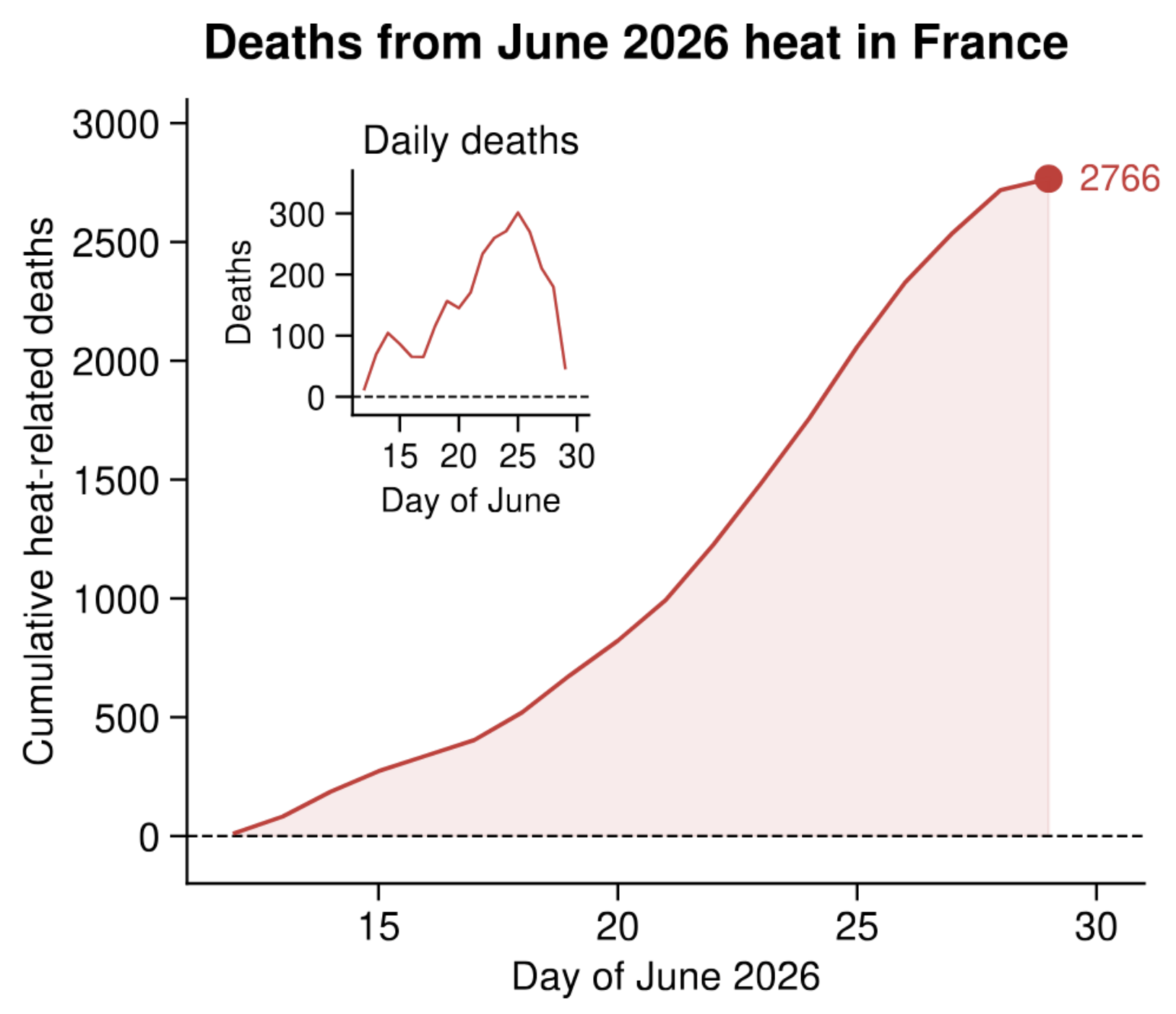
Over 12-29 June, we found that France has experienced around 2,700 heat-related deaths above the average baseline. Day-to-day heat-related mortality rates rose from less than 100 to almost 300 on the hottest days of 24 and 25 June.
This is shown in the graph below, which illustrates the cumulative total heat-related deaths seen in France over the two-and-a-half week period. The inset shows how heat-related deaths fluctuated on a day-to-day basis during this time.
Estimated heat-related mortality over 12-29 June, based on a U-shaped response of mortality to temperature. The main plot shows cumulative total deaths and the inset shows daily deaths. Credit: Dr Christopher Callahan, based on data and methods in Callahan et al. (2025)
Recent analysis by World Weather Attribution has already shown that human-caused climate change increased the frequency and intensity of the June heat wave across Europe.
Meanwhile, previousresearch has shown there is substantial evidence that heat-related mortality in Europe has already been elevated by greenhouse gas emissions.
As a result, we can be confident that at least some of the more than 2,700 deaths already seen in France are directly due to the burning of fossil fuels.
Calculating climate risk
In April, the UN-led body responsible for coordinating the work of climate modelling centres – the Coupled Modelling Intercomparison Project (CMIP) – unveiled a set of seven new emissions scenarios.
These are designed to replace the previous scenarios that have been used by scientists to understand how the climate might change in the future. They will feed into the upcoming seventh assessment report (AR7) of the Intergovernmental Panel on Climate Change (IPCC).
The range of future emissions in the new CMIP scenarios is smaller, with scenarios of very high or very low emissions no longer on the table.
The retirement of the very-high emissions scenario – known as “RCP8.5” – led to certain commentators in the media and in politics, including US president Donald Trump, arguing that the risks of climate change had been “overstated”.
[For more on false and misleading claims around the new emissions scenarios, see Carbon Brief’s factcheck.]
Our analysis of June’s heat-related deaths in France suggests that, even if the most severe emissions pathways are no longer needed, climate impacts are taking a heavy toll on society.
Moreover, the temperatures seen in France show that climate models continue to underpredict the magnitude of heatwaves for a particular level of global warming.
This is because greenhouse gas emissions are only a first step in estimating the impacts of climate change.
The second step is converting emissions to changes in the climate at both the global and local levels – or hazards. This includes heatwaves, flash floods and droughts.
The third step is to determine how changes in the hazards will affect local populations. This can be determined by calculating people’s exposure and vulnerability to hazards.
Substantial uncertainty persists at every stage of this sequence.
For example, scientists do not know exactly how the global climate will react to ever-rising greenhouse gas emissions – nor the extent to which global temperature increases will drive local climate hazards. We also do not know how climate change at a local level impacts human health outcomes.
Adaptation options, such as air conditioning, heat action plans and social support for isolated people, will be crucial as the climate moves away from the typical conditions that people are used to.
Neo-Fascist Climate Science Denier Donald Trump says Burn, Baby, Burn.Nigel Farage urges you to ignore facts and reality and be a climate science denier like him. He says that Reform UK has received millions and millions from the fossil fuel industry to promote climate denial and destroy the planet.Donald Trump urges you to be a Climate Science denier like him. He says that he makes millions and millions for destroying the planet, Burn, Baby, Burn and Flood, Baby, Flood.