This work by Middle East Monitor is licensed under a Creative Commons Attribution-NonCommercial-ShareAlike 4.0 International License.
Israeli army construction equipment is working to reinforce military positions in the villages of Jubata al-Khashab and Samadaniyya as the Israeli army continues its violations in the countryside of Quneitra province in southwestern Syria on November 05, 2025. [Bakr Al Kasem – Anadolu Agency]
Israeli public broadcaster sources reported on Monday evening that security negotiations between Israel and Syria have hit a dead end, with widening differences between Damascus’s demands and Tel Aviv’s conditions.
According to the sources, Israel rejected Syrian President Ahmad Al-Sharaa’s request to withdraw its forces from all areas it occupied following the fall of Bashar Al-Assad’s government on 8 December 2024.
They added that Tel Aviv will only withdraw as part of a comprehensive peace agreement, not through a limited security deal, which does not appear feasible at present.
Both sides had been expected to sign a US-brokered security agreement during last September’s UN General Assembly meetings, but media reports indicated the talks broke down at the last moment.
Israeli security sources said disagreements arose during meetings between Syrian Foreign Minister Asaad Al-Shaibani and Israeli Strategic Affairs Minister Ron Dermer. The disputes focused on Syria’s demands for Israel to return to the lines set by the 1974 disengagement agreement, stop violating Syrian airspace, and withdraw from the areas occupied by Israel in late 2024.
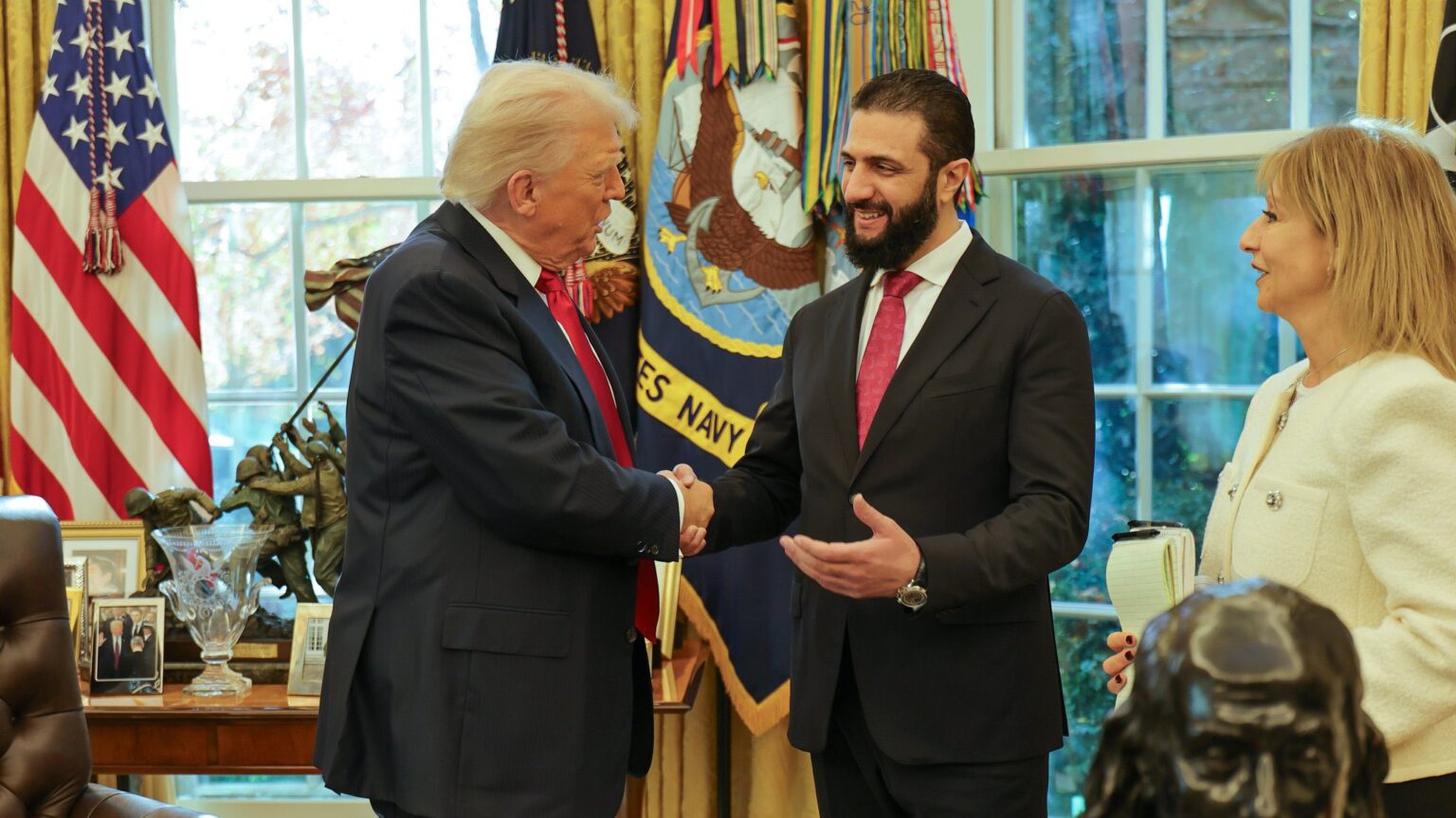
Syrian interim President Ahmad al-Sharaa meets US President Donald Trump at the White House Nov. 10. Photo: Syrian presidency
The visit of Syria’s interim president to Washington has once again showcased the ambivalence of US counter-terrorism policy, which changes according to temporal interests.
Syrian interim President Ahmad al-Sharaa arrived in Washington on Monday, November 10, to discuss various issues of mutual interest with US President Donald Trump.
The occurrence, which marks Al-Sharaa’s first visit to the United States has stirred controversy, and invited the mockery of critics, as it came a mere two days after Al-Sharaa was removed from the US Specially Designated Global Terrorist (SDGT) sanctions list.
This in turn has exposed the ambivalence of US counter-terrorism policy, which apparently designates or revokes persons and organizations from terrorism lists based on US interests at any given moment.
One day before being revoked from the SDGT sanctions list, the United Nations Security Council had also adopted a US resolution to remove Al-Sharaa and his Interior Minister, Anas Khattab, from sanctions targeting members and supporters of terrorist groups, including ISIS and Al-Qaeda.
Furthermore, Al-Sharaa’s visit followed the onset of a large-scale military campaign by Syria’s government forces on Saturday, November 8, against “terrorist cells” affiliated with ISIS in different governorates, according to the Syrian Ministry of Interior.
In what was interpreted as paving the way for Al-Sharaa to remain in office after Syria’s transitional period ends, Trump praised the former Al-Qaeda militant, saying:
“He’s a very strong leader, he comes from a very tough place. He’s a tough guy. I like him. I get along with the president, the new president of Syria, and we’ll do everything we can to make Syria successful because that’s part of the Middle East.”
Al-Sharaa says the visit marks new beginning for strategic relations with the US
For his part, Al-Sharaa considered his visit a new beginning for strategic relations between his country and the United States. During an interview with Fox News following his meeting with Trump on Monday, Syria’s new ruler said:
“For the past sixty years, Syria has been isolated from the rest of the world, and the relations were cut off between the United States and Syria. This is the first time a Syrian president has visited the White House since the establishment of Syria in the 40s of the last century.”
“After the fall of the former regime, Syria has entered into a new era and this will build on a new strategy specially with the United States,” Al-Sharaa added.
Syria joins US-led international coalition against ISIS
When he was asked whether he committed to having his country join the US-led international coalition to fight ISIS in the West Asia region, Al-Sharaa answered:
“We have fought many battles against ISIS over the past ten years and endured great suffering, losing a significant number of men. While there are reasons for the US military presence in Syria, this presence must now be coordinated with the Syrian government. We need to discuss these issues and reach an agreement regarding ISIS.”
On Tuesday, November 11, Syria’s information minister, Hamza al-Mustafa, and a US official announced that Syria signed a “political declaration” with the coalition, confirming that it will have a role in “combating terrorism and supporting regional stability”.
However, Al-Mustafa clarified that “the agreement is political and until now contains no military components.”
Al-Sharaa offers extraction of Syria’s gas to become US ally
Al-Sharaa also told Fox News that he discussed with Trump future investment opportunities in Syria, particularly the extraction of gas by the United States.
“We talked about the investment opportunities in the future in Syria, so that Syria is no longer looked at as a security threat. It is now looked at as a geopolitical ally. And it’s a place where the United States can have great investments, especially extracting gas,” he noted.
Regarding Syria’s future relation with Israel, Al-Sharaa ruled out the possibility of joining the “Abraham Accords”, but he expressed his hope that the Trump administration will help his country to reach a security agreement with Israel to end its occupation of the Golan Heights.
“I believe that the situation in Syria is different from the situation of the countries that signed on to the Abraham Accords. Syria has borders with Israel, and Israel has occupied the Golan Heights since 1967. We are not going to enter into negotiations directly right now. Maybe the United States administration with President Trump will help us reach this kind of negotiation.”
Nevertheless, Al-Sharaa provided contradictory statements regarding the involvement of his government in negotiations with Israel during an interview with The Washington Post on the same day of being interviewed by Fox News.
The American newspaper cited Syria’s transitional leader saying:
“We are engaged in direct negotiations with Israel, and we have gone a good distance on the way to reach an agreement. But to reach a final agreement, Israel should withdraw to their pre-Dec. 8 borders.”
US declares partial suspension of sanctions on Syria following Al-Sharaa-Trump meeting
As both nations are looking forward to bolstering mutual security and economic interests, Al-Sharaa told The Washington Post that lifting the sanctions is essential for maintaining stability, which is, in turn, linked to economic development.
It is worth noting that shortly after the meeting, the United States Treasury Department announced that the Trump administration suspended key provisions of the Caesar Act sanctions on Syria for 180 days.
Syrians wave the country’s new flag as they gather for Friday prayers at the Umayyad mosque in Damascus, Syria, December 13, 2024
THOUSANDS of Syrians gathered in the capital Damascus today in rallies called by its new rulers to celebrate the fall of Bashar al-Assad, as the United States and Turkey “broadly agreed” on their plans for the country.
US Secretary of State Anthony Blinken met allies in Jordan, Turkey and Iraq to shape the transition of Syria’s leadership, calling for an “inclusive and non-sectarian” interim government.
After talks with Turkey’s Foreign Minister Hakan Fidan, Mr Blinken said there was “broad agreement” between Turkey and the US on what they would like to see in Syria.
Mr Fidan said the priority was “establishing stability in Syria as soon as possible, preventing terrorism from gaining ground, and ensuring that Islamic State and the Kurdistan Workers Party aren’t dominant.”
Hayat Tahrir al-Sham (HTS), which has ruled Idlib since 2017 under Turkish protection and swept to power last weekend, claims it has broken ties with its extremist past linked to al-Qaida and its leader, Ahmad al-Sharaa (also known as Abu Mohammed al-Julani), invited the public to “show their happiness” at Damascus’s squares.
Huge crowds, including some insurgent fighters, packed the capital’s historic Umayyad Mosque in the old city for Friday prayers.